GCSE equilibrium model answers
star
star
star
star
star
Last updated 5 months ago
5 questions
6
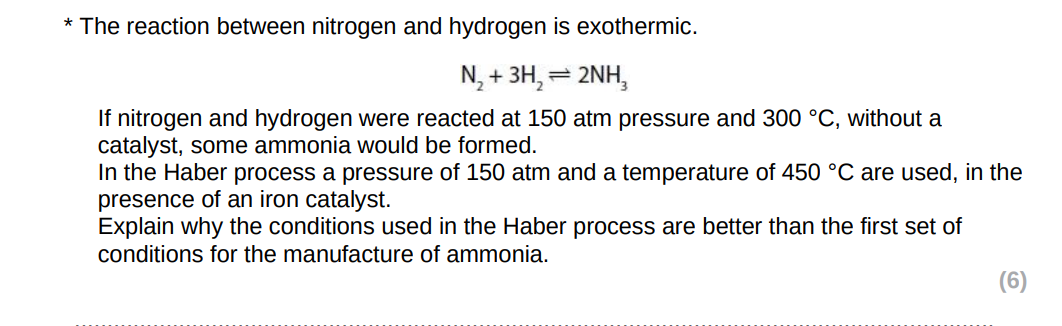
A higher temperature increases the _________ of reaction because molecules have more ____________ energy and move faster. This leads to more frequent collisions, and more of these collisions exceed the required _______________ energy to be successful.
However, a higher temperature decreases the equilibrium __________ of ammonia. This is because the ____________ reaction to make ammonia is _______________ , so the ________________ shifts to the left in the ________________ direction to oppose the change.
A _____________ is used to speed up the reaction but it does not affect the final yield. This is because it speeds up both the forward and ____________ reactions by the same amount.
Other Answer Choices:
reverse
forward
exothermic
endothermic
catalyst
kinetic
activation
yield
rate
equilibrium
6
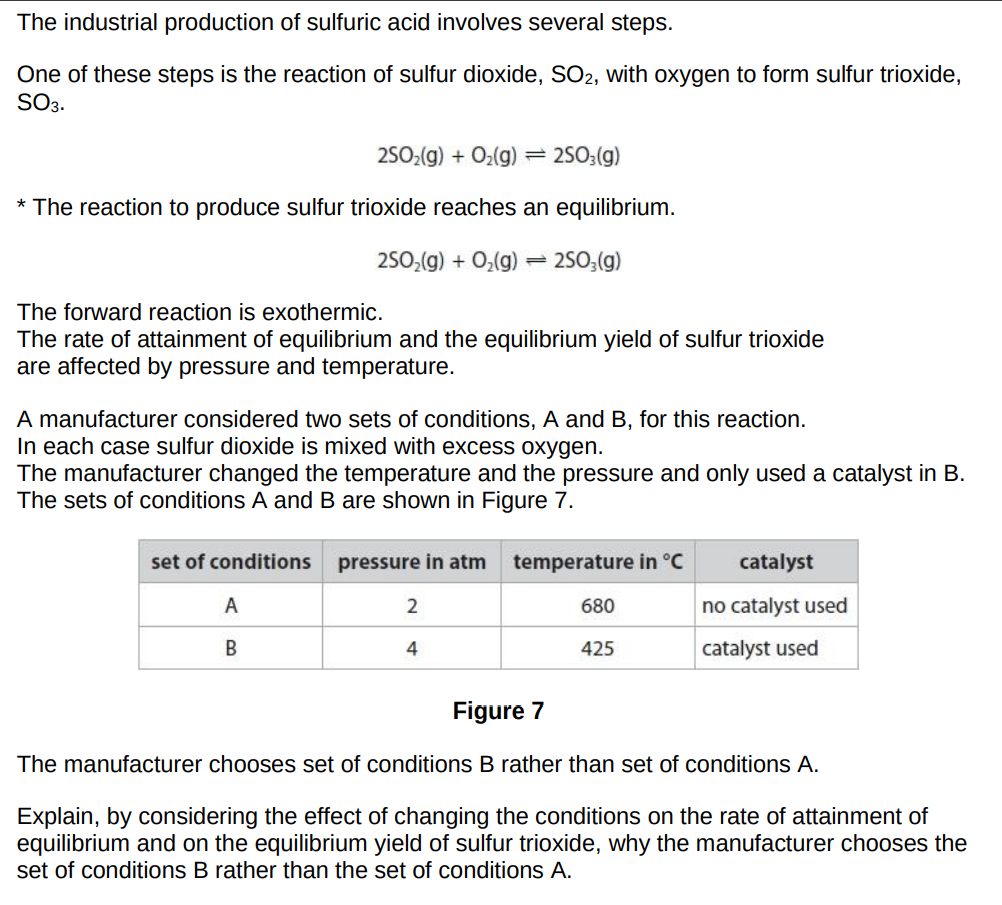
- Higher Pressure (Yield): Increasing the pressure increases the equilibrium yield of sulfur trioxide. This is because there are __________ moles of gas on the product side (2 moles) compared to the reactant side (3 moles), so the equilibrium shifts to the __________to reduce the pressure.
- Higher Pressure (Rate): The higher pressure increases the rate of reaction, as the gas molecules are closer together, leading to more _____________ collisions.
- Lower Temperature (Yield): Decreasing the temperature from 680 °C (Set A) to 425 °C (Set B) further increases the equilibrium yield. As the forward reaction is _______________ , a lower temperature causes the equilibrium to shift to the right to release heat and counteract the change.
- The Rate Compromise: Although a lower temperature would normally decrease the reaction rate, this is overcome in Set B by the use of a _____________ .
- Catalyst (Rate): The catalyst increases the rate at which equilibrium is reached by providing an alternative reaction pathway with a lower _______________ energy.
- Catalyst (Yield): The catalyst _____________ affect the position of the equilibrium or the final yield.
Other Answer Choices:
activation
frequent
right
catalyst
fewer
does not
exothermic
6
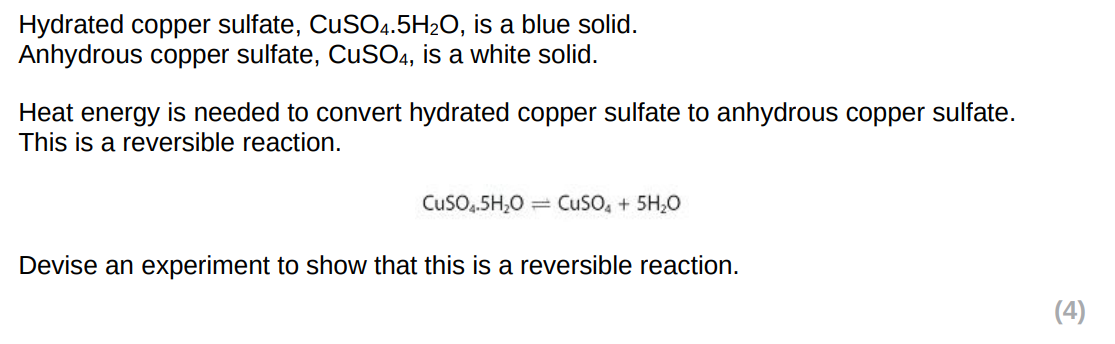
Forward Reaction
- Place a sample of _________ , hydrated copper(II) sulfate crystals into a boiling tube and gently _________ with a Bunsen burner.
- Observation: The blue crystals will turn into a __________ powder, and steam will be produced, which may condense into __________ droplets on the cooler part of the tube.
Reverse Reaction
- Allow the white, anhydrous copper(II) sulfate powder to cool completely.
- Carefully add a few drops of __________ to the white powder.
- Observation: The powder will turn _________ again, reforming the hydrated crystals. The boiling tube will also feel hot, showing the reaction is _______________ .
Since the original substance can be reformed by adding water to the products, the reaction is demonstrated to be reversible.
Other Answer Choices:
blue
water
heat
exothermic
blue
white
6
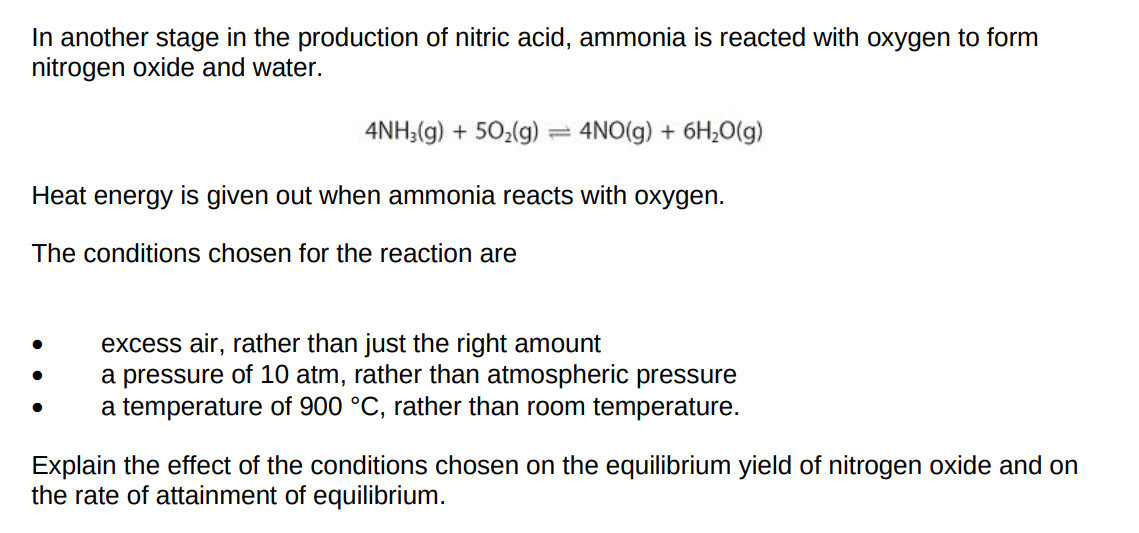
- A high temperature of 900 °C ______________ the rate of reaction as particles have more kinetic energy, leading to more _____________ and more energetic collisions.
- However, the high temperature decreases the equilibrium yield because the forward reaction is exothermic, so the equilibrium shifts to the _________ to absorb the added heat.
- A high pressure of 10 atm increases the reaction rate because the gas molecules are ___________ together, increasing collision frequency.
- The high pressure decreases the yield, as the equilibrium shifts to the left, the side with __________ moles of gas (9 moles vs 10 moles), to oppose the pressure increase.
- Using excess air increases the concentration of oxygen, shifting the equilibrium to the __________ to favour the products and therefore increasing the yield.
- Overall, the conditions are a _______________ , sacrificing a high yield to achieve an economically fast rate of production.
Other Answer Choices:
left
closer
compromise
frequent
increases
fewer
right
6
- The very high temperature (900 °C) makes the reaction happen much faster because it gives the particles lots of energy to move around and _________ into each other with enough force to react.
- However, this high temperature actually means you get less of the final product. Because the ____________ reaction releases heat, the reaction tries to cool itself down by going backwards instead.
- The high pressure also makes the reaction faster by squashing all the gas particles closer together, making them collide more _______________ .
- But, like temperature, the high pressure also means you get less product. The reaction tries to lower the pressure by going backwards to the side that has __________ gas particles (9 particles on the left vs 10 on the right).
- Adding extra air helps to push the reaction forward to make more ____________ , because the reaction wants to use up the extra oxygen that has been added.
- So, these conditions are a _______________ . They are chosen to make the reaction happen fast enough to be useful, even if it means you don't get the maximum possible amount of product.
For fun the hint is written to explain what is going on to a 5 year old.
Other Answer Choices:
forward
bump
frequently
fewer
compromise
product