Log in
Sign up for FREE
arrow_back
Library

UNIT 3 DIRECT STUDY GUIDE - THE ENGLISH COLONIES ARE SETTLED AND GROW

star
star
star
star
star
Last updated 11 months ago
50 questions
Required
2
Required
2
Required
2
Required
2
Required
2
Required
2
Required
2
Required
2
Required
2
Required
2
Required
2
Required
2
Required
2
Required
2
Required
2
Required
2
Required
2
Required
2
Required
2
Required
2
Required
2
Required
2
Required
2
Required
2
Required
2
Required
2
Required
2
Required
2
Required
2
Required
2
Required
2
Required
2
Required
2
Required
2
Required
2
Required
2
Required
2
Required
2
Required
2
Required
2
Required
2
Required
2
Required
2
Required
2
Required
2
Required
2
Required
2
Required
2
Required
2
Required
2
Question 1
1.

Question 2
2.

Question 3
3.

Question 4
4.

Question 5
5.

Question 6
6.

Question 7
7.

Question 8
8.

Question 9
9.

Question 10
10.

Question 11
11.

Question 12
12.

Question 13
13.

Question 14
14.

Question 15
15.

Question 16
16.

Question 17
17.

Question 18
18.

Question 19
19.

Question 20
20.

Question 21
21.

Question 22
22.

Question 23
23.

Question 24
24.

Question 25
25.

Question 26
26.

Question 27
27.

Question 28
28.

Question 29
29.

DIRECTIONS: Multiple Choice Indicate the answer choice that best answers the question.
“[Settlers to Carolina] have Potatoes, and the other Roots and Herbs. . . . They have Indico [indigo], Tobacco very good, and Cotton-wool; Lime-trees, Orange, Lemon, and other Fruit Trees. . . . They have two Crops of Indian-Corn in one year, and great increase every Crop; Apples, Pears, and other English fruit, grow there out of the planted Kernels: The Marshes and Meadows are very large from 1500 to 3000 Acres. . . are excellent food for Cattle, and will bear any Grain being prepared; . . .Hogs find so much Mast [acorns, fruit, and nuts] and other Food in the Woods, that they want no other care than a Swine-herd to keep them from running wild.” —from A Brief Description of the Province of Carolina, by Robert Horne, 1666
Question 30
30.

Question 31
31.

“[W]e not only have enough for ourselves, but a considerable surplus to dispose of among our neighboring colonies. . . . Our surplus grain and cattle we trade to Barbados for rum, syrup, sugar, and salt. The furs, however, we export to England for other manufactured goods.” —from A Particular Geographical Description of the Lately Discovered Province of Pennsylvania, by Francis Daniel Pastorius, 1700
Question 32
32.

Question 33
33.

Question 34
34.

Question 35
35.

Question 36
36.

Question 37
37.

Question 38
38.

Question 39
39.

DIRECTIONS: Multiple Choice Indicate the answer choice that best completes the statement or answers the question.
“Now all of us at James Town, [began] to feel that sharp prick of hunger. . . . Then having fed upon horses and other beasts as long as they lasted, we were glad to make shift with vermine, as dogs, cats, rats, and mice.” —from A True Relation of the Proceedings and Occurrences of Moment which have happened in Virginia from the Time Sir Thomas Gates shipwrecked upon the Bermudes anno 1609 until my departure out of the Country which was in anno Domini 1612, by George Percy, 1624
Question 40
40.

Question 41
41.

“We set, the last spring, some twenty acres of Indian corn, as sowed some six acres of barley and pease; and, according to the manner of the Indians, we manured our ground with herrings, or rather shads [fish], which we have in great abundance, and take with great ease at our doors.” —Letter from Edward Winslow to a friend, December 11, 1621
Question 42
42.

Question 43
43.

DIRECTIONS: Multi-Select - Indicate the answer choice OR answer choices that best answer the question. Select ALL that apply.
Question 44
44.

Question 45
45.

Question 46
46.

Question 47
47.

Question 48
48.

Question 49
49.

Question 50
50.

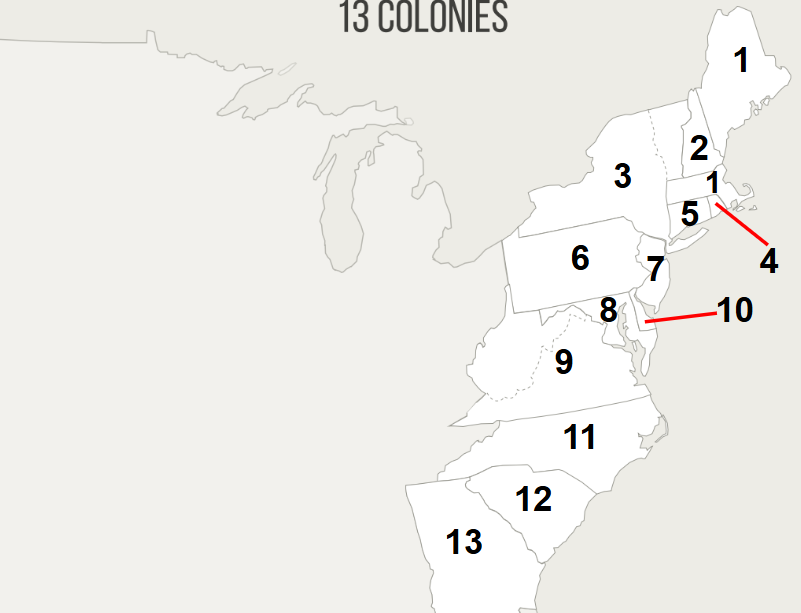
1. What is the name of colony #1 on the map?
Maine
Massachusetts
New Hampshire
Connecticut
2. What is the name of colony #2 on the map?
New Hampshire
Maine
Connecticut
Massachusetts
3. What is the name of colony #3 on the map?
New York
New Jersey
Pennsylvania
New Albany
4. What is the name of colony #4 on the map?
Rhode Island
Massachusetts
Pennsylvania
Connecticut
5. What is the name of colony #5 on the map?
Connecticut
Pennsylvania
Rhode Island
Massachusetts
6. What is the name of colony #6 on the map?
New Jersey
New York
New Albany
Pennsylvania
7. What is the name of colony #7 on the map?
Maryland
Delaware
New York
New Jersey
8. What is the name of colony #8 on the map?
Delaware
New Jersey
Virginia
Maryland
9. What is the name of colony #9 on the map?
South Carolina
Virginia
North Carolina
Maryland
10. What is the name of colony #10 on the map?
Virginia
New Jersey
Maryland
Delaware
11. What is the name of colony #11 on the map?
North Carolina
Virginia
Maryland
South Carolina
12. What is the name of colony #12 on the map?
Georgia
South Carolina
North Carolina
Virginia
13. What is the name of colony #13 on the map?
South Carolina
Virginia
Georgia
North Carolina
14. Jamestown was established by the Virginia Company, a joint-stock company. Which of the following is true about a joint-stock company?
Each colonist in Jamestown was a partner in the company.
Investors share in the profits or losses of the company.
The company claimed complete ownership of all land used by the colonists.
The company, not the colonists, decided how the colony should be governed.
15. In 1619, the Virginia Company created the House of Burgesses, which
could veto orders from the English monarch
claimed exclusive authority in all English colonies
was the beginning of representative government in America.
created a system of checks and balances.
16. How did the founding of Massachusetts differ from the founding of Virginia?
Massachusetts colonists were loyal to the king, while Virginia colonists sought
Massachusetts colonists sought wealth, while Virginia colonists sought religious freedom
Massachusetts colonists sought independence from England, while Virginia colonists were loyal to the king
Massachusetts colonists sought religious freedom, while Virginia colonists sought wealth
17. English people who wished to establish their own churches were called
Separatists
Anglicans
Puritans
Pilgrims
18. The founding of Rhode Island was based on the principle of
separation of powers
religious tolerance
universal voting rights
representative government
19. What was the main cause of King Philip’s War?
the refusal of New England settlers to trade with Native Americans
D. the desire of New England settlers to form an independent nation
the resistance of Native Americans against Christian missionaries
the steady advance of English settlers onto Native American lands
20. In 1660, which nation controlled the lands between the New England Colonies and Virginia?
the Netherlands
France
England
Spain
21. Which statement about the colonies of New York and New Jersey is accurate?
Both colonies prospered mainly through farming.
Both colonies made slavery strictly illegal.
Both colonies were ethnically diverse.
Both colonies were established by Puritans.
22. What was Peter Stuyvesant’s role in the English colonization of the Middle Colonies?
He turned over control of New Amsterdam to the English
He founded a colony dedicated to ethnic and religious tolerance.
Both colonies made slavery strictly illegal.
Both colonies were ethnically diverse.
23. Which two cities in the Middle Colonies became prosperous centers of trade?
New York and Philadelphia
Albany and New York
Boston and Portsmouth
Philadelphia and Boston
24. Which words best characterize William Penn’s dealings with Native Americans?
deceitful and corrupt
strict and cruel
kind and fair
naive and immature
25. What was the southernmost Middle Colony?
New Amsterdam
Pennsylvania
Virginia
Delaware
26. The first enslaved Africans were brought against their will to which English colony?
Virginia
Massachusetts
Georgia
South Carolina
27. How was the establishment of Maryland similar to the establishment of the Massachusetts Bay Colony?
Both were founded on the principles of ethnic diversity.
Both were founded as havens for convicted convicts.
Both were founded in part to escape religious persecution.
Both were founded by proprietors who hoped to become wealthy.
28. Who founded the colony of Maryland?
James Oglethorpe
William Penn
Sir George Calvert, Lord Baltimore
Captain John Smith
29. What was the motivation behind Bacon’s Rebellion?
Nathaniel Bacon wanted greater access to Native American land and resources.
Nathaniel Bacon wanted the freedom to practice his own religion.
Nathaniel Bacon demanded the right to vote despite not being a landowner.
Nathaniel Bacon strongly opposed Virginia’s harsh treatment of Native Americans.
30. What does the excerpt suggest about the resources and economy of the Carolina colony?
Settlers were guaranteed to receive limes, oranges, lemons, apples, pears, and other fruits.
Colonists who settled in Carolina were entitled to receive 1,500 to 3,000 acres to farm.
Colonists who settled in Carolina enjoyed a hospitable climate and abundant food sources.
Settlers in Carolina would likely face challenges from hogs and wild animals.
31. This excerpt is from an advertising pamphlet written to persuade people to settle in Carolina. Considering the purpose of the pamphlet, what can you infer about the source?
It is objective and reliable
It is completely unreliable
It is biased in favor of Carolina as a good location for settlement.
It is biased against Carolina as a good location for settlement.
32. Based on this description of Pennsylvania’s economy, what can you infer about the Middle Colonies?
The climate was generally cold and rainy.
The climate was hot and humid.
The soil was excellent for farming.
Swampy land discouraged agriculture.
33. Based on the excerpt, why do you think the Middle Colonies grew wealthy?
They harvested only enough to feed themselves and other colonies.
They were forced to trade with neighboring colonies.
They could export many raw materials for manufactured goods.
They relied on trade with Barbados or England.
34. Which of the following is one reason the colony of Georgia was founded?
as a dumping ground for prisoners of war
as a refuge for English debtors
as a place for pacifists to settle
as a buffer against Native Americans
35. Most people in colonial America worked as
trappers
farmers
traders
hunters
36. Why did most enslaved people live in the Southern Colonies?
New England and the Middle Colonies lacked harbors to receive ships carrying enslaved Africans.
The economy of the Southern Colonies was built around labor-intensive farming.
Slavery was illegal throughout New England and the Middle Colonies.
Agriculture was a minor part the economies of New England and the Middle Colonies.
37. Which English principles of government had the greatest effect on the development of government in the American colonies?
federalism and the divine right of kings
limited government and popular sovereignty
protecting rights and representative legislatures
checks and balances and protecting rights
38. Which best describes the role and status of women in colonial America?
They contributed significantly to the economic activities of their families.
They worked primarily as domestic servants and schoolteachers
They were not allowed to operate home-based businesses or work in trades.
They were responsible primarily for planting crops and raising livestock.
39. How did the Great Awakening impact colonial society?
It convinced most colonists that slavery was immoral for religious reasons.
It increased religious diversity and promoted the idea of religious freedom.
It promoted the idea that women and minorities should have a bigger political voice
It helped establish a single and uniquely “American” church.
40. This excerpt describes the “starving time” at Jamestown, when Native Americans stopped providing colonists with food. Based on the excerpt, what can you infer about the first settlers at Jamestown?
They lacked the necessary skills to provide for themselves.
They were too proud to accept help from Native Americans.
They were lazy and refused to work hard to establish their colony.
They spent too much time growing tobacco.
41. What conclusion can you draw from this excerpt about the “starving time” at Jamestown?
The region’s Native Americans lacked advanced farming techniques.
It proved that the Chesapeake Bay was a poor place to settle.
Colonists and Native Americans had developed friendly relations.
Many colonists died during this time due to lack of food.
42. This letter, written by a colonist at Plymouth, describes the colony’s successful harvest. Based on the excerpt, which is a valid conclusion about the early years of the Plymouth Colony?
The colony quickly established a profitable business of trade with the colony at Jamestown.
The colony began to prosper only after eliminating most of the area’s native peoples.
The colony’s survival depended greatly on the assistance of native peoples.
The colony became rich by sending abundant cash crops back home to England.
43. This excerpt suggests that the economies of the New England Colonies would come to depend on
fishing
growing peas
growing indigo
raising cattle
44. Which of the following English colonies were founded in the name of religious freedom?
Rhode Island
Connecticut
Massachusetts
Virginia
45. What was Thomas Hooker's role in the development of representative government in the English colonies?
He led Virginia's House of Burgesses, the first elected legislature in the English colonies.
He established a colony based on Quaker ideals of tolerance and equality rather than on requiring colonists to follow a specific religious doctrine.
He helped formulate North America's first constitution, the Fundamental Orders of Connecticut.
He drafted the Mayflower Compact, establishing an orderly government in Massachusetts.
46. How did trade support the economy of the Middle Colonies?
Colonists in Virginia and the Carolinas traded cotton to England and received manufactured goods in return.
Workers floated lumber downstream to port cities such as Boston, which linked the Middle Colonies with other markets.
Farmers sent surplus grain and livestock to New York and Philadelphia, where they could be shipped elsewhere.
Traders exchanged tobacco and indigo from Pennsylvania for corn and livestock from the Southern Colonies.
47. What did the founding of the English colony of Virginia and the Dutch colony of New Netherlands have in common?
They were both founded by people eager to spread Christianity
They were both founded by people hoping to become wealthy.
They were both founded by people who wanted to create independent nations.
They were both founded by people looking for religious freedom.
48. How did the growth and success of the Virginia colony impact Bacon's Rebellion?
As lands along the coast became crowded, more and more settlers wanted to move west onto Native American lands
Colonists resented Native Americans taking jobs on plantations that formerly belonged to settlers.
Many colonists, including Nathaniel Bacon, opposed the Virginia governor's pledge to stay out of native territory.
Virginia's governor raised taxes on tobacco and other cash crops to pay for essential services, angering plantation owners.
49. Why did commercial farming fail to become a major part of New England's economy?
Most settlers in New England were fishers, not farmers.
The rocky soil made it difficult for farmers to grow crops.
The region's Native Americans refused to share their knowledge of agriculture.
The cool climate resulted in a rather short growing season.
50. What was the significance of the Magna Carta on colonial governments?
It encouraged women and minorities to participate in local town meetings.
It emphasized the authority of the English monarchs.
It granted partial independence to royal colonies.
It affirmed that individual citizens had personal rights.