@romeo: @juliet14, I will see thee in an hour!
What does the word "thee" mean in this status?
@mercutio: @romeo, hast thou disappeared? We will never see each other anymore!
What does the word "hast" mean in this status?
@juliet14: @romeo, you should leave soon, lest you be late to my house.
What does the word "lest" mean in this status?
@juliet14: @romeo, shalt you come tomorrow?
What does the word "shalt" mean in this status?
@mercutio: @juliet14, @romeo, thy families are difficult.
What does the word "thy" mean in this status?
@juliet14: @romeo, I feel as though I will never see thee again.
What does the word "thee" mean in this status?
@bigtybalt: @juliet14, thou hast made a huge mistake in following @romeo.
What does the word "hast" mean in this status?
@mercutio: @bigtybalt, surround yourself with friends lest you are caught in a fight.
What does the word "lest" mean in this status?
@bigtybalt: I shalt be the winner.
What does the word "shalt" mean in this status?
@juliet14: @mercutio, thy opinion matters not to me.
What does the word "thy" mean in this status?
Two households, both alike in
In fair Verona, where we
From ancient
Where civil blood makes civil hands unclean.
From forth the
A pair of
Whose misadventur'd piteous
Doth with their death
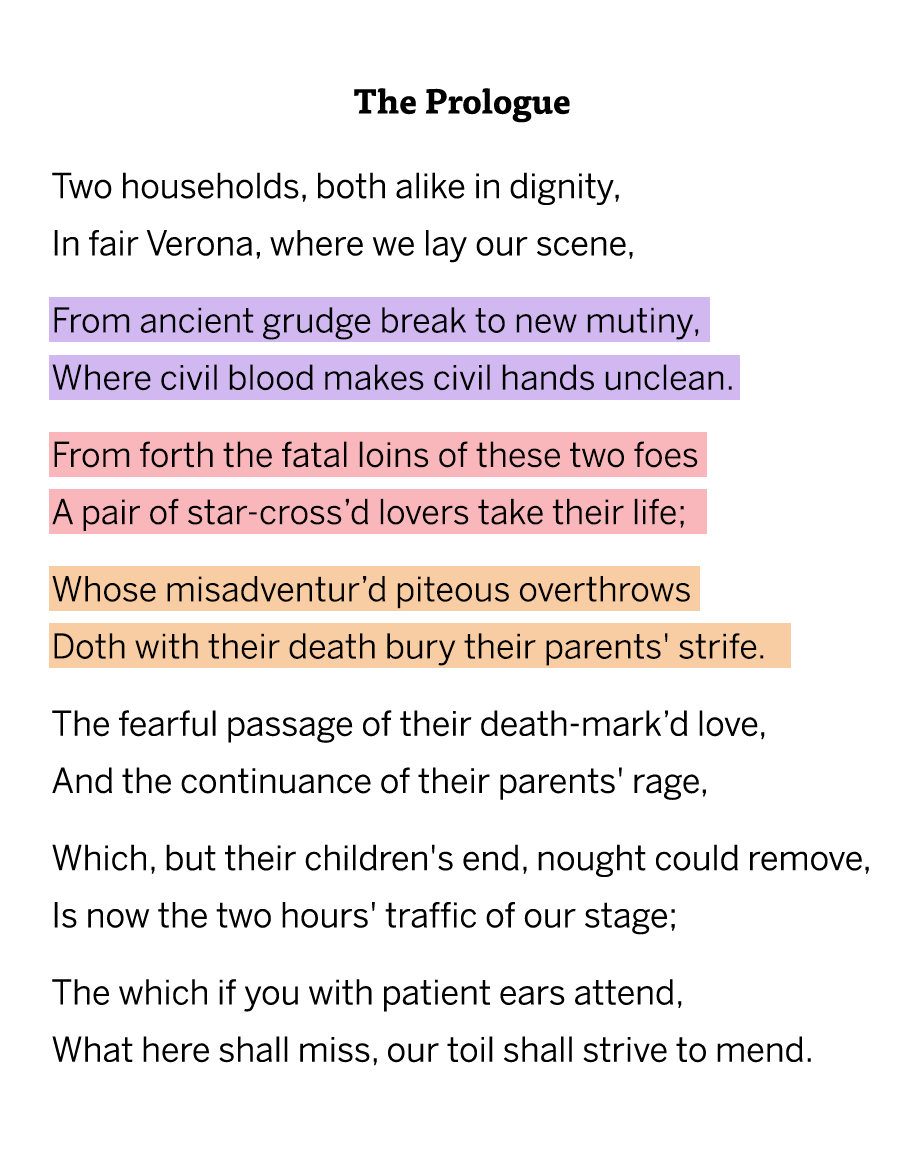
Choose one of the highlighted pairs of lines and translate into your own words. Use details and words from the text to explain what the lines mean and what they suggest happen in the play. (You will need to write at least 100 words.)
Match the correct summary to each pair of lines.
From ancient grudge break to new mutiny,
Where civil blood makes civil hands unclean.
From forth the fatal loins of these two foes
A pair of star-cross'd lovers take their life;
Whose misadventur'd piteous overthrows
Doth with their death bury their parents' strife.
Fill in the blanks of the final lines of The Prologue by dragging synonyms into the blanks.
The fearful passage of their (death-marked) love And the (continuance) of their parents’ rage, Which, but their children’s end, (nought) could remove, Is now the two hours’ (traffic) of our stage; The which, if you with (patient) ears attend, What here shall miss, our (toil) shall strive to mend.
Based on your answers above, what do you think Shakespeare is saying in these lines?
Drag two pieces of information The Prologue gives you about the setting and background of the play.
What does Shakespeare mean when he writes “their parents’ rage,/Which, but their children’s end, nought could remove” (10–11)?
What are two additional pieces of information The Prologue tells us.
What information about The Prologue have you found the most interesting? Explain your thinking.
Look closely at the The Prologue. What number is repeated multiple times?
Why do you think this number is repeated so many times? Explain your answer using evidence from the text. (APE)