Ɛhia
1
Ɛhia
1
Ɛhia
1
Ɛhia
1
Ɛhia
4
Ɛhia
1
Excerpt from Chapter 4 in The Secret of the Yellow Death by Suzanne Jurmain
1 Early July 1900
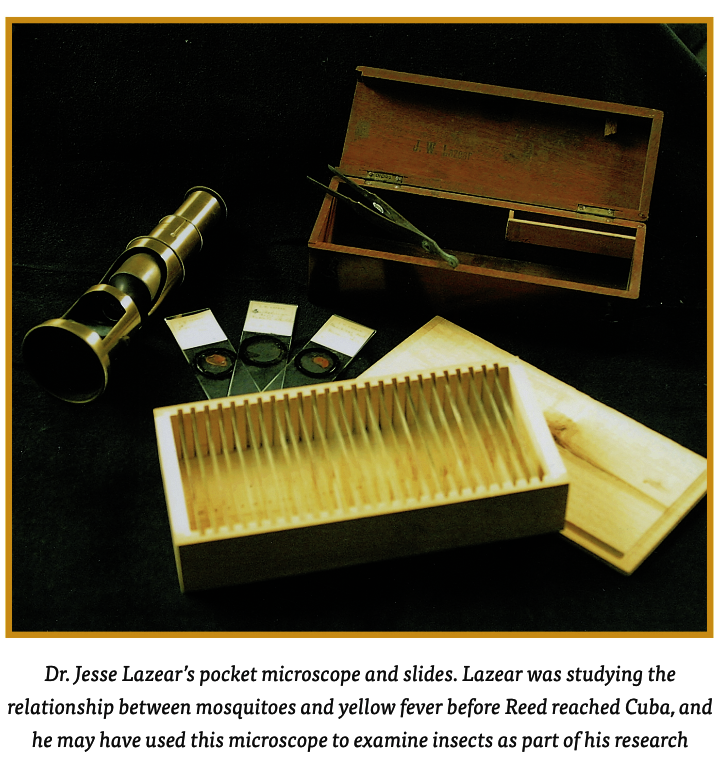
2 The lab didn’t look like much. It was an old wooden shack at Camp Columbia, stuffed with wooden tables, shelves, jars, flasks, test tubes, a hot oven for sterilizing, an incubator to provide the warmth needed for growing bacteria, and a couple of microscopes. From morning until lunch, from lunch until dinner, Reed and Carroll worked side by side, juggling tubes and peering through microscope lenses. Lazear came and went, taking his turn at studying the steady stream of tissue specimens Agramonte sent from his autopsy lab in Havana.
3 The problem seemed simple. If Bacillus icteroides caused yellow fever, it ought to be found in the bodies of yellow fever victims. All Reed and his colleagues had to do was look. So, as the warm July days sped past, the four doctors searched for Bacillus icteroides in blood samples that had been taken from live yellow fever patients. They also tried to find the bacteria in blood and bits of tissue that had been taken from the dead. With delicate loops made of platinum wire they streaked infected blood onto gelatin-filled plates and popped these cultures in the incubator to see if warmth and the gelatin food would make Dr. Giuseppe Sanarelli’s mysterious bacteria grow. They tried to grow the bacteria by placing tiny samples of the livers, spleens, kidneys, intestines, and hearts of yellow fever victims in test tubes filled with bouillon that bacteria liked to eat. But nothing much grew in the tubes or on the plates. And no matter how carefully the men looked through their microscopes, they couldn’t find a single sample of Bacillus icteroides.
4 Yet yellow fever was all around the team that summer. Men and women in Havana were dying of the disease. American officers were coming down with yellow fever, even though Walter Reed never mentioned that in personal letters.
5 Almost every day, he sat down at the long wooden table in his quarters and wrote a cheerful, chatty letter to his “precious wife,” Emilie. He told her that he’d bought himself “a large Cork [sic] helmet for wearing in the sun” and that he’d eaten cake and watermelon for dinner. He asked her to tell him all about the strawberry patch, the flower garden, and the relatives at home. But when Emilie sent a letter that asked about Reed’s chance of getting yellow fever while in Cuba, her husband answered, “I have said nothing about yellow fever because I didn’t want to give you any worry, especially as I wasn’t taking any risks whatever.”
6 No risks whatever?
7 The truth was, all of Reed’s activities were risky.
8 But, apparently, Reed didn’t want his wife to know it. When he wrote his letters home, Reed didn’t tell Emilie that yellow fever was sweeping across Cuba. He didn’t say that he might get the illness from handling infected tissue specimens. And he also didn’t mention one other troubling fact: the team was making very little progress.
9 By the middle of July, Reed and his colleagues had produced dozens of gelatin cultures and bouillon preparations. They had spent hours looking at organ tissue under the microscope. But they couldn’t find Bacillus icteroides—or any other type of germ that might possibly be the cause of yellow fever.
10 That bothered Dr. Jesse Lazear.
11 At work the former football player always did his job. To team members, he was always “pleasant” and “polite.” In his spare time, he wrote cheery letters home, telling his pregnant wife about the tropical rain and the funny way that the charmless Dr. Carroll’s ears stuck out. But sometimes, when he sat alone, writing to his family, Lazear couldn’t hold his feelings back. The laboratory work wasn’t going well, he reported. The project was getting nowhere. And as for his teammates . . . Well, it wasn’t Carroll’s ears he was concerned about. It was Carroll. The tall, balding bacteriologist had a “dull” expression. He didn’t seem imaginative. All he seemed to care about was studying “germs for their own sake.” And Reed? Reed seemed to be stuck. All he seemed to care about, Lazear wrote, was hunting for Bacillus icteroides. But Lazear thought that looking for the strange bacillus was a waste of time. A dead end. To make progress, the team needed a new direction. And Jesse Lazear had ideas—good ideas—about what that direction ought to be. Unfortunately, the rest of the team didn’t seem to be taking those ideas very seriously. “I . . . want to do work which may lead to the discovery of the real organism,” Lazear told his wife.
12 But how could he? Reed gave the orders. Lazear had to obey. Nothing seemed likely to change.
13 And then, quite suddenly, something happened.
Use information from the text to help you complete the following statements. Drag each answer option into the correct blank.
1. Dr. Reed’s team puts together a working laboratory at Camp
2. Dr. Reed’s team searches for in blood and tissue samples from yellow fever patients and victims.
3. The team is told that U.S. soldiers are dying of a mysterious illness at
4. Dr. Agramonte autopsies a U.S. soldier and discovers that he died of
5. Dr. Reed and Dr. Agramonte diagnose 35 with yellow fever.
6. One in a locked guardhouse dies of yellow fever.
Bacillus icteroides
3 The problem seemed simple. If Bacillus icteroides caused yellow fever, it ought to be found in the bodies of yellow fever victims. All Reed and his colleagues had to do was look. So, as the warm July days sped past, the four doctors searched for Bacillus icteroides in blood samples that had been taken from live yellow fever patients. They also tried to find the bacteria in blood and bits of tissue that had been taken from the dead. With delicate loops made of platinum wire they streaked infected blood onto gelatin-filled plates and popped these cultures in the incubator to see if warmth and the gelatin food would make Dr. Giuseppe Sanarelli’s mysterious bacteria grow. They tried to grow the bacteria by placing tiny samples of the livers, spleens, kidneys, intestines, and hearts of yellow fever victims in test tubes filled with bouillon that bacteria liked to eat. But nothing much grew in the tubes or on the plates. And no matter how carefully the men looked through their microscopes, they couldn’t find a single sample of Bacillus icteroides.
What specific claim is being presented in the text? Select the sentence that explains the yellow fever theory that Dr. Reed’s team is testing. (From The Secret of the Yellow Death: A True Story of Medical Sleuthing, Ch. 4 “Going Nowhere,” paragraph 3)
The problem seemed simple.
What does the evidence you collected in the table above suggest about the following theories?
A. The evidence to the theory of Bacillus icteroides as the source of yellow fever.
3. The evidence to the theory of contaminated clothing as the source of yellow fever.
4. The evidence to the theory of mosquitoes as the source of yellow fever.
Summarize the team’s investigation at Camp Columbia.
State the hypothesis for this investigation by completing the if/then statement below. (If Bacillus icteroides caused yellow fever, then ____).
6 After leaving the autopsy room, the doctor walked through the camp’s hospital ward, moving carefully from bed to bed. To his horror, there were more patients showing telltale signs of yellow fever. There was no mistaking the yellow skin and eyes, the bleeding gums, the high temperatures, and the slow pulse rates. Somehow the doctors at Pinar del Rio had failed to recognize a yellow fever outbreak.
7 Agramonte immediately telegraphed the news to headquarters. Reed jumped on a train the following morning. By July 21 he had joined his colleague at the camp, and the two men began to search for the cause of the disease.
8 The statistics were clear. Thirty-five soldiers at the army post had come down with yellow fever. Eleven had been killed by the vicious illness. How had all those young Americans become infected?
9 One man, a prisoner who’d been locked up in the guardhouse, had died of the disease. But he hadn’t been near any yellow fever patients before or during his imprisonment. He hadn’t ever touched clothes or sheets that had been used by other yellow fever victims. How could he possibly have gotten sick?
10 And what about the eight other men who shared his cell? They had breathed the same air the sick man had breathed. They had touched his clothes, brushed against his blankets, and handled his dishes. But those eight men had stayed completely well.
11 So what had caused the dead prisoner’s attack of yellow fever?
12 Reed and Agramonte examined the possibilities.
13 It wasn’t Bacillus icteroides. That much was clear. After weeks of work, the team had found no evidence that Sanarelli’s bacteria had anything to do with yellow fever. That eliminated one theory.
14 Contact with infected clothing and bedding didn’t seem to have spread the disease to the dead prisoner’s cellmates. That discredited the idea that yellow fever was somehow spread by touch.
15 So where had the disease come from? And how had it managed to strike only one soldier in a locked guardhouse?
What does the evidence suggest about the following theories?
1. The evidence to the theory of Bacillus icteroides as the source of yellow fever.
2. The evidence to the theory of contaminated clothing as the source of yellow fever.
3. The evidence to the theory of mosquitoes as the source of yellow fever.
What was the hypothesis that the team could have investigated in this situation? Complete the if/then statement to explain.
If contact with infected patients of their belongings caused yellow fever, then
Excerpt from Chapter 5 in The Secret of the Yellow Death by Suzanne Jurmain
1 Mid–Late July 1900
2 On one hot summer day, the team got word that American soldiers were dying of an illness at the Pinar del Rio army post, located about one hundred miles from Camp Columbia in Cuba. But was the sickness yellow fever? No one seemed to know, and army officials ordered Dr. Agramonte to investigate.
3 It was a good choice. Agramonte, a charming and sophisticated man, was also a very smart, well-qualified physician. He’d examined plenty of living yellow fever patients. He’d autopsied the bodies of those who’d died of the disease. He knew all the symptoms of the illness, and he headed to Pinar del Rio right away.
4 One of the sick soldiers had died just hours before Agramonte reached the camp. The body was waiting, and Agramonte promptly did an autopsy.
5 As he worked, the doctor looked for the usual signs of yellow fever: the yellow eyes, the yellowish liver, the yellow skin, all of which were caused by serious damage to the liver. Since liver injury can prevent the blood from clotting and because yellow fever can also make the body’s veins and arteries “leak,” Agramonte thoroughly checked the corpse for signs of bleeding. Was there liquid blood in parts of the digestive tract? Partially digested blood that looked like coffee grounds inside the stomach? One by one, the doctor noted down his findings, and by the time he put his scalpel down, Agramonte knew one thing for certain. The soldier on the table had died of yellow fever.
6 After leaving the autopsy room, the doctor walked through the camp’s hospital ward, moving carefully from bed to bed. To his horror, there were more patients showing telltale signs of yellow fever. There was no mistaking the yellow skin and eyes, the bleeding gums, the high temperatures, and the slow pulse rates. Somehow the doctors at Pinar del Rio had failed to recognize a yellow fever outbreak.
7 Agramonte immediately telegraphed the news to headquarters. Reed jumped on a train the following morning. By July 21 he had joined his colleague at the camp, and the two men began to search for the cause of the disease.
8 The statistics were clear. Thirty-five soldiers at the army post had come down with yellow fever. Eleven had been killed by the vicious illness. How had all those young Americans become infected?
9 One man, a prisoner who’d been locked up in the guardhouse, had died of the disease. But he hadn’t been near any yellow fever patients before or during his imprisonment. He hadn’t ever touched clothes or sheets that had been used by other yellow fever victims. How could he possibly have gotten sick?
10 And what about the eight other men who shared his cell? They had breathed the same air the sick man had breathed. They had touched his clothes, brushed against his blankets, and handled his dishes. But those eight men had stayed completely well.
11 So what had caused the dead prisoner’s attack of yellow fever?
12 Reed and Agramonte examined the possibilities.
13 It wasn’t Bacillus icteroides. That much was clear. After weeks of work, the team had found no evidence that Sanarelli’s bacteria had anything to do with yellow fever. That eliminated one theory.
14 Contact with infected clothing and bedding didn’t seem to have spread the disease to the dead prisoner’s cellmates. That discredited the idea that yellow fever was somehow spread by touch.
15 So where had the disease come from? And how had it managed to strike only one soldier in a locked guardhouse?
16 That was a mystery, but wrapped inside that mystery was a clue.
Here are the theories of yellow fever transmission:
The bacteria Bacillus icteroides is the source of yellow fever transmission.
Contaminated clothing is the source of yellow fever transmission.
Mosquitoes are the source of yellow fever transmission.
Based on the team’s findings, which claim currently appears to be most supported by evidence? Explain two pieces of evidence in your response.
Use at least two of these related vocabulary words in your response: contaminated, bacteria, germ(s), hypothesis, infected, yellow fever.
How did the team investigate their theory? What did they learn? Use the information from the passage to trace how the resulting evidence supports or opposes the claim that Bacillus icteroides causes yellow fever. (What the team did/investigation versus what they learned/result)
No Bacillus icteroides grew on plates or in tubes. | No Bacillus icteroides | No Bacillus icteroides present | |
|---|---|---|---|
“...the four doctors searched for Bacillus icteroides in blood samples that had been taken from live yellow fever patients.” | |||
“They also tried to find the bacteria in blood and bits of tissue that had been taken from the dead.” | |||
“They tried to grow the bacteria by placing tiny samples of the livers, spleens, kidneys, intestines, and hearts of yellow fever victims in the test tubes filled with bouillon that bacteria liked to eat.” (4, 3) |
Complete the therefore statement to summarize the results.
The researchers didn’t find Bacillus icteroides in their samples; therefore, the scientists will probably conclude that _____.
What observations did the scientists make about the prisoner who died of yellow fever at Pinar del Rio? What did the team learn from this new evidence?
A person could catch yellow fever even if they had not had contact with contaminated materials. | Yellow fever did not pass from person to person through the air. | A person could catch yellow fever even if they had not been near someone who was already infected. | |
|---|---|---|---|
The dead prisoner had not been near yellow fever patients before or during his imprisonment. | |||
The dead prisoner had never touched contaminated materials. | |||
None of the eight cellmates who breathed the same air as the dead prisoner caught yellow fever. |
Summarize the team’s investigation of the prisoner’s case of yellow fever at Pinar del Rio.
Yes | No | |
|---|---|---|
infected with yellow fever? | ||
died from yellow fever? | ||
recently near yellow fever patients? | ||
recently near infected bedding or clothing? |
What did the team learn from this event? Use the therefore statement to explain how evidence from the investigation of the prisoner’s death supports or does not support each of the yellow fever claims.
The prisoner wasn't near yellow fever patients or infected bedding or clothing; therefore, the scientists will probably conclude that
Which of the following pieces of evidence supports the claim in paragraph 14 of Chapter 5 that “Contact with infected clothing and bedding didn’t seem to have spread the disease to the dead prisoner’s cellmates”?
Excerpt from Chapter 6 in The Secret of the Yellow Death by Suzanne Jurmain
1 Late July 1900 2 After weeks of work, the team had finally found a clue, and it was just the kind of clue Jesse Lazear probably had hoped for. It fit in with his private thoughts exactly, because for the last few months—while Reed, Carroll, and Agramonte had been focused on finding Bacillus icteroides—Dr. Jesse Lazear had been thinking about bugs. 3 Since May 1900 he’d been studying insects and considering the possible relationship between yellow fever and mosquitoes. Scientific articles had taught him that biting ticks could spread the deadly Texas fever germ through an entire herd of cattle. From reading, Lazear had also learned that mosquitoes infected with a tiny microbe could transmit the sickness that people called malaria. If insects could spread the tiny germs that caused those two diseases, he reasoned, there was a good chance they could carry the germ of yellow fever, too. Right from the start, Lazear had wanted the team to do mosquito research. But none of the other doctors had seemed particularly interested. 4 Until now. 5 Now all four doctors were willing to admit that something must have carried yellow fever through the bars of that Pinar del Rio guardhouse. Something had allowed the disease to strike a single prisoner. And that something could have been a mosquito. 6 It was time to investigate further, and the first step was to consult an expert.
7 At some time, possibly in late July, members of the Reed team drove up to a house on Aguacate Street in Havana. They had come to visit Dr. Carlos Finlay, the Cuban scientist who had tried for years to prove that mosquitoes carried yellow fever. For decades medical researchers around the world had laughed at “crazy” Dr. Finlay and his lunatic ideas. But the formally dressed, white-whiskered gentleman who greeted the Americans didn’t seem like a mad scientist. He was a dignified, highly educated, bespectacled sixty-seven-year-old who knew six languages—including English—and spoke all of them with a slight stutter. During the day, Dr. Finlay treated patients—whether or not they could afford to pay. At night, he devoted time to scientific research. For twenty years he’d ignored the rude remarks that others made about his work on yellow fever. For twenty years he’d continued to believe his theory. And now he was eager to share his thoughts with the others.
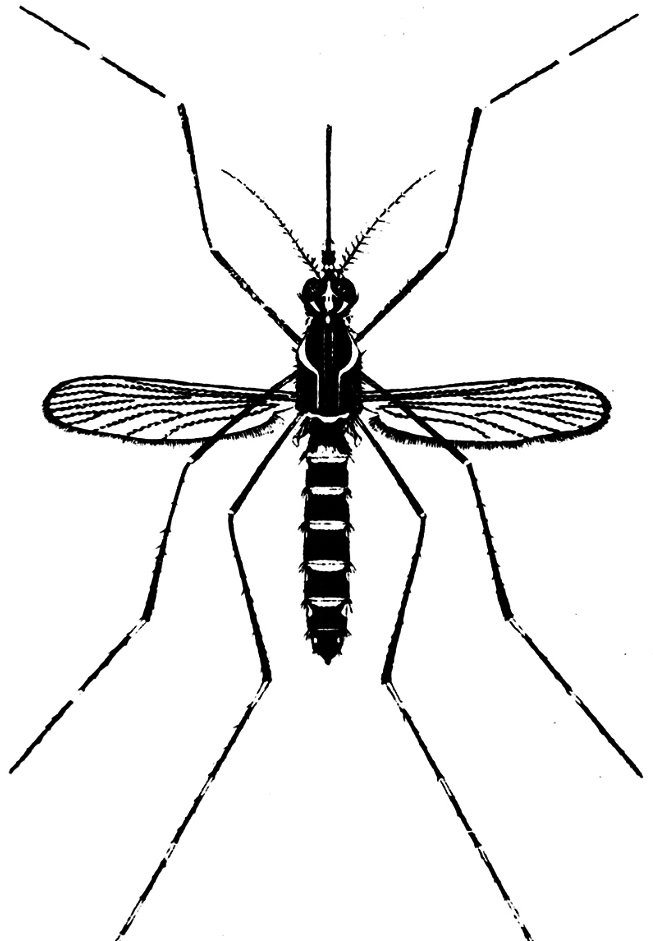
8 Yellow fever, he told the team, was probably spread by the bite of one particular kind of mosquito—a striped insect that was called the Aedes aegypti (pronounced a-dees egypti) mosquito by scientists. 9 That was the first point. 10 The second point, Dr. Finlay noted, was that mosquitoes—including Aedes aegypti—spread disease by sucking blood. 11 When a mosquito bites, it is actually using its long, needlelike nose (called a proboscis) to stab through the skin and draw blood from its victim. If the mosquito bites a sick person, it sucks in germ-infected blood. Later, when that infected mosquito bites again, it uses its proboscis to inject those germs into a healthy person’s body.
12 The process is simple, but only a female mosquito can carry it out—because only a female mosquito is capable of sucking blood. 13 As a rule, both males and females eat plant juice and fruit nectar. Females, however, also need blood meals to help them manufacture the thousands of eggs that they lay in ponds, pools, puddles, and containers of still water. 14 To illustrate this point, Dr. Finlay handed the Americans a batch of tiny black “cigar-shaped” specks. They were dried Aedes aegypti eggs that he had recently scooped out of a bowl of water in his own library. If those eggs were placed in water and kept relatively warm, Finlay told the team, they would grow into adult mosquitoes in about two weeks.
15 The visit had been enormously helpful. As they left Finlay’s Havana house, carrying the batch of mosquito eggs, the Americans must have been excited. There was a new theory to test. There were new experiments to plan. But, excited or not, the team still wasn’t ready to devote all its energy to bugs. Carroll, who still had serious doubts about the mosquito theory, would keep on working with his microscope in hopes of finding the actual yellow fever germ. Agramonte would continue to do autopsies of yellow fever victims because their bodies might hold some new, important clue. Reed wouldn’t be able to do much initially because he had to spend a few weeks in the United States, finishing up a report on typhoid fever that he had started earlier. That left Lazear—whose passionate interest made him the perfect person to take charge of the new mosquito research program.
16 First, he would hatch the eggs that Dr. Finlay had provided and raise a crop of Aedes aegypti mosquitoes that had never been exposed to any illness. Then he would have the females bite a group of yellow fever patients so that the disease-free bugs could pick up the infection. Finally, to prove that the insects could actually carry the disease germ, Dr. Lazear would have to allow female Aedes aegypti mosquitoes that had bitten yellow fever patients to bite healthy animals or humans. Then he would have to see if the healthy creatures developed the disease. 17 And that was a problem. As far as the team knew, animals didn’t get yellow fever. That meant the infected mosquitoes would have to bite a group of people. 18 But who? Who was going to be bitten? 19 The decision would have to be made soon. Reed had to return to the United States August 2, and it was important to get the new mosquito research started.
20 On the night of August 1—when, for some unknown reason, Agramonte was not present—Reed, Carroll, and Lazear met at Camp Columbia. They discussed the problem and decided that all three of them would volunteer for the experiments. 21 Of course, if Carlos Finlay and Jesse Lazear were right—if mosquitoes did carry the disease germs—a human volunteer bitten by an infected bug could get yellow fever and die of the disease. That was the risk. But all three doctors were prepared to face it. To fight the illness they were ready to take what Dr. Carroll later called “a soldier’s chances.”
The team visited Dr. Carlos Finlay in order to
Which of the following does the author not do in paragraph 3?
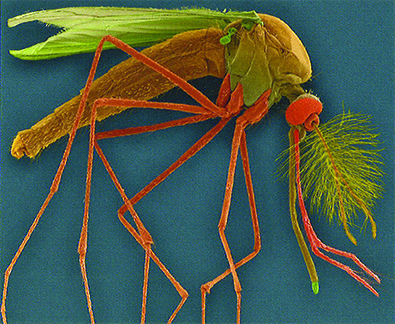
Use the following information to label the picture as either male or female:
"The female...like all female mosquitoes has a long nose (called a proboscis) that allows her to stab through skin and draw blood. The male...like all male mosquitoes, has bushy antennae on his head that make him look different from the female."
Which team member was chosen to lead the mosquito research?
Put the steps of Dr. Lazear’s experiment in order:
Have female mosquitoes bite yellow fever patients.
Have the same female mosquitoes bite healthy people.
Hatch mosquito eggs.
Observe the healthy people to see if the disease develops.
What did Dr. Carroll mean when he said that the team was ready to take “ ‘a soldier’s chances’ ” (21). Use details from the text to support your answer.