Ɛhia
1
Ɛhia
1
Ɛhia
1
Ɛhia
2
Ɛhia
1
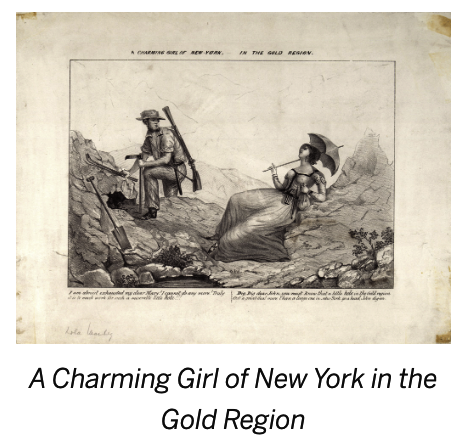
Part 1: Judging from her descriptions, the writer most likely that the male miners respect the intelligence of the female visitors.
Ɛhia
1
List new things that you learned about the gold rush in the last lesson.
Now you will answer a new scavenger hunt question about the gold rush. You will find the answer by exploring texts in The Gold Rush Collection.
Scavenger Hunt Question: Who found gold-dust worth $3.25?
1. To find the answer, scan each text in this activity.
2. Then answer the close reading questions that accompany it.
Part 1: Judging from her descriptions, the writer most likely that the male miners respect the intelligence of the female visitors.
Written in a poetic form known as an ode, “Pioneers, O Pioneers” is a tribute to the pioneering men, women, and children of the 19th century. Note its forward-moving rhythm, which almost seems to gallop off the page. Excerpt: “Pioneers! O Pioneers!” from Leaves of Grass Author: Walt Whitman Printed by: Rome Brothers, Brooklyn, NY Published: 1865 (public domain) 1 Come my tan-faced children, 2 Follow well in order, get your weapons ready, 3 Have you your pistols? have you your sharp-edged axes? 4 Pioneers! O pioneers! 5 For we cannot tarry here, 6 We must march my darlings, we must bear the brunt of danger, 7 We the youthful sinewy races, all the rest on us depend, 8 Pioneers! O pioneers! 9 O you youths, Western youths, 10 So impatient, full of action, full of manly pride and friendship, 11 Plain I see you Western youths, see you tramping with the foremost, 12 Pioneers! O pioneers! 13 Have the elder races halted? 14 Do they droop and end their lesson, wearied over there beyond the seas? 15 We take up the task eternal, and the burden and the lesson, 16 Pioneers! O pioneers! 17 All the past we leave behind, 18 We debouch upon a newer mightier world, varied world, 19 Fresh and strong the world we seize, world of labor and the march, 20 Pioneers! O pioneers! 21 We detachments steady throwing, 22 Down the edges, through the passes, up the mountains steep, 23 Conquering, holding, daring, venturing as we go the unknown ways, 24 Pioneers! O pioneers! 25 We primeval forests felling, 26 We the rivers stemming, vexing we and piercing deep the mines within, 27 We the surface broad surveying, we the virgin soil upheaving, 28 Pioneers! O pioneers! 29 Colorado men are we, 30 From the peaks gigantic, from the great sierras and the high plateaus, 31 From the mine and from the gully, from the hunting trail we come, 32 Pioneers! O pioneers! 33 From Nebraska, from Arkansas, 34 Central inland race are we, from Missouri, with the continental blood intervein’d,
35 All the hands of comrades clasping; all the Southern, all the Northern, 36 Pioneers! O pioneers! 37 O resistless restless race! 38 O beloved race in all! O my breast aches with tender love for all! 39 O I mourn and yet exult, I am rapt with love for all, 40 Pioneers! O pioneers!
List some words and phrases that show violence in the poem. What do you think they say about being a pioneer?
When Whitman writes in line 7, “all the rest on us depend,” who are “all the rest,” and for what do they depend on the pioneers?
How do you know Whitman thinks remembering the past is important for future generations?
Who found gold-dust worth $3.25?
Now you will answer a new scavenger hunt question about the gold rush. You will find the answer by exploring texts in The Gold Rush Collection.
Scavenger Hunt Question: What direction are the people in this picture headed?
1. Examine each image in this activity.
2. Then answer the close reading questions that accompany it.
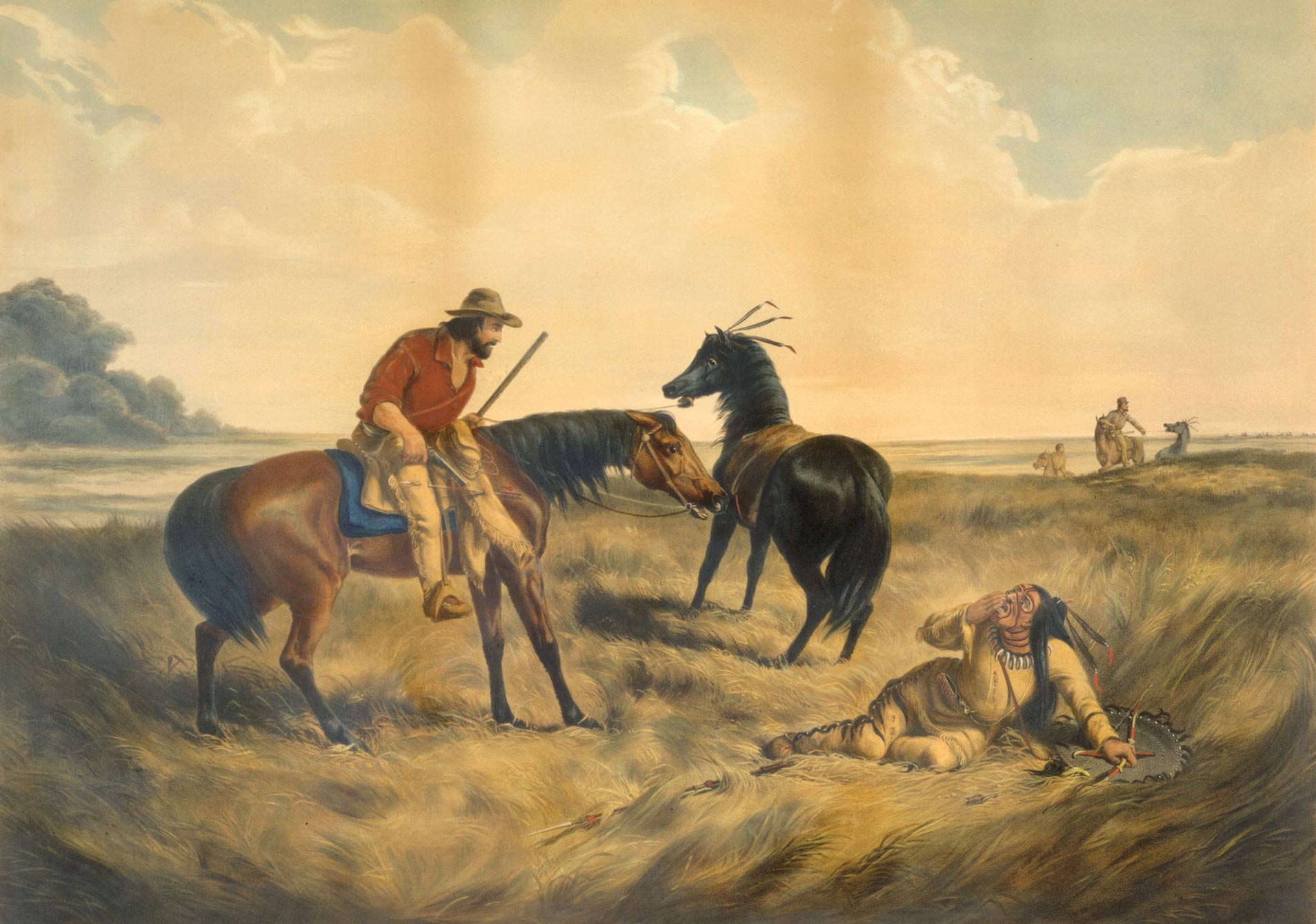
Describe this scene.
What questions do you have about this scene?
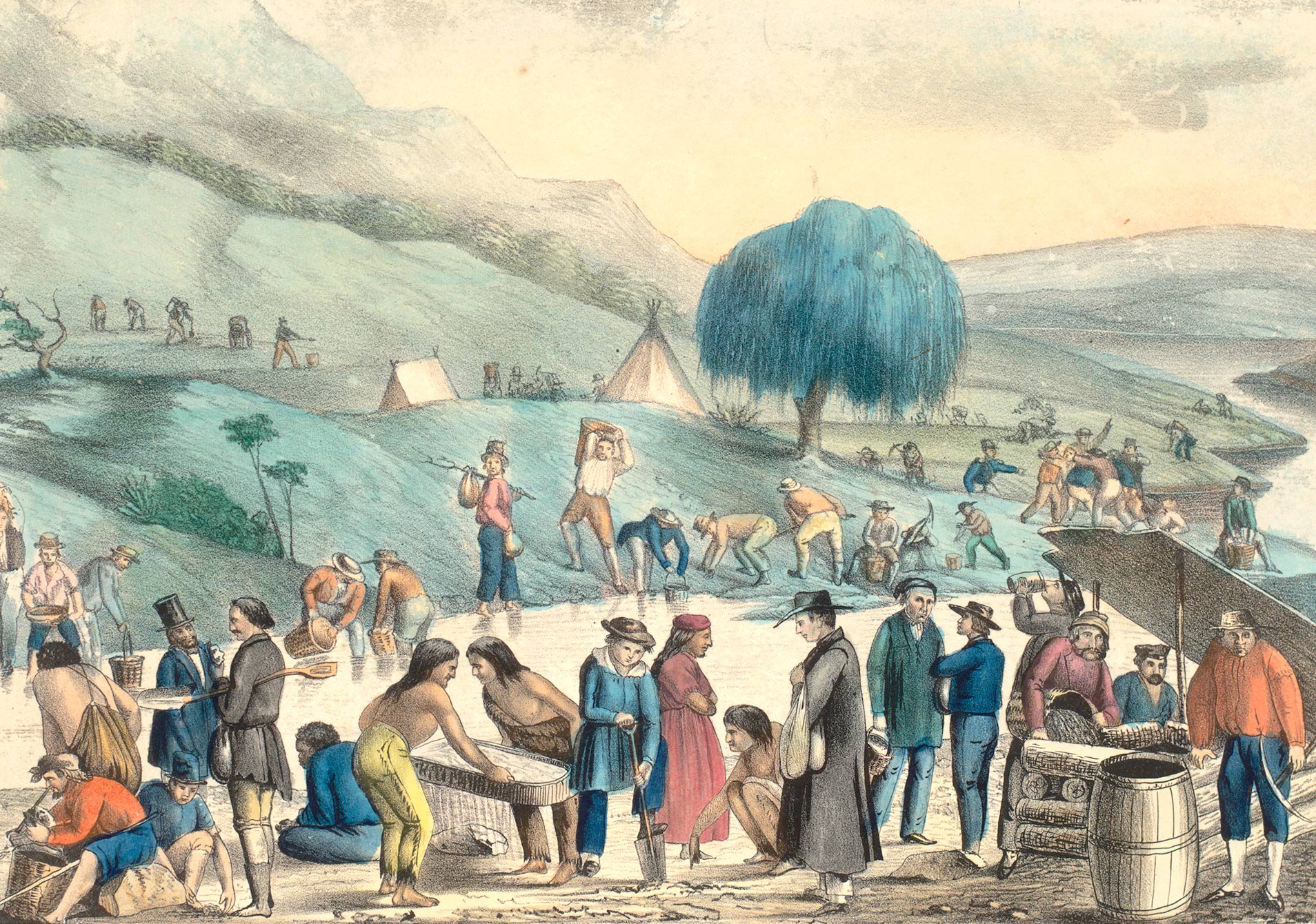
Describe the different types of people you see in this image.
The gold diggers in this image seem to be working together. If you were a gold digger, would you want to work with other people or by yourself? Why?
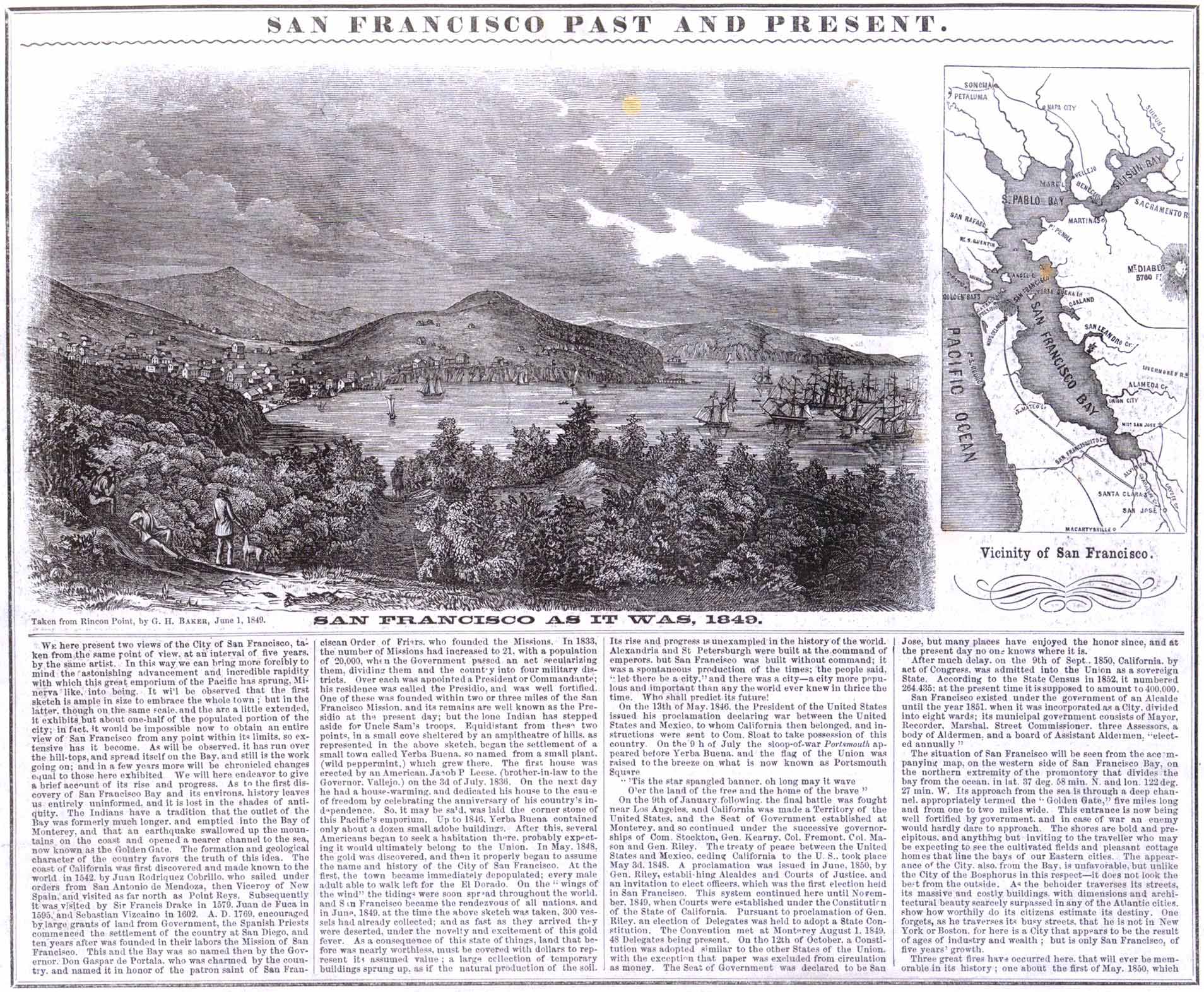
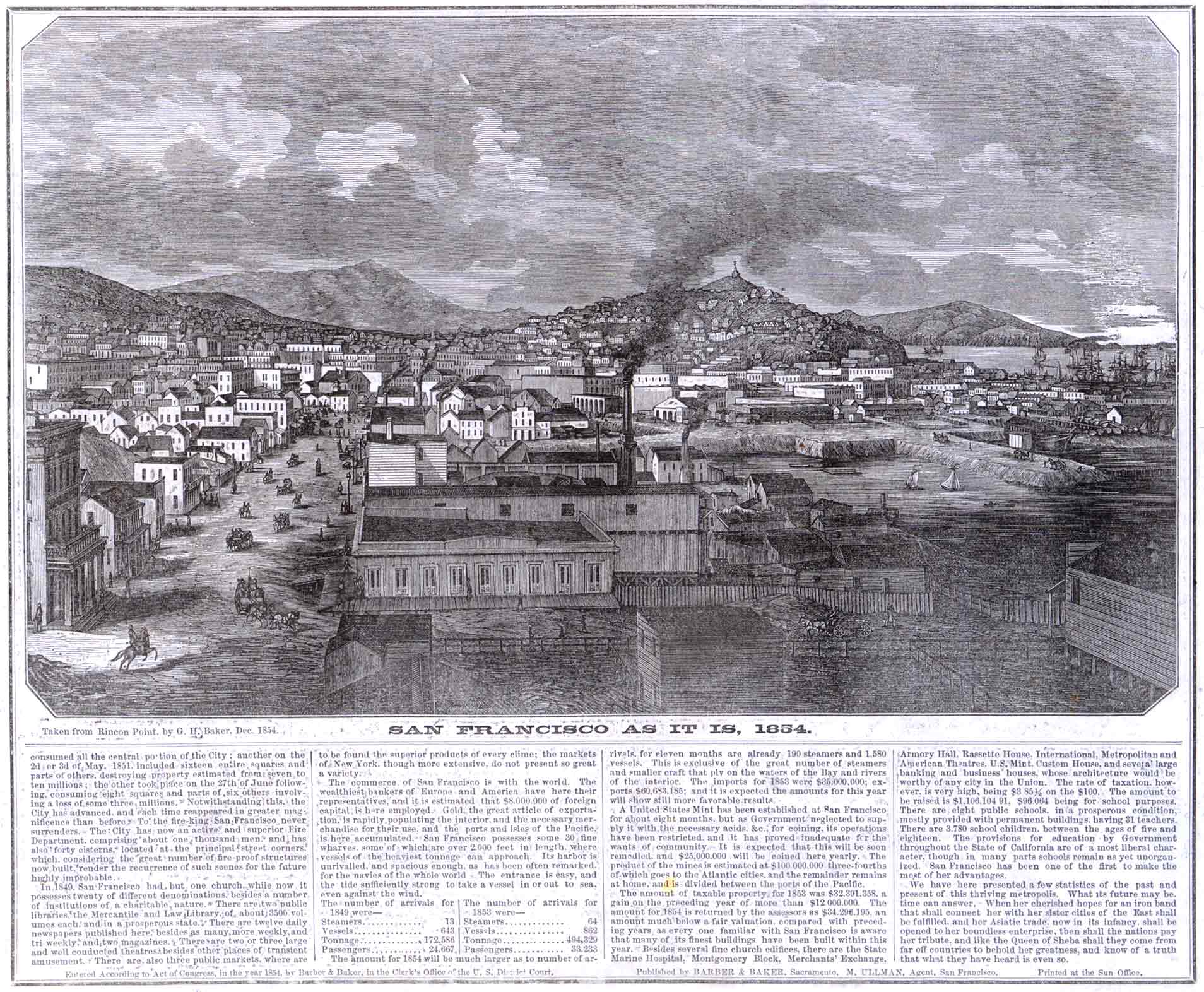
Describe the differences between the San Francisco of the “past” and the San Francisco of the “present.”
Some say that San Francisco is a city known for its harbor (a place by the water for storing boats). Why would it be useful for a city to grow around a harbor?
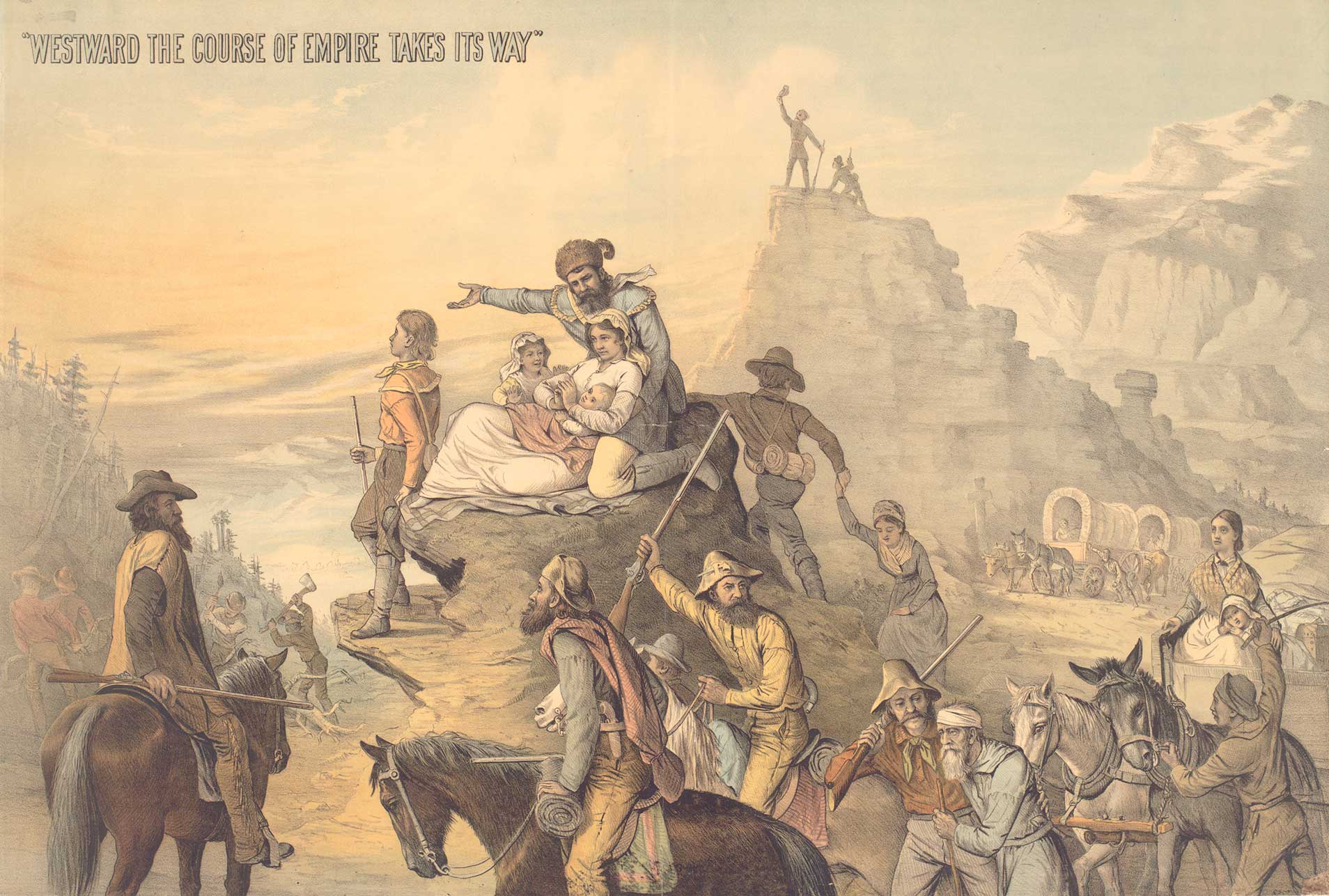
Describe what the people in this picture are doing.
In Westward the Course of Empire Takes Its Way, a caravan (group traveling together) of settlers reaches the Pacific Ocean. Does it look like it was an easy journey? Explain your answer.
What direction are the people in this picture headed?
Excerpts: Chapter XXVII and Chapter XXVIII from Roughing It Author: Mark Twain Publisher: American Publishing Company, Hartford, CT Published: 1872 (public domain) Chapter XXVII
1 HURRY, was the word! We wasted no time. Our party consisted of four persons—a blacksmith sixty years of age, two young lawyers, and myself. We bought a wagon and two miserable old horses. We put eighteen hundred pounds of provisions and mining-tools in the wagon and drove out of Carson on a chilly December afternoon. The horses were so weak and old that we soon found that it would be better if one or two of us got out and walked. It was an improvement. Next, we found that it would be better if a third man got out. That was an improvement also. It was at this time that I volunteered to drive, although I had never driven a harnessed horse before, and many a man in such a position would have felt fairly excused from such a responsibility. But in a little while it was found that it would be a fine thing if the driver got out and walked also. It was at this time that I resigned the position of driver, and never resumed it again. Within the hour, we found that it would not only be better, but was absolutely necessary, that we four, taking turns, two at a time, should put our hands against the end of the wagon and push it through the sand, leaving the feeble horses little to do but keep out of the way and hold up the tongue. Perhaps it is well for one to know his fate at first, and get reconciled to it. We had learned ours in one afternoon. It was plain that we had to walk through the sand and shove that wagon and those horses two hundred miles. So we accepted the situation, and from that time forth we never rode. More than that, we stood regular and nearly constant watches pushing up behind. 2 We made seven miles, and camped in the desert. Young Claggett (now member of Congress from Montana) unharnessed and fed and watered the horses; Oliphant and I cut sage-brush, built the fire and brought water to cook with; and old Mr. Ballou, the blacksmith, did the cooking. This division of labor, and this appointment, was adhered to throughout the journey. We had no tent, and so we slept under our blankets in the open plain. We were so tired that we slept soundly. 3 We were fifteen days making the trip—two hundred miles; thirteen, rather, for we lay by a couple of days, in one place, to let the horses rest. We could really have accomplished the journey in ten days if we had towed the horses behind the wagon, but we did not think of that until it was too late, and so went on shoving the horses and the wagon too when we might have saved half the labor. Parties who met us, occasionally, advised us to put the horses in the wagon, but Mr. Ballou, through whose iron-clad earnestness no sarcasm could pierce, said that that would not do, because the provisions were exposed and would suffer, the horses being “bituminous from long deprivation.” The reader will excuse me from translating. What Mr. Ballou customarily meant, when he used a long word, was a secret between himself and his Maker. . . . 4 We four always spread our common stock of blankets together on the frozen ground, and slept side by side; and finding that our foolish, long-legged hound pup had a deal of animal heat in him, Oliphant got to admitting him to the bed, between himself and Mr. Ballou, hugging the dog’s warm back to his breast and finding great comfort in it. But in the night the pup would get stretchy and brace his feet against the old man’s back and shove, grunting complacently the while; and now and then, being warm and snug, grateful and happy, he would paw the old man’s back simply in excess of comfort; and at yet other times he would dream of the chase and in his sleep tug at the old man’s back hair and bark in his ear. The old gentleman complained mildly about these familiarities, at last, and when he got through with his statement he said that such a dog as that was not a proper animal to admit to bed with tired men, because he was “so meretricious in his movements and so organic in his emotions.” We turned the dog out. 5 It was a hard, wearing, toilsome journey, but it had its bright side; for after each day was done and our wolfish hunger appeased with a hot supper of fried bacon, bread, molasses, and black coffee, the pipe-smoking, song-singing, and yarn-spinning around the evening camp-fire in the still solitudes of the desert was a happy, care-free sort of recreation that seemed the very summit and culmination of earthly luxury. It is a kind of life that has a potent charm for all men, whether city or country bred. We are descended from desert-lounging Arabs, and countless ages of growth toward perfect civilization have failed to root out of us the nomadic instinct. We all confess to a gratified thrill at the thought of “camping out.” 6 Once we made twenty-five miles in a day, and once we made forty miles (through the Great American Desert), and ten miles beyond—fifty in all—in twenty-three hours, without halting to eat, drink, or rest. To stretch out and go to sleep, even on stony and frozen ground, after pushing a wagon and two horses fifty miles, is a delight so supreme that for the moment it almost seems cheap at the price. 7 We camped two days in the neighborhood of the “Sink of the Humboldt.” We tried to use the strong alkaline water of the Sink, but it would not answer. It was like drinking lye, and not weak lye, either. It left a taste in the mouth, bitter and every way execrable, and a burning in the stomach that was very uncomfortable. We put molasses in it, but that helped it very little; we added a pickle, yet the alkali was the prominent taste, and so it was unfit for drinking. The coffee we made of this water was the meanest compound man has yet invented. It was really viler to the taste than the unameliorated water itself. Mr. Ballou, being the architect and builder of the beverage, felt constrained to indorse and uphold it, and so drank half a cup, by little sips, making shift to praise it faintly the while, but finally threw out the remainder, and said frankly it was “too technical for him.” 8 But presently we found a spring of fresh water, convenient, and then, with nothing to mar our enjoyment, and no stragglers to interrupt it, we entered into our rest. Chapter XXVIII 9 AFTER leaving the Sink, we traveled along the Humboldt River a little way. People accustomed to the monster mile-wide Mississippi, grow accustomed to associating the term “river” with a high degree of watery grandeur. Consequently, such people feel rather disappointed when they stand on the shores of the Humboldt or the Carson and find that a “river” in Nevada is a sickly rivulet which is just the counterpart of the Erie canal in all respects save that the canal is twice as long and four times as deep. One of the pleasantest and most invigorating exercises one can contrive is to run and jump across the Humboldt River till he is overheated, and then drink it dry. 10 On the fifteenth day we completed our march of two hundred miles and entered Unionville, Humboldt County, in the midst of a driving snow-storm. Unionville consisted of eleven cabins and a liberty pole. Six of the cabins were strung along one side of a deep canyon and the other five faced them. The rest of the landscape was made up of bleak mountain walls that rose so high into the sky from both sides of the canyon that the village was left, as it were, far down in the bottom of a crevice. It was always daylight on the mountain-tops a long time before the darkness lifted and revealed Unionville. 11 We built a small, rude cabin in the side of the crevice and roofed it with canvas, leaving a corner open to serve as a chimney, through which the cattle used to tumble occasionally, at night, and mash our furniture and interrupt our sleep. It was very cold weather and fuel was scarce. Indians brought brush and bushes several miles on their backs; and when we could catch a laden Indian it was well—and when we could not (which was the rule, not the exception), we shivered and bore it. 12 I confess, without shame, that I expected to find masses of silver lying all about the ground. I expected to see it glittering in the sun on the mountain summits. I said nothing about this, for some instinct told me that I might possibly have an exaggerated idea about it, and so if I betrayed my thought I might bring derision upon myself. Yet I was as perfectly satisfied in my own mind as I could be of anything, that I was going to gather up, in a day or two, or at furthest a week or two, silver enough to make me satisfactorily wealthy—and so my fancy was already busy with plans for spending this money. The first opportunity that offered, I sauntered carelessly away from the cabin, keeping an eye on the other boys, and stopping and contemplating the sky when they seemed to be observing me; but as soon as the coast was manifestly clear, I fled away as guiltily as a thief might have done and never halted till I was far beyond sight and call. Then I began my search with a feverish excitement that was brimful of expectation—almost of certainty. I crawled about the ground, seizing and examining bits of stone, blowing the dust from them or rubbing them on my clothes, and then peering at them with anxious hope. Presently I found a bright fragment and my heart bounded! I hid behind a boulder and polished it and scrutinized it with a nervous eagerness and a delight that was
Roughing It chronicled Mark Twain’s adventures traveling westward across the country. In these excerpts, he describes the extremities of life on the trail, with exhausted horses, endless hikes, frozen nights, and undrinkable water. When he and his companions finally reach Nevada, Twain gets a taste of prospecting fever, but is soon awakened to the fact that “all that glitters is not gold.”
12 (cont.) more pronounced than absolute certainty itself could have afforded. The more I examined the fragment the more I was convinced that I had found the door to fortune. I marked the spot and carried away my specimen. Up and down the rugged mountainside I searched, with always increasing interest and always augmenting gratitude that I had come to Humboldt and come in time. Of all the experiences of my life, this secret search among the hidden treasures of silver-land was the nearest to unmarred ecstasy. It was a delirious revel. By and by, in the bed of a shallow rivulet, I found a deposit of shining yellow scales, and my breath almost forsook me! A gold-mine, and in my simplicity I had been content with vulgar silver! I was so excited that I half believed my overwrought imagination was deceiving me. Then a fear came upon me that people might be observing me and would guess my secret. Moved by this thought, I made a circuit of the place, and ascended a knoll to reconnoiter. Solitude. No creature was near. Then I returned to my mine, fortifying myself against possible disappointment, but my fears were groundless—the shining scales were still there. I set about scooping them out, and for an hour I toiled down the windings of the stream and robbed its bed. But at last the descending sun warned me to give up the quest, and I turned homeward laden with wealth. As I walked along I could not help smiling at the thought of my being so excited over my fragment of silver when a nobler metal was almost under my nose. In this little time the former had so fallen in my estimation that once or twice I was on the point of throwing it away. 13 The boys were as hungry as usual, but I could eat nothing. Neither could I talk. I was full of dreams and far away. Their conversation interrupted the flow of my fancy somewhat, and annoyed me a little, too. I despised the sordid and commonplace things they talked about. But as they proceeded, it began to amuse me. It grew to be rare fun to hear them planning their poor little economies and sighing over possible privations and distresses when a gold-mine, all our own, lay within sight of the cabin, and I could point it out at any moment. Smothered hilarity began to oppress me, presently. It was hard to resist the impulse to burst out with exultation and reveal everything; but I did resist. I said within myself that I would filter the great news through my lips calmly and be serene as a summer morning while I watched its effect in their faces. I said: 14 “Where have you all been?” 15 “Prospecting.” 16 “What did you find?” 17 “Nothing.” 18 “Nothing? What do you think of the country?”
19 “Can’t tell, yet,” said Mr. Ballou, who was an old gold-miner, and had likewise had considerable experience among the silver-mines. 20 “Well, haven’t you formed any sort of opinion?” 21 “Yes, a sort of a one. It’s fair enough here, maybe, but overrated. Seven-thousand-dollar ledges are scarce, though. That Sheba may be rich enough, but we don’t own it; and, besides, the rock is so full of base metals that all the science in the world can’t work it. We’ll not starve, here, but we’ll not get rich, I’m afraid.” 22 “So you think the prospect is pretty poor?” 23 “No name for it!” 24 “Well, we’d better go back, hadn’t we?” 25 “Oh, not yet—of course not. We’ll try it a riffle, first.” 26 “Suppose, now—this is merely a supposition, you know—suppose you could find a ledge that would yield, say, a hundred and fifty dollars a ton—would that satisfy you?” 27 “Try us once!” from the whole party. 28 “Or suppose—merely a supposition, of course—suppose you were to find a ledge that would yield two thousand dollars a ton—would that satisfy you?” 29 “Here—what do you mean? What are you coming at? Is there some mystery behind all this?” 30 “Never mind. I am not saying anything. You know perfectly well there are no rich mines here—of course you do. Because you have been around and examined for yourselves. Anybody would know that, that had been around. But just for the sake of argument, suppose—in a kind of general way—suppose some person were to tell you that two-thousand-dollar ledges were simply contemptible—contemptible, understand—and that right yonder in sight of this very cabin there were piles of pure gold and pure silver—oceans of it—enough to make you all rich in twenty-four hours! Come!” 31 “I should say he was as crazy as a loon!” said old Ballou, but wild with excitement, nevertheless. 32 “Gentlemen,” said I, “I don’t say anything—I haven’t been around, you know, and of course don’t know anything—but all I ask of you is to cast your eye on that, for instance, and tell me what you think of it!” and I tossed my treasure before them. 33 There was an eager scrabble for it, and a closing of heads together over it under the candle-light. Then old Ballou said: 34 “Think of it? I think it is nothing but a lot of granite rubbish and nasty glittering mica that isn’t worth ten cents an acre!” 35 So vanished my dream. So melted my wealth away. So toppled my airy castle to the earth and left me stricken and forlorn. 36 Moralizing, I observed, then, that “all that glitters is not gold.” 37 Mr. Ballou said I could go further than that, and lay it up among my treasures of knowledge, that nothing that glitters is gold. So I learned then, once for all, that gold in its native state is but dull, unornamental stuff, and that only low-born metals excite the admiration of the ignorant with an ostentatious glitter. However, like the rest of the world, I still go on underrating men of gold and glorifying men of mica. Commonplace human nature cannot rise above that.
What were some of the difficulties faced on the road from Carson to Unionville?
What are some of the differences between Twain’s experience of travel and how we travel today? Were there any joys on his trip that you might not get traveling today?
When Twain says at the end, “I still go on underrating men of gold and glorifying men of mica” (37), what do you think he means?
Which best expresses the author’s point of view in this passage?
What details does the author include to communicate his point of view? Copy two quotes from the text and explain what they show.
“It was at this time that I resigned the position of driver, and never resumed it again.” (1)
According to the text, why did Twain “resign” his position as driver?
What are two ways the men displayed a willingness to cooperate on the journey?
In paragraph 4, the narrator infers the dog’s thoughts and emotions by observing its behavior.
The function of paragraph 5 is to
Which best describes what the author is doing when he states that, “One of the pleasantest and most invigorating exercises one can contrive is to run and jump across the Humboldt River till he is overheated, and then drink it dry.” (9)?
(circa 1849) While male miners greatly outnumbered female ones, some women did venture to California during the Gold Rush. Some set up camp and prospected for gold, but many stayed in town where they made a living providing services for the miners such as cooking, cleaning, and clothes laundering. Excerpt: “Letter the Tenth: Amateur Mining—Hairbreadth ’Scapes, &c.” from The Shirley Letters from California Mines in 1851–1852 Author: Dame Shirley (Louise Amelia Knapp Smith Clappe) Printed by: Thomas C. Russell, San Francisco, CA Published: 1922 (public domain) 1 From our Log Cabin, INDIAN BAR, November 25, 1851. 2 NOTHING of importance has happened since I last wrote you, except that I have become a mineress, that is, if the having washed a pan of dirt with my own hands, and procured there from three dollars and twenty-five cents in gold-dust, which I shall inclose in this letter, will entitle me to the name. I can truly say, with the blacksmith’s apprentice at the close of his first day’s work at the anvil, that I am sorry I learned the trade, for I wet my feet, tore my dress, spoilt a pair of new gloves, nearly froze my fingers, got an awful headache, took cold, and lost a valuable breastpin, in this my labor of love. After such melancholy self-sacrifice on my part, I trust you will duly prize my gift. I can assure you that it is the last golden handiwork you will ever receive from Dame Shirley. 3 Apropos of lady gold-washers in general, it is a common habit with people residing in towns in the vicinity of the diggings to make up pleasure-parties to those places. Each woman of the company will exhibit, on her return, at least twenty dollars of the oro, which she will gravely inform you she has just panned out from a single basinful of the soil. This, of course, gives strangers a very erroneous idea of the average richness of auriferous dirt. I myself thought (now, don’t laugh) that one had but to saunter gracefully along romantic streamlets on sunny afternoons, with a parasol and white kid gloves perhaps, and to stop now and then to admire the scenery, and carelessly rinse out a small panful of yellow sand (without detriment to the white kids, however, so easy did I fancy the whole process to be), in order to fill one’s workbag with the most beautiful and rare specimens of the precious mineral. Since I have been here I have discovered my mistake, and also the secret of the brilliant success of former gold-washeresses. 4 The miners are in the habit of flattering the vanity of their fair visitors by scattering a handful of “salt” (which, strange to say, is exactly the color of gold-dust, and has the remarkable property of often bringing to light very curious lumps of the ore) through the dirt before the dainty fingers touch it, and the dear creatures go home with their treasures, firmly believing that mining is the prettiest pastime in the world. 5 I had no idea of permitting such a costly joke to be played upon me; so I said but little of my desire to “go through the motions” of gold-washing, until one day, when, as I passed a deep hole in which several men were at work, my companion requested the owner to fill a small pan, which I had in my hand, with dirt from the bed-rock. This request was, of course, granted, and the treasure having been conveyed to the edge of the river, I succeeded, after much awkward maneuvering on my own part, and considerable assistance from friend H., an experienced miner, in gathering together the above-specified sum. All the diggers of our acquaintance say that it is an excellent “prospect,” even to come from the bed-rock, where, naturally, the richest dirt is found. To be sure, there are, now and then, “lucky strikes,” such, for instance . . . where a person took out of a single basinful of soil two hundred and fifty-six dollars. But such luck is as rare as the winning of a hundred-thousand-dollar prize in a lottery. We are acquainted with many here whose gains have never amounted to much more than wages, that is, from six to eight dollars a day. And a claim which yields a man a steady income of ten dollars per diem is considered as very valuable.
What word does Dame Shirley use to describe herself in the beginning instead of “miner”? Why do you think she chooses it?
How was Dame Shirley’s idea of gold mining different from her experience of gold mining?
How did experienced miners trick visiting women miners? Why do you think they did this?
How well does Dame Shirley seem to know the person she’s writing to (her reader)? What details in the letters make you think so?
Part 2: Which of the following quotes provides the best support for your answer in Part 1?