Copy of Gold Rush- Scavenger Hunt 1 (6/23/2025)

Last updated 6 months ago
36 questions
What Do We Know?
Required
1

What do you already know about the Gold Rush?

Required
1

Create a list of everything you would like to learn about the gold rush.

Scavenger Hunt Part I
Welcome to the Gold Rush scavenger hunt. To find the answers to the scavenger hunt questions, you’ll have to explore the texts and images.

Scavenger Hunt Questions:
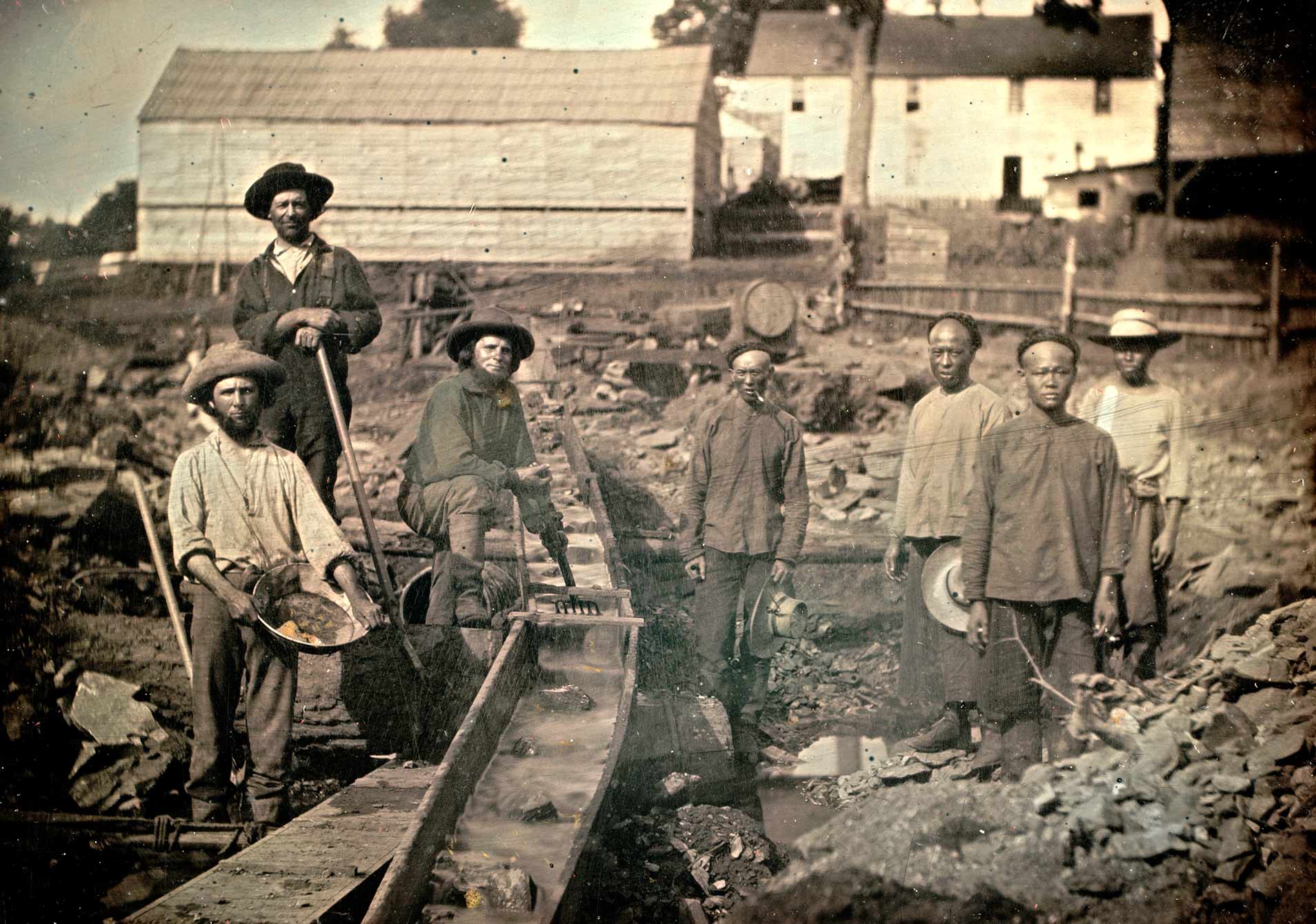
  • Who is standing in front of Sutter's Mill?

Directions:

1. To find the answer, scan each text in this activity.
2. Read the text and answer the close reading questions that accompany it.
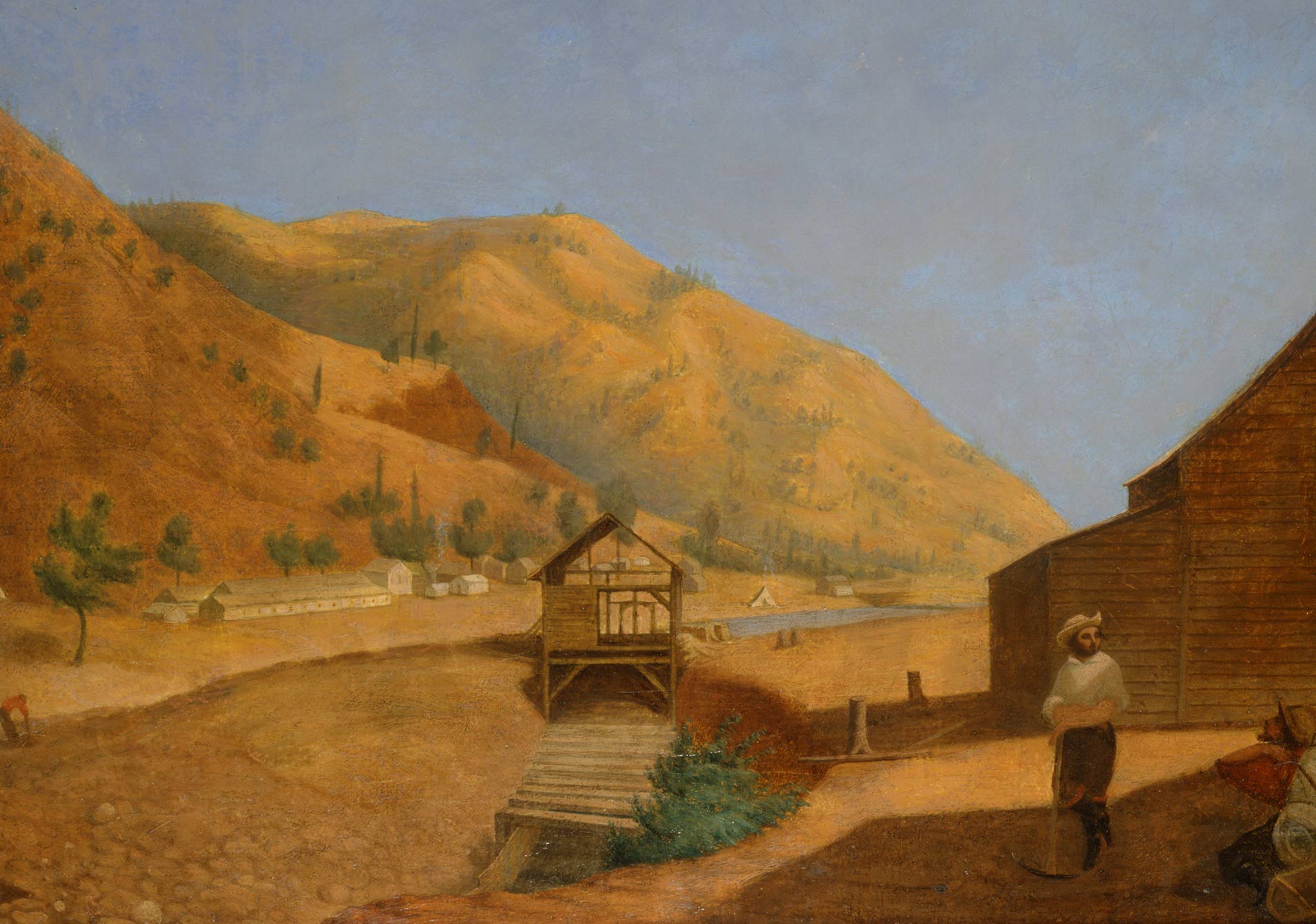
Head of Auburn Ravine, Unknown Artist (1852) On May 16, 1848, gold was discovered in the river at Auburn Ravine (located in the Sierra Nevada foothills, near Sacramento, California). Auburn was the second mining settlement (after Sutter’s Mill at Coloma) of the California Gold Rush. Six million dollars worth of gold was extracted from Auburn and nearby Rich Ravine by the end of 1848.
Required
1

Describe the landscape of this mining settlement.

Required
1

Look at the expressions of the workers. What do you think it was like working at the mine?

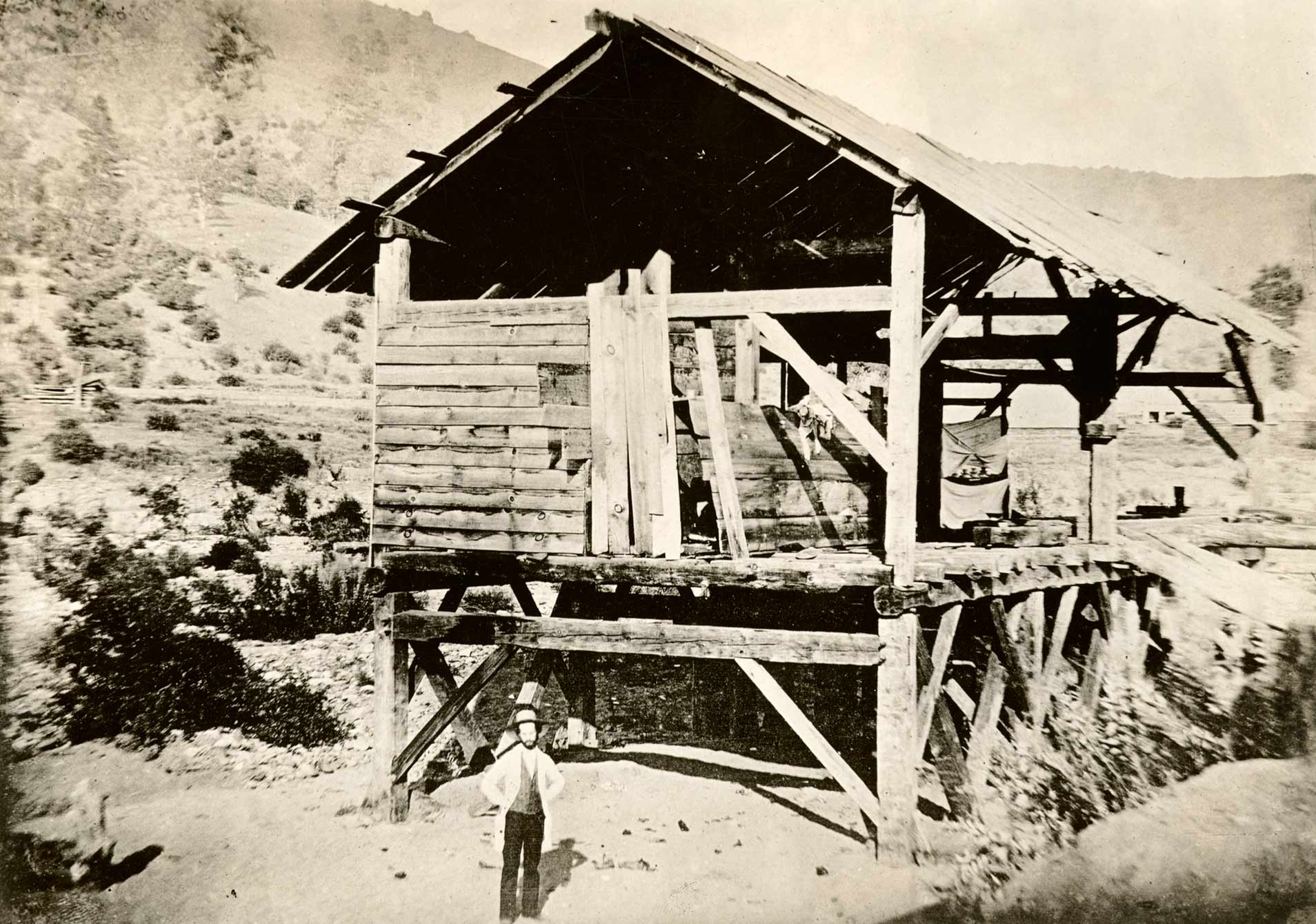
Gold Mining at Sutter's Mill, Coloma, California, Unknown Artist (19th century)
James Marshall at Sutter's Mill, Coloma, CA in 1848, Unknown Artist
Required
2

What things do you learn from the painting (left picture)? What things do you learn from the photograph (right picture)?

Required
1

You are a gold seeker on your way to Sutter’s Mill. Which image would you want to see before your trip and why?

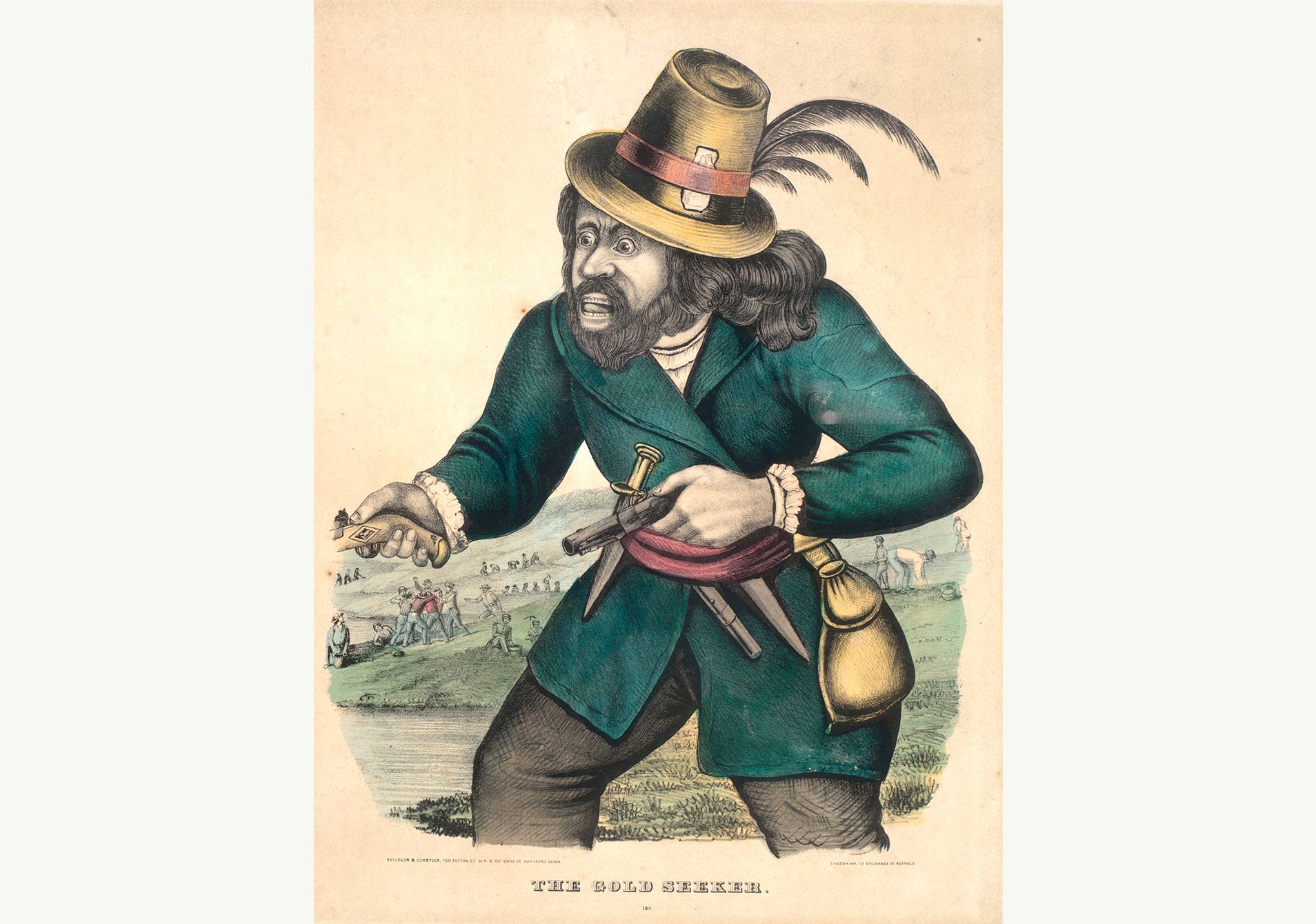
The Gold Seeker, Kelloggs & Comstock (Publisher) (Between 1849 and 1852)
Required
1

Describe two things in this picture that stand out to you and why.

Required
1

How many weapons does the gold seeker have? What does this say about what life was like during the gold rush?

Required
1

Who is standing in front of Sutter’s Mill?

Scavenger Hunt Part II
Welcome to the Gold Rush scavenger hunt. To find the answers to the scavenger hunt questions, you’ll have to explore the texts and images.
Scavenger Hunt Questions:
  • Where are Ramon Gil Navarro's men when they get sick?

Directions:

1. To find the answer, scan each text in this activity.
2. Read the text and answer the close reading questions that accompany it.
Excerpt: “California Culinary Experiences” from The Overland Monthly Author: Prentice Mulford Published: 1869 (public domain) 1 I am a survivor of all the different eras of California amateur cookery. The human avalanche precipitated on these shores in the rush of “49” and “50” was a mass of culinary ignorance. Cooking had always by us been deemed a part of woman’s kingdom. We knew that bread was made of flour, and for the most part so made by woman. It was as natural that it should be made by them as that the sun should shine. Of the knowledge, skill, patience and experience required to conduct this and other culinary operations, we realized nothing. So when the first—the pork, bean and flapjack—era commenced, thousands of us boiled our pork and beans together an equal period of time, and then wondered at the mysterious hardness of the nutritious vegetable. In the fall of “50” a useful scrap of wisdom was disseminated from Siskiyou to Fresno. It was that beans must be soaked over night and boiled at least two hours before the insertion of the pork. And many a man of mark to-day never experienced a more cheerful thrill of combined pride and pleasure, than when first he successfully accomplished the feat of turning a flap-jack. 2 We soon tired of wheat cakes. Then commenced the bread era; the heavy bread era, which tried the stomach of California. That organ sustained a daily attack of leaden flour and doubtful pork. The climate was censured for a mortality which then prevailed, due, in great measure, to this dreadful diet. With the large majority of our amateur cooks, bread-making proved but a series of disastrous failures. Good bread makers, male or female, are born, not made. In flour we floundered from the extreme of lightness to that of heaviness. We produced in our loaves every shade of sourness and every tint of orange, from excess of salæratus. Our crust, in varying degrees of hardness and thickness, well illustrated the stratifications of the earth. Our loaves “did” in spots. Much prospecting was often necessary to develop pay-bread. 3 In the early portion of “51,” just preceding the pie period, came an epoch of stewed dried apples. Even now, my stomachic soul shudders as I recall that trying time. After we had apple-sauced ourselves to satiety, with diabolical ingenuity we served it up to each other, hidden in thick, heavy ramparts of flour. It was a desperate struggle with duff and dumplings . . . I can now recall no living comrade of the dried apple era. 4 But those who first ventured on pies were men possessed in some degree of taste and refinement. No coarser nature ever troubled itself with pie-making. The preparation and seasoning of the mince meat, the rolling out and manipulation of the crusts, their proper adjustment to the plate, the ornamental scollops around the edge, (made with the thumb) and the regulation of the oven’s heat to secure that rich shade of brown, required patience and artistic skill.

5 The early pie-makers of our State were men who as soon as possible slept in sheets instead of blankets, who were skilled in washing linen, who went in clean attire on Sundays, and who subscribed for magazines and newspapers. On remote bars and gulches such men have kept households of incredible neatness, their cabins sheltered under the evergreen oak, with clear rivulets from the mountain gorges running past the door, with clothes-lines precisely hung with shirts and sheets, with gauze-covered meat safe hoisted high in the branches of the overshadowing trees, protecting those pies from intruding and omniverous ground squirrels and inquisitive yellow-jackets; while about their doorway the hard, clean-swept red earth resembled a well-worn brick pavement. There is morality in pies. 6 There was a canned provision era, fruitful in sardines and oysters. The canned oysters of those days were as destructive as cannister shot. They penetrated everywhere. In remote and seldom-visited valleys of the Sierras, I have grown solemn over the supposition that mine were the first footsteps which had ever indented the soil. And then I have turned but to behold the gaping, ripped and jagged mouth of one of those inevitable tin cylinders scattered like dew over the land, and labelled “Cove Oysters.” One of our prominent officials, giving evidence in a suit relative to the disputed possession of a mining claim in a remote district, when asked what, in the absence of a house or shaft, he would consider to be indications of the former presence of miners, answered: “Empty oyster cans and empty bottles.”

ADAPTED
7 I am a survivor of all the different eras of California amateur cookery. The human avalanche that fell on these shores in the gold rush of “49” and “50” was a mass of culinary ignorance. We knew that bread was made of flour, and that it was so made by women. It was as natural that it should be made by them as that the sun should shine. We realized nothing of the knowledge, skill, patience and experience required for this and other culinary operations. So when the first “pork, bean and flapjack” era began, thousands of us boiled our pork and beans together for the same length of time, and then wondered at the mysterious hardness of the nutritious vegetable. In the fall of “50” a useful scrap of wisdom spread from Siskiyou to Fresno: that the beans must be soaked overnight and boiled at least two hours before adding the pork. And a man never experienced a more cheerful thrill than when he first successfully accomplished the feat of turning a flapjack.

8 However, we soon tired of wheat cakes. Next came the heavy bread era, which strained the stomach of California. For most of our amateur cooks, bread-making proved a series of disastrous failures. Good bread makers, male or female, are born, not made. In flour we floundered from the extreme of lightness to that of heaviness. We produced in our loaves every shade of sourness and every tint of orange, from too much baking soda. Our crust, in varying degrees of hardness and thickness, resembled the layers of the earth. Much prospecting was often necessary to develop “pay bread.” 9 Early in “51,” just before the pie period, came an epoch of stewed dried apples. Even now, my stomach’s soul shudders as I recall that trying time. After we had apple-sauced ourselves to fullness, we served it up, hidden in thick, heavy walls of flour. It was a desperate struggle with duff [flour pudding] and dumplings. I can’t think of anyone who survived the dried apple era.

10 Those who first tried pie making were men with some degree of taste and refinement. Patience and artistic skill were required for the preparation and seasoning of the mincemeat, the rolling out of the crusts, their proper placement on the plate, the ornamental indents (made with the thumb) around the edge, and the regulation of the oven’s heat to produce that rich shade of brown. The early pie makers of our state were men who as soon as possible slept in sheets instead of blankets, who were skilled at washing linen, who wore clean attire on Sundays, and who subscribed to magazines and newspapers. On remote sandbars and gulches such men kept households of incredible neatness, their cabins sheltered under the evergreen oak, their clotheslines precisely hung with shirts and sheets, their meat pies hung safely in the tree branches, protected from intruding ground squirrels and yellow jackets. Around their doorways, the hard, clean-swept red earth resembled a well-worn brick pavement. There is morality in pies. 11 There was a canned provision era, fruitful in sardines and oysters. The canned oysters of those days were as destructive as cannon shot. They penetrated everywhere. In remote and seldom-visited valleys of the Sierras, I have grown solemn over the idea that my footsteps were the first to have ever indented the soil. And then I have turned to behold the gaping, ripped and jagged mouth of one of those tin cylinders scattered like dew over the land, and labeled “Cove Oysters.” One of our prominent officials was once asked what, in the absence of a house or shaft, he would consider an indication of the former presence of miners. He answered: “Empty oyster cans and empty bottles.” PARAPHRASED
12 I survived all the different eras (periods) of California cookery. The men who swarmed these shores in the gold rush of “49” and “50” did not know how to cook. We knew that bread was made of flour, and that women usually made it. This seemed as natural as sunshine. However, we did not have the knowledge, skill, patience and experience to make bread or anything else. 13 When the first “pork, bean and flapjack” era began, we boiled our pork and beans together for the same length of time. When the beans turned out hard, we wondered why. Then, in the fall of “50,” we learned that beans must be soaked overnight and boiled at least two hours before adding the pork. And what a cheerful thrill a man got when he first successfully turned a flapjack. 14 However, we soon grew tired of wheat cakes. Next came the heavy bread era, which strained our stomachs. For most of us, bread making was a series of disastrous (terrible) failures. Good bread makers, male or female, are born, not made. The bread was either much too light or much too heavy. Our loaves were sour and orange in color, from too much baking soda. Our crust had layers of hardness and thickness, like the layers of the earth.

15 Early in “51” came the era of stewed dried apples. Even now, my stomach shudders as I recall that difficult time. After filling ourselves up with applesauce, we served it to each other, hidden in thick, heavy walls of flour. We struggled with puddings and dumplings. I cannot think of anyone who survived the dried apple era.
16 The first pie makers were men of taste and manners. It took patience and artistic skill to prepare the mincemeat, to roll out the crusts, to place them on the plate, and, using the thumb, to make the fancy dents around the edge. Then the oven’s heat had to be controlled to produce that rich, brown crust. The early pie makers of our state slept in sheets instead of blankets, and were skilled at washing them. They wore clean clothes on Sundays. They sent away for magazines and newspapers. Though they lived on far-away sandbars and gulches, they kept their homes incredibly neat. Evergreen oak trees sheltered their cabins. They hung their meat pies in the branches, safe from hungry ground squirrels and yellow jackets. The hard, clean-swept red earth outside their doors looked like worn brick pavement. Good pies make good men.

17 Next came the canned goods era, full of sardines and oysters. The canned oysters of those days were as harmful as cannon balls. They were found everywhere. I have visited far-away valleys of the Sierras where I grew sad knowing my footsteps were the first to break the soil. I have seen the open, jagged mouths of those cans scattered over the land.
Text Overview: In 1848, gold was discovered near Sacramento, California. A massive migration of people—mostly men—arrived from all over the world with the hope of striking it rich. The new miners had to learn to cook for themselves, often with limited ingredients and crude equipment. This writer experienced the ups and downs of “California amateur cookery” (1) and lived to tell the tale!
Required
1

How do the men feel when they flip their first flapjack, and why?

Required
1

To what does the author compare the crust of the bread made by miners?

Required
1

Describe the pie making process and the characteristics men needed to be good at this job.

Required
1

Select the sentence in paragraph 1 that describes how the men in California felt when they cooked their first flap-jack.

I am a survivor of all the different eras of California amateur cookery. The human avalanche precipitated on these shores in the rush of “49” and “50” was a mass of culinary ignorance. Cooking had always by us been deemed a part of woman’s kingdom. We knew that bread was made of flour, and for the most part so made by woman. It was as natural that it should be made by them as that the sun should shine. Of the knowledge, skill, patience and experience required to conduct this and other culinary operations, we realized nothing. So when the first—the pork, bean and flapjack—era commenced, thousands of us boiled our pork and beans together an equal period of time, and then wondered at the mysterious hardness of the nutritious vegetable. In the fall of “50” a useful scrap of wisdom was disseminated from Siskiyou to Fresno. It was that beans must be soaked over night and boiled at least two hours before the insertion of the pork. And many a man of mark to-day never experienced a more cheerful thrill of combined pride and pleasure, than when first he successfully accomplished the feat of turning a flap-jack.
1
The author compares the crust of the bread made by miners to __________
Required
4

Put the list of eras described in the text in chronological order.

  1. Pork, bean and flapjack
  2. Bread making
  3. Stewed dried apples
  4. Pies
Required
1
Part 1: In paragraph 2, the author suggests that breadmaking is __________
Required
1

Part 2: Write down a quote from the text that supports your answer above.

Required
2

In paragraph 4, the author claims that the people who first cooked pies "were men possessed in some degree of taste and refinement." Write two details about pie-making that the author provides to support this claim.

Excerpts: Preface and Chapter XI from Sights in the Gold Region, and Scenes by the Way Author: Theodore T. Johnson Publisher: Baker and Scribner, New York, NY Published: 1849 (public domain) Preface 1 SEIZED with the gold fever and resolved to judge of the wealth of El Dorado by actual observation, I embarked in one of the first steamers which sailed from New York, after the public announcement of the wonderful and extensive gold discoveries. Thus having obtained much information as well as considerable experience, I have written the following narrative during the leisure of a brief sojourn in the country, since my recent return from California. Chapter XI 2 Our high fever of excitement, amidst such a state of affairs, would be difficult to define. Wandering everywhere, eyes and ears were constantly employed. The bar-rooms and hotels were crowded with revellers—money, wines, and liquor flowed like water. Gold dust, doubloons, and dollars were the only currency men would look at, old miners often scattering smaller coins in the streets by handfulls, rather than to count or carry them. A French café was thronged with hungry customers, at three dollars for a cup of coffee, bit of ham, and two eggs. Gambling prevailed to an extent heretofore unheard of and unknown. The monté and roulette tables, encircled continually day and night by a dense mass, were covered with bags of gold dust and heaps of doubloons and Mexican dollars, which were incessantly changing hands in enormous amounts. Pistols and revolvers, fired in recklessness or fun sometimes, made the air musical with loud reports or whistling messengers, while, at other hours, intoxicated men, mounted on fleet horses, were rushing to and fro through the streets, or tramping over the portico of the City Hotel. 3 Leaving these wild scenes, we strolled among the tents in the outskirts of the town. Here was “confusion worse confounded” chiefly among Mexicans, Peruvians and Chilians. Every kind, size, color and shape of tent, pitched helter skelter and in the most awkward manner, were stowed full of everything under the sun. Outside, innumerable articles were exposed for sale or stored in the open air, while the smoke of the cook’s fire and greasy pork, overpowered both olfactory and visual organs. . . .
Text Overview: Theodore T. Johnson explored and chronicled his experiences during the gold rush era in California and Oregon. Sights in the Gold Region, and Scenes by the Way is the first published book that let readers know what life was really like during this unique time.
Required
1

Why does Theodore T. Johnson want to travel to California?

Required
1

Theodore T. Johnson describes “gold fever” in this passage. What are some of these “feverish” scenes he encounters?

Required
1

What are some of the activities Johnson describes people doing that would be illegal today? Do you think there was more illegal activity in California than in other states during the same time period? Why or why not?

Excerpts from July 22–August 10, 1849, The Gold Rush Diary of Ramón Gil Navarro Author: Ramón Gil Navarro (edited and translated by María del Carmen Ferreyra and David S. Reher) Publisher: University of Nebraska Press, Lincoln, NE Published: 2000 SUNDAY, 22 JULY. At the placer on the Calaveras River 1 Well, I am now here. Three of the men are sick. So far they have only taken out 1,200 pesos’ worth of gold. It would be worse if we had found nothing at all. The time will come when we will not find anything, just like all of the rest of Eve’s children who are around here. It is all a matter of pure luck, like with all mines. Before you know it, the lode has dried up and there is not a bit of gold left. I am going to do some panning myself, because I need some ounces of gold that I alone have mined. They will be a souvenir . . . and can be made into a wedding ring . . . or some other crazy thing like that.31 2 This afternoon I tried my hand for the first time, and the place where 1washed the first shovelfuls of soil rendered up almost one-fourth of an ounce. Today is Sunday, and I should not have worked, but God knows that this gold will be destined for something other than just making me rich. It is to be spent on too sacred an object for God not to forgive my having forgotten one of his commandments. Well, now I have more than enough for that wedding ring. But I still need more. MONDAY, 23 JULY. Sickness 3 Today four of my men are ill, and one of them has fever. We probably lose three or four ounces of gold for every day one of the men does not work. The gold for my rings is growing; today I got a bit more than yesterday. There is no power on earth that will make me work at this once I have secured the small amount I need for my museum of souvenirs and curiosities. There is no job that is more difficult than panning for gold. You have to work bent over in water up to your knees, and after a quarter of an hour your body feels all beaten up. Today the eleven laborers working here have taken out a total of 220 pesos. WEDNESDAY, 25 JULY. Mokelumne Hill 4 They have discovered a very rich claim about five leagues from here. It seems as though it was Mexicans who discovered it, but about 200 Americans made up an armed force and, as is custom among them, shamefully threw out all the Chileans, Peruvians, Mexicans, and anybody else who speaks Spanish. They especially have it in for the Chileans, though I do not know exactly why. Every day there are people coming by who have been thrown out of their claims. There is no other tyranny or arbitrariness as great as that carried out by this nation of free and republican people. There were groups of men who were told to leave within fifteen minutes or else their lives would be at risk. They have gotten rid of anyone who was in their way. 5 Despite all this, today I sent two miners there with supplies for an entire week. They will work under the orders of Mr. Alfredo, who is English but who passes for American. We shall see what happens. If they are allowed to work I shall send another two, and then another three, and so on, until the doctor comes back, and then he will be the American who goes there with my men. FRlDAY, 27 JULY. I lost my wife! 6 Today a fatality happened to me that is one of the worst I could ever have imagined here. I lost my only consolation, my distraction, my love. I lost my guitar. This is a tragedy for me, an event that will mark my entire diary, a loss that I will lament as the greatest loss of all if I lose, as I think I shall, all hope of remedying it. First, the back of the guitar came unglued because of all of the heat, and I mistakenly gave it to the first person who offered to fix it. He put it in water to straighten it, and by today it was totally destroyed, broken into 9,999 pieces. I am like a widower or, better, like a lover who has just lost the illusions of his loved one. My God! At first I could only think of where I might find another guitar and how I could get it here if it came from San Francisco. Well, I have just written to Samuel and feel a little bit better now. FRIDAY, 10 AUGUST. The reptiles of California 7 Last night the two men I had sent to the gulch discovered by the laborers of Don Maximo Peiro returned. All of it was false. They have been looking for gold ever since they left and have not found anything richer than this. The fact is that right now discoveries of gold are few and far between, just like the water in the rivers. I cannot wait for the doctor to come so that I can take off with half the men to try my hand at Lady Luck, who so far has been remiss with all the others. 8 There are probably few countries in the world with more snakes and other poisonous animals than California. A few days ago we killed an immense rattlesnake right next to the tent, and the day before yesterday we killed another one we found in the kitchen, which was nearly a yard and a half long. Yesterday on my way back from the wash, as I came into the sunlight near some large rocks about six paces from the tent, my arm brushed up against the head of an immense snake that, at my jump of surprise, retreated into a crevasse in the rock. I threw hot water on it, and it came out furiously showing a long tongue covered with froth. We killed it right away, but it was not easy. It was nearly two yards long. This is another of these epidemics they have around here, where the Yankees, the Indians, yellow fever, or something else is always threatening your life. Fortunately, up till now I have come through all of these plagues pretty much unscathed. I escaped the Yankees in Stockton, and it will be pretty hard for them to take me by surprise the next time around.

(According to family tradition, Navarro actually made his wedding ring from the gold he brought from California.)
Text Overview: Ramón Gil Navarro, originally from Argentina, wrote about his experiences during the California gold rush in his diary entries of 1849. The entirety of Navarro’s diary spans 1845-1856. He began the diary when he was 18, and was 22 in 1849.
Required
1

What does the author want to do with the gold he finds?

Required
1

Describe how the miners interact when they reach the claim at Mokelumne Hill.

Required
2

Describe some of the hardships the author experiences. Which one of these experiences most deeply affects him, and why?

Required
1

Where are Ramon Gil Navarro's men when they get sick?

Scavenger Hunt Part III
Welcome to the Gold Rush scavenger hunt. To find the answers to the scavenger hunt questions, you’ll have to explore the texts and images.
Scavenger Hunt Questions:
  • What happened to the land that the California Indians lived on during the 1850s?

Directions:

1. To find the answer, scan each text in this activity.
2. Read the text and answer the close reading questions that accompany it.
This popular song was written in 1884 and was based on the 1863 song “Down by the River Lived a Maiden” by H. S. Thompson. In this Montrose version, Clementine was “light” and “like a fairy.” In Thompson’s original, “Her lips were like two luscious beefsteaks / Dipp’d in tomato sass and brine.” In 1946, John Ford directed the Western My Darling Clementine, using the song as part of his score. During the 1950s, it was the trademark of cartoon dog Huckleberry Hound to howl the song out of tune.

Song Excerpt: “Oh My Darling, Clementine” Author: Percy Montrose Published: 1884 (public domain) 1 In a cavern, in a canyon 2 Excavating for a mine 3 Lived a miner forty-niner 4 And his daughter, Clementine.
5 Light she was and like a fairy 6 And her shoes were number nine 7 Herring boxes without topses 8 Sandals were for Clementine. 9 Drove the ducklings to the water 10 Every morning just at nine 11 Hit her foot against a splinter 12 Fell into the foaming brine. 13 In my dreams she still doth haunt me 14 Robed in garments soaked in brine 15 Though in life I used to hug her 16 Now she’s dead, I’ll draw the line. 17 Oh, my darling, oh, my darling 18 Oh, my darling Clementine 19 You are lost and gone forever 20 Dreadful sorry, Clementine.
Required
1

What do we know about Clementine?

Required
1

How does she die?

Required
1

What does Clementine’s death imply about the life of a miner?

Excerpt: Chapter 3—“The Magic Equation” from California: The Great Exception Author: Carey McWilliams Publisher: University of California Press Published: 1976 1 IF ASKED to name the most important respect in which California differs from the other forty-seven states, I would say that the difference consists in the fact that California has not grown or evolved so much as it has been hurtled forward, rocket-fashion, by a series of chain-reaction explosions. The rhythm of the state’s development is unlike that of the other states, and the basic explanation is to be found in a set of peculiar and highly exceptional dynamics. The existence of these underlying dynamics accounts for the tempo of social change, the foreshortening of economic processes, the speed of development. Europeans have long marveled at the driving force, the “restless energy,” of America; but it is only in California that this energy is coeval with statehood. Elsewhere the tempo of development was slow at first, and gradually accelerated as energy accumulated. But in California the lights went on all at once, in a blaze, and they have never been dimmed. It was, of course, the discovery of gold that got California off to a flying start, and set in motion its chain-reaction, explosive, self-generating pattern of development. Not gold alone, but the magic equation “gold-equals-energy,” is the key to the California puzzle. . . . Poor Man’s Gold Rush 2 The California gold rush was unique, first of all, in that the discovery of gold in California coincided with a revolution in the means of transportation and communication which made possible a mass migration from all points on the compass. . . . 3 Furthermore, the California gold rush was the first, and to date the last, poor man’s gold rush in history. The gold-fields were located in California on the public domain. Every miner in California was a trespasser on the public domain and nearly every ounce of gold produced in the state belonged to the federal government. But, in the confusion of the period, the American military commander “prudently decided that he would permit all to work freely” in the diggings. In sixteen years of “free mining” in California, over $100,000,000 was taken from the public domain without a dollar’s revenue passing to the federal treasury. There were no squatters, no prior claimants to the gold lands in California; and, since there were no regulations, it was quite impossible for anyone to acquire title to a mining claim other than by holding it and working it. This made for an extraordinarily rapid development, and a truly amazing democracy in production. . . . 4 . . . Not only were wages high, but a vast number of miners made individual fortunes (and, of course, promptly lost them). Four hundred men, working on the American River in 1849, produced an average daily yield from $30,000 to $50,000 in gold. Governor Mason reported that he knew of two men who had produced $17,000 in gold in seven days and of a woman who had “washed” $2,125 in 46 days. Within a few years, as Dr. Caughey has pointed out, the “Californians came to have more money per capita in hand and in circulation than any other people anywhere.” 5 Since there was no “law of mines” in 1848, the California miners adopted their own rules and regulations in which they were careful to safeguard the equality of opportunity which had prevailed at the outset. California was preeminently the home of what has been called “the small mines claim” system. The rules adopted in the California camps carefully emphasized the policy of “one miner, one claim”: barred slavery from the mines; and based rights, not on ownership, which could not be established, but on prior discovery and use. These same rules also narrowly limited the size of mining claims. . . .

The “Something for Nothing” Business 6 . . . One can make a most impressive case in support of the point that gold production did more harm than good to the economy of California. The senseless explorations and wasteful methods used did irreparable damage to forests, farm lands, and river systems. Much of the labor that went into the production of gold was completely wasted. In the long run, most of the miners got a very small return for their labors. Indian villages in California were engulfed and destroyed by the spread of the mining frontier. Furthermore the gold produced was not valuable, in the sense that iron is valuable; for gold is only useful, writes Dr. Caughey, “for beauty and dentistry.” But gold production is the incomparable stimulant to trade and business and industry, for it involves manifold activities. It is the very best economic pump-primer. For example, one flume and aqueduct constructed in northern California during the gold rush was 70 miles long, cost a million dollars to build, and its construction kept a large crew busy for a year. The production of gold created more problems for California than it solved; but it was nevertheless “the touchstone” that set California in motion towards greatness and power. From 1848 to 1860, eastern coal miners were lucky to receive a wage of $1 a day; but the average daily wage in the California mines was $3, and, for most of the period, $5 a day. This, again, is another measure of the value of gold as a pump-primer. 7 But by far the greatest value of gold to California was its value as a symbol. Overnight California became a world-famous name and, as a name, California meant gold. It was the discovery of gold that catapulted California into the national limelight; that increased its population 2,500 per cent in four years; that gave it statehood within two years after the discovery. A state that gets off to this sort of flying start possesses advantages that do not disappear with time and changed conditions. The tide of migration which the discovery of gold set in motion is still running strong. The world-wide publicity which the discovery gave the state is still a potent factor in its development. The plain fact is that it is quite impossible to appraise the importance of the discovery of gold in California, for the ramifications are endless. Examine any phase of California life—agriculture, labor, government, industry, social organization—and the examination inevitably involves some consideration of the importance of the discovery of gold. Nothing is more exceptional about this exceptional state than the unique combination of factors and conditions produced by the discovery of gold. Nothing quite like it has ever occurred, or is ever likely to occur again, in world history.
Text Overview: California was launched by the gold rush of 1849–1850. A tremendous flood of people rushed out West seeking gold, giving the state a “flying start” (1), in the words of this author.

This text is challenging and is a particularly important opportunity to work with students to examine an author's argument. Consider stopping here and reading the text aloud and having students answer the questions even though this text isn't the one that answers the Scavenger Hunt question. Be sure to discuss the answers together.
Required
1

Name and explain two pieces of the author's evidence for why the California gold rush was known as the "poor man's gold rush."

Required
1

Choose one piece of evidence that the author provides about the California gold rush that he doesn't explain clearly enough. Quote the part of his explanation that doesn't make sense to you or is less convincing than other parts and explain why.

Required
1

Is the author's evidence stronger when he discusses the harm that gold did to California or when he discusses the value of gold to California? Explain your answer.

Excerpt: Chapter 8—“Good Haul of Diggers” from Digger: The Tragic Fate of the California Indians from the Missions to the Gold Rush Author: Jerry Stanley Publisher: Random House, New York, NY Published: 1997 1 DURING THE 1850s, the California Indians didn’t know they were participating in the color and excitement of the gold rush decade. They were too busy fighting for their lives. America—whatever “America” was—had laid claim to their land. The forty-niners arrived, swamped the valleys and streams, and the “gold rush” was on—whatever that was. Americans believed in “Manifest Destiny,” the idea that it was God’s plan to expand America from the East to the West Coast, but the California Indians hadn’t heard it. They hadn’t signed any treaty giving up their land. They hadn’t issued invitations to have their home destroyed. And as far as they knew, they hadn’t done anything to deserve being driven from their homes.

2 The forty-niners had a different view. The forty-niners had read about the savages out west, and they brought to California a certain image of what the Indian was like: naked, dirty, wild, and bloodthirsty. He was forever wandering about, with no real home and no claim to the land. He didn’t farm, he didn’t have a written language, and with no knowledge of morality he was a thief, a liar, and a cheat. A godless heathen forever bent on war, he raped white women and scalped white men. Uncivilized and subhuman, he was seen as a natural obstacle to be overcome, like a dangerous river or a steep mountain pass. As President Andrew Jackson said in 1830: “What good man would prefer a country covered with forests and ranged by a few thousand savages to our extensive Republic . . . with all the blessings of liberty, civilization, and religion?” 3 As fast as a rifle’s bullet, the image the “Digger” Indian was created so he could be killed or driven away. The San Francisco Chronicle, one of the state’s leading newspapers, said the California Indians “grazed in the fields like beasts and ate roots, snakes, and grasses like cattle, like pigs, like dogs . . . and like hungry wolves.” One forty-niner said they slept “like animals in a pigsty.” Another likened them to reptiles, saying they were “coiled up like a parcel of snakes.” When he encountered some Maidu in 1850, a miner from Connecticut exclaimed, “What heathens they are!” Referring to Modoc in 1853, a Humboldt County newspaper declared, “We can never rest in security until the red skins are treated like the other wild beasts of the forest.” As early as April 1849, the newspaper Alta California predicted that in order for whites to mine gold “it will be absolutely necessary to exterminate the savages.” 4 The war against the California Indians started when the first forty-niners rushed in. Early in 1849 white miners from Oregon entered a Maidu village, raped several women, and shot the men who tried to resist. When the Maidu killed five of the Oregon men in retaliation, the Oregon miners struck back by attacking the village, killing a dozen Indians and executing seven more afterward. During the summer of 1849 other miners from parts unknown attacked a Southern Maidu village, killing thirty natives and wounding ten more, who were then knifed to death. In August five miners disappeared from a camp in the land of the Wintun; although there was no proof that Indians were involved, the miners formed a posse and attacked a Wintun tribelet. They killed twenty and captured eighty; when the captives tried to escape, all eighty were shot to death. 5 In 1849 the Pomo killed two white ranchers for raping Pomo women and mistreating Indian workers. To stop future attacks by the Pomo, in May 1850 the U.S. Army was dispatched to the home of the Pomo at Clear Lake. The Pomo met the army in peace, but the soldiers attacked, killing 135 men, women, and children. Captain N. Lyon, who led the troops, ordered his men to encircle the Pomo village and move in firing their rifles. He described the result as “a perfect slaughter pen.” The Pomo fell, one observer said, “as grass before the sweep of the scythe.” This was the gold rush as it was known to California Indians, and it was just getting started. 6 In 1850 it hit them like a tidal wave. Whites overran their land by the thousands, and during the 1850s and 1860s the Indians were swept away like unwanted debris. Red Bluff, Marysville, and other towns offered bounties for Indian scalps, arms, and hands, or other proof of a dead Indian; there was no discussion of whether a severed limb had belonged to a peaceful or hostile Indian. Whites formed unofficial militia units to kill Indians and submitted claims for expenses to the state. In 1851 and 1852 the state paid $1 million in such claims, and in 1857 issued $400,000 in bonds to pay the expenses of volunteers engaged in “the suppression of Indian hostilities."
Text Overview: This text provides an overview of what happened to the California Indians during the gold rush years of 1849 and 1850.
Required
1

How did the forty-niners view the California Indians?

Required
2

How did the public learn of the forty-niners attitude toward the California Indians? How would the public learn this news today?

Required
1

Explain this statement: “This was the gold rush as it was known to California Indians, and it was just getting started.” (5)

Required
1

What happened to the land that the California Indians lived on during the 1850s?

Required
1

The authors of The Gold Rush Diary of Ramón Gil Navarro and Digger: The Tragic Fate of the California Indians from the Missions to the Gold Rush both write about snakes. Which of the following best describes how each author presents the significance of snakes?