Copy of Copy of Yellow Death 4 (6/23/2025)
star
star
star
star
star
Last updated 6 months ago
21 questions
Theories of Yellow Fever Transmission
Excerpt from Chapter 2 in The Secret of the Yellow Death by Suzanne Jurmain
4 But where was he going to start? Before leaving Washington, Reed had read the latest medical books and done some preliminary experiments. He’d looked at scientific articles on yellow fever, and he’d also talked to people who’d spent time studying the illness. By now he knew that there were several current theories on the cause of the disease, and he could tick off on his fingers the first three items that had to be investigated.
5 First was an idea suggested by Dr Giuseppe Sanarelli. A few years earlier this Italian researcher had announced that a type of bacteria called Bacillus icteroides was the cause of yellow fever. That sounded good. But Reed’s recent experiments had shown that Bacillus icteroides actually caused a pig disease called hog cholera. Now scientists were arguing about which research results were right, and Walter Reed knew that his team would have to find a way of settling the issue. That was a big project, and it was only the beginning.
6 Next on the list was an old theory—one that had been around for years. It claimed that healthy people got the disease by touching clothing, bedding, or furniture that had been used by yellow fever patients. That idea was so popular that it had appeared in medical books. Many health authorities believed it. So did many doctors. Of course, no scientist had ever proved the theory to be true. But it was definitely a matter for Reed and his assistants to consider.
7 And then, finally, there was another idea. A very different one. For almost twenty years, in more than one hundred experiments, a Cuban doctor named Carlos Finlay had tried to prove that mosquito bites caused yellow fever. Time and time again, the Cuban scientist had attempted to show that bugs could carry the disease by letting mosquitoes he thought might be infected with the germ bite groups of healthy patients. But none of Finlay’s patients ever developed a truly clear-cut case of yellow fever from the bites. The experiments were unsuccessful. Many scientists laughed at the Cuban doctor’s failures. The mosquito theory didn’t seem to fit the facts, and no one understood why Finlay still continued to believe it. Maybe, some people said, the Cuban doctor was “touched.” Others came right out and called him “crazy.” Even Reed’s boss, the surgeon general of the army, George Sternberg—a leading American bacteriologist—thought that the mosquito theory was a joke. Investigating it was useless,” he told Reed. And there was a good chance that the army surgeon general was right. Most sensible scientists did think the mosquito theory sounded pretty flaky. And Bacillus icteroides? Well, because of his own research, Reed privately thought that was probably pretty flaky, too.
8 But, of course, what Reed thought didn’t matter. Science wasn’t about opinions or theories. It was about facts. And Reed’s job was clear. With the help of his team, he had to find the facts. He had to test each one of the theories.
1
Review the three most promising theories for the cause of yellow fever in 1900. Match the theory to its explanation.
Bacillus icteroides ______________________
Contaminated material ______________________
Mosquito bites ______________________
Other Answer Choices:
Yellow fever spreads through items used by patients.
Yellow fever is carried by mosquitoes.
Yellow fever is caused by a particular bacteria, Bacillus icteroides.
8 But, of course, what Reed thought didn’t matter. Science wasn’t about opinions or theories. It was about facts. And Reed’s job was clear. With the help of his team, he had to find the facts. He had to test each one of the theories.
9 He had to find out—once and for all—if any of them was right. And if all three current theories were wrong, Reed would have to come up with a new idea—and test that. It was a big job. A tough one. But if Reed and his team could do it . . . if somehow they could find the cause of yellow fever, it might help scientists prevent the disease—or cure it.
1
Reread paragraphs 8 and 9.
Explain what the author means when she writes, "But, of course, what Reed thought didn’t matter."
Reread paragraphs 8 and 9.
Explain what the author means when she writes, "But, of course, what Reed thought didn’t matter."
1
What did matter to Dr. Reed?
Evidence Defined
Evidence: Material presented to support (or counter) a claim or theory
Types of Evidence
Fact/data
Something that can be proven to be true, or to have happened. Numbers that relate to a piece of information, obtained through research.
Expert opinion
A belief or judgment about something given by an expert on the subject.
Individual stories/examples
Personal experience or observation by you or others; anecdotes.
1
Imagine that you are investigating the following theory: Washing your hands prevents illness.
Which of these pieces of evidence provides the strongest support for this claim? Evaluate and arrange the evidence from strongest to weakest.
Strongest _________________________________________________________________________________________________________________________________________________________________________________________________________________________________________________________
_____________________________________________________________________________________________ _______________________________________________________________________________________________________________
Weakest _________________________________________________________________
Other Answer Choices:
A research study published in a famous medical journal showed that children whose families received soap and handwashing directions had a 50% lower incidence of certain illnesses than children whose families did not receive soap and directions.
Using a microscope, you observe that hands have less bacteria after washing than before.
A doctor friend says he thinks that his patients who wash their hands regularly need fewer medical visits.
Your mother always makes you wash your hands before you eat.
Evaluating the Evidence
5 First was an idea suggested by Dr Giuseppe Sanarelli. A few years earlier this Italian researcher had announced that a type of bacteria called Bacillus icteroides was the cause of yellow fever. That sounded good. But Reed’s recent experiments had shown that Bacillus icteroides actually caused a pig disease called hog cholera. Now scientists were arguing about which research results were right, and Walter Reed knew that his team would have to find a way of settling the issue. That was a big project, and it was only the beginning.
1
What are 1-2 details or information that supports the theory that Bacillus icteroides causes the spread of yellow fever.
1
What are 1-2 details or information that counters (does not support) the theory of Bacillus icteroides.
1
Evidence: The Bacillus icteroides theory was announced by an Italian researcher, Dr. Giuseppe Sanarelli.
Evidence strength: This piece of evidence related to the Bacillus icteroides theory is __________
1
Evidence: Bacillus icteroides causes hog cholera.
Evidence strength: This piece of evidence related to the Bacillus icteroides theory is __________
6 Next on the list was an old theory—one that had been around for years. It claimed that healthy people got the disease by touching clothing, bedding, or furniture that had been used by yellow fever patients. That idea was so popular that it had appeared in medical books. Many health authorities believed it. So did many doctors. Of course, no scientist had ever proved the theory to be true. But it was definitely a matter for Reed and his assistants to consider.
7 And then, finally, there was another idea. A very different one. For almost twenty years, in more than one hundred experiments, a Cuban doctor named Carlos Finlay had tried to prove that mosquito bites caused yellow fever. Time and time again, the Cuban scientist had attempted to show that bugs could carry the disease by letting mosquitoes he thought might be infected with the germ bite groups of healthy patients. But none of Finlay’s patients ever developed a truly clear-cut case of yellow fever from the bites. The experiments were unsuccessful. Many scientists laughed at the Cuban doctor’s failures. The mosquito theory didn’t seem to fit the facts, and no one understood why Finlay still continued to believe it. Maybe, some people said, the Cuban doctor was “touched.” Others came right out and called him “crazy.” Even Reed’s boss, the surgeon general of the army, George Sternberg—a leading American bacteriologist—thought that the mosquito theory was a joke. Investigating it was “useless,” he told Reed. And there was a good chance that the army surgeon general was right. Most sensible scientists did think the mosquito theory sounded pretty flaky. And Bacillus icteroides? Well, because of his own research, Reed privately thought that was probably pretty flaky, too.
1
What are 1-2 details or information that supports the theory of:
Yellow fever spreads through items used by patients.
What are 1-2 details or information that supports the theory of:
Yellow fever spreads through items used by patients.
1
What are 1-2 details or information that supports the theory of:
Yellow fever is carried by mosquitoes.
What are 1-2 details or information that supports the theory of:
Yellow fever is carried by mosquitoes.
Homework
Read each piece of evidence below and determine:
- Does this piece of evidence support the theory?
- What type of evidence is this? (Facts/data, Expert opinion, Individual story/example)
Required
1
PART A
Claim: Mosquito bites cause yellow fever.
Evidence: “For almost twenty years, in more than one hundred experiments, a Cuban doctor named Carlos Finlay had tried to prove that mosquito bites caused yellow fever…but none of Finlay’s patients ever developed a clear-cut case of yellow fever from the bites.” (2, 7)
This evidence __________ the claim.
Required
1
PART BWhat type of evidence is this?
PART B
What type of evidence is this?
Required
1
PART A
Claim: Bacillus icteroides causes yellow fever.
Evidence: “A few years earlier this Italian researcher had announced that a type of bacteria called Bacillus icteroides was the cause of yellow fever.” (2, 5)
This evidence __________ the claim.
Required
1
PART BWhat type of evidence is this?
PART B
What type of evidence is this?
Required
1
PART A
Claim: Healthy people get yellow fever by touching clothing, bedding, or furniture that has been used by yellow fever patients.
Evidence: One mother claimed that her son became sick after playing with a stuffed animal that had belonged to a child with yellow fever.
This evidence __________ the claim.
Required
1
PART BWhat type of evidence is this?
PART B
What type of evidence is this?
Excerpt from Chapter 3 in The Secret of the Yellow Death by Suzanne Jurmain
1 June 25, 1900
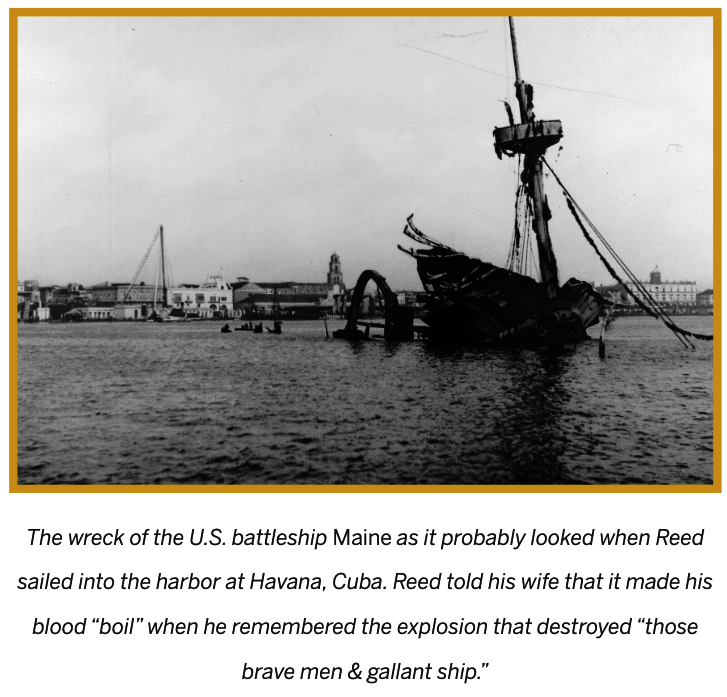
2 The sun was warm. The sea was blue. The orange juice, black coffee, and dry toast had stayed down. And Walter Reed was standing at the rail watching as his ship steamed past wharves, past the wreck of the battleship Maine, and into the harbor of Havana, Cuba.
3 When the ship docked at around eleven, Reed was ready to move. An epidemic of yellow fever had recently broken out in the Cuban town of Quemados. Some people in Havana were also sick with the disease. Even the chief U.S. medical officer for Western Cuba, Reed’s good friend Major Jefferson Kean, had come down with the illness several days earlier. There was no time to waste.
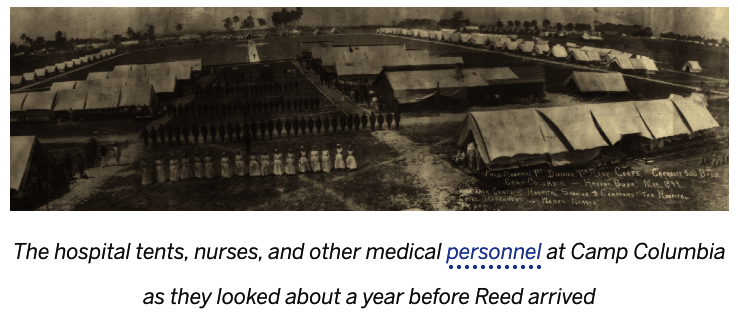
4 Reed quickly loaded his bags into a carriage and drove through the bustling city streets of Havana and across eight miles of country roads until he reached the U.S. Army post at Camp Columbia. After dropping his bags at the Officers’ Quarters, he was off again, dashing across the grounds to visit Major Kean in the camp’s yellow fever hospital just outside the base.
5 There the news was good. Kean’s case was fairly mild. He was expected to live. At the bedside Reed probably chatted like any other visitor, but he must have also assessed the patient with a scientific eye. Was Kean’s skin yellow? Was his temperature high? Were his gums bleeding? What had he been doing in the days before he got sick? Had he been near mosquitoes? Infected clothing? Reed had read descriptions of yellow fever, but this was the first live case he’d ever seen. He was hungry for information. He wanted clues. But he couldn’t spend the rest of the day at Kean’s bedside. If Reed was going to get the research started, he had to organize his team.
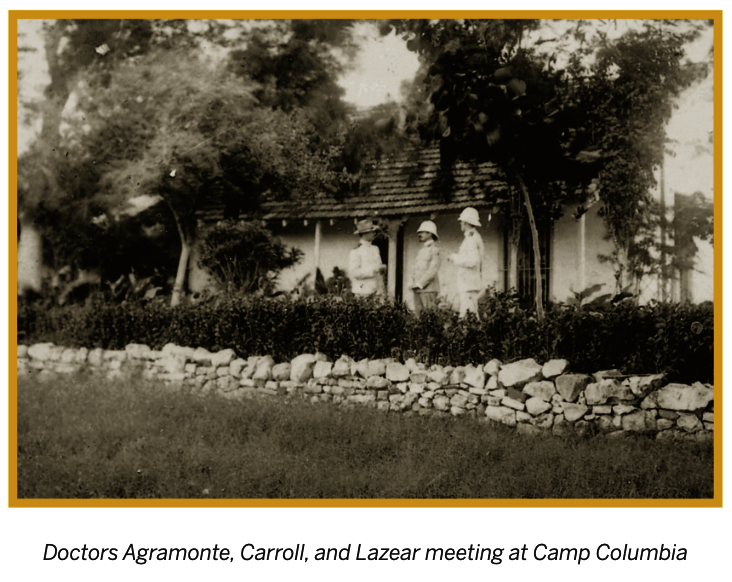
6 The first meeting had already been called, and late in the afternoon Reed walked onto the garden patio outside Camp Columbia’s Officers’ Quarters to greet the three men he’d be working with.
7 They were all there, formally dressed in their crisp white tropical army uniforms. On one side was the tall, thin, balding Dr. James Carroll, a blunt, outwardly charmless man who seemed to be more comfortable looking through a microscope than making conversation. Near Carroll was the chatty Cuban-born, U.S.-educated Dr. Aristides Agramonte, looking like a dandy with his pointed, curled mustache. And rounding out the group was the quiet, bearded, darkly handsome Dr. Jesse W. Lazear.
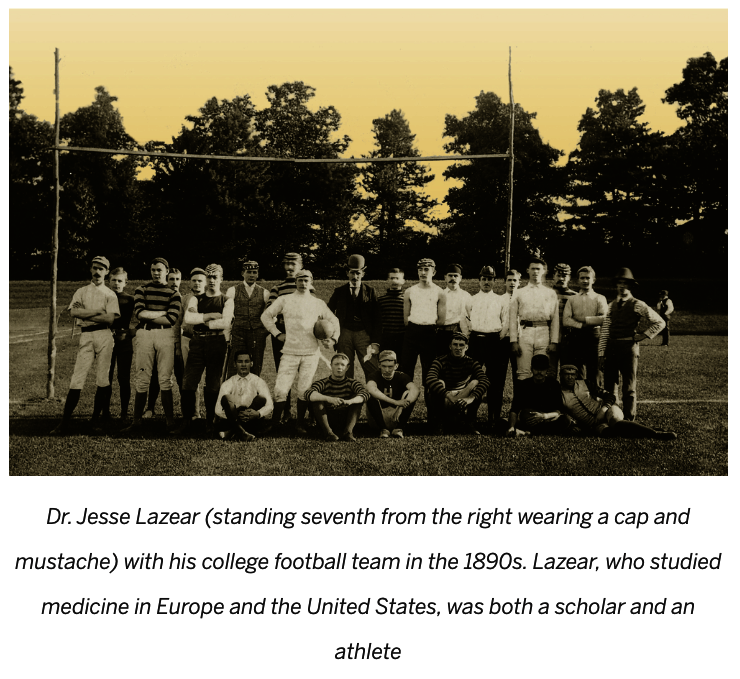
8 All of the men had graduated from medical school. All had studied bacteriology, and together they brought a wealth of talent to the project. Carroll had a real passion for lab work. Agramonte, an honors graduate of Columbia University Medical School, had already spent time investigating yellow fever. And Lazear, a former college football player who’d studied medicine in both the United States and Europe, had headed one of the clinical labs at America’s prestigious Johns Hopkins University. All three men had worked with Reed in the past, and they listened intently as the chief scientist outlined his program.
9 The first job, Reed told his colleagues, was to prove that Bacillus icteroides was—or was not—the cause of yellow fever.
10 That would take a lot of lab work, and each scientist would have his own specific job.
11 Agramonte would do autopsies. He’d surgically open the bodies of dead yellow fever victims and take out samples of blood, stomach, heart, kidney, and other organ tissues.
12 Carroll, the best bacteriologist, would take those samples to the lab. He would place tiny amounts of the tissue Agramonte harvested in tubes or dishes filled with a food substance like gelatin or bouillon. Then he would watch to see if any of the tissue samples grew Bacillus icteroides or any other bacteria that might prove to be the cause of yellow fever.
13 Lazear would help examine the bacteria and tissues under a microscope.
14 Reed would coordinate the work and help out wherever he could. That covered the important points. But there was one thing more. As he looked around at his assistants, Reed said that he hoped the group would stick closely to his plan. Finding the cause of yellow fever was a tremendous challenge, and he wanted the men to combine their efforts and attack the problem as a team.
15 Everyone agreed. Work was scheduled to start the following morning. And, as they left the meeting, the four men must have known they were about to start a very dangerous project. People who had had yellow fever were immune. They couldn’t possibly get the disease again. But none of the men on Reed’s team had ever had a full-blown attack of yellow fever. Reed had certainly never had the disease. Neither had Lazear or Carroll. Though there was a chance that the Cuban-born Agramonte might have had a very mild case as a small child, he was not definitely immune. And all four doctors knew that by being on the fever-stricken island of Cuba, by coming close to sick patients, and by studying bacteria in the lab, they were running a serious risk of getting yellow fever.
1
What words or phrases show that Dr. Reed had “no time to waste”?Choose two phrases that show that Dr. Reed has no time to waste.
What words or phrases show that Dr. Reed had “no time to waste”?
Choose two phrases that show that Dr. Reed has no time to waste.
Reed quickly loaded his bags into a carriage and drove through the bustling city streets of Havana and across eight miles of country roads until he reached the U.S. Army post at Camp Columbia. After dropping his bags at the Officers’ Quarters, he was off again, dashing across the grounds to visit Major Kean in the camp’s yellow fever hospital just outside the base.
Required
1
In paragraph 5, the term “assessed” means __________
Required
1
According to Dr. Reed, the first job of the team was to test whether __________ caused yellow fever.
Required
1
What does the author outline in paragraphs 11–14?
Required
1
Based on the author’s descriptions of jobs and roles, which team member do you think has the most important job? Why? Use two details from the text to support your response.