Ɛhia
1
Ɛhia
1
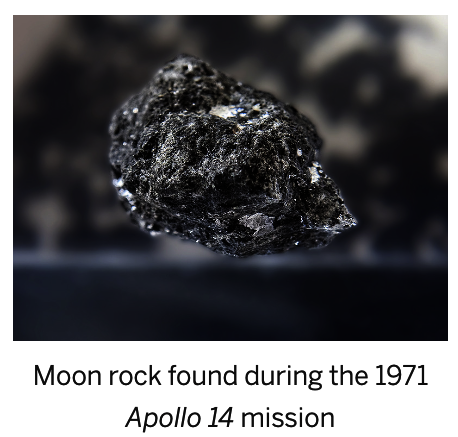
Ɛhia
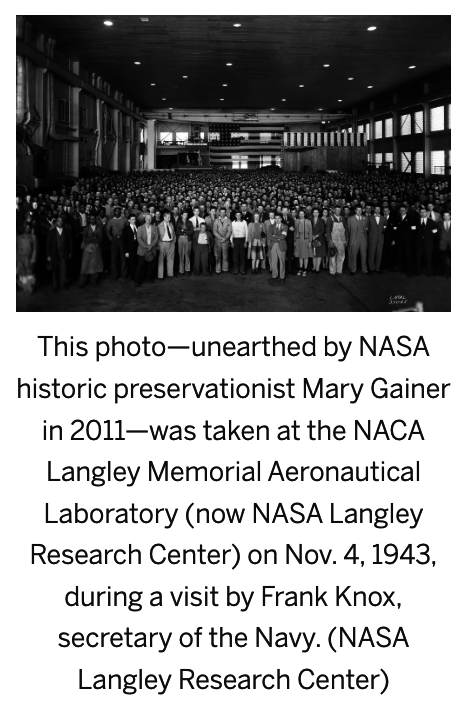
1
Ɛhia
1
Ɛhia
2
Ɛhia
1
Ɛhia
1
Ɛhia
4
Create a list of a few new facts you discovered about the Space Race in the last lesson.
Welcome to the Space Race scavenger hunt! You will find the answer to the scavenger hunt question by exploring texts in The Space Race Collection.
Scavenger Hunt: Who calculated the flight path for America's first mission in space?
Directions:
1. To find the answer, scan each text in this activity. 2. Then answer the close reading questions that accompany it.
Who brought Katherine Johnson's work to the attention of a broad audience, and how did she do it?
What was the scientists’ first reaction to the moon rocks?
Why do you think the moon rocks were “the most sought after, the most eagerly awaited, of all specimens in the history of science” (3)?
The samples contained no traces of life or dangerous substances. How do you imagine the space program might have changed if the analysis had yielded different results?
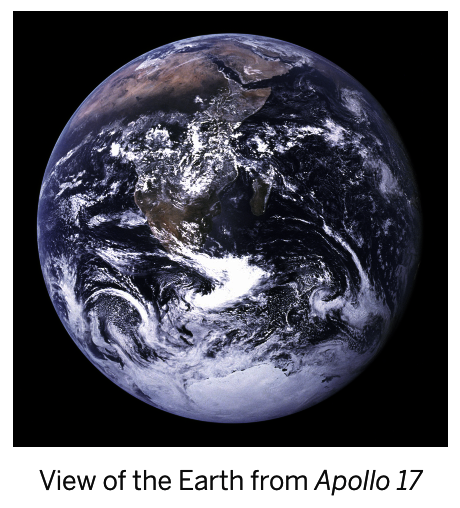
On December 7, 1972, the crew of the Apollo 17 mission took a picture of the Earth from 28,000 miles away. Showing the planet fully illuminated and in full color for the first time, the image became known as “Blue Marble.” In the midst of Cold War struggles over the Space Race and nuclear armament, the photograph was a revelation: a powerful reminder that all the Earth was one small planet, and that its inhabitants were united in their fate. Excerpt: “You Are Here” from Pale Blue Dot Author: Carl Sagan Publisher: Random House 1 Published: 1994
2 Mariners had painstakingly mapped the coastlines of the continents. Geographers had translated these findings into charts and globes. Photographs of tiny patches of the Earth had been obtained first by balloons and aircraft, then by rockets in brief ballistic flight, and at last by orbiting spacecraft—giving a perspective like the one you achieve by positioning your eyeball about an inch above a large globe. While almost everyone is taught that the Earth is a sphere with all of us somehow glued to it by gravity, the reality of our circumstance did not really begin to sink in until the famous frame-filling Apollo photograph of the whole Earth—the one taken by the Apollo 17 astronauts on the last journey of humans to the Moon. 3 It has become a kind of icon of our age. There’s Antarctica at what Americans and Europeans so readily regard as the bottom, and then all of Africa stretching up above it: You can see Ethiopia, Tanzania, and Kenya, where the earliest humans lived. At top right are Saudi Arabia and what Europeans call the Near East. Just barely peeking out at the top is the Mediterranean Sea, around which so much of our global civilization emerged. You can make out the blue of the ocean, the yellow-red of the Sahara and the Arabian desert, the brown-green of forest and grassland. 4 And yet there is no sign of humans in this picture, not our reworking of the Earth’s surface, not our machines, not ourselves: We are too small and our statecraft is too feeble to be seen by a spacecraft between the Earth and the Moon. From this vantage point, our obsession with nationalism is nowhere in evidence. The Apollo pictures of the whole Earth conveyed to multitudes something well known to astronomers: On the scale of worlds—to say nothing of stars or galaxies—humans are inconsequential, a thin film of life on an obscure and solitary lump of rock and metal. 5 It seemed to me that another picture of the Earth, this one taken from a hundred thousand times farther away, might help in the continuing process of revealing to ourselves our true circumstance and condition. It had been well understood by the scientists and philosophers of classical antiquity that the Earth was a mere point in a vast encompassing Cosmos, but no one had ever seen it as such. Here was our first chance (and perhaps also our last for decades to come).
Sagan points out that you cannot see any signs of human life, man-made machines, or state borders from space. Why do you think Sagan tells the reader this? What point is he trying to make?
Sagan writes, “On the scale of worlds—to say nothing of stars or galaxies—humans are inconsequential, a thin film of life on an obscure and solitary lump of rock or metal” (4). Explain what he means.
A reality TV show will send volunteers to colonize Mars. Excerpt: “Life on Mars to Become a Reality in 2023, Dutch Firm Claims” from The Guardian Author: Karen McVeigh 1 Published: April 22, 2013 2 A few months before he died, Carl Sagan recorded a message of hope to would-be Mars explorers, telling them: “Whatever the reason you’re on Mars is, I’m glad you’re there. And I wish I was with you.” 3 On Monday, 17 years after the pioneering astronomer set out his hopeful vision of the future in 1996, a company from the Netherlands is proposing to turn Sagan’s dreams of reaching Mars into reality. The company, Mars One, plans to send four astronauts on a trip to the Red Planet to set up a human colony in 2023. But there are a couple of serious snags. 4 Firstly, when on Mars their bodies will have to adapt to surface gravity that is 38% of that on Earth. It is thought that this would cause such a total physiological change in their bone density, muscle strength and circulation that voyagers would no longer be able to survive in Earth’s conditions. Secondly, and directly related to the first, they will have to say goodbye to all their family and friends, as the deal doesn’t include a return ticket. 5 The Mars One website states that a return “cannot be anticipated nor expected”. To return, they would need a fully assembled and fuelled rocket capable of escaping the gravitational field of Mars, on-board life support systems capable of up to a seven-month voyage and the capacity either to dock with a space station orbiting Earth or perform a safe re-entry and landing. 6 “Not one of these is a small endeavour” the site notes, requiring “substantial technical capacity, weight and cost”. . . . 7 The prime attributes Mars One is looking for in astronaut-settlers is resilience, adaptability, curiosity, ability to trust and resourcefulness, according to Kraft. They must also be over 18. 8 Professor Gerard ’t Hooft, winner of the Nobel prize for theoretical physics in 1999 and lecturer of theoretical physics at the University of Utrecht, Holland, is an ambassador for the project. ’T Hooft admits there are unknown health risks. The radiation is “of quite a different nature” than anything that has been tested on Earth, he told the BBC. 9 Founded in 2010 by Bas Lansdorp, an engineer, Mars One says it has developed a realistic road map and financing plan for the project based on existing technologies and that the mission is perfectly feasible. The website states that the basic elements required for life are already present on the planet. For instance, water can be extracted from ice in the soil and Mars has sources of nitrogen, the primary element in the air we breathe. The colony will be powered by specially adapted solar panels, it says. 10 In March, Mars One said it had signed a contract with the American firm Paragon Space Development Corporation to take the first steps in developing the life support system and spacesuits fit for the mission. 11 The project will cost a reported $6bn (£4bn), a sum Lansdorp has said he hopes will be met partly by selling broadcasting rights. “The revenue garnered by the London Olympics was almost enough to finance a mission to Mars,” Lansdorp said, in an interview with ABC News in March. 12 Another ambassador to the project is Paul Römer, the co-creator of Big Brother, one of the first reality TV shows and one of the most successful. . . . 13 The aim is to establish a permanent human colony, according to the company’s website. The first team would land on the surface of Mars in 2023 to begin constructing the colony, with a team of four astronauts every two years after that. 14 The project is not without its sceptics, however, and concerns have been raised about how astronauts might get to the surface and establish a colony with all the life support and other requirements needed. There were also concerns over the health implications for the applicants. 15 Dr Veronica Bray, from the University of Arizona’s lunar and planetary laboratory, told BBC News that Earth was protected from solar winds by a strong magnetic field, without which it would be difficult to survive. The Martian surface is very hostile to life. There is no liquid water, the atmospheric pressure is “practically a vacuum”, radiation levels are higher and temperatures vary wildly. High radiation levels can lead to increased cancer risk, a lowered immune system and possibly infertility, she said. 16 To minimise radiation, the project team will cover the domes they plan to build with several metres of soil, which the colonists will have to dig up. 17 The mission hopes to inspire generations to “believe that all things are possible, that anything can be achieved” much like the Apollo moon landings. 18 “Mars One believes it is not only possible, but imperative that we establish a permanent settlement on Mars in order to accelerate our understanding of the formation of the solar system, the origins of life, and of equal importance, our place in the universe” it says. 19 The longest anyone has ever spent in space is 438 days, achieved by Valeri Polyakov, of Russia, in a manned space flight in 1994. 20 But the Mars One website states: “While a cosmonaut on board the Mir was able to walk upon return to Earth after 13 months in a weightless environment, after a prolonged stay on Mars the human body will not be able to adjust to the higher gravity of Earth upon return. 21 “There is a point in time after which the human body will have adjusted to the 38% gravitation field of Mars, and be incapable of returning to the Earth’s much stronger gravity. This is due to the total physiological change in the human body, which includes reduction in bone density, muscle strength, and circulatory system capacity.”
Who calculated the flight path for America's first mission in space?
Welcome to the Space Race scavenger hunt! You will find the answer to the scavenger hunt question by exploring texts in The Space Race Collection.
Scavenger Hunt: Which astronaut is seen on the moon with a lunar rover and lunar module?
Directions:
1. To find the answer, examine each image in this activity.
2. Then answer the close reading questions that accompany it.
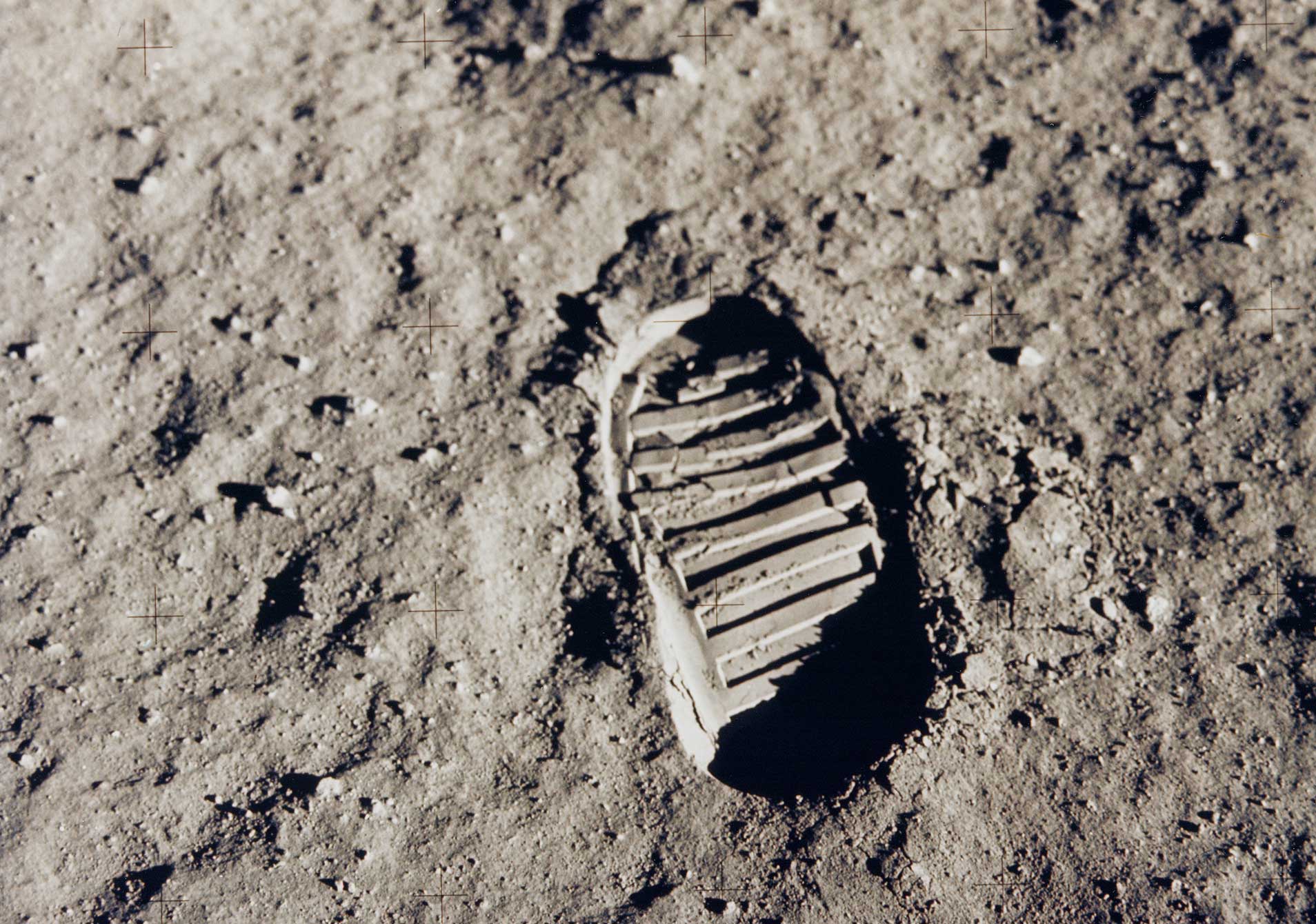
Travelers to wilderness areas or national parks are often encouraged to “leave only footprints.” This is Aldrin’s “wilderness." What is the ground like in this picture? What other features of the moon’s surface, besides the boot print, stand out?
Imagine the surface of the moon covered with boot prints like this one. How would that change the importance of this one footprint?
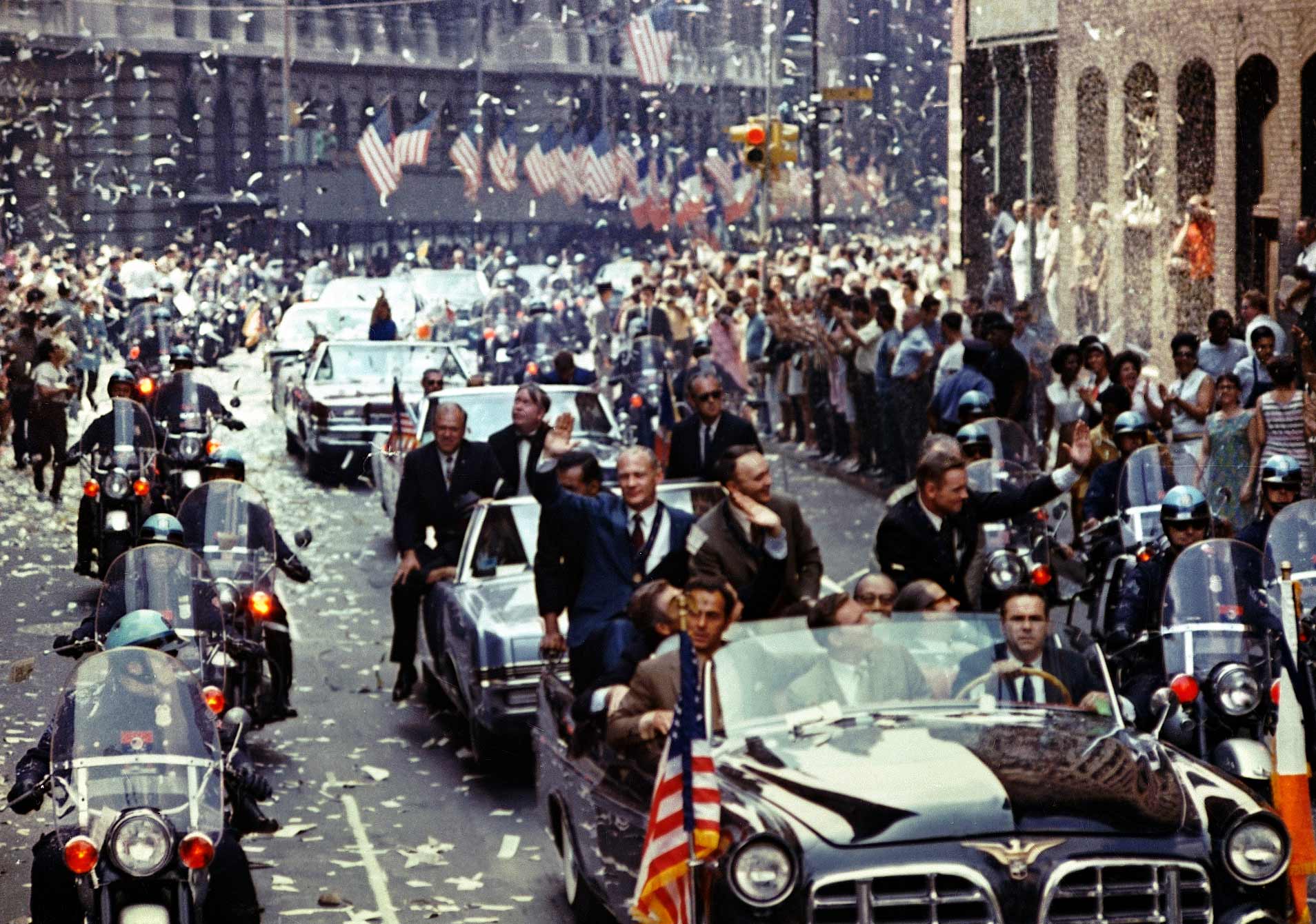
What clues in the picture reveal the date it was taken?
This photo was taken in 1969. How would a parade honoring American heroes be different and similar today?
Briefly describe a momentous world event that took place in your lifetime. Was it celebrated with a parade? If not, how was it celebrated?
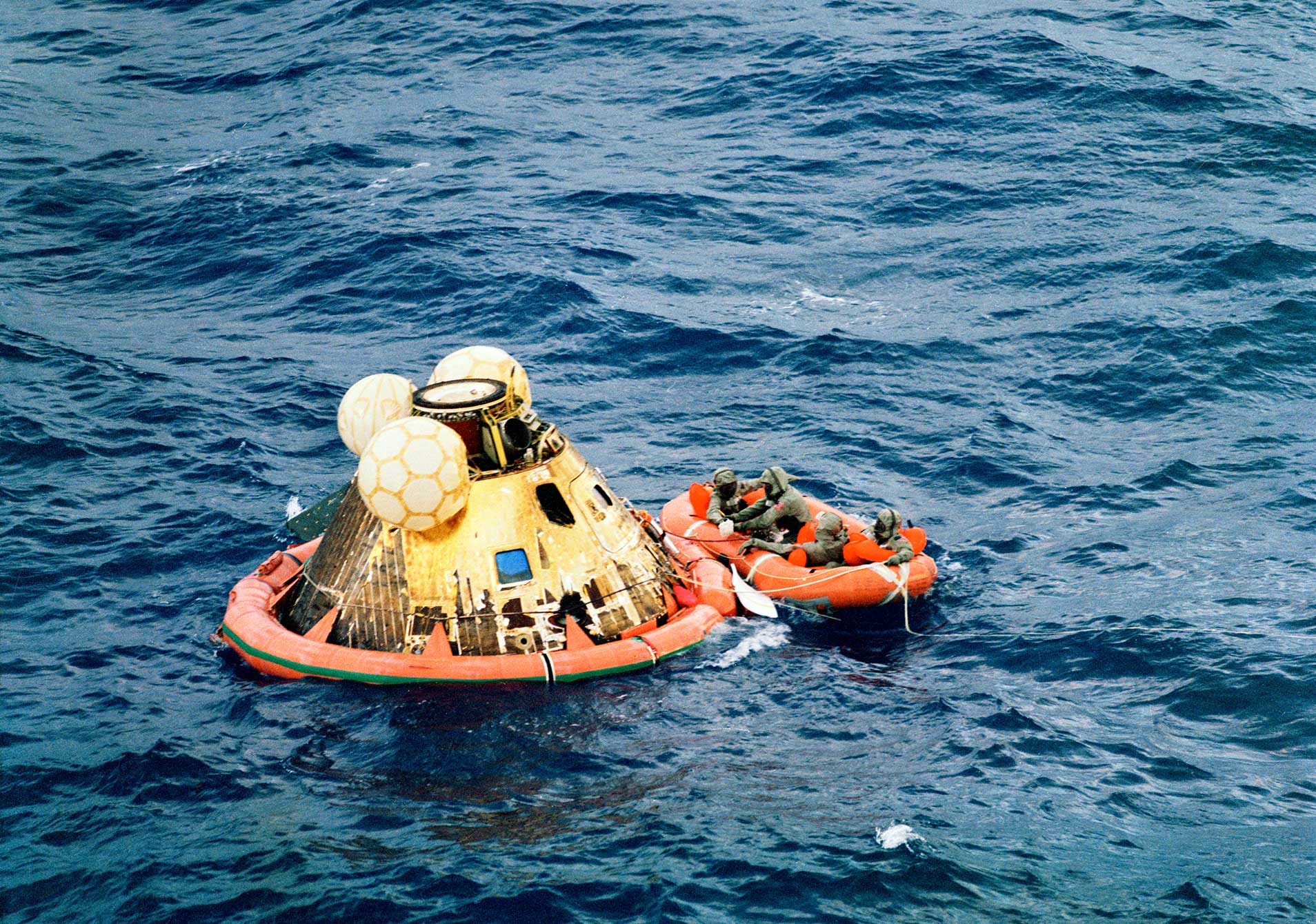
Look carefully at the photo, and describe the size of the Columbia command module.
Describe the suits worn by the Navy divers in the picture. Why do you think these suits were necessary?
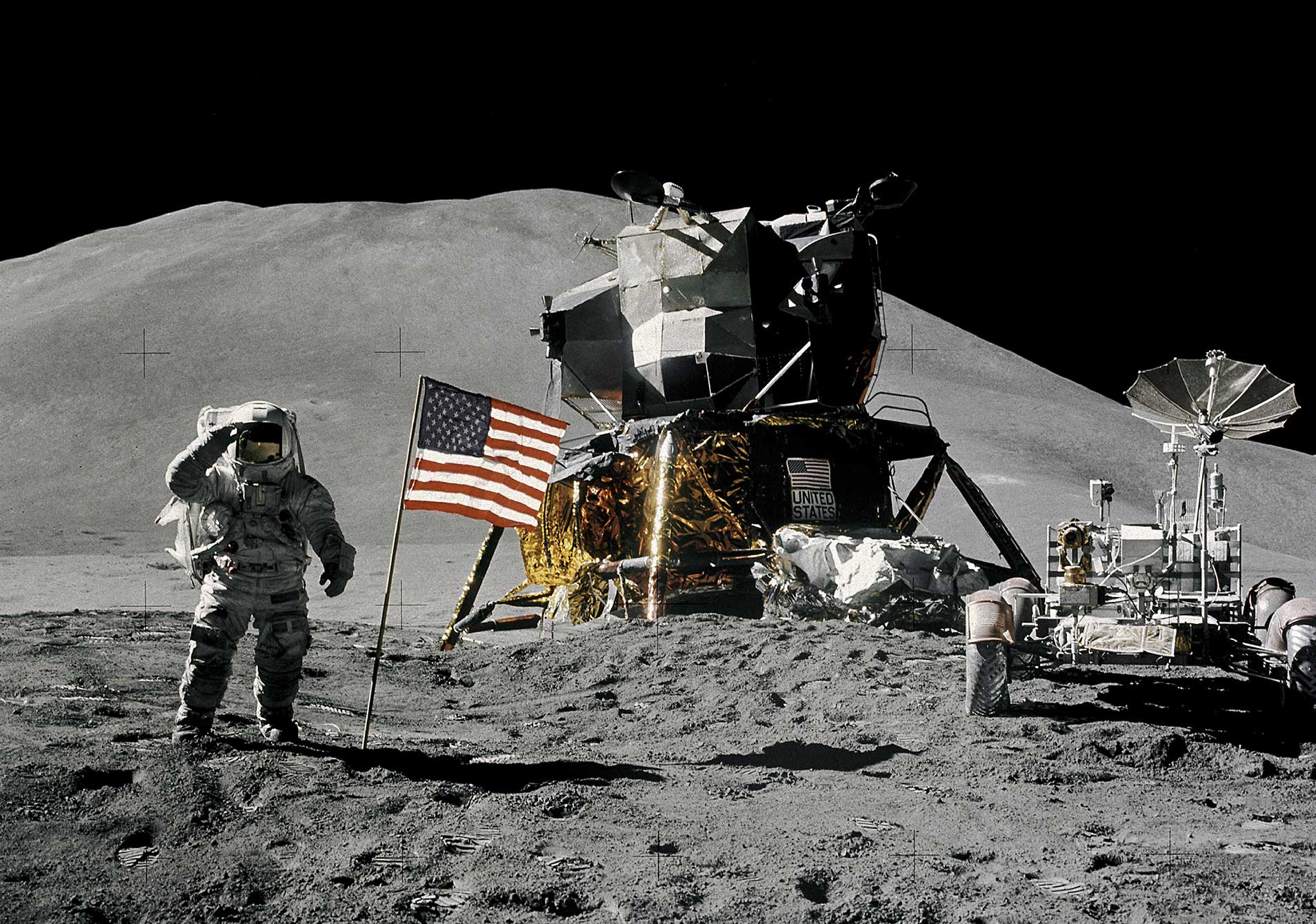
What do you think the astronaut, James Irwin, is doing in this photograph? Why?
Look closely at the flag. Does it appear to be moving? Why or why not?
Describe the moon’s surface in this picture. Compare the surface in front of Irwin to the surface in back of him.
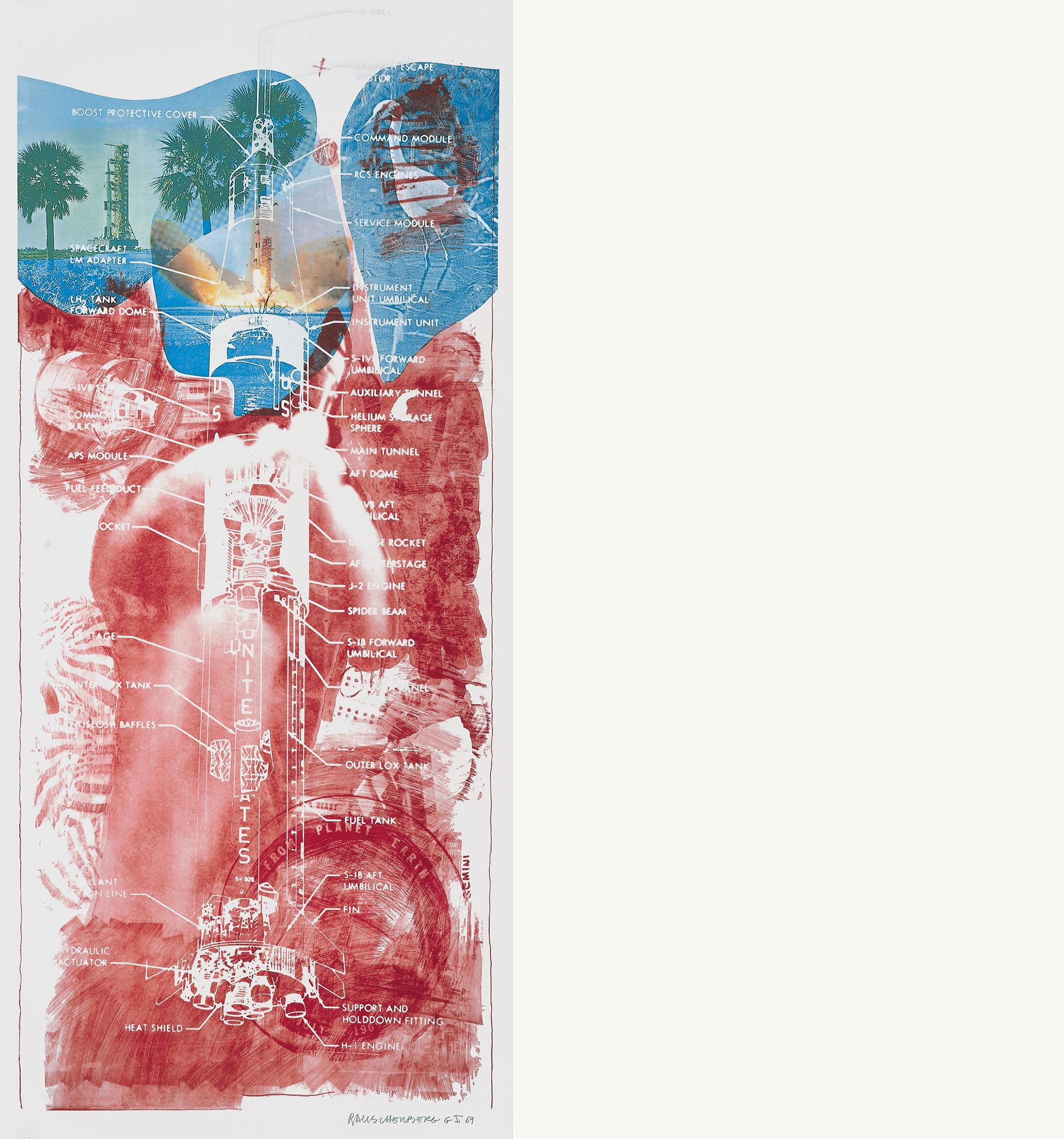
Rauschenberg thought that artists and engineers should share ideas. List five items in this print that are connected to engineering and science.
Rauschenberg’s title Sky Garden (Stoned Moon) gives us clues to what is going on in this work of art. What items in the print are from a “garden”? What items are from the “sky”?
This artwork includes lots of information. What does your eye focus on, and why?
Which astronaut is seen on the moon with a lunar rover and lunar module?
Excerpt: “Dreaming of a Moonage” from Moondust
1 When you’ve shared a moment with the whole world, it can be hard to know precisely where your memories end and everyone else’s begin. . . . 2 They’re going to the moon. My dad took me into the garden to look at it last night. I saw him frown as it reflected watery gold on his upturned face, as if someone had stepped over his grave or shone a bright light in his eyes. It was one thing to land a man on the Moon, quite another to bring him back afterward. But to have stood there in the first place . . . the thought alone made you tingle. . . . 3 . . . It’s 1:15 PM. My parents’ friends the Reuhls and the sweet and elderly Fishes from across the road are leaning forward on couches and chairs, forward over the gold and orange shag carpet, clutching beers or cups of coffee tightly with varying mixtures of anxiety and disbelief on their faces. A familiar singsong southern drawl is floating from the TV, decorated with static and peculiar little squeaks and pings which sound like someone flicking the lip of a giant wineglass with their finger. We know this as the voice of Mission Control. His name is Charles Duke, but the astronauts just call him “Houston.” There are other voices, too, but they all sound distant and intermingled and it’s hard to get hold of what they’re saying. An air of expectancy hangs in the room.
Find a quote from “Dreaming of a Moonage” that supports your answer.
Excerpt: Preface from Flight: My Life in Mission Control
14 The problems on the launch pad weren’t so bad. I’d held the countdown when an electrical unit overheated and Ham started to get warm. He was strapped into a form-fitted couch and sealed in a small pressurized capsule where an astronaut would normally sit. If it had been Al up there, I could have asked the Capcom to inquire about his comfort. Knowing Al, he would have said something like “No sweat,” making a joke of the heating problem. And he would have changed settings on his environmental control unit to cool down a bit. 15 Ham and I didn’t have that option. Outer space was new territory for exploration, and nobody knew much about it. A lot of doctors were predicting that zero gravity would have dire consequences for the human body. Most of us, including test pilots and astronauts, didn’t believe them. But the only way to make our point was to substitute monkeys or chimpanzees for men, then see what happened. Al would gladly have traded places with Ham on that January day. He had supreme confidence in what rigors the human body—especially his own—could handle. The decision wasn’t his to make, so a trained chimp was out there on the pad. 16 Instead of passing an order to an astronaut, I told EECOM, on the environment, electrical, and communications console, to turn off Ham’s unit. While we waited for it to cool down, I asked Surgeon to evaluate Ham’s comfort level.
Copy and paste a quote from each passage that BEST supports your answer.
In 1975, after nearly 20 years of competition in space and, behind the scenes, years of careful diplomatic negotiation and scientific cooperation, the United States and the Soviet Union carried out their first joint mission: the Apollo-Soyuz Test Project. Excerpt: “Smooth as a Peeled Egg” from Two Sides of the Moon: Our Story of the Cold War Space Race Authors: David Scott and Alexei Leonov with Christine Toomey Publisher: St. Martin’s Press 1 Published: 2004 2 The cosmodrome at Baikonur was a very different place in 1975 from what it had been ten years before. A new hotel had been built there with a swimming pool and tennis courts. There was a theater in the town, too, many new shops and a fleet of air-conditioned buses available for crews in training. At the end of April that year, less than three months before the Apollo-Soyuz launch, we invited the American astronauts to visit Baikonur. 3 Before showing the Americans the launch facility we took them on a brief tour of the Soviet Uzbek cities of Tashkent, Bukhara and Samarkand. When we arrived at Baikonur a big party had been arranged to welcome the Americans. Some local people of this remote region of Kazakhstan arrived by camel, weighed down with regional dishes and specialities. Sitting cross-legged in a traditional Kazakh tent we drank toast after toast to the success of our joint mission. 4 This was the last opportunity our two crews would have to spend any time together before the start of the mission. The next time we would shake hands and propose a toast to each other’s good health would be while orbiting the Earth at 30,000 kph. 5 During the two months that followed I sometimes spoke to Tom Stafford on the phone. The evening before the launch he called me to ask how everything was. 6 “Everything is going as smoothly as a peeled egg,” I told him. “How about you?” 7 “As smoothly as three peeled eggs,” Tom replied in his broad Oklahoma twang. “See you in space.”
8 Some of our team had already been dispatched to Mission Control in Houston for the duration of the mission, while members of the American team had arrived at a new Mission Control center we had by then developed at Kaliningrad on the northern outskirts of Moscow. All had undertaken foreign language instruction, as we had. Everything was set . . . 9 . . . Our launch was scheduled for mid-afternoon on 15 July. Apollo would also launch mid-afternoon local time in Houston. Orbital dynamics and the rotation of the Earth determined this would bring us into parallel trajectories. 10 It was hot, with clear skies and light winds, when we blasted away from the launchpad at Baikonur that Tuesday afternoon. It was the first launch of any space mission broadcast live on television in the Soviet Union. Fortunately, it was flawless: no hiccups at all. The only hitch in the first hours was a technical problem with the system of television cameras aboard Soyuz. No signal from our module was being received back on Earth. 11 For a mission whose significance was to demonstrate to a watching world that cooperation in space was possible, this was a problem that had to be solved quickly. 12 We had no choice but to dismantle a major part of our orbital section in order to gain access to the wiring for the system of five cameras connected to the switchboard, and fix the problem by disconnecting the switchboard from the circuit. It was a long and painstaking task. It took us many hours, during which we had been scheduled to sleep. 13 During our joint training sessions with the American crew, my crewmate Valery Kubasov had earned a reputation as an expert “handy-man.” “If anything breaks down, Kubasov can weld it together,” they used to joke. And it was true. During the Soyuz 6 mission with Gyorgy Shonin in 1969, Valery, as flight engineer, had done the first ever welding in space. 14 Our gradual progress in solving the problem was followed in live transmissions broadcast on Soviet radio. On our return to Earth this prompted a hilarious mailbag of requests from fellow Soviet citizens wanting Kubasov and me to come and fix their television sets. 15 As we were finishing off this complicated task we picked up our first radio transmission from the Apollo spacecraft after it launched. It was Tom speaking in Russian. “Vyo normalno [Everything is OK].” 16 And then we heard Vance Brand’s voice. “Miy nakhoditsya na orbite [We are in orbit].” 17 They were on their way. Everything was going according to plan. It was an exhilarating feeling. 18 We were not due to rendezvous until our second day in space; at the moment our two vehicles were still on opposite sides of the Earth. During this time the American crew had their own technical hitch to deal with. Listening in to their transmissions with Houston we understood that, at the end of their first day in space, they were having some difficulty in opening the hatch leading from the orbital section of the Apollo spacecraft to its docking module. 19 After a few hours’ rest we followed events aboard Apollo carefully and realized that, like us, they had ironed out their initial difficulty. Vance Brand, “Vanya,” had managed to disassemble the docking probe, and Deke had been able to move into the docking module to check that everything was working as it should. 20 By the morning of 17 July it was time to move toward each other. Until that point Apollo had been circling the Earth in a higher orbit. We could hear the voices of its crew in our headsets, but could not see it. By lowering their apogee, and so increasing their speed, Apollo moved closer to us. 21 As our orbit took both vehicles high above the European continent, I suddenly caught sight of the American spacecraft’s beacon out of my viewing porthole. There it was, right in front of us. At first, from a distance of about 25 km, it looked like a bright star. Then, as it came closer, I could see the clear outline of the silver spacecraft. 22 “Apollo, Soyuz. How do you read me?” I transmitted when I heard Deke Slayton wishing us “Dobroye utro [Good morning].” 23 “Alexei,” said Deke, “I hear you excellently. How do you read me?” 24 “I read you loud and clear,” I replied. 25 The maneuvers that followed, bringing the vehicles closer and closer, though conducted at speeds of over 30,000 kph, seemed like choreography from a graceful celestial ballet. Eventually, as the two spacecraft drew to within a few meters of each other I could make out a face in one of Apollo’s windows. It was Tom. He was smiling. 26 Fifty-two hours after we had lifted away from the launchpad at Baikonur, our spacecraft were given the go-ahead by Houston and Moscow to move together for final contact. The new androgynous docking mechanism that had been specially designed to allow Apollo and Soyuz to join and lock together glided smoothly into place. 27 “We have capture,” Tom reported. 28 “Soyuz and Apollo are shaking hands now,” I replied. 29 It would be several hours before we could open the hatches of the docking mechanism and see each other face to face. The difference in pressure between the two craft had to be equalized first, in order to prepare the vehicle for the transfer of crews. We had been slowly lowering the pressure inside Soyuz for some time. Now the American crew had to increase the pressure inside their docking module by adding nitrogen to its almost pure oxygen atmosphere. 30 During this time we received a message of congratulations from the Politburo. It was the second time Leonid Brezhnev had addressed me while I was orbiting the Earth. This time I was more prepared to conduct a conversation with the general secretary from space. This time I was not walking in open space at the time but sitting more comfortably inside the spacecraft. 31 “The whole world is watching with rapt attention and admiration your joint activities,” said Brezhnev. Detente and positive changes in Soviet-American relations have made possible the first international spaceflight.” 32 Then he spoke of his hopes that such cooperation between our two countries would continue once we had returned to Earth. It was something I believed in and wished for very profoundly. 33 Once the pressure between our two craft was equalized, we were ready to open the hatches separating Soyuz from Apollo. First I opened the hatch of Soyuz and eased myself into the joint docking module, surrounded by a tangle of life-support cables. Then, watched by millions around the world, the Apollo hatch opened and, for the first time in history, a Soviet cosmonaut and an American astronaut came face to face in space. Tom gave me a big smile. 34 “Very, very happy to see you,” I told him as I stretched out my hand and started pulling him across the dividing line between our two craft to give him a big bear hug. 35 “Tovarich! [Friend!]” Tom replied, grabbing me by the arms. 36 At that moment I felt that everything I had been through in my career as a cosmonaut—all the disappointments and very difficult years—had been worth it. This was the highlight of the mission. Few experiences before or after have been able to touch the elation I felt then.
What does Leonov say the purpose of the mission is?
What difficulty does Alexei Leonov encounter on this mission? How does it affect the mission’s purpose?
What did Leonov consider to be the historical and personal significance of this mission’s success? Explain your answer with textual evidence.
Which best describes Leonov’s reaction to accomplishing this mission?
Drag two things Leonov sees from the window of the Soyuz.
The Apollo's crew making repairs
The outline of the Apollo
As soon as the two spacecrafts made contact, the astronauts inside were able to greet each other in person.
At first, Leonov could not see the American spacecraft because it was too
Place the events from the passage in the order in which they occur:
The hatch of the Apollo does not open easily and needs to be fixed.
Politburo congratulates the cosmonauts.
The Apollo and the Soyuz move toward each other, separated by 25 km.
The television cameras on board the Souyz 6 are not working.
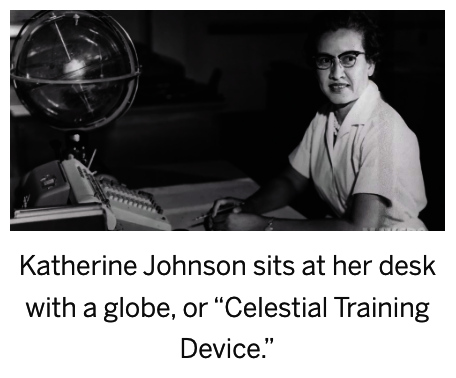
Katherine Johnson: Trailblazer and Brilliant Mathematician
Excerpt: Remarks by the President at Medal of Freedom Ceremony The White House November 24, 2015 1 President Barack Obama:
Well, welcome to the White House, everybody.…Today, we celebrate some extraordinary people—innovators, artists, and leaders—who contribute to America’s strength as a nation. And we offer them our highest civilian honor—the Presidential Medal of Freedom.… 2 Growing up in West Virginia, Katherine Johnson counted everything. She counted steps. She counted dishes. She counted the distance to the church. By 10 years old, she was in high school. By 18, she had graduated from college with degrees in math and French. As an African-American woman, job options were limited—but she was eventually hired as one of several female mathematicians for the agency that would become NASA. 3 Katherine calculated the flight path for America’s first mission in space, and the path that put Neil Armstrong on the moon. She was even asked to double-check the computer’s math on John Glenn’s orbit around the Earth. So if you think your job is pressure-packed—hers meant that forgetting to carry the one might send somebody floating off into the Solar System. In her 33 years at NASA, Katherine was a pioneer who broke the barriers of race and gender, showing generations of young people that everyone can excel in math and science, and reach for the stars. Excerpt: The nearly forgotten story of the black women who helped land a man on the moon Author: Stephanie Merry Publisher: The Washington Post Published: September 13, 2016 4 It all started with a mysterious photograph. 5 In 2011, Mary Gainer worked as a historic preservationist for NASA, and she stumbled on a 1943 picture of a thousand people standing in a huge building. Gainer figured that the black men posing in the front were probably machinists, and the rest of the group was mostly white men in suits and ties. 6 But scattered here and there was something unexpected: Women, some white and some black, in conspicuous knee-length skirts and pompadour hairdos. 7 Gainer, who worked at Langley Research Center in Hampton, Va., tasked her new intern, Sarah McLennan, with getting to the bottom of it. There were too many to be the few secretaries employed then, so who were they, she wanted to know. 8 Unbeknown to Gainer, another person was on a similar hunt—only Margot Lee Shetterly was a step ahead. Shetterly’s father was a scientist who worked at Langley, so growing up in the 1970s and ’80s, she was aware of the history of black women at NASA. 9 “There are these women and I knew them, and my dad worked with them and they went to our church and their kids were in my school,” she said recently over the phone from her home in Charlottesville. “It was my husband who was like, ‘What is this story? How come I’ve never heard about it?’” 10 This was a special story, she suddenly realized: black women living in Jim Crow–era Virginia hired by NASA to do math and research that would launch men into space. 11 Shetterly started poking around and linked up with Gainer, whose intern was compiling oral histories from former employees and their families. Shetterly’s book about those math whizzes, “Hidden Figures,” came out earlier this month. In January, a movie version will hit multiplexes with a cast that includes Taraji P. Henson, Octavia Spencer and Janelle Monáe. 12 And just like that, a piece of history that was nearly lost could become common knowledge.
13 Shetterly and her neighbors all knew the stories of these women. “Growing up in Hampton, the face of science was brown like mine,” Shetterly writes in her book. 14 But at the very place where these prodigies were employed, the history was fading. 15 Everyone knows what a computer looks like: the hard drive, the monitor, the keyboard, the mouse. But in the middle of the last century at Langley (which was until 1958 part of NASA’s precursor, the National Advisory Committee for Aeronautics, or NACA), it looked different. Women who used pencils and paper to calculate data from wind tunnel tests, among other research, were called computers. The first of their kind were hired in 1935, and their ranks swelled during the labor shortage of World War II. In other fields, as men trickled back from overseas, women returned to more traditional roles at home, but not at Langley. The female computers became invaluable as the needs for aircraft advancements gave way to a different kind of battle: beating, Russia to the moon. 16 The women who had these jobs may not have felt remarkable. They were just happy to have work that paid better than the alternatives—teaching and nursing. The jobs were classified as “subprofessional,” even though they entailed specialized math skills. 17 One such woman was Katherine G. Johnson. At 98, she still lives in Hampton, and she has emerged as the most high-profile of the computers. In the past year, she’s won the Presidential Medal of Freedom, saw a building named after her and had a bench dedicated in her honor. On her birthday, in late August, #HappyBirthdayKatherineJohnson started trending on Twitter. In a few months, Henson, an Oscar nominee, will play her on-screen. 18 Like a lot of the other computers, Johnson studied math in college. She was also one of three graduate students to desegregate West Virginia University in 1940, but marriage and a family derailed her plans for an advanced degree. At NASA, she worked on the life-or-death task of determining launch timing. Her calculations helped propel Alan Shepard into space and guided him successfully back to Earth; they landed Neil Armstrong on the moon and brought him home. 19 She never talked about work much, her daughter Joylette Hylick said recently. 20 “To come home and start talking about complex equations wouldn’t go over with teenagers,” Hylick explained. Plus, “we had activities—church, sports, music lessons, the whole nine, so it was quite a full life. She was not a stay-at-home but she also was not a workaholic in the sense that everything revolved around that.” 21 When asked about her accomplishments, Johnson, a prodigy who graduated high school at 14, tends to deflect in every interview. Shetterly says Johnson told her again and again, “I was just doing my job.” (Johnson was unavailable to comment for this story.) 22 It wasn’t until well into adulthood that Hylick realized the importance of it.
23 After all, her mother was a trailblazer amid rampant discrimination. The earliest group of black women who worked at NACA were segregated from another computing pool of white women, and they had to use different bathrooms. At lunch in the cafeteria, they were relegated to a table with a white cardboard sign that read “colored computers.” One woman, Miriam Daniel Mann, snatched the sign off the table and hid it in her purse, depositing it at home. At first, replacements would materialize, but when Mann kept taking them, they eventually stopped appearing. It was the first of many victories.…
Paragraphs 4–13 describe the investigations into the role of Black women at NASA, and paragraphs 15–23 give an overview of Katherine Johnson’s life and career. What do you think the author’s purpose was in structuring the article this way?
What did it mean to be hired by NASA to be a "computer"?
What made Katherine Johnson remarkable in the history of the Space Race?
Which of the following best describes what made Katherine Johnson remarkable in the history of the Space Race?
When Apollo 11 landed on the moon in 1969, scientists back on Earth waited in rapt anticipation for samples of moon soil and rock. No one knew what the lunar samples would tell us about the moon and its history. “What the Moon Rocks Tell Us” from National Geographic Author: Kenneth F. Weaver 1 Published: December 1969 2 “When we opened that first box of moon rocks, the hushed, expectant atmosphere in the Lunar Receiving Laboratory was, I imagine, like that in a medieval monastery as the monks awaited the arrival of a fragment of the True Cross.” 3 Such keen anticipation, as described by Dr. Robin Brett, a NASA geologist on the team that first examined the lunar samples, is understandable. These were the most sought after, the most eagerly awaited, of all specimens in the history of science. Moreover, as some 500 scientists have labored in recent months to make every conceivable kind of test on them, the moon rocks and soil have become the most intensely studied of all scientific specimens. 4 At first glance, when the box was opened, the excitement hardly seemed warranted. On that historic moment on July 26, scientists clad in surgeons’ gowns and caps, and carrying gas masks for use in case they should be exposed to any moon dust, crowded together to peer intently through a glass port in the lab’s high-vacuum chamber. From the opposite side of the stainless-steel chamber, a technician working through stiff gloves raised the lid of the sample box and laid back the Teflon bag inside. 5 “What we saw,” wryly recalls one observer, “was not much different from a bag of charcoal. The rocks were so covered with dark-gray dust that no one could tell a thing about them.” 6 But later, when the dust was cleaned off and the minerals could be clearly seen, the rocks began to tell their story. It was a story full of surprises. It revealed that no one had been totally right in his ideas of the moon, and it raised more questions than it answered.
7 Sometime in January, the lunar scientists will gather to report the story of the first moon samples in formal detail. Meanwhile, here are the preliminary highlights, based on interviews with a number of scientists:
Moon dust holds no threat to life on earth. The samples show no fossil life, no living organisms, and no organic material (except minute traces believed to be almost entirely contamination from the rock boxes or the lunar laboratory). To test for pathogens, or disease-causing agents, biologists inoculated 200 germ-free mice with finely ground particles of lunar material. These mice had been bred in a completely sterile environment and lacked almost all immunity to disease. Yet they showed no ill effects whatever. This and other experiments indicate that the rock sample containers were no Pandora’s boxes after all, despite early qualms.
The age of the Sea of Tranquillity appears to be extremely great—almost as old as the moon itself—to the surprise of many geologists. These rocks, dated by the rate at which radioactive potassium has been converted into argon, seem to have crystallized in their present form about three billion years ago. (The moon, like the rest of the solar system, is estimated to have been formed about 4.6 billion years ago.)
High temperatures—higher than 2,200 degrees F.—attended the birth of these rocks. The material filling the Sea of Tranquillity is igneous (fire-formed), and was once molten, but whether it erupted from volcanic fires below the surface or was melted by cataclysmic impacts of meteorites is not settled.
The moon is virtually paved with bits of glass, much of it in irregular fragments. Glass makes up fully half of the moon-soil sample brought back to earth. About 5 percent of the glass consists of delicate globules and teardrops that show beautiful shades of brown, green, wine-red, and lemon.
erosion processes that may be like sandblasting have rounded and smoothed the surfaces of rocks. Most of the specimens show tiny glass-rimmed pits or glassy splotches. Is this from a continual rain of meteorites? The explanation is still not clear, says Dr. Paul W. Gast of the Lamont-Doherty Geological Observatory, chairman of the group of scientists in charge of distribution of the moon samples. But the rocks and soil show abundant evidence of impact shock.
Any question of surface water in the Sea of Tranquillity at any time since the rocks were first exposed may be dismissed. The rocks are now extremely dry and show no evidence of rounding by water. Moreover, their mineral makeup indicates that the liquid from which the rocks crystallized had negligible amounts of water chemically bound within it.
Moon stuff from the Sea of Tranquillity resembles earthly basalt, yet there are no earth rocks just like it. It does have the same constituents—notably oxygen, silicon, iron, aluminum, titanium, calcium, and magnesium—but the proportions are different. For example, Dr. S. Ross Taylor of the Australian National University burned bits of the lunar dust in an electric arc; a white halo around the flame immediately betrayed the presence of titanium. Lunar basalt seems to be rich in this and other refractory elements—those with high melting points—and is at the same time relatively poor in the more volatile elements with low melting points, such as sodium and potassium.
8 As new samples come back from succeeding Apollo flights—eight more are scheduled after Apollo 12—scientists will have their hands full comparing the maria with one another, and the maria materials with those from the highlands. 9 Even the historic Apollo 11 samples will probably not all go on museum shelves for a long time. As Dr. Taylor says, “The moon rocks are different enough from earth rocks to keep us busy for years.”
If you took the Apollo 17 photograph of Earth, would you title it “Pale Blue Dot”? Why or why not?
What are some issues Mars One encountered as preparations were made to send astronauts to the Red Planet?
What was the mission of the Mars One project?
Would you want to travel to the Red Planet? Why or why not?
What is the one key idea that best applies to both the passage and the image?
What is similar about both passages?