Copy of Space Race- Scavenger Hunt 1 (6/23/2025)
star
star
star
star
star
Last updated 6 months ago
59 questions
What Do We Know?
Required
1
What do you already know about the Space Race?
Required
1
Create a list of everything you would like to learn about the Space Race.
Scavenger Hunt Part I

Required
1
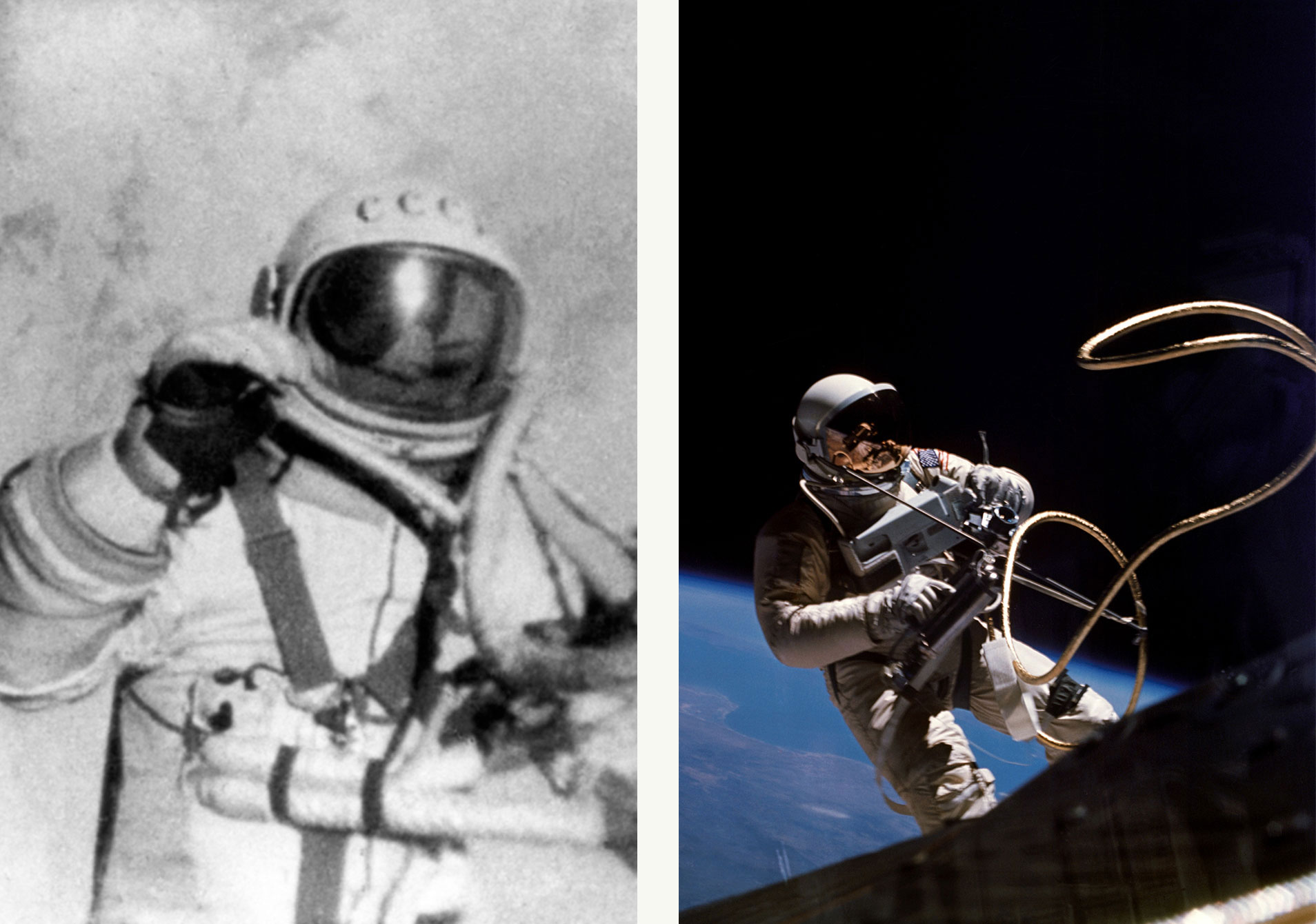
Compare the two spacewalk photographs. List two differences and two similarities.
Required
1
These photographs were taken within three months of each other. Does that surprise you? Explain your answer.

Required
1
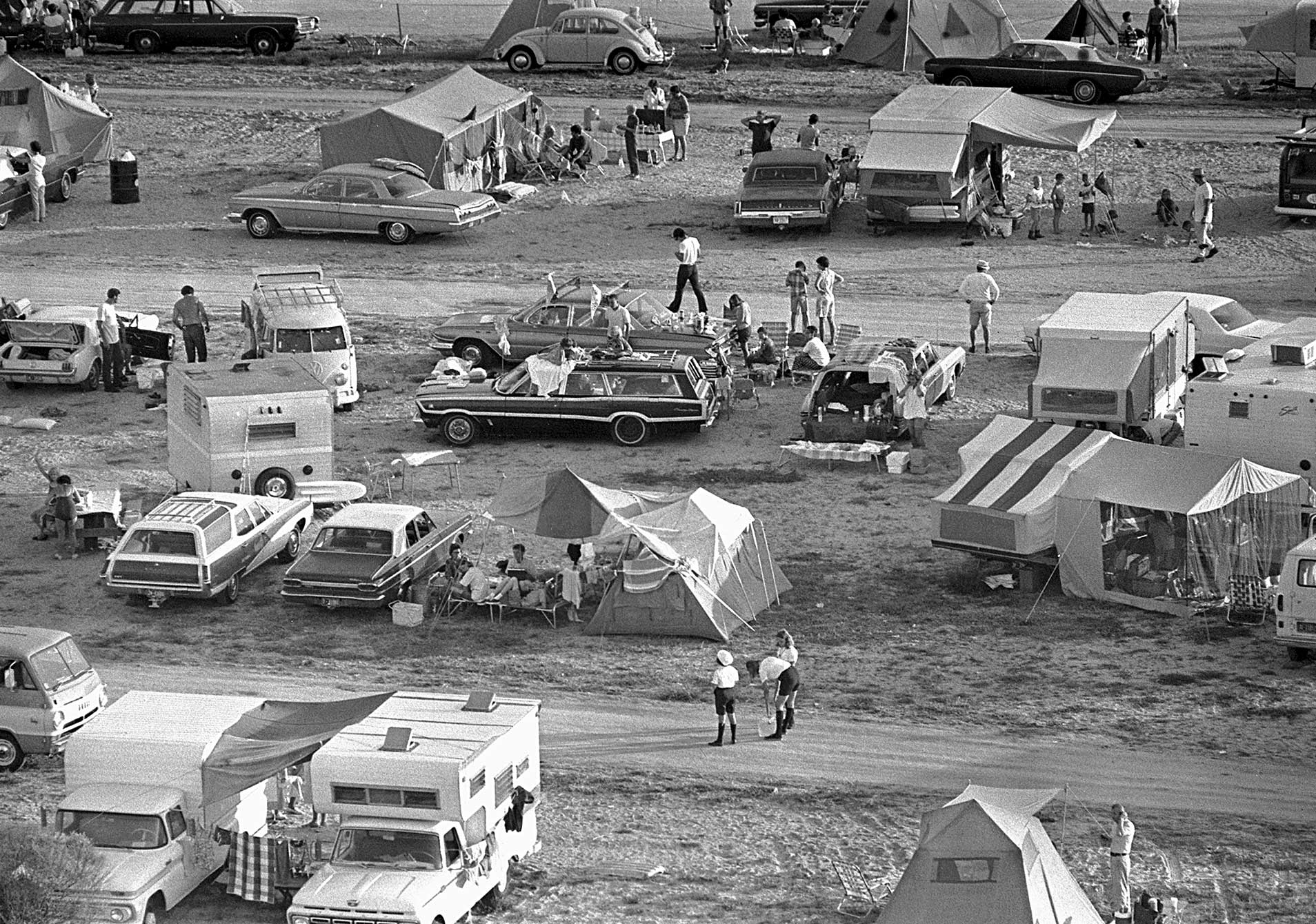
It is estimated that almost a million people came to watch the launch of Apollo 11. This picture shows some of the spectators at the launch. Why do you think so many people wanted to see the launch in person?
Required
1
This photograph was taken in 1969. How would it look different if this event took place today?
Required
1
List three important events in the news (political, scientific, or social) that have taken place in your lifetime. Which (if any) did you camp out to witness in person? Which events did you wish you could have seen in person? Which one could you imagine camping out to witness in person? Explain your answer.

Required
1
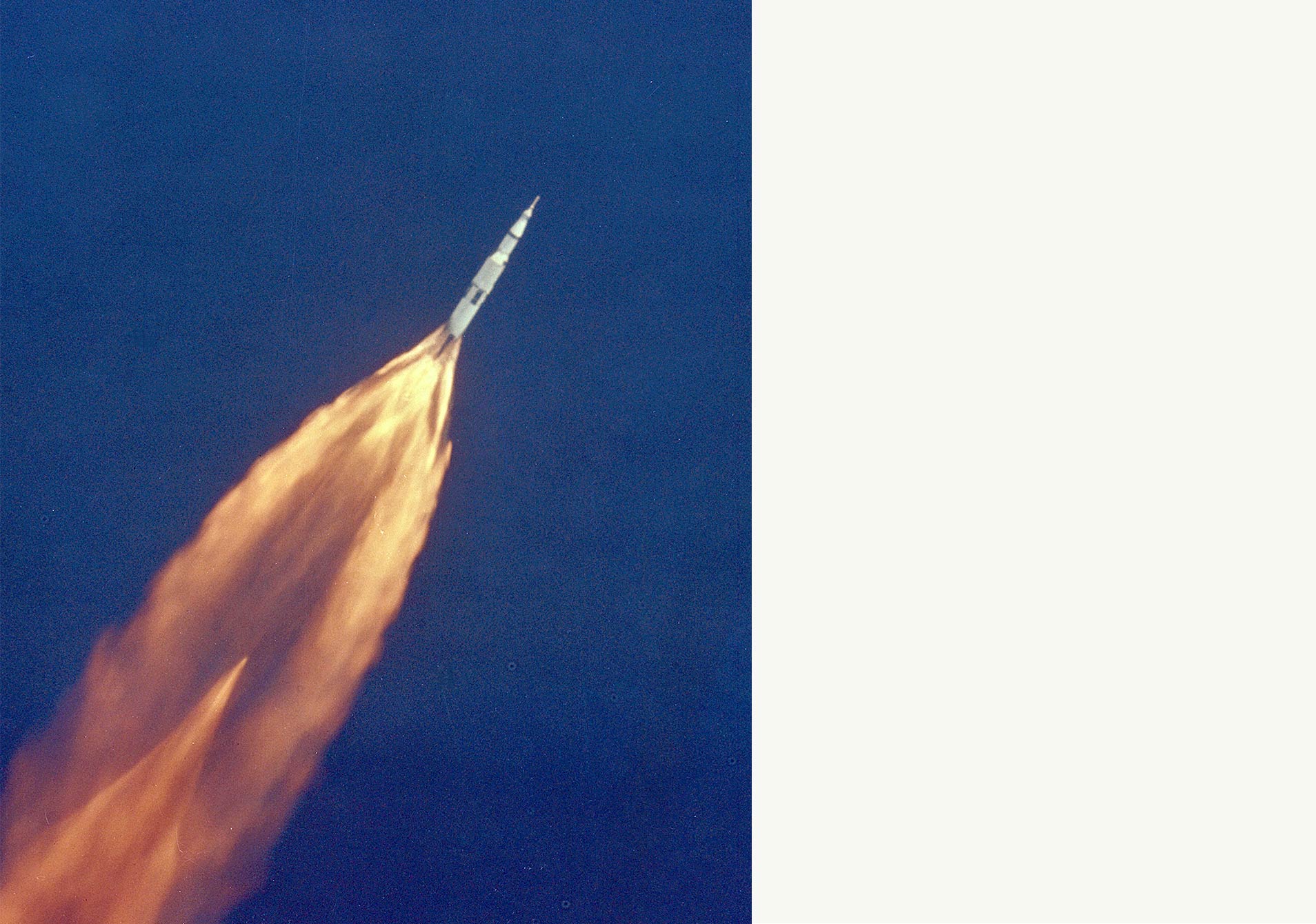
The Saturn V rocket was over 350 feet tall. That’s longer than a football field. What aspects of the photo give you clues to the rocket’s size?
Required
1
How do you think the astronauts inside the rocket might have felt while this photo was being taken? Use your imagination and/or what you know about space to explain your answer.
Required
1
Look at the massive streak of flame shooting out behind the rocket, and imagine how much fuel is being burned, minute by minute. The cost of fuel is just one of the many reasons this project was very expensive and time-consuming. Do you think it’s worth it to spend so much time and money to send people into space? Explain your answer.

Required
1
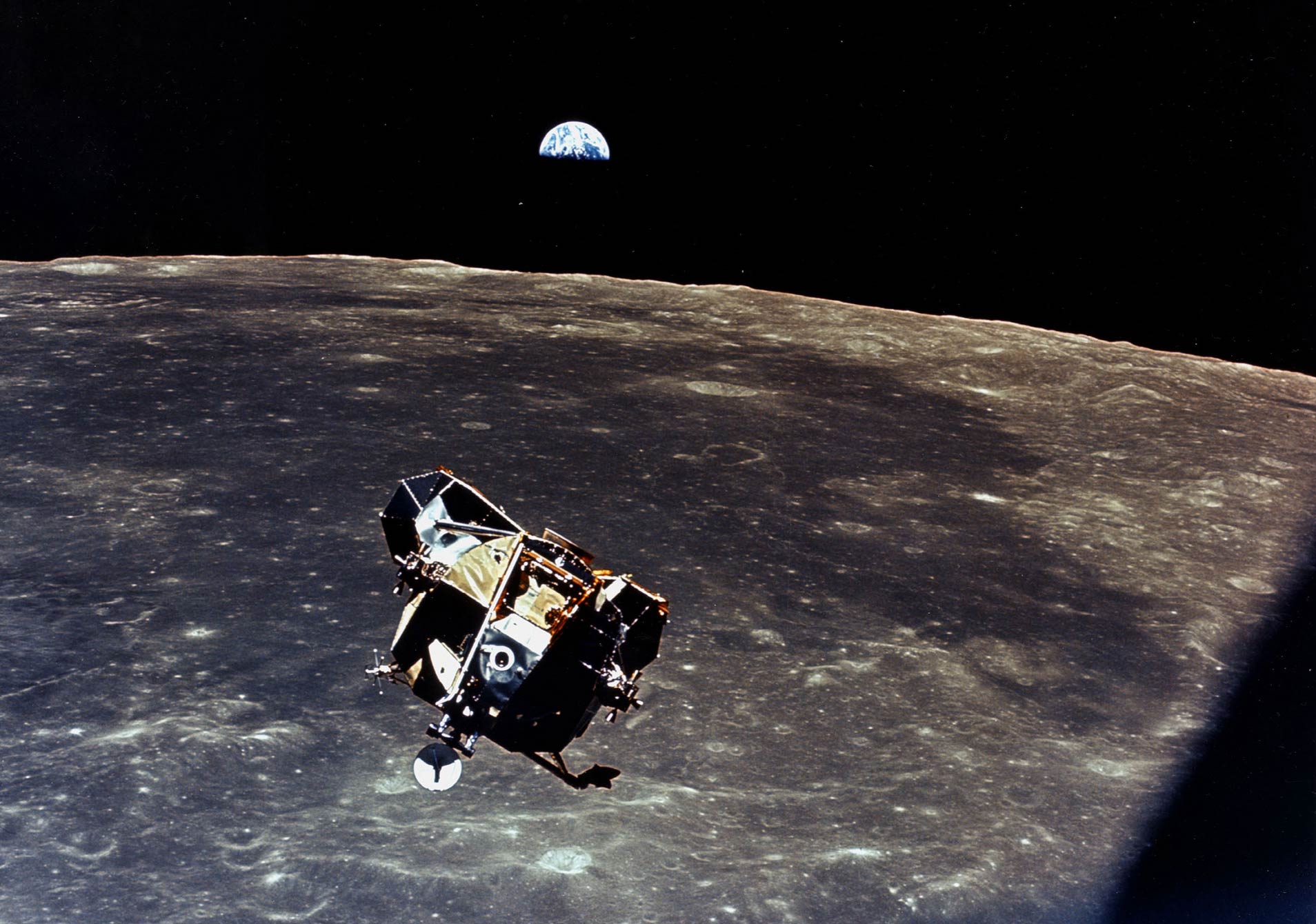
Look at the moon’s surface in this photograph. Does it look like the kinds of landscapes we have on Earth? Explain why or why not.
Required
1
When you look at a bright, full moon on a night without clouds, does it look like this? How is it similar? How is it different?
Required
1
Michael Collins piloted the module while Neil Armstrong and Buzz Aldrin walked on the moon. Using your imagination, and what you know about space, describe the challenges and risks of both roles. Which job would you prefer to do, and why?

Required
3
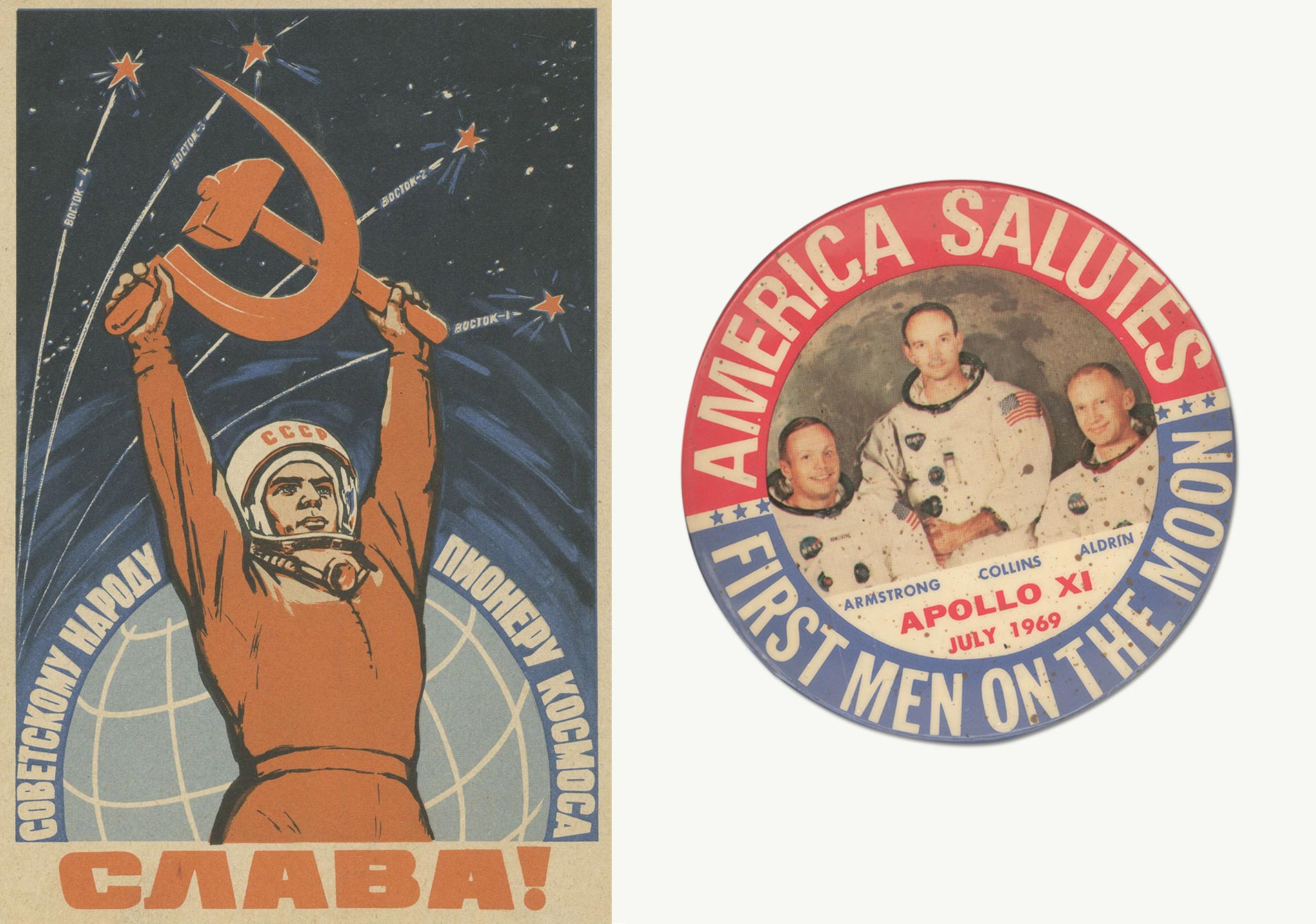
Look closely at the Soviet poster. List three features that convey the overall mood or tone of the poster.
Required
3
Look closely at the US button. List three features that convey the overall mood or tone of the button.
Required
2
Compare the poster and the button. How do they differ from each other, and how are they similar?
Required
2
The poster and the button are propaganda, or advertising. Which do you think is most successful? Explain your answer.
Required
1
What was one way in which the Soviets promoted their space program?
Scavenger Hunt Part II
The Space Race: An Introduction
1 Author: Lapham’s Quarterly editors (2014)
2 For decades, the United States and the Soviet Union were locked in a tense race against time where only one question mattered: Who would be the first to dominate space exploration? This competition would become known as the “Space Race.”
3 While this monumental struggle played out most visibly in the late-1950s to the mid-1970s, the origins of the Space Race reach all the way back to World War II. On October 3, 1942, Nazi Germany launched the V-2 rocket, developed by German engineer Wernher von Braun. Flying faster than 3,500 miles per hour, the V-2 shot upward for 60 miles, escaped the Earth’s atmosphere and became the first man-made object to successfully reach the edge of space. While this achievement should have been cause for worldwide celebration, the Nazis turned the V-2 rocket into a weapon and used it to rain explosives on the city of London, killing more than nine thousand civilians.
4 In the spring of 1945, the United States, Great Britain, and the Soviet Union formed an alliance against Nazi Germany and successfully ended the war. But, in the wake of victory, the United States and the Soviet Union became outright enemies. Immediately after World War II, both nations scrambled to bring Germans with knowledge of the V-2 technology to their own country. Von Braun and five hundred of his top German scientists surrendered to the U.S. Army. The Soviets took nearly five hundred other engineers.
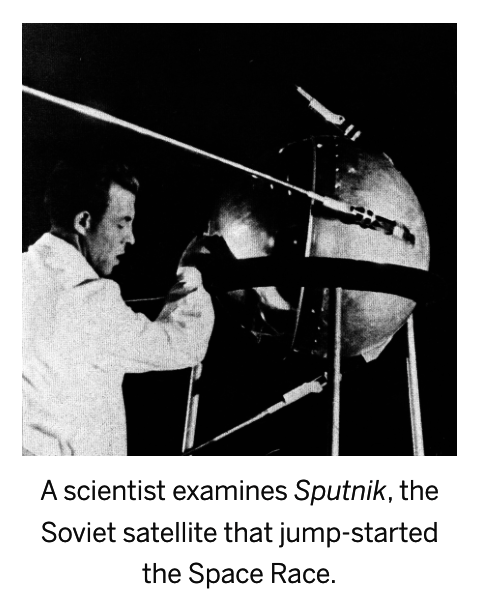
5 The Space Race roared to life on October 4, 1957, when the Soviets mounted a satellite onto a rocket and launched it into orbit. It was named Sputnik, meaning “fellow traveler of Earth,” and it circled the globe every 92 minutes at a speed of 18,000 miles per hour. The world was stunned, and the Americans were embarrassed and worried. How could the Soviets have beaten them into orbit?
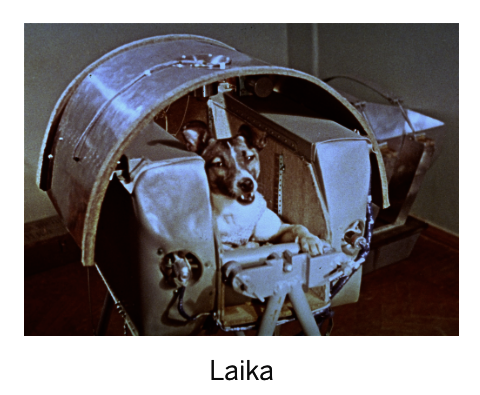
6 Compounding these fears, between 1957 and 1975, the Soviet Union finished first at almost everything in the Space Race! They sent the first animal (a dog called Laika) and the first human (Yuri Gagarin) into orbit. They launched the first multi-person crew. They made the first space walk. They were the first to achieve unmanned orbit of the moon. They were even the first to land an unmanned capsule on the moon!
7 But in 1968, the Americans staged a spectacular surprise victory. The astronauts of Apollo 8 became the first humans to orbit the moon. And, in 1969, Americans Neil Armstrong and Buzz Aldrin of the Apollo 11 mission became the first humans to pilot a craft to the moon, land, and step onto its surface.
8 Around this time, tensions between the two countries began to ease. This period was known as Détente, which is French for “easing” or “relaxing.” It began with a treaty in which the two countries agreed to help prevent the spread of nuclear technology. In 1972, President Nixon and Soviet Premier Alexei Kosygin signed the “Agreement Concerning Cooperation in the Exploration and Use of Outer Space for Peaceful Purposes.” This was a pact that promised a joint American-Soviet mission to space. Finally, in 1975, after years of careful diplomatic negotiations, the two countries launched the Apollo-Soyuz Test Project. On July 17, 1975, the American Apollo and the Soviet Soyuz spacecrafts met high above the Earth and docked. Floating in space, an American astronaut and a Soviet cosmonaut reached through the open hatches of their joined ships and shook hands. While it would still take another decade for U.S. and Soviet tensions to truly relax, this historic gesture signaled the end of the epic competition known as the Space Race.
Required
1
Why were people who knew about V-2 technology so valuable to both the United States and the Soviet Union after World War II?
Required
2
What was Sputnik, and why was it an important part of the Space Race?
Required
1
Which statement best describes the relationship between the United States and the Soviet Union at the beginning and end of the Space Race?
Required
1
According to the text, what did the Soviet Union and the United States do that revealed that they thought the V-2 technology was very valuable?
1 In October 1957, the world’s first artificial satellite, Sputnik 1, was launched into orbit by the Soviets. Americans were shocked and confused. Would the satellite be used to spy on us? Were we in danger? What, exactly, did it mean?
Excerpt: “Sputnik” from Rocket Boys
Author: Homer Hickam
Publisher: Random House
2 Published: 1998
3 I guess it’s fair to say there were two distinct phases to my life in West Virginia: everything that happened before October 5, 1957 and everything that happened afterward. My mother woke me early that morning, a Saturday, and said I had better get downstairs and listen to the radio. “What is it?” I mumbled from beneath the warm covers. High in the mountains, Coalwood could be a damp, cold place even in the early fall, and I would have been happy to stay there for another couple of hours, at least.
4 “Come listen,” she said with some urgency in her voice. I peeked at her from beneath the covers. One look at her worried frown and I knew I’d better do what she said, and fast.
5 I threw on my clothes and went downstairs to the kitchen, where hot chocolate and buttered toast waited for me on the counter. There was only one radio station we could pick up in the morning, WELC in Welch. Usually, the only thing WELC played that early was one record dedication after the other for us high-school kids. Jim, a year ahead of me and a football star, usually got several dedications every day from admiring girls. But instead of rock and roll, what I heard on the radio was a steady beep-beep-beep sound. Then the announcer said the tone was coming from something called Sputnik. It was Russian and it was in space. Mom looked from the radio to me. “What is this thing, Sonny?”
6 I knew exactly what it was. All the science-fiction books and Dad’s magazines I’d read over the years put me in good stead to answer. “It’s a space satellite,” I explained. “We were supposed to launch one this year too. I can’t believe the Russians beat us to it!”
7 She looked at me over the rim of her coffee cup. “What does it do?”
8 “It orbits around the world. Like the moon, only closer. It’s got science stuff in it, measures things like how cold or hot it is in space. That’s what ours was supposed to do, anyway.”
9 “Will it fly over America?”
10 I wasn’t certain about that. “I guess,” I said.
11 Mom shook her head. “If it does, it’s going to upset your dad, no end.”
12 I knew that was the truth. As rock-ribbed a Republican as ever was allowed to take a breath in West Virginia, my father detested the Russian Communists, although, it should be said, not quite as much as certain American politicians. For Dad, Franklin Delano Roosevelt was the Antichrist, Harry Truman the vice-Antichrist, and UMWA chief John L. Lewis was Lucifer himself. I’d heard Dad list all their deficiencies as human beings whenever my Uncle Ken—Mom’s brother—came to visit. Uncle Ken was a big Democrat, like his father. Uncle Ken said his daddy would’ve voted for our dog Dandy before he’d have voted for a Republican. Dad said he’d do the same before casting a ballot for a Democrat. Dandy was a pretty popular politician in our house.
13 All day Saturday, the radio announcements continued about the Russian Sputnik. It seemed like each time there was news, the announcer was more excited and worried about it. There was some talk as to whether there were cameras on board, looking down at the United States, and I heard one newscaster wonder out loud if maybe an atomic bomb might be aboard. Dad was working at the mine all day, so I didn’t get to hear his opinion on what was happening. I was already in bed by the time he got home, and on Sunday, he was up and gone to the mine before the sun was up. According to Mom, there was some kind of problem with one of the continuous miners. Some big rock had fallen on it. At church, Reverend Lanier had nothing to say about the Russians or Sputnik during his sermon. Talk on the church steps afterward was mostly about the football team and its undefeated season. It was taking awhile for Sputnik to sink in, at least in Coalwood.
14 By Monday morning, almost every word on the radio was about Sputnik. Johnny Villani kept playing the beeping sound over and over. He talked directly to students “across McDowell County” about how we’d better study harder to “catch up with the Russians.” It seemed as if he thought if he played us his usual rock and roll, we might get even farther behind the Russian kids. . . .
Required
1
How did the author first learn about satellites?
Required
1
How did Homer’s family and the people in his community react to the news about Sputnik? Why did they react this way?
Required
1
What was the difference between what was heard on the radio before and after October 5, 1957? According to Johnny Villani, why was this change important for students? Support your answer with evidence from the text.
Required
1
How did the author first learn about satellites?
Required
1
Part 1: How did Homer and his mother first react to the news about Sputnik?
Required
1
Part 2: Read the following sentences from the text. Select the sentence that best supports your answer to Part 1.
All day Saturday, the radio announcements continued about the Russian Sputnik. It seemed like each time there was news, the announcer was more excited and worried about it. There was some talk as to whether there were cameras on board, looking down at the United States, and I heard one newscaster wonder out loud if maybe an atomic bomb might be aboard. Dad was working at the mine all day, so I didn’t get to hear his opinion on what was happening. I was already in bed by the time he got home, and on Sunday, he was up and gone to the mine before the sun was up. According to Mom, there was some kind of problem with one of the continuous miners. Some big rock had fallen on it.
Required
1
Reread paragraph 12. Which best describes the meaning of “deficiencies”?I’d heard Dad list all their deficiencies as human beings whenever my Uncle Ken—Mom’s brother—came to visit.
Reread paragraph 12. Which best describes the meaning of “deficiencies”?
I’d heard Dad list all their deficiencies as human beings whenever my Uncle Ken—Mom’s brother—came to visit.
Required
1
The dog Dandy is compared to a politician in paragraph 12 to __________
Required
1
In the last paragraph of the passage, what does Homer infer from what he hears on the radio?
The first animal ever sent into orbit around the Earth was a dog named Laika—launched on November 3, 1957, by the Soviet Union. Her flight was a significant victory for the Soviets, coming just one month after the successful launch of Sputnik 1, the world’s first artificial satellite: It was two big wins in a row for the Soviet Union. But for Laika, the journey was anything but a success.
Excerpt: “And a Dog Shall Lead Them” from A Ball, a Dog, and a Monkey
Author: Michael D’Antonio
Publisher: Simon & Schuster
1 Published: 2007
2 Found on the streets of Moscow, Laika possessed all the qualities that make a mutt a perfect pet. She was intelligent, calm, and easily trained. In shape and color she was a bit like a tiny German shepherd. Her long muzzle was mainly black, as was her face. However, a narrow line of tan fur ran from the tip of her nose, between her eyes, to her forehead. And over each eye, a tan patch the size of a quarter made it look like her brows were always arched in surprise. Gentle but playful, Laika was the kind of dog that children loved. Before her trip to Baykonur, one of her minders had brought her home to see his own children. The time Laika spent playing with them was a reward for the duty to come.
3 Laika was placed in the padded capsule of Sputnik II at midday on October 31. Leather straps kept her from turning around, but she was able to eat some of the special jelled food prepared for her journey. Hours later the satellite, which included a silvery ball similar to the first Sputnik, was stacked on top of the R-7. Preparation for the launch went on continuously. The fuel tanks were filled with kerosene and liquid oxygen. The large steel supports that held the R-7 upright were pulled back. Finally at 7:30 A.M. on November 3, the countdown reached zero and the rocket’s engines ignited on schedule.
4 Shaken by ignition and rattled as the rocket lifted off, Laika was subjected to a truly deafening roar as the R-7 climbed into the Kazak sky. She panted furiously and her heartbeat raced to triple its resting rate as the acceleration created pressures several times greater than the force of gravity. The force on Laika’s body subsided as the satellite reached weightless orbit, but she had trouble recovering from the stress of the launch. Tests conducted in a centrifuge on Earth had shown that Laika’s heartbeat could return to normal soon after excessive g-force was reduced. But in the isolation of the capsule, with no reassuring handlers around, she needed much longer to calm down.
5 Unlike the first Sputnik, which separated from its entire launch vehicle, Sputnik II went into orbit with its second stage attached. All this hardware—six tons of stuff worth half a billion rubles—flew along an elliptical path that was about 530 miles high, on average. The rocket-capsule-dog combination circled the Earth once every 104 minutes, passing 160 miles above the orbit of Sputnik I. . . .
6 . . . Early reports stressed Laika’s healthy condition, describing her as “calm” and in “generally satisfactory condition.” In America, experts debated the possibility that Laika might return to Earth safely. Vanguard program scientists discussed the techniques required and theorized that a rocket engine might be used as a brake to slow reentry. But Wernher von Braun’s colleague Willy Ley dismissed this prospect, saying he was almost certain the Soviets were not capable, adding that even if they could get Laika safely to ground, locating the capsule once it landed would be extremely difficult.
7 With expert opinion quickly coalescing around the notion that Laika was doomed, national humane societies in America, Great Britain, and many other countries lodged formal protests with the Soviet government. They were joined by many angry pro-animal activists, including Mary Riddell, president of the Bide-a-Wee Home Association of Manhattan. She was among the first to note the obvious, that returning Laika to terra firma was impossible. “Your Government,” she wrote in a letter to the Soviet embassy, “once again proved its inhumanity.”
8 Things were actually much worse than Mrs. Riddell imagined. The truth of the matter, which wouldn’t be revealed for decades, was that Laika probably died from heat exhaustion, and perhaps stress, within hours of beginning her mission. As Sputnik II soared over the Soviet Union for the fourth time, the instruments that checked her vital signs showed Laika had died as both the temperature and humidity in the capsule had steadily increased. (It turned out that the Chief Designer’s team had failed to create an adequate cooling system for the capsule.)
9 Many days would pass before Laika’s demise would be reported officially. In the meantime Laika’s inevitable fate was, for most people, obscured by the playful spectacle of a dog in space. Photos and drawings of the dog appeared in the press for weeks. In the Riviera town of Rapallo, Italy, officials announced they would erect a statue in Laika’s honor. In the Soviet Union, packs of Laika cigarettes went on sale to commemorate her achievement.
10 American officials said nothing about the ethical implications of killing a dog in space. This silence was probably due, in part, to the fact that the United States itself was relying on a menagerie of animal test subjects in its own space research. As Laika was circling the globe, the U.S. Air Force was settling four black bears from Catskill, New York, into their new home at Holloman Air Force Base in New Mexico. Officials first denied the bears would be used in high-speed sled tests. A week later a bear named Oscar was knocked out with anesthetics, strapped into the chair of a high-speed sled, and sent on a ride that subjected him to twenty times the force of gravity. “We wanted to prove that a person could withstand rapid deceleration with no ill effects,” said a military spokesman. A thorough examination being necessary to prove the absence of ill effects, Oscar was killed and then autopsied.
Required
1
What characteristics made Laika a good pet? Would these qualities make her a good candidate to be a space traveler? Explain your answer.
Required
1
Describe all the conditions that placed stress on Laika’s body in space, and explain her reaction to these conditions.
Required
1
Many pro-animal activists were angry about Laika’s treatment in space, but the American officials said nothing. Why did they keep silent?
Eight days after Soviet cosmonaut Yuri Gagarin became the first human to orbit the Earth, President Kennedy wrote this memo. It was time to ramp up American efforts in space. We needed to win the Space Race—the question was how we were going to do it.
Memorandum for the Vice President
Author: John F. Kennedy
1 (public domain)
2 THE WHITE HOUSE
3 WASHINGTON
4 April 20, 1961
5 MEMORANDUM FOR VICE PRESIDENT
6 In accordance with our conversation I would like for you as Chairman of the Space Council to be in charge of making an overall survey of where we stand in space.
- Do we have a chance of beating the Soviets by putting a laboratory in space, or by a trip around the moon, or by a rocket to land on the moon, or by a rocket to go to the moon and back with a man? Is there any other space program which promises dramatic results in which we could win?
- How much additional would it cost?
- Are we working 24 hours a day on existing programs? If not, why not? If not, will you make recommendations to me as to how work can be speeded up.
- In building large boosters should we put our emphasis on nuclear, chemical or liquid fuel, or a combination of these three?
- Are we making maximum effort? Are we achieving necessary results?
7 I have asked Jim Webb, Dr. Weisner, Secretary McNamara and other responsible officials to cooperate with you fully. I would appreciate a report on this at the earliest possible moment.
8 (President Kennedy’s signature)
Required
1
President Kennedy asks if Americans have a chance at “beating the Soviets” (6). How does he think Americans might be able to beat them?
Required
1
Which questions best show the president’s sense of urgency in moving forward with the space program? Explain why.
Required
1
Which questions might Jim Webb (NASA Administrator), Dr. Weisner (Science Advisor), and Secretary McNamara (Secretary of Defense) answer?
In September 1962, about a year after Soviet cosmonaut Yuri Gagarin became the first person ever to orbit the Earth, President Kennedy addressed nearly 40,000 people in a football stadium at Rice University in Houston, Texas. It was time for the United States to take control of the Space Race, and the president had a plan.
Excerpt: President Kennedy’s Address at Rice University, September 12, 1962
Author: John F. Kennedy
1 (public domain)
2 President Pitzer, Mr. Vice President, Governor, Congressman Thomas, Senator Wiley, and Congressman Miller, Mr. Webb, Mr. Bell, scientists, distinguished guests, and ladies and gentleman:
3 I appreciate your president having made me an honorary visiting professor, and I will assure you that my first lecture will be very brief.
4 I am delighted to be here, and I’m particularly delighted to be here on this occasion. . . .
5 Those who came before us made certain that this country rode the first waves of the industrial revolutions, the first waves of modern invention, and the first wave of nuclear power, and this generation does not intend to founder in the backwash of the coming age of space. We mean to be a part of it—we mean to lead it. For the eyes of the world now look into space, to the moon and to the planets beyond, and we have vowed that we shall not see it governed by a hostile flag of conquest, but by a banner of freedom and peace. We have vowed that we shall not see space filled with weapons of mass destruction, but with instruments of knowledge and understanding.
6 Yet the vows of this Nation can only be fulfilled if we in this Nation are first, and, therefore, we intend to be first. In short, our leadership in science and in industry, our hopes for peace and security, our obligations to ourselves as well as others, all require us to make this effort, to solve these mysteries, to solve them for the good of all men, and to become the world’s leading space-faring nation.
7 We set sail on this new sea because there is new knowledge to be gained, and new rights to be won, and they must be won and used for the progress of all people. For space science, like nuclear science and all technology, has no conscience of its own. Whether it will become a force for good or ill depends on man, and only if the United States occupies a position of pre-eminence can we help decide whether this new ocean will be a sea of peace or a new terrifying theater of war. I do not say that we should or will go unprotected against the hostile misuse of space any more than we go unprotected against the hostile use of land or sea, but I do say that space can be explored and mastered without feeding the fires of war, without repeating the mistakes that man has made in extending his writ around this globe of ours.
8 There is no strife, no prejudice, no national conflict in outer space as yet. Its hazards are hostile to us all. Its conquest deserves the best of all mankind, and its opportunity for peaceful cooperation may never come again. But why, some say, the moon? Why choose this as our goal? And they may well ask why climb the highest mountain? Why, 35 years ago, fly the Atlantic? Why does Rice play Texas?
9 We choose to go to the moon. We choose to go to the moon in this decade and do the other things, not because they are easy, but because they are hard, because that goal will serve to organize and measure the best of our energies and skills, because that challenge is one that we are willing to accept, one we are unwilling to postpone, and one which we intend to win, and the others, too.
10 It is for these reasons that I regard the decision last year to shift our efforts in space from low to high gear as among the most important decisions that will be made during my incumbency in the office of the Presidency.
11 In the last 24 hours we have seen facilities now being created for the greatest and most complex exploration in man’s history. We have felt the ground shake and the air shattered by the testing of a Saturn C-1 booster rocket, many times as powerful as the Atlas which launched John Glenn, generating power equivalent to 10,000 automobiles with their accelerators on the floor. We have seen the site where the F-1 rocket engines, each one as powerful as all eight engines of the Saturn combined, will be clustered together to make the advanced Saturn missile, assembled in a new building to be built at Cape Canaveral as tall as a 48 story structure, as wide as a city block, and as long as two lengths of this field.
12 Within these last 19 months at least 45 satellites have circled the earth. Some 40 of them were “made in the United States of America” and they were far more sophisticated and supplied far more knowledge to the people of the world than those of the Soviet Union.
13 The Mariner spacecraft now on its way to Venus is the most intricate instrument in the history of space science. The accuracy of that shot is comparable to firing a missile from Cape Canaveral and dropping it in this stadium between the the [sic] 40-yard lines.
14 Transit satellites are helping our ships at sea to steer a safer course. Tiros satellites have given us unprecedented warnings of hurricanes and storms, and will do the same for forest fires and icebergs.
15 We have had our failures, but so have others, even if they do not admit them. And they may be less public.
16 To be sure, we are behind, and will be behind for some time in manned flight. But we do not intend to stay behind, and in this decade, we shall make up and move ahead.
17 The growth of our science and education will be enriched by new knowledge of our universe and environment, by new techniques of learning and mapping and observation, by new tools and computers for industry, medicine, the home as well as the school. Technical institutions, such as Rice, will reap the harvest of these gains. . . .
18 But if I were to say, my fellow citizens, that we shall send to the moon, 240,000 miles away from the control station in Houston, a giant rocket more than 300 feet tall, the length of this football field, made of new metal alloys, some of which have not yet been invented, capable of standing heat and stresses several times more than have ever been experienced, fitted together with a precision better than the finest watch, carrying all the equipment needed for propulsion, guidance, control, communications, food and survival, on an untried mission, to an unknown celestial body, and then return it safely to earth, re-entering the atmosphere at speeds of over 25,000 miles per hour, causing heat about half that of the temperature of the sun—almost as hot as it is here today—and do all this, and do it right, and do it first before this decade is out—then we must be bold. . . .
19 Many years ago the great British explorer George Mallory, who was to die on Mount Everest, was asked why did he want to climb it. He said, “Because it is there.”
20 Well, space is there, and we’re going to climb it, and the moon and the planets are there, and new hopes for knowledge and peace are there. And, therefore, as we set sail we ask God’s blessing on the most hazardous and dangerous and greatest adventure on which man has ever embarked.
21 Thank you.
Required
1
What does President Kennedy worry will happen to outer space if it is not explored by Americans?
Required
1
Read the speech closely and find two examples that show President Kennedy asserting American superiority over the Soviets. Write those sentences here.
Required
1
President Kennedy states, “We set sail on this new sea because there is new knowledge to be gained, and new rights to be won, and they must be won and used for the progress of all people” (7). Explain what he means.
Required
1
What does President Kennedy mean when he says, “We choose to go to the moon in this decade and do the other things, not because they are easy, but because they are hard” (9)? Why choose to do the hard thing?
Required
1
Who developed the V-2 rocket?
Scavenger Hunt III
This passage describes what life was like for Yuri Gagarin during his April 1961 Vostok mission. It also details observations he made about what the Earth looks like from space.
Excerpt: “First to Fly” from Into That Silent Sea
Authors: Francis French and Colin Burgess
Publisher: University of Nebraska Press
1 Published: 2007
2 Vladimir Suvorov, in charge of filming the launch that day and dangerously close to the launch pad at the moment of ignition, recorded his impressions of the liftoff in his secret diary:
3 “Now the powerful engines come to life, the rocket is trembling and the white frost wraps it in a thin haze. There are reflections of the flame of the engines on the rocket body. At last after the final jerk it starts moving as if awakened from a long sleep.” Inside the spacecraft, Gagarin found it hard to identify the exact moment when the rocket left the ground. He had felt the rocket sway slightly a minute before launch as the valves began to operate, but the difference in the rocket’s shaking and noise at launch had been too subtle to pinpoint. In fact, the rocket seemed relatively slow and quiet as he began his mission, to the point where he did not feel like he was moving at all. Over the faint roar he heard Korolev wish him a good flight as he ascended, and he responded with a cheery “Poyekhali!” (Off we go!).
4 Prepared to eject if he needed to, Gagarin felt the shaking increase just over a minute after liftoff, then slowly decrease as the amplitude and frequency of the vibrations changed. As the rocket accelerated, the g-forces rose steadily, interrupted only by the first-stage booster engines falling away. It soon became hard for him to speak as his face muscles tightened, but following his extensive training handling the g’s was no problem. When the second stage shut down, Gagarin was pushed forward against his seat straps with a jolt and a bang, making him fear for a moment that a piece had broken off the spacecraft. He became aware that the noise of the engines had suddenly ceased, and the sudden reduction in acceleration gave him the false sensation that he was weightless. Ignition of the third stage pushed him back into the seat again, but this booster stage was a quieter one. The bullet-shaped aerodynamic shield covering the spacecraft soon separated with another bang and sharp jolt. When the third stage also shut down, Vostok separated from it and began a slow spin. Nine minutes after launch, Gagarin was in orbit.
5 As his spacecraft slowly rotated, Gagarin looked at the Earth below him. His first view was of a mountain area with rivers, forests, and ravines, which he later believed to be the Ob or Irtush River area. As he continued to look at the revolving scene, he was struck by the beauty of it—a curved horizon above an Earth of surprisingly intense blue, the deep black of space, and a sun too bright to look at. It was not lost on him that he was seeing the Earth as spherical, with his own eyes—the first time any human had been able to do so. The horizon looked particularly beautiful to him, and he was entranced by the smooth change from the brilliance of Earth to the darkness of space, a myriad of colors filling the thin, filmlike layer that separated the two. He had never seen a blackness as deep as the infinity of space he stared into.
6 Looking down at the Earth again, Gagarin saw seas, cities, the coasts of continents, islands, and other sights never before seen by a human being from this vantage point. As the features slipped by, the speed of his journey around the world was vividly evident. As he observed a coastline change to ocean, he noticed how surprisingly gray the water looked, appearing “darkish, with faintly gleaming spots.” From orbital height, the ocean’s ripples reminded him of sand dunes. He was also fascinated by the sharp shadows of the clouds over the Earth’s surface.
7 Over land, he observed the squares of fields, and could easily distinguish meadows from ploughed areas. Through gaps in the cloud, he saw the forested islands of Japan. For the first time in his life, whether on the ground or in space, he was looking at a foreign country. At times the view reminded him of the vista from a high-altitude jet, but there was so much more to it.
8 Back in Gzhatsk, his mother wept as she listened to the breaking news over the radio. “What has he gone and done?” she kept repeating, as if still talking about the mischievous childhood Yuri.
9 Gagarin kept his thoughts concentrated on the flight program; he wanted to carry out his assignments to the best of his abilities. He checked the spacecraft systems and saw that everything was functioning perfectly. He also reflected on how he was feeling; he was having no problems with the prolonged weightlessness. “It was an unusual sensation,” he later reported. “Weightlessness is a strange phenomenon, and at first I felt uncomfortable, but I soon got used to it.” The lack of up or down made him feel like he was hanging from the spacecraft ceiling by his straps. “It seemed as if my hands and legs and my whole body did not belong to me,” he reported. Yet he was feeling no discomfort, and in fact found it easier to work in the cabin because of the lack of weight. He noted that he did not feel hungry or thirsty, but he ate and drank as part of the mission plan, with no problems. “On Vostok the water supply was kept in a polyethylene-lined container fitted with a tube with a special mouthpiece,” he would later describe. “To get a drink I had to take the mouthpiece, press the button of a special looking mechanism, and then suck the water out.” Some water leaked from the end of the tube and slowly floated around the cabin as he watched, fascinated by the tiny, gleaming sphere of fluid. . . .
10 Half an orbit after launch, over the vast Pacific Ocean, Vostok glided serenely into the shadowed side of the planet following a beautiful sunset. Gagarin was surprised by how quickly darkness came on, a huge difference from the blindingly bright sunlight. He looked down at the Earth’s surface but could see no lights, so surmised he must be traveling over water. As he looked to the horizon, more stars appeared than he had ever seen before, brighter and sharper than when observed from Earth. “Of all the nights I had seen in my lifetime,” Gagarin recounted, “none was remotely comparable to night in space. I have never forgotten it. The sky was blacker than it ever appears from the Earth, with the real, slate-blackness of space.” It would be the shortest night of his life, however. All too soon, Gagarin saw a vivid orange curve on the horizon, “a very beautiful sort of halo,” which gradually changed to a multitude of colors, then blue as the blinding sun rose again, faster than he had imagined it would.
11 The spacecraft’s automatic systems were functioning well, so much so that Gagarin never needed to touch the controls, only monitoring the systems to ensure that Vostok was doing everything correctly. Far from feeling isolated and alone in space, he felt like there was more attention focused on him than at any other time in his life.
12 For this first mission, only one orbit was planned. As scheduled, seventy-nine minutes into the flight, the retrorockets made a forty-second automatic burn, slowing the spacecraft. Gagarin closed his helmet, tightened his straps, and felt the bang and deceleration force as the rockets fired to bring him home. He was feeling great and would have been happy to continue the flight, but knew that wasn’t within the scope of this mission. . . .
13 To reenter Earth’s atmosphere, the spherical cabin was supposed to separate cleanly from the equipment module that had provided the essential power and telemetry. No longer needed, the module was designed to be cast off and burn up in the atmosphere, leaving the ball-shaped cabin to descend safely. However, all was not going to plan. A cable between the two spacecraft parts had not detached, and Yuri found himself rapidly tumbling as the crew cabin and its unwanted encumbrance made a spinning, dangerous plunge into the atmosphere. “Through the windows I saw Earth and sky, from time to time the blinding rays of the sun,” he recalled. “I waited for separation, but separation did not occur. The wait was terrible. It was as if time had stopped. Seconds felt like long minutes.” . . .
14 After ten dangerous and uncomfortable minutes, the cable holding the modules together finally sheared and burned through under the intense forces with an audible bang, and the two spacecraft parts were whipped away from each other like spinning tops. . . . Through the borders of the now-closed blinds, he could still see the bright red fire of reentry and could hear and feel the crackling thermal coating. He assumed the position for ejection, and waited. . . .
15 At twenty-three thousand feet the spacecraft hatch automatically blew off with a loud bang, and the cosmonaut tensed, waiting for the ejection process to begin. “I sat there, thinking, what about me?” Gagarin recalled. “I slowly turned my head upwards, and at that moment the charge fired and I was ejected. I flew out with the seat.” His parachute opened, and he steadily drifted down toward the ground. His emergency parachute suddenly and dangerously opened in addition to his main chute. Luckily for Gagarin, it hung limply below him and did not tangle with the other shroud. After the perils of reentry, he was safe at last, and as he descended he began singing to himself happily.
Required
1
What major event in history is described in this chapter? What two sentences in the chapter provide clues to what this event was?
Required
1
The authors write, “Far from feeling isolated and alone in space, he [Gagarin] felt like there was more attention focused on him than at any other time in his life” (11). What are the authors referring to?
Required
1
According to the authors, when Gagarin’s mission ended with his landing near the air club where he first started flying, he said, “It was like a good novel” (16). Name three other characteristics of Gagarin’s experience on this mission that you think are “like a novel.”
In 1963, after highly secretive preparation and training, Soviet cosmonaut Valentina Tereshkova became the first woman ever to travel into space. In one trip, she circled the Earth 48 times and logged more hours outside of Earth’s atmosphere than all the American male astronauts combined.
Excerpt: “A Seagull in Flight” from Into That Silent Sea
Authors: Francis French and Colin Burgess
Publisher: University of Nebraska Press
1 Published: 2007
2 Vostok 6 lifted off at 12:29 p.m. For the first time a woman was on her way into space. Almost to herself, Valya cried out, “I’m off!” She later reflected in her memoirs that “The music of launch begins with the low sounds. I hear the roar that reminds me of the sound of thunder. The rocket is shaking like a thin tree under the wind. The roar grows, becomes wider, more upper notes are distinguished in it. The spaceship is shivering.” As Vostok 6 climbed ever higher in the sky, dwindling into an intense, starlike dot for spectators below, Tereshkova felt the trembling vibration associated with launch and a steadily increasing heaviness in her arms and legs. She also experienced an unseen weight pressing down on her chest. “It becomes hard to breathe,” she reported. “I can’t move a single finger.” Every time she thought the pressure had reached its limit it continued to mount, but she remained focused on the task ahead. “Somewhere in the star-filled height flies the lonely spaceship controlled by Valery Bykovsky,” she later reflected in her memoirs. Then, she heard some reassuring words: “‘Chaika, Chaika, everything is excellent, the machine is working well.’ I shake with surprise. The voice of Yuri Gagarin sounds right near, as if he’s sitting next to me, as an instructor in the right seat of the plane. I answer not at once; maybe because of the cheering words of my friend; maybe the flight to orbit is over, and the pressure disappeared, as it melted under the warm wave spreading in my body. Breathing became easy.”
3 Soon an excited voice was broadcast from the orbiting spacecraft: “Ya Chaika, Ya Chaika [I am Seagull]! I see the horizon—a light blue strip, a blue band. This is the Earth; how beautiful it is. Everything goes well.” She later told a group of reporters that her first sight of Earth from space was “overwhelming”: “It was breathtakingly beautiful, like something out of a fairy tale. There is no way to describe the joy of seeing the Earth. It is blue, and more beautiful than any other planet. Every continent, every ocean, had its own distinct beauty. The Earth was visible very clearly, even though the craft was traveling at [five miles] a second. Africa shone out in yellow and green, Australia was fringed in an opal color. Unfortunately, every time I went over Europe it was sheathed in cloud.”
4 By three o’clock that afternoon the two cosmonauts had established radio contact. Dubbed the “cosmic couple” by the press, they were soon exchanging comments and information about conditions aboard their craft, as well as communicating with ground controllers. The same equipment that had allowed Soviet scientists to study Bykovsky in orbit was now brought into play for Tereshkova. Television images of her were beamed to the world, smiling happily as a pencil and small logbook drifted in front of her helmet. telemetry data was good, and Tereshkova seemed to be adapting easily to weightlessness. . . .
5 On her fourth orbit Tereshkova enjoyed a light-hearted chat with Premier Khrushchev. In concluding he told her to be of good cheer, that the Soviet people were proud of her feat, and expressed wishes for a successful completion of her flight. In response, she said she was deeply moved by his attention and fatherly concern.
6 Despite the sounds of communications and Vostok 6’s operating noises, Tereshkova knew her spacecraft was surrounded by a profound silence. It created in her a distinct longing for the familiar things of life back on Earth. “The further away a spacecraft drifts,” she once reflected, “the more you start to miss the sounds of nature—rainfall, for instance.” Following her conversation with Khrushchev, Tereshkova made preparations to sleep—this time according to the flight schedule. By ten o’clock that night Bykovsky had completed fifty-four orbits and Tereshkova twenty-three. She had flown one more orbit than America’s most-traveled astronaut at that time, Gordon Cooper. Tereshkova woke early the next morning, Moscow time, and spent fifteen minutes performing some light physical exercise. She then washed her face and hands using a dampened cloth and ate breakfast.
7 In a later interview with Kerrie Dougherty, Tereshkova disclosed that her flight unavoidably allowed her mother to discover the truth about her activities. “It was top secret. My mother, [like] the mother of Yuri Gagarin, first knew about it with the rest of the country. It was a very big surprise. One can understand what a mother feels like in this kind of situation.” She had explained her lengthy absence from Yaroslavl by telling her mother that she had to complete advanced parachute training in Moscow. Yelena had accepted this. Though uncomfortable with the danger, she was nevertheless proud and wanted her to do well. Her daughter wrote home regularly, and on two occasions made brief visits to Yaroslavl to see everyone. Tereshkova hated being untruthful about what she was really doing in Moscow. Before the flight she had written ten letters saying she was very busy but well and happy. A friend had promised to post one each day to her mother; however, one of the later letters was delayed, only arriving in Yaroslavl on the day of the flight.
8 As Tereshkova revealed to Dougherty, friends told her mother that on television they had seen a woman in space who greatly resembled her daughter. Yelena dismissed this as idle gossip. “She said, ‘No, my daughter is just a parachute jumper. She could not be aboard this spaceship!’” Tereshkova related. “My mother was absolutely certain that I could not hide anything from her, but then she saw my photo, and when she heard my message to her—because I had a special message I transmitted to her—then she recognized her daughter on the television screen!” Though proud of this remarkable achievement, Yelena is said to have been deeply hurt by the deception. It would be some time before she finally forgave her Valya for what she considered to be her lack of faith in her own mother. . . .
9 As Vostok 6 began its forty-eighth orbit, the spacecraft was oriented for reentry by means of a solar sensor located in the service module. Tereshkova was supposed to describe the operation of this sensor to the ground as well as the sensations of reentry. She did neither, to the frustration of the ground controllers. The braking rocket fired as scheduled, slowing the spacecraft, which was then separated explosively from the service module. The spherical Vostok 6 craft now began a fiery ballistic return to Earth, shielded from the immense heat of reentry by a protective ablative coating. As Tereshkova recalled in Stars Are Calling, the pressure pushed her back in her couch, and though it was difficult to keep her eyes open she took note of what was happening to her space capsule: “I notice the dark red tongues of the flame outside the windows. I’m trying to memorize, fix all the feelings, all peculiarities of this descending, to tell those who will be conquering space after me. My mind is working calmly and logically. With a loud roar, the spaceship bumps into the dense atmosphere. The noise grows with every second; it already reminds me of the thunder of hundreds of drums, the final part of some outrageous heroic symphony.”
10 Four miles above the ground, bolts securing the pilot’s hatch were severed explosively and the hatch, situated above her head, was jettisoned. Two seconds later ejection rockets fired, catapulting Tereshkova and her contoured seat out of the craft. After a parachute descent to thirteen thousand feet the seat was also discarded, and Tereshkova continued her descent under a separate parachute. The abandoned spacecraft’s parachutes also deployed at that altitude bringing it to the expected heavy landing—one deemed too heavy for the Vostok pilots to safely sustain. As she descended, Tereshkova raised her faceplate for a better view of the landing area. Below her was a large field, with a lake nearby; she became concerned that she might actually land in the water. However, there was a strong wind blowing, and it carried her away from the lake. Then, despite orders not to do so, she looked up at her red-and-white parachute and was struck in the face by a small piece of falling metal, leaving a small cut and bruise on her nose.
Required
1
Why was Tereshkova’s mother surprised when she saw a photo of her daughter in space?
Required
1
At one point, Tereshkova describes the "profound silence”(6) of space. How did that silence affect her?
Required
1
If you had traveled in space with Tereshkova, what would you have noted in your logbook?
Required
1
Why did Tereshkova write ten letters before the flight?
This statement was written by a White House speechwriter in case the Apollo 11 mission to the moon were to go horribly wrong. The speech was to be delivered by the president if astronauts Neil Armstrong and Buzz Aldrin became stranded on the moon’s surface, unable to return.
In Event of Moon Disaster
Author: William Safire
(public domain)
1 To: H. R. Haldeman
From: Bill Safire
July 18, 1969
IN EVENT OF MOON DISASTER:
2 Fate has ordained that the men who went to the moon to explore in peace will stay on the moon to rest in peace.
3 These brave men, Neil Armstrong and Edwin Aldrin, know that there is no hope for their recovery. But they also know that there is hope for mankind in their sacrifice.
4 These two men are laying down their lives in mankind’s most noble goal: the search for truth and understanding.
5 They will be mourned by their families and friends; they will be mourned by their nation; they will be mourned by the people of the world; they will be mourned by a Mother Earth that dared send two of her sons into the unknown.
6 In their exploration, they stirred the people of the world to feel as one; in their sacrifice, they bind more tightly the brotherhood of man.
7 In ancient days, men looked at stars and saw their heroes in the constellations. In modern times, we do much the same, but our heroes are epic men of flesh and blood.
8 Others will follow, and surely find their way home. Man’s search will not be denied. But these men were the first, and they will remain the foremost in our hearts.
9 For every human being who looks up at the moon in the nights to come will know that there is some corner of another world that is forever mankind.
PRIOR TO THE PRESIDENT’S STATEMENT:
10 The President should telephone each of the widows-to-be.
AFTER THE PRESIDENT’S STATEMENT, AT THE POINT WHEN NASA ENDS COMMUNICATIONS WITH THE MEN:
11 A clergyman should adopt the same procedure as a burial at sea, commending their souls to “the deepest of the deep,” concluding with the Lord’s Prayer.
Required
1
According to the author, if there had been a moon disaster and Armstrong and Aldrin had died, what should the president have done prior to the reading of this speech? Why?
Required
1
What are some things that the author says Neil Armstrong and Buzz Aldrin accomplished simply by going into space? What effect does Safire think their “exploration” had?
Required
1
Which two lines of this memo stand out to you, and why?
Before sending a human into space, American scientists wanted to know what space travel might do to an animal that was similar to us. On January 31, 1961, the US rocketed a chimpanzee into space.
Excerpt: Preface from Flight: My Life in Mission Control
Authors: Christopher C. Kraft, Jr., and James L. Schefter
Publisher: Penguin
1 Published: 2001
2 My name is Christopher Columbus Kraft Jr. My gut’s got a knot in it, but for the next few minutes there’s nothing I can do. I’m in a room that I conceived in my mind, then invented, it seems, almost overnight. Some of the men who helped me are here now, as quiet and grave as I am.
3 We’re waiting for news.
4 I’m thirty-six years old on this day, January 31, 1961. Exactly three years ago other men worked in a dingy room only a few miles from here, and in the dark before midnight, they made history. One of them flipped a toggle switch. Not far from that firing room, a Jupiter-C rocket spit flame and soared into the night sky. It carried a little thirty-one-pound package of instruments with the grand name of Explorer. A few minutes later, Explorer 1 was a new satellite in orbit around the earth.
5 America, frightened and confused by the two Sputniks sent into orbit by our Cold War enemy the Soviet Union, had finally joined the space race.
6 Now I’m standing here mute in Mercury mission control, wanting to curse the silence in my headset, wanting to curse the Redstone rocket that was a Jupiter-C’s closest relative, wanting to curse the damned arrogant German who promised this wouldn’t happen. I should have punched him when I had the chance, I grumble to myself.
7 But if I had, I probably wouldn’t be here today. And somebody else would be making the decisions that could mean life or death to an astronaut in space.
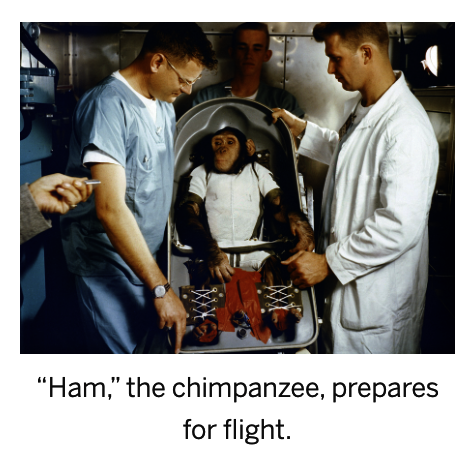
8 It isn’t an astronaut out there today. It’s a chimpanzee named Ham. No matter. We’ve all learned something today, beyond the lessons laid out so carefully in our mission plan. We learned on this flight, and will repeat the lesson on the many flights yet to come, that our first concern is for the crew. We’ve known this instinctively, of course, from the beginning of America’s program to put men into space. The crew comes first. But today, when things were going wrong, we learned just how visceral those instincts are.
9 I’m the flight director for this mission, Mercury-Redstone 2, the first mission in Project Mercury to put a living thing into space. Ham was the living thing, but we never thought of him as anything but crew.
10 We all have monikers. They call me Flight on the mission control intercom loop. The doctor—he and his brethren have given us fits for years—is Surgeon. The engineer responsible for getting the capsule down, for monitoring and calculating its retrofire systems, is Retro. Flight dynamics, the infant science of trajectories and propulsion, is the domain of FIDO. There are others, too. The voice link between mission control and the capsule is Capcom, short for “capsule communicator.”
11 Eventually, an astronaut would be Capcom, but today the console is manned by an engineer. Alan Shepard is nearby, in the launch blockhouse. He has a personal interest in today’s events. If the Redstone rocket and the Mercury capsule work well, and if Ham does his job on board that capsule, and if we do ours on the ground, Al will be next. He’ll be the world’s first man in space.
12 There’s only one flight director. From the moment the mission starts until the moment the crew is safe on board a recovery ship, I’m in charge. I ask. I listen. I make decisions. No one can overrule me. Not my immediate boss in the still-young National Aeronautics and Space Administration, the mission director, Walt Williams. Not his boss, a man I respect and revere, the guiding light of America’s manned space program, Bob Gilruth. Not even Jack Kennedy, the president of the United States, who’s only had his job for ten days or so. They can fire me after it’s over. But while the mission is under way, I’m Flight. And Flight is God.
13 I don’t feel so godly right now, I muse.
14 The problems on the launch pad weren’t so bad. I’d held the countdown when an electrical unit overheated and Ham started to get warm. He was strapped into a form-fitted couch and sealed in a small pressurized capsule where an astronaut would normally sit. If it had been Al up there, I could have asked the Capcom to inquire about his comfort. Knowing Al, he would have said something like “No sweat,” making a joke of the heating problem. And he would have changed settings on his environmental control unit to cool down a bit.
15 Ham and I didn’t have that option. Outer space was new territory for exploration, and nobody knew much about it. A lot of doctors were predicting that zero gravity would have dire consequences for the human body. Most of us, including test pilots and astronauts, didn’t believe them. But the only way to make our point was to substitute monkeys or chimpanzees for men, then see what happened. Al would gladly have traded places with Ham on that January day. He had supreme confidence in what rigors the human body—especially his own—could handle. The decision wasn’t his to make, so a trained chimp was out there on the pad.
16 Instead of passing an order to an astronaut, I told EECOM, on the environment, electrical, and communications console, to turn off Ham’s unit. While we waited for it to cool down, I asked Surgeon to evaluate Ham’s comfort level.
17 “He’s go, Flight.”
18 I took Surgeon at his word. In mission control, nobody lies to Flight. They tell what they know, or they tell me their best informed guess. There’s only one other option: “I don’t know, Flight.” Anybody who gives me that answer more than a few times will be looking for a new job.
19 We picked up the count and had the same problem. I held us for an hour this time, letting the electrical unit and Ham get comfortable again. But it was getting late; we wanted as much daylight as possible in the recovery area in case things went wrong. We should have launched at 9:30 A.M. Now it was after eleven. Then the elevator at the pad stuck. Another hold while a technician fixed the problem, and then the pad was clear.
20 By now, I’d stopped thinking of Ham as a monkey. Some of the jokesters were calling this a monkey flight, and the phrase had been picked up by the press. So had a one-liner from some nightclub comic who was pointing out that Ham was paving the way for Al Shepard. “First the chimp, then the chump,” that’s what some of them were saying. Al wasn’t amused, and neither was I.
21 In my mind as the countdown headed toward zero, Ham was a real astronaut, he was crew, and we were treating every moment just the way we would when it was Al up there on that skinny little, black-and-white rocket built by Wernher von Braun and the same Germans who’d bombed London. I heard the numbers in my headset.
22 “. . . three, two, one . . . lift off . . .”
Required
1
The author thinks of Ham, the chimpanzee, as “crew.” In what ways is Ham an astronaut? In what ways is he an animal test subject?
Required
1
Ham’s inability to communicate with Mission Control poses some problems. How do they get around these problems? How would it have been different if Ham were human?
Required
1
Why was a chimpanzee sent into space before a human?
Buzz Aldrin talks about the Apollo 11 mission’s high points and hazards.
“Buzz Aldrin on His Lunar Home, the Eagle” from The Wall Street Journal
Author: Marc Myers
1 Published: May 16, 2013
2 For 21½ hours, two astronauts lived aboard a cold, cramped lunar module with a balky circuit breaker.
3 —Buzz Aldrin, 83, was a member of the Apollo 11 moon mission and one of the first men to walk on the lunar surface. He is author of “Mission to Mars: My Vision for Space Exploration” (National Geographic). Mr. Aldrin was interviewed by reporter Marc Myers.
4 I can’t see the moon from my bedroom window. But I do like to go onto my patio to watch it rise majestically over Los Angeles. When I see the moon up there, I don’t say to myself, “Hey, I walked on your face,” or “Thanks for disrupting my life.” I just feel grateful it let us land safely in 1969 and let us take off.
5 Believe it or not, my mother’s maiden name was Moon. Her family came from Britain, and she suffered terribly from depression. Like my grandfather and cousins on her side of the family, she took her own life. It happened in 1968—a year before the Apollo 11 launch. It was tough, but I blocked it out by focusing on all the years she supported me—as did my father, who was an aviation pioneer and had known Orville Wright.
6 After Apollo 11 lifted off in Florida [on July 16, 1969], the three of us—me, Neil Armstrong and Mike Collins—traveled in space for three days to reach the moon’s orbit.
7 The next day, Neil and I climbed into the lunar module and detached from [command module] Columbia to begin our descent to the moon. We had to stand in the craft—the design didn’t allow for seats. Our feet were held down on the floor by elastic cords to keep us from floating around.
8 Landing on the moon—with all of the risks—sounds scary. But our training prepared us by concentrating on failures and solving big problems under extreme pressure.
9 Once we touched down at the Sea of Tranquility [on July 20], the Eagle was our home for the next 21½ hours. When I was a kid, my first airplane ride was in a propeller aircraft painted to look like an eagle and piloted by my father. The lunar module was named Eagle—and an eagle insignia was on our arm patch—so I felt safe.
10 On the moon, we had one-sixth of Earth’s gravity, allowing Neil and me to move around easily in the Eagle to put on equipment for our walk. The module’s color scheme wasn’t much—the interior was gray and industrial, and there were lots of labels with white and black text. Some handles were yellow, and there was a yellow guard around our telescope.
11 We ate freeze-dried packaged food and had a mix that became an orange-grapefruit drink when water was added. There was no coffee. The Columbia orbiting above had hot water, but not the Eagle.
12 Four hours after we touched down, Neil went out of the craft first to set up a TV camera pointed at Earth and take photos. I followed 20 minutes later. When I stepped onto the moon’s surface, it felt cushiony, not gravelly—thanks to all the dust. There was no crunchy sound under my boot.
13 The strangest feeling was standing on the surface and looking back home at Earth—where every other human being was except the three of us. One of the most famous pictures from the mission was taken by Neil of my gold helmet visor—with Neil and the Eagle reflected in it. If you look carefully, you’ll see smudges on both legs of my spacesuit.
14 When Neil had come down the ladder, he had to jump a little to drop to the next rung. His boots left moon dust on the last rung. So when I jumped a little coming down to the pad, I underestimated the leap and my shins brushed the last rung, picking up the dust.
15 Returning to the Eagle about two hours later, we had a problem. I noticed the engine arm’s circuit breaker on my side had detached. It had to be engaged somehow if the ascent engine was to fire and lift us off the surface.
16 Houston wanted us to sleep while they learned as much as possible about the breaker problem. But the module was freezing cold, so Neil and I put on our helmets, and I turned the heat full-up. I curled up on the floor, and Neil tried to sleep sitting on top of the asset engine cover. But he told me later that Earth’s bright blue light was shining through the Eagle’s telescope and into his eyes, keeping him awake. Not very homey—but we managed.
17 When Houston woke us several hours later, they told me what to do to fix the circuit breaker. I engaged it with a felt-tip pen. Since the pen was made of plastic, there wasn’t a risk of encountering electrical voltage when I pushed in the remainder of the disengaged breaker.
18 Once Houston concluded the problem was fixed, relief replaced concern. I felt we might make it home instead of perishing there. A short time later, Houston gave us the go-ahead: “Apollo 11 at Tranquility Base, you’re cleared for liftoff.” I responded, “Roger, Houston. We’re No. 1 on the runway.” Those were two absurdities, of course. There was no runway and no one else was behind us. A little space humor.
19 The Eagle was like home on the moon—only we didn’t have two wives telling us to clean up. We were the chief cooks and bottle-washers. So before we left, we put out the trash, just as we did back home. It’s all still sitting there on the lunar surface waiting for the trash collector.
Required
1
What was it like to live in the lunar module? Use three quotes from the text in your answer.
Required
1
What passage in the text tells you that Aldrin thought they might not make it home from the moon? Why was he worried?
Required
1
Describe what Armstrong and Aldrin did when they set foot on the moon. What was going through Aldrin’s mind as he stood on the moon?
Required
1
What did Valentina Tereshkova think the Vostok 6 sounded like as it took off?