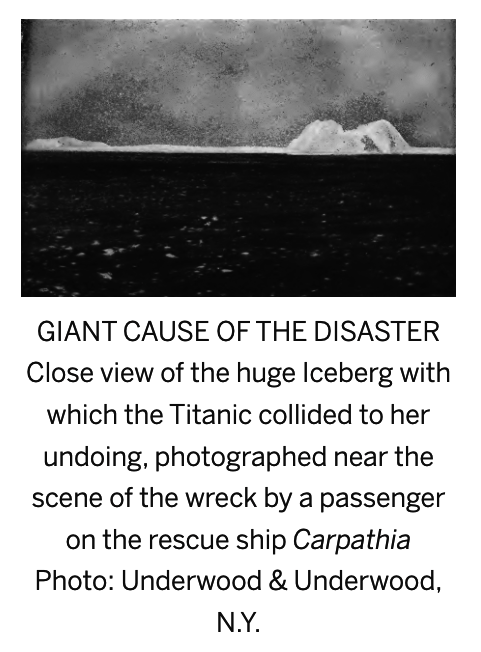
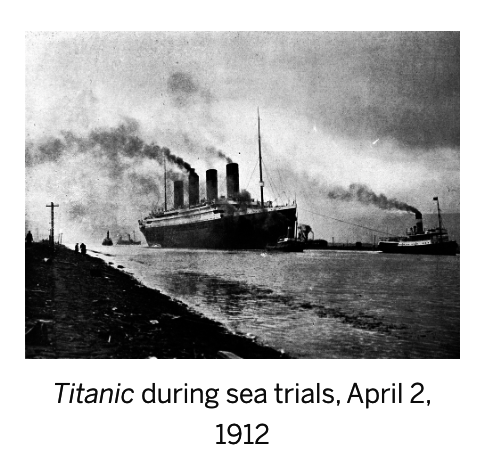
Copy of Titanic- Scavenger Hunt 1 (6/23/2025)
star
star
star
star
star
Last updated 6 months ago
48 questions
What Do We Know?
Required
1
What do you already know about the Titanic?
Required
1
1. Drag true statements about the Titanic into the box.
__________________________________ __________________________________________ _____________________________________________
Other Answer Choices:
Emergency plans were carefully made.
There were too few lifeboats.
There were too many lifeboats.
No one had confidence in this ship.
The people in charge were too confident.
Most survivors were from first class.
Required
1
The video narration says the Titanic was "deemed __________ unsinkable."
Required
1
Explain what you think the above quote really means. What was the Titanic “deemed,” or said to be?
Scavenger Hunt Part I
This letter was written by a Titanic survivor a few days after the the ship went down. In her letter, she attempted to describe to a loved one what that night was like for her and her mother.
A Letter from Mary Lines (1912)
1 On Board the
CUNARD
R.M.S. “CARPATHIA”
Wednesday April 16
2 My dearest;
3 God has been so good to us. My mother and I have been saved. I’m writing to you from the ship that picked us up. Oh, my darling, it was a horrible night, and I hope you never have to pass one like it.
4 I’m going to try to tell you everything. First, at a quarter to midnight, my mother felt that the ship had received a terrible blow. She jumps from her bed and wakes me up, for I was still asleep. Then we hear the sound of steam escaping with a frightful hissing. We ring for the steward who reassures us and tells us to go to bed. Then our next-door neighbors (Hilma and Ragnihild’s uncle and cousin) come down again and the father tells us there’s no danger at all. Then we go to bed. Ten minutes later we hear Mr. White who comes down and shouts to his son: “Richard! Life boats!” You can imagine that we hurried to get up, we quickly grabbed some coats, then we rushed to the deck. As I’m leaving our cabin I hear Mr. White’s son (he was just 21) shouting “Life belts!” I go back to look for them and there we are on deck. They tell us to go back down for a little while and since we weren’t dressed, my mother runs to look for our things. Since she was slow in returning I got worried and rushed to our cabin. I beg her to come and we roll up all our things in a blanket. Then as we were going up again we see everybody hurrying, hurrying. We arrive on deck and jump into a small rowing boat. They lower the boat on ropes down to the water; and there we are, away. Meanwhile I’d thrown away all our clothing, since the bundle was too big to bring along in the little boat. WE pull away from the Titanic as fast as possible, and a half hour later it sank. Oh! My darling, what a horrible thing, this enormous ship engulfed in the little space of two hours. And the cries of the dying as it sank!!! For there are only 700 saved out of two thousand, I believe. Finally we drifted on the sea, which by the grace of God was calm like your pond at Brion, for three and a half hours. At four o’clock we made out a ship in the distance, and the men started to row with all their might; and soon we were picked up by this ship. I’ll never forget this sunrise; the sky clear as a glass of water, the sea calm as a mirror, and the enormous icebergs surrounding us, white as swans. Then all of a sudden on the horizon these two stars, but steady stars that didn’t fade and that soon appeared as ship’s lights. How happy we were. You can’t imagine it. God has shown miraculous clemency and mercy towards us.
5 There are still lots of details of this frightful night that would interest you, but I’ll write them to you later or I’ll tell you about them when I see you again, if God grants that I see you again. We are now surrounded by a thick, thick fog, and I don’t know when we’ll see New York.
6 Oh! My darling, help me to thank God for his inexpressible goodness!
7 My mother isn’t very well today. She’s beginning to feel the fatigues of the other night.
8 Naturally we’ve lost everything. My dresses, my hats, everything is at the bottom of the sea.
9 Au revoir, my dear, write me soon. Our address will be:
10 158 Archer Avenue
11 Mount Vernon
12 New York
13 With heaps of love
14 Yours as ever – Mary
Required
1
What things do Mary and her family attempt to bring on the lifeboat?
Required
1
List three similes that Mary uses to describe the ocean and the iceberg.
Required
1
Was the experience of getting into a lifeboat orderly or chaotic? Were passengers kept informed about what was happening to the ship? Explain your answer.
Excerpt: “Testimony of Olaus Abelseth” from United States Senate Inquiry
May 3, 1912 (public domain)
Day 13
1 (testimony taken separately before Senator William Alden Smith, chairman of the subcommittee.)
2 (The witness was sworn by Senator Smith.)
Senator SMITH.
3 How old are you?
Mr. ABELSETH.
4 Twenty-six years of age in June.
Senator SMITH.
5 Did you sail on the Titanic?
Mr. ABELSETH.
6 Yes.
Senator SMITH.
7 From what port?
Mr. ABELSETH.
8 From Southampton.
Senator SMITH.
9 Where had you been?
Mr. ABELSETH.
10 I had been in Norway. I left here last fall.
Senator SMITH.
11 Where do you live now?
Mr . ABELSETH.
12 My home is in South Dakota, where I have my homestead.
Senator SMITH.
13 I wish you would tell the reporter when you first knew of this collision, and what you did, and where you were in the ship. I believe you were a steerage passenger?
Mr. ABELSETH.
14 Yes, sir.
Senator SMITH.
15 In the forward part of the ship?
Mr. ABELSETH.
16 Yes, I was in compartment G on the ship.
Senator SMITH.
17 Go ahead and tell us just what happened.
Mr. ABELSETH.
18 I went to bed about 10 o’clock Sunday night, and I think it was about 15 minutes to 12 when I woke up; and there was another man in the same room—two of us in the same room—and he said to me, “What is that?” I said, “I don’t know, but we had better get up.” So we did get up and put our clothes on, and we two went up on deck in the forward part of the ship.
19 Then there was quite a lot of ice on the starboard part of the ship. They wanted us to go down again, and I saw one of the officers, and I said to him: “Is there any danger?” He said, “No.” I was not satisfied with that, however, so I went down and told my brother-in-law and my cousin, who were in the same compartment there. They were in the same room, but they were just a little ways from where I was. I told them about what was happening, and I said they had better get up. Both of them got up and dressed, and we took our overcoats and put them on. We did not take any lifebelts with us. There was no water on the deck at that time . . .
20 . . . We all went up on deck and stayed there. We walked over to the port side of the ship, and there were five of us standing, looking, and we thought we saw a light.
Senator SMITH.
21 On what deck were you standing?
Mr. ABELSETH.
22 Not on the top deck, but on—I do not know what you call it, but it is the hind part, where the sitting room is; and then there is a kind of a little space in between, where they go up on deck. It was up on the boat deck, the place for the steerage passengers on the deck. We were then on the port side there, and we looked out at this light. I said to my brother-in-law: “I can see it plain, now. It must be a light.”
Senator SMITH.
23 How far away was it?
Mr. ABELSETH.
24 I could not say, but it did not seem to be so very far. I thought I could see this mast light, the front mast light. That is what I thought I could see.
25 A little while later there was one of the officers who came and said to be quiet, that there was a ship coming. That is all he said . . .
26 . . . There were a lot of steerage people there that were getting on one of these cranes that they had on deck, that they used to lift things with. They can lift about two and a half tons, I believe. These steerage passengers were crawling along on this, over the railing, and away up to the boat deck. A lot of them were doing that.
Senator SMITH.
27 They could not get up there in any other way?
Mr. ABELSETH.
28 This gate was shut.
Senator SMITH.
29 Was it locked?
Mr. ABELSETH.
30 I do not know whether it was locked, but it was shut so that they could not go that way . . .
31 . . . We stayed a little while longer, . . . We were standing there looking at them lowering this boat. We could see them, some of the crew helping take the ladies in their arms and throwing them into the lifeboats. We saw them lower this boat, and there were no more boats on the port side.
32 So we walked over to the starboard side of the ship, and just as we were standing there one of the officers came up and he said just as he walked by, “Are there any sailors here?”
33 I did not say anything. I have been a fishing man for six years . . . I would have gone, but my brother-in-law and my cousin said, in the Norwegian language, as we were speaking Norwegian: “Let us stay here together.” I do not know, but I think the officer wanted some help to get some of these collapsible boats out. All he said was: “Are there any sailors here?” I did not say anything, but I have been used to the ocean for a long time. I commenced to work on the ocean when I was 10 years old with my dad fishing. I kept that up until I came to this country.
34 Then we stayed there, and we were just standing still there. We did not talk very much. Just a little ways from us I saw there was an old couple standing there on the deck, and I heard this man say to the lady, “Go into the lifeboat and get saved.” . . . She replied: “No, let me stay with you.” I could not say who it was, but I saw that he was an old man. I did not pay much attention to him, because I did not know him.
35 I was standing there, and I asked my brother-in-law if he could swim and he said no. I asked my cousin if he could swim and he said no. So we could see the water coming up, the bow of the ship was going down, and there was a kind of an explosion. We could hear the popping and cracking, and the deck raised up and got so steep that the people could not stand on their feet on the deck. So they fell down and slid on the deck into the water right on the ship. Then we hung onto a rope in one of the davits. We were pretty far back at the top deck.
36 My brother-in-law said to me, “We had better jump off or the suction will take us down.” . . . So, then, it was only about 5 feet down to the water when we jumped off. It was not much of a jump. Before that we could see the people were jumping over. There was water coming onto the deck, and they were jumping over, then, out in the water.
37 My brother-in-law took my hand just as we jumped off; and my cousin jumped at the same time. When we came into the water, I think it was from the suction—or anyway we went under, and I swallowed some water. I got a rope tangled around me, and I let loose of my brother-in-law’s hand to get away from the rope. I thought then, “I am a goner.” That is what I thought when I got tangled up in this rope. But I came on top again, and I was trying to swim, and there was a man—lots of them were floating around—and he got me on the neck like that (illustrating) and pressed me under, trying to get on top of me. I said to him, “Let go.” Of course, he did not pay any attention to that, but I got away from him. Then there was another man, and he hung on to me for a while, but he let go. Then I swam; I could not say, but it must have been about 15 or 20 minutes. It could not have been over that. Then I saw something dark ahead of me. I did not know what it was, but I swam toward that, and it was one of those collapsible boats.
38 When we jumped off the ship, we had life preservers on. There was no suction from the ship at all. I was lying still, and I thought “I will try to see if I can float on the lifebelt without help from swimming,” and I floated easily on the lifebelt.
39 When I got on this raft or collapsible boat, they did not try to push me off and they did not do anything for me to get on. All they said when I got on there was, “Don’t capsize the boat.” So I hung onto the raft for a little while before I got on.
40 Some of them were trying to get up on their feet. They were sitting down or lying down on the raft. Some of them fell into the water again. Some of them were frozen; and there were two dead, that they threw overboard.
41 I got on this raft or collapsible boat and raised up, and then I was continually moving my arms and swinging them around to keep warm. There was one lady aboard this raft, and she got saved. I do not know her name. I saw her on board the Carpathia, but I forgot to ask her name. There were also two Swedes, and a first class passenger—I believe that is what he said—and he had just his underwear on. I asked him if he was married, and he said he had a wife and child. There was also a fireman named Thompson on the same raft. He had burned one of his hands. Also there was a young boy, with a name that sounded like Volunteer. He was at St. Vincent’s Hospital afterwards. Thompson was there, too.
42 The next morning we could see some of the lifeboats. One of the boats had a sail up, and he came pretty close, and then we said, “One, two, three”: we said that quite often. We did not talk very much, except that we would say, “One, two, three,” and scream together for help . . .
. . . Senator SMITH.
43 Did you see any icebergs on that morning?
Mr. ABELSETH.
44 We saw three big ones. They were quite a ways off.
Senator SMITH.
45 I want to direct your attention again to the steerage. Do you think the passengers in the steerage and in the bow of the boat had an opportunity to get out and up on the decks, or were they held back?
Mr. ABELSETH.
46 Yes, I think they had an opportunity to get up.
Senator SMITH.
47 There were no gates or doors locked, or anything that kept them down?
Mr. ABELSETH.
48 No, sir; not that I could see.
Senator SMITH.
49 You said that a number of them climbed up one of these cranes?
Mr ABELSETH.
50 That was on top, on the deck; after they got on the deck. That was in order to get up on this boat deck.
Senator SMITH.
51 Onto the top deck?
Mr. ABELSETH.
52 Onto the top deck; yes. But down where we were, in the rooms, I do not think there was anybody that help anybody back.
Senator SMITH.
53 You were not under any restraint? You were permitted to go aboard the boats the same as other passengers?
Mr. ABELSETH.
54 Yes, sir.
Senator SMITH.
55 Do you think the steerage passengers in your part of the ship all got out?
Required
1
What words did Mr. Abelseth use to describe the noises he heard as the Titanic sank? Where was Mr. Abelseth when he heard these noises and what did he see?
Required
1
What was Mr. Abelseth’s response when a call went out for sailors to step up and help after the ship hit the iceberg? Why did he react this way?
Required
1
After reading Mr. Abelseth’s testimony, do you think steerage passengers were locked below deck after the Titanic hit the iceberg? Explain your answer using evidence from the testimony.
Required
2
Which two of these words did Mr. Abelseth use to describe the noises he heard as the Titanic sank?
Required
1
When Mr. Abelseth heard these noises he was __________
Required
7
Review paragraphs 31–41.
Who did Mr. Abelseth see or hear while he was still on the Titanic?
Review paragraphs 31–41.
Who did Mr. Abelseth see or hear while he was still on the Titanic?
Yes | No | |
|---|---|---|
An officer looking for sailors | ||
A woman looking for her secretary | ||
Mr. Abelseth’s brother-in law | ||
A fishing man | ||
An old man talking to his wife | ||
Mr. Abelseth’s cousin | ||
The captain of the Titanic |
Required
1
PART I: Look back at paragraphs 39–40.
Judging from Mr. Abelseth's testimony, being in a lifeboat meant you survived. __________
Required
1
PART II:Copy and paste or type 1-2 pieces of evidence from the text to support your answer.
Excerpt: Chapter 7—“There Is Your Beautiful Nightdress Gone” from A Night to Remember
Author: Walter Lord
Publisher: Henry Holt and Company, LLC, New York, NY
Published: 1955
1 As the sea closed over the Titanic, Lady Cosmo Duff Gordon in Boat 1 remarked to her secretary Miss Francatelli, “There is your beautiful nightdress gone.”
2 A lot more than Miss Francatelli’s nightgown vanished that April night. Even more than the largest liner in the world, her cargo, and the lives of 1,502 people.
3 Never again would men fling a ship into an ice field, heedless of warnings, putting their whole trust in a few thousand tons of steel and rivets. From then on Atlantic liners took ice messages seriously, steered clear, or slowed down. Nobody believed in the “unsinkable ship.”
4 Nor would icebergs any longer prowl the seas untended. After the Titanic sank, the American and British governments established the International Ice Patrol, and today Coast Guard cutters shepherd errant icebergs that drift toward the steamer lanes. The winter lane itself was shifted further south, as an extra precaution.
5 And there were no more liners with only part-time wireless. Henceforth every passenger ship had a 24-hour radio watch. Never again could the world fall apart while a Cyril Evans lay sleeping off-duty only ten miles away.
6 It was also the last time a liner put to sea without enough lifeboats. The 46,328-ton Titanic sailed under hopelessly outdated safety regulations. An absurd formula determined lifeboat requirements: all British vessels over 10,000 tons must carry 16 lifeboats with a capacity of 5,500 cubic feet, plus enough rafts and floats for 75 percent of the capacity of the lifeboats.
7 For the Titanic this worked out at 9,625 cubic feet. This meant she had to carry boats for only 962 people. Actually, there were boats for 1,178—the White Star Line complained that nobody appreciated their thoughtfulness. Even so, this took care of only 52 percent of the 2,207 people on board, and only 30 percent of her total capacity. From then on the rules and formulas were simple indeed—lifeboats for everybody.
8 And it was the end of class distinction in filling the boats. The White Star Line always denied anything of the kind—and the investigators backed them up—yet there’s overwhelming evidence that the steerage took a beating: Daniel Buckley kept from going into First Class . . . Olaus Abelseth released from the poop deck as the last boat pulled away . . . Steward Hart convoying two little groups of women topside, while hundreds were kept below . . . steerage passengers crawling along the crane from the well deck aft . . . others climbing vertical ladders to escape the well deck forward.
9 Then there were the people Colonel Gracie, Lightoller and others saw surging up from below, just before the end. Until this moment Gracie was sure the women were all off—they were so hard to find when the last boats were loading. Now, he was appalled to see dozens of them suddenly appear. The statistics suggest who they were—the Titanic’s casualty list included four of 143 First Class women (three by choice) . . . 15 of 93 Second Class women . . . and 81 of 179 Third Class women.
10 Not to mention the children. Except for Lorraine Allison, all 29 First and Second Class children were saved, but only 23 out of 76 steerage children.
11 Neither the chance to be chivalrous nor the fruits of chivalry seemed to go with a Third Class passage.
12 It was better, but not perfect, in Second Class. Lawrence Beesley remembered an officer stopping two ladies as they started through the gate to First Class. “May we pass to the boats?” they asked.
13 “No, madam; your boats are down on your own deck.”
14 In fairness to the White Star Line, these distinctions grew not so much from set policy as from no policy at all. At some points the crew barred the way to the Boat Deck; at others they opened the gates but didn’t tell anyone; at a few points there were well-meaning efforts to guide the steerage up. But generally Third Class was left to shift for itself. A few of the more enterprising met the challenge, but most milled helplessly about their quarters—ignored, neglected, forgotten.
15 If the White Star Line was indifferent, so was everybody else. No one seemed to care about Third Class—neither the press, the official Inquiries, nor even the Third Class passengers themselves.
16 In covering the Titanic, few reporters bothered to ask the Third Class passengers anything. The New York Times was justly proud of the way it handled the disaster. Yet the famous issue covering the Carpathia’s arrival in New York contained only two interviews with Third Class passengers. This apparently was par for the course—of 43 survivor accounts in the New York Herald, two again were steerage experiences.
17 Certainly their experiences weren’t as good copy as Lady Cosmo Duff Gordon (one New York newspaper had her saying, “The last voice I heard was a man shouting, ‘My God, my God!’”). But there was indeed a story. The night was a magnificent confirmation of “women and children first,” yet somehow the loss rate was higher for Third Class children than First Class men. It was a contrast which would never get by the social consciousness (or news sense) of today’s press.
18 Nor did Congress care what happened to Third Class. Senator Smith’s Titanic investigation covered everything under the sun, including what an iceberg was made of (“Ice,” explained Fifth Officer Lowe), but the steerage received little attention. Only three of the witnesses were Third Class passengers. Two of these said they were kept from going to the Boat Deck, but the legislators didn’t follow up. Again, the testimony doesn’t suggest any deliberate hush-up—it was just that no one was interested.
19 The British Court of Enquiry was even more cavalier. Mr. W. D. Harbinson, who officially represented the Third Class interests, said he could find no trace of discrimination, and Lord Mersey’s report gave a clean bill of health—yet not a single Third Class passenger testified . . .
Required
4
List four changes in ocean travel that occurred as a result of the Titanic disaster.
Required
1
How were third-class (or steerage) passengers treated on the Titanic?
Required
1
Do you think the inquiries on the sinking of the Titanic held in the United States and England were fair or unfair? Explain your answer.
Required
1
According to the article, what belief was lost along with the Titanic?
Excerpts from various public domain sources: Final Wireless Transmissions Aboard the RMS Titanic
April 14, 1912; 1.40 pm
SS Baltic to RMS Titanic:
1 Captain Smith, Titanic. Have had moderate variable winds and clear fine weather since leaving. Greek steamer Athenai reports passing icebergs and large quantity of field ice today in latitude 41.51 N, longitude 49.52 W. Last night we spoke (with) German oil tanker Deutschland, Stettin to Philadelphia, not under control, short of coal; latitude 40.42 N, longitude 55.11 W. Wishes to be reported to New York and other steamers. Wish you and “Titanic” all success.
April 14, 1912; 7.30 pm
SS Antillian to RMS Titanic:
2 “6.30 p.m., apparent time, ship; latitude 42.3 N, longitude 49.9 W. Three large bergs five mile to southward of us.”
April 14, 1912; 9:30 pm
SS Mesaba to RMS Titanic and All Eastbound Ships:
3 Ice report: In latitude 42 N to 41.25 N, longitude 49 W to 50.3 W. Saw much heavy pack ice and great number of large icebergs, also field ice. Weather good, clear.
April 14, 1912; 9.35 pm
RMS Titanic to SS Mesaba:
4 Received, thanks.
April 14, 1912; 9.38 pm
SS Mesaba to RMS Titanic:
5 Stand by.
14 April 1912; 11.00 p.m. (approx)
RMS Californian to RMS Titanic:
6 Say, old man, we are stopped and surrounded by ice.
14 April 1912; 11.10 p.m. (approx)
RMS Titanic to RMS Californian:
7 Keep out! Shut up, shut up! I am busy, I am working Cape Race.
14 April 1912; 11.15 p.m. (approx)
RMS Titanic to Cape Race, Newfoundland:
8 Sorry, please repeat. Jammed.
15 April 1912; 12.15 a.m.
RMS Titanic to Any Ship:
9 CQD Titanic 41.44 N 50.24 W [CQD means distress]
15 April 1912; 12.17 a.m.
RMS Titanic to Any Ship:
10 CQD CQD SOS Titanic Position 41.44 N 50.24 W. Require immediate assistance. Come at once. We struck an iceberg. Sinking.
15 April 1912; 12.20 a.m.
RMS Titanic to RMS Carpathia:
11 Come at once. We have struck a berg. It’s a CQD, old man. Position 41.46 N 50.14 W
15 April 1912; 12.21 a.m.
RMS Carpathia to RMS Titanic:
12 I say old man, do you know there is a batch of messages coming through for you from MCC?
15 April 1912; 12.22 a.m.
RMS Titanic to RMS Carpathia:
13 CQD CQD
15 April 1912; 12.25 a.m.
RMS Carpathia to RMS Titanic:
14 Shall I tell my captain? Do you require assistance?
15 April 1912; 12.26 a.m.
RMS Titanic to RMS Carpathia:
15 Yes, come quick!
15 April 1912; 12.32 a.m.
RMS Carpathia to RMS Titanic:
16 Putting about and heading for you.
15 April 1912; 12.40 a.m.
RMS Titanic to RMS Carpathia:
17 SOS Titanic sinking by the head. We are about all down. Sinking . . .
Required
1
What was the weather like on the night the Titanic sank?
Required
1
How many warnings of icebergs did the Titanic operator receive?
Required
1
How much time elapsed from the first mention of hitting an iceberg to the last transmission?
Discovery of the Titanic
Author: Lapham’s Quarterly editors
2014
1 Just after midnight on September 1, 1985, the explorers aboard the research boat Knorr settled into their positions. Some slept; two men watched a video feed of the ocean floor below them; Lieutenant George Rey monitored the sonar; and the leader of their expedition, Robert Ballard, laid down in his bunk with a book. The twenty-five person crew was looking for the Titanic. They knew somewhere in the North Atlantic lay the sunken wreck. But no one was certain where, and their mission was made harder still by the two and a half miles of cold, dark water separating them from the ocean floor; a distance that made it dangerous and impractical to search for the wreck in a submarine. The crew was tired and numb—for six days, they had tracked endless miles of featureless mud on the ocean floor, and they were becoming discouraged.
2 During her tragic journey, the coordinates given by the Titanic in her distress call had proven incorrect, and all previous expeditions to find the remains of the famous ship had failed. Oceanographer Robert Ballard had always dreamt of finding the wreck, to him finding the Titanic would be like scaling a “mountain that had never been climbed.” He’d even tried to find the Titanic once before, in 1977, and had been unsuccessful. He wanted to try again and asked for the support of the U.S. Navy to help build underwater robotic technology he needed to find the ship. The navy agreed on the following condition: Ballard would first have to find two sunken nuclear submarines—the USS Thresher and the USS Scorpion. If he first found and photographed the lost submarines, he was then free to use the navy’s resources and underwater robots to search for the Titanic.
3 Ballard completed the navy’s assignment in late August and had just twelve days left to find the Titanic. He had a new search strategy—rather than looking just for the ship, he and his crew would look for a debris trail. A sinking ship leaves a path of debris, since parts of the ship break off and fragments scatter as it sinks. The Titanic, which sank two and a half miles below the surface of the Atlantic, would be somewhere within a huge debris field. Argo, an underwater robot fitted with cameras, glided back and forth across a 100-square-mile search area—a procedure that they called “mowing the lawn”—looking for any signs of the enormous sunken ocean liner.
4 Around 1 AM, Bill Lange and Stu Harris, the two crew members watching the underwater video feed, noticed something unusual on the ocean floor. Instead of mud, they began to glimpse man-made objects, wreckage, and, finally, a gigantic boiler. This evidence was unmistakable; the Titanic was somewhere nearby. News spread around the ship and the rest of the crew gathered excitedly around them, watching the images on screen grow more vivid. They saw the Titanic’s portholes, railings, and deck.
5 The expedition explained a lot about the ship’s sinking. Before the wreck was discovered, no one knew where the Titanic lay or whether she sank in one piece. For the first time in 73 years, it was evident that the ship cracked in half and her boilers could be seen embedded in the ocean’s floor. After lots of cheering and clapping, the crew grew silent as the time drew nearer to 2 AM, (the hour of the ship’s sinking) in remembrance of the approximately 1,500 people who died during the disaster.
6 One year later, in 1986, Ballard returned to make a detailed study of the wreck from a deep-sea submarine called Alvin, which he had helped design. Alvin was small, only fitting three people, and was equipped with a titanium hull that gave her the stability to withstand the water pressure 13,000 feet below the surface. Ballard explored the ship’s remains and collected photographs of her once-majestic interior—the Grand Staircase, the chandeliers, and the intricate ironwork were still in place.
7 It has been estimated that, in 50 years, the hull of the Titanic may collapse entirely. This is partly due to damage from the many exploratory trips since Ballard’s missions and partly due to iron-eating bacteria on the ship’s hull. To protect the delicate remains, the R.M.S. Titanic Maritime Memorial Act was passed in 1986, which designates the wreckage an international memorial to those who lost their lives in the disaster. The act ensures that the wreckage will be used respectfully for exploration and research and will not be plundered for memorabilia.
Required
1
Name two reasons why it was so hard for the Knorr to find the wreck of the Titanic.
Required
1
What strategy did Ballard use for finding the sunken ship?
Required
1
What is expected to happen to the wreck of the Titanic in 50 years' time? Why?
Excerpt: “The Iceberg Was Only Part of It” from The New York Times
Author: William J. Broad
Published: April 10, 2012
1 What doomed the Titanic is well known, at least in outline. On a moonless night in the North Atlantic, the liner hit an iceberg and disaster ensued, with 1,500 lives lost.
2 Hundreds of books, studies and official inquiries have addressed the deeper question of how a ship that was so costly and so well built — a ship declared to be unsinkable — could have ended so terribly. The theories vary widely, placing the blame on everything from inept sailors to flawed rivets.
3 Now, a century after the liner went down in the early hours of April 15, 1912, two new studies argue that rare states of nature played major roles in the catastrophe.
4 The first says Earth’s nearness to the Moon and the Sun — a proximity not matched in more than 1,000 years — resulted in record tides that help explain why the Titanic encountered so much ice, including the fatal iceberg.
5 And a second, put forward by a Titanic historian from Britain, contends that the icy waters created ideal conditions for an unusual type of mirage that hid icebergs from lookouts and confused a nearby ship as to the liner’s identity, delaying rescue efforts for hours.
6 The author, Tim Maltin, said his explanation helps remove the stain of blunder from what he regards as a tragedy.
7 “There were no heroes, no villains,” Mr. Maltin said in an interview. “Instead, there were a lot of human beings trying to do their best in the situation as they saw it.” The title of his new book, “Titanic: A Very Deceiving Night,” . . . alludes to how mirages could have wrought havoc with human observations.
8 Scholars of the Titanic, as well as scientists, are debating the new theories. Some question whether natural factors can outweigh the significance of ineptitude. Others find the mirage explanation plausible — but only in limited scenarios. Over all, though, many experts are applauding the fresh perspectives . . .
9 . . . From the start, news reports and inquiries said that the ice in the North Atlantic was unusually bad that year. The New York Times, in an article shortly after the sinking, quoted United States officials as saying that the winter had produced “an enormously large crop of icebergs.”
10 Recently, a team of researchers from Texas State University-San Marcos and Sky & Telescope magazine found an apparent explanation in the heavens. They published their findings in the magazine’s April issue.
11 The team discovered that Earth had come unusually close to the Sun and Moon that winter, enhancing their gravitational pulls on the ocean and producing record tides. The rare orbits took place between December 1911 and February 1912 — about two months before the disaster.
12 The researchers suggest that the high tides refloated masses of icebergs traditionally stuck along the coastlines of Labrador and Newfoundland and sent them adrift into the North Atlantic shipping lanes.
13 “We don’t claim that our idea is conclusive,” Donald Olson, a physicist at Texas State, said in an interview. But, he added, the team continues to gather new supporting evidence.
14 Dr. Olson said that after the study’s publication, “we found there had been remarkable tidal events around the globe — in England and New Zealand.” A Sydney newspaper, he noted, had a headline that told of “record tides.”
15 The icy waters that night created ideal conditions for an unusual kind of mirage, according to Mr. Maltin, who owns a public relations firm in London and has written three books on the Titanic. Andrew T. Young, an astronomer and mirage specialist at San Diego State University, helped him refine his theory.
16 Most people know mirages as natural phenomena caused when hot air near the Earth’s surface bends light rays upward. In a desert, the effect prompts lost travelers to mistake patches of blue sky for pools of water.
17 But another kind of mirage occurs when cold air bends light rays downward. In that case, observers can see objects and settings far over the horizon. The images often undergo quick distortions — not unlike the wavy reflections in a funhouse mirror.
18 In an interview, Mr. Maltin said he first learned of the possibility of cold mirages when reading a 1992 British inquiry on the Titanic’s sinking. It suggested that the icy waters could have cooled the adjacent air and warped images that confused the Californian, a ship nearby that could have rushed to the Titanic’s aid but instead did nothing.
19 Fascinated, Mr. Maltin, who sailed boats in his youth, dug into navigational records and found that both the Californian and the Titanic had moved into the icy Labrador Current that night and had encountered conditions ideal for cold mirages. He then hunted through reams of official and unofficial testimony to see what people saw — or what they thought they saw.
20 A drama of misperceptions ensues. Mr. Maltin’s book shows how mirages could have created false horizons that hid the iceberg from the Titanic’s lookouts. By this theory, the intersection of dark sea and starry sky would have looked blurry, reducing the contrast with the looming iceberg.
21 Mr. Maltin cites three lookouts on the Titanic who, despite the night’s remarkable clarity, testified to seeing an unusual haze on the horizon.
22 George Symons described the distant view as “rather hazy.”
23 Frederick Fleet told an official inquiry of a “slight haze” on the horizon before the Titanic struck the iceberg. He said it was significant enough to have discussed with a colleague.
24 Reginald Lee, his shipmate, described the iceberg as “a dark mass that came through that haze.”
25 Mr. Maltin suggests that the speeding Titanic would have slowed down if its crew and officers had understood how the cold night was bending light in confusing ways.
26 As for the failed rescue, Mr. Maltin cites testimony that he sees as revealing the role of natural trickery. The Californian — a modest steamer with a small smokestack — knew the luxury liner was nearby but wrote off sightings of its lights and distress rockets.
27 Mr. Maltin calculates that the two ships were about 10 miles apart when both stopped and began drifting in the Labrador Current. But cold mirages, he says, let the crews see the vessels as much closer — on the order of five miles. One Titanic officer said he could see the Californian’s porthole lights.
28 This sense of closeness — as well as the funhouse distortions inherent in the play of mirages — helped create a disastrous series of false impressions, Mr. Maltin argues . . .
29 . . . The Californian’s captain, Stanley Lord, said the nearby ship seemed to be a medium-size steamer rather than a giant passenger liner bearing four huge smokestacks. “I am positive,” he testified, “it was not the Titanic.” . . .
30 . . . The Californian’s captain is often vilified as irresponsible and criminally negligent. But Mr. Maltin says Captain Lord may have genuinely mistaken the giant liner for a small ship.
31 The title for Mr. Maltin’s book comes from the concluding remarks the captain made when asked by an inquiry about the causes of the disaster.
32 “It was,” he replied, “a very deceiving night.”
Required
1
Why were there unusually high tides two months before the Titanic sank?
Required
1
How does the cold water mirage theory explain why the Californian didn’t come to the rescue of the Titanic’s passengers and crew?
Required
1
How could a cold mirage have played a part in the sinking of the Titanic? This is an unusual argument to find in The New York Times. Trace the scientist's argument. Pick the evidence that you find most convincing and the evidence that you find most outrageous. Explain why.
Required
1
Which lifeboat rescued Miss Francatelli and her boss from the sinking Titanic?
Required
1
At what time did the Titanic receive the first report of large quantities of ice in the area?
Scavenger Hunt Part II

Required
1
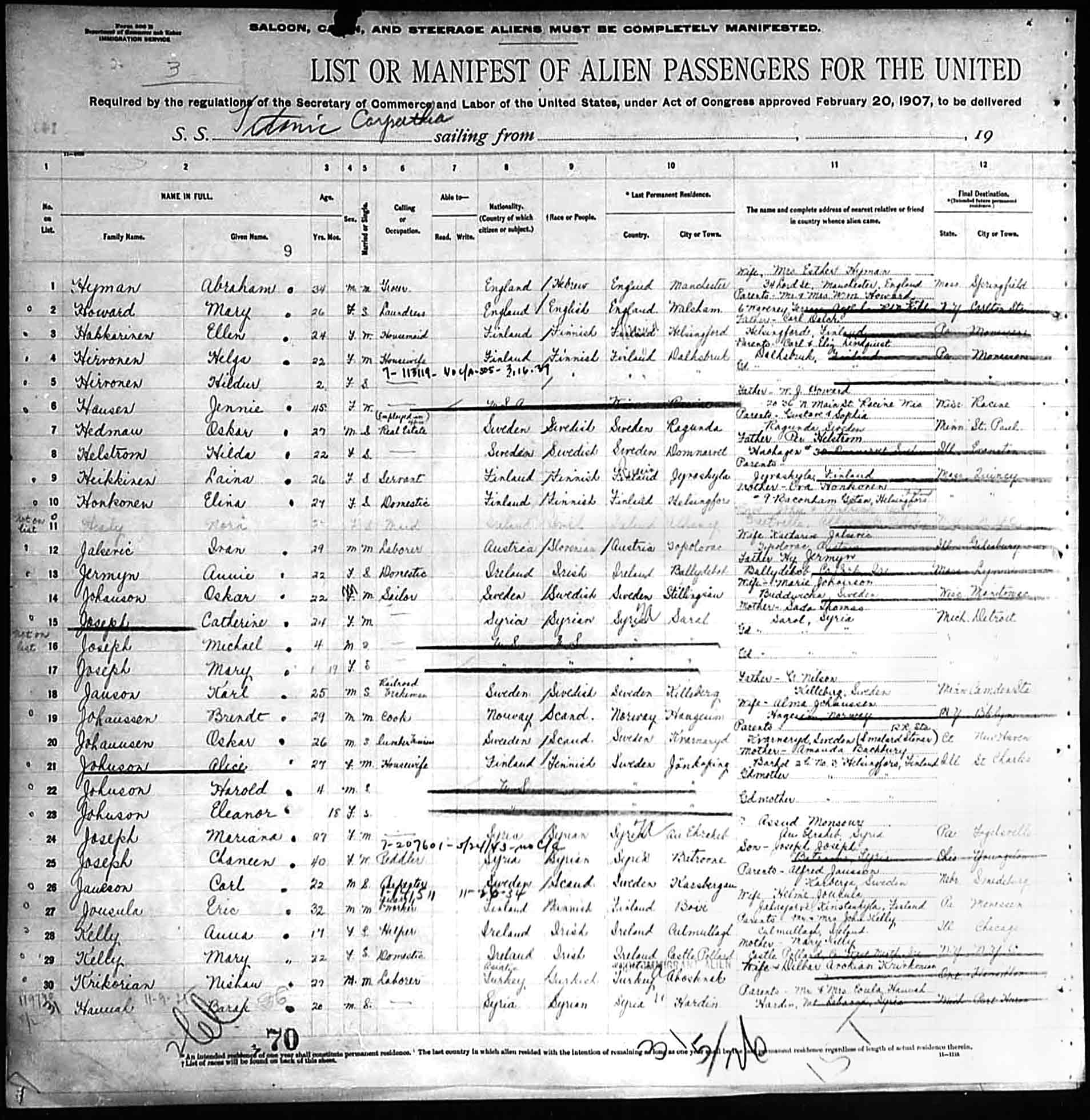
Examine the “Calling or Occupation” column. What class do you think most of these passengers were traveling in?
Required
1
Do you think that the government was asking for useful information? If you were the one taking a survey of the survivors of the Titanic, what questions would you have asked them and why?
Required
1
For lines 22 and 23, Harold and Eleanor Johnson, it is MOST likely that column 6, “Calling or Occupation,” was left blank because of their __________
Required
8
How many people from each of the countries listed were on the ship's manifest?
1-2 | 3-4 | 5-6 | |
|---|---|---|---|
England | |||
Ireland | |||
Norway | |||
Finland | |||
Sweden | |||
Austria | |||
Syria | |||
Turkey |
Required
2
Which two things do all of the people on this list have in common?
________________________________________________ ______________________________
Other Answer Choices:
Last names in the same part of the alphabet
Countries of origin that are on the same continent
Similar ages
Related jobs or occupations
Same gender
Passengers on the Titanic
Required
2
Do you think the information on this manifest was useful? If you were the one taking a survey of the survivors of the Titanic, what questions would you have asked them, and why?

Required
1
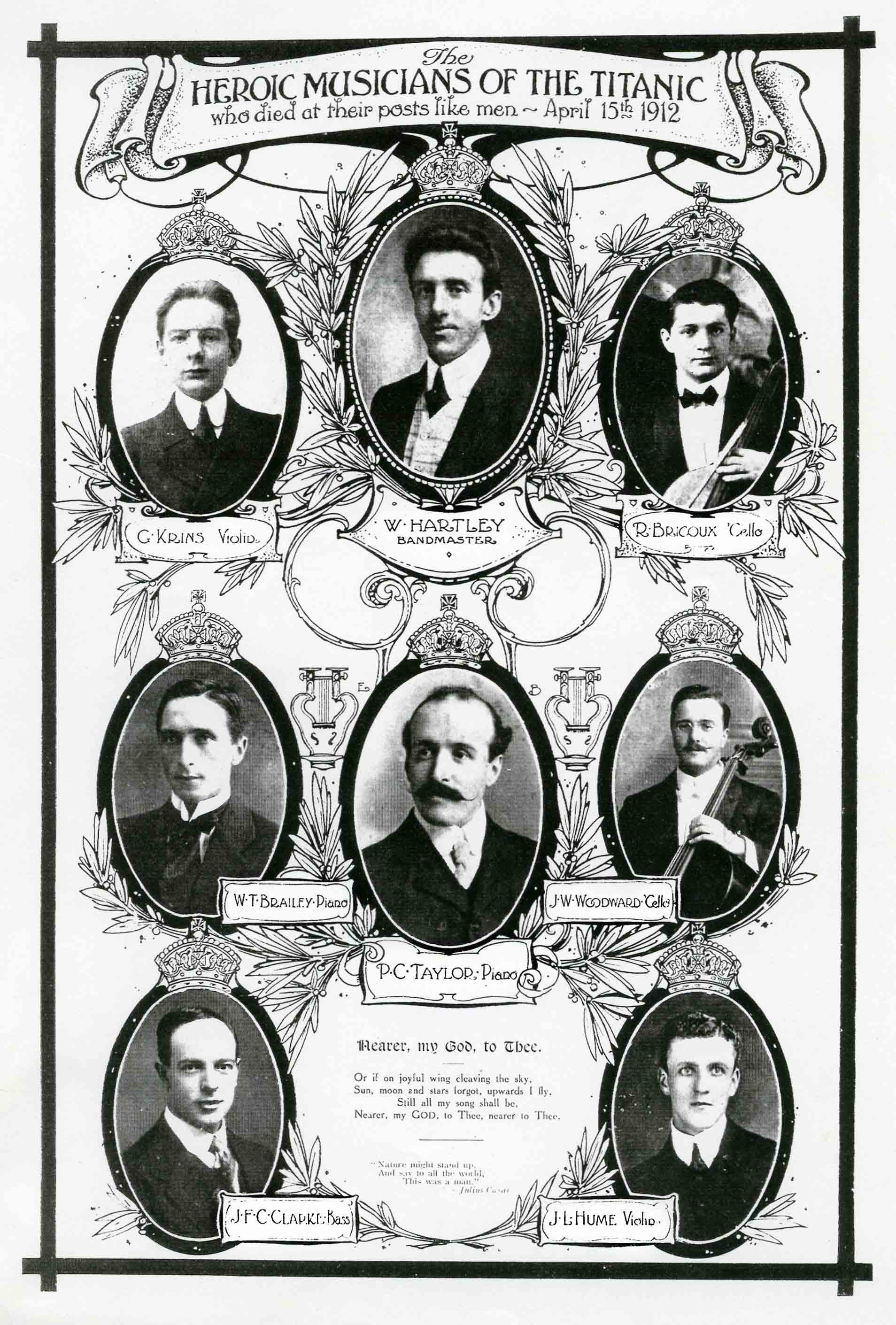
What’s the most notable decorative element used in framing the photos of the musicians? Why do you think the artist chose this image?
Required
1
The title states that the musicians “died at their posts like men.” Rewrite this part of the title using your own words.
Required
1
Why do you think that the band decided to stay on deck and play music, even as the ship began to sink?

Required
1
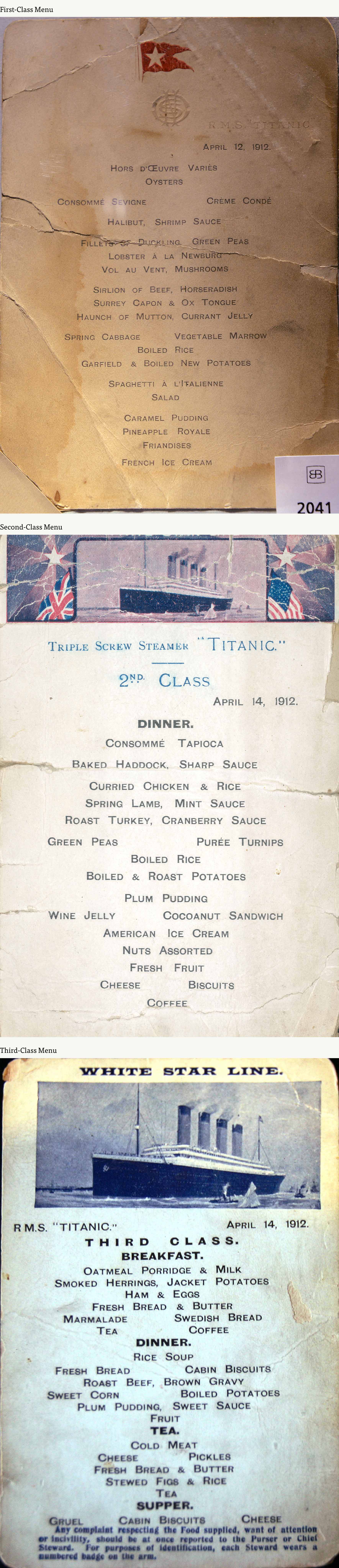
The first-, second-, and third-class menus are not the same. Name three differences and explain why you think these differences existed.
Required
1
There is one striking addition to the third-class menu that none of the other menus have. What is it? Why is it included? Does it seem fair or unfair? Explain your answer.
Required
1
Imagine you’ve never heard of the Titanic. The only artifacts that survived are these menus. What conclusions would you draw from what the passengers were served?

Required
1
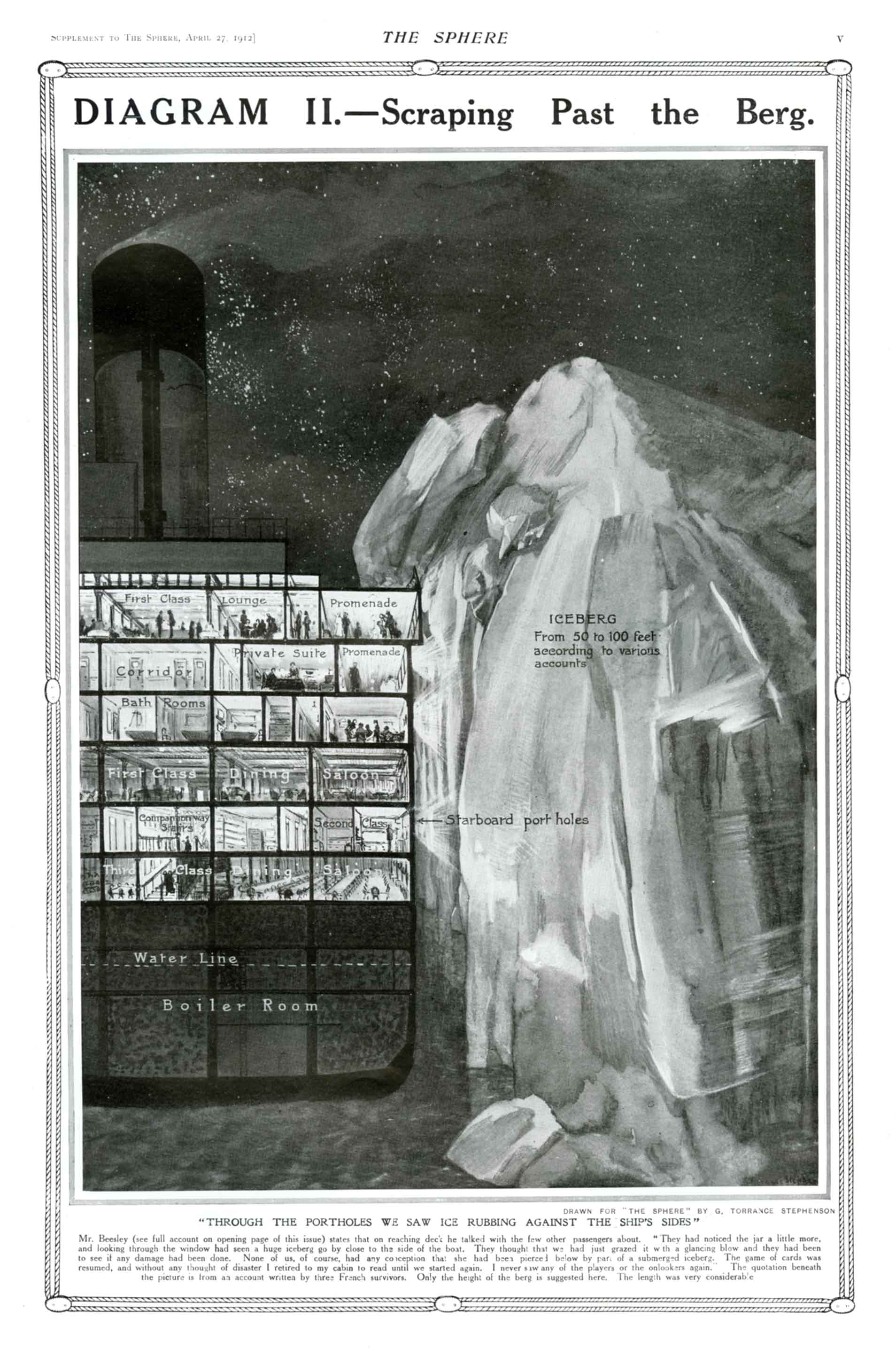
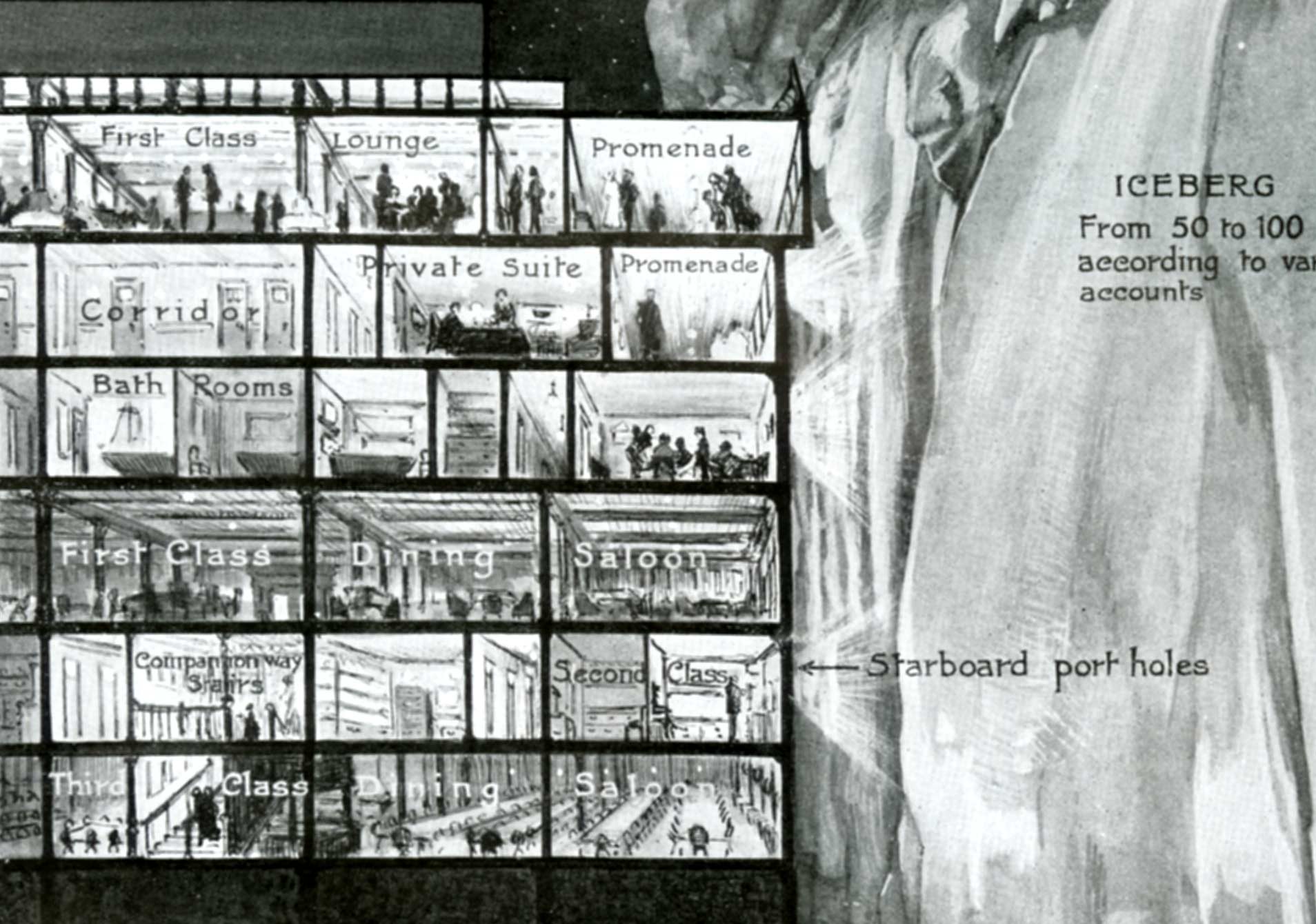
Look closely at the illustrations of the rooms on the Titanic. What differences do you see between the first- and third-class dining saloons?
Required
1
The caption beneath the illustration states, “THROUGH THE PORTHOLES WE SAW ICE RUBBING AGAINST THE SHIP'S SIDES.” According to the picture, where would you need to be to have the best view of the iceberg?

Required
1
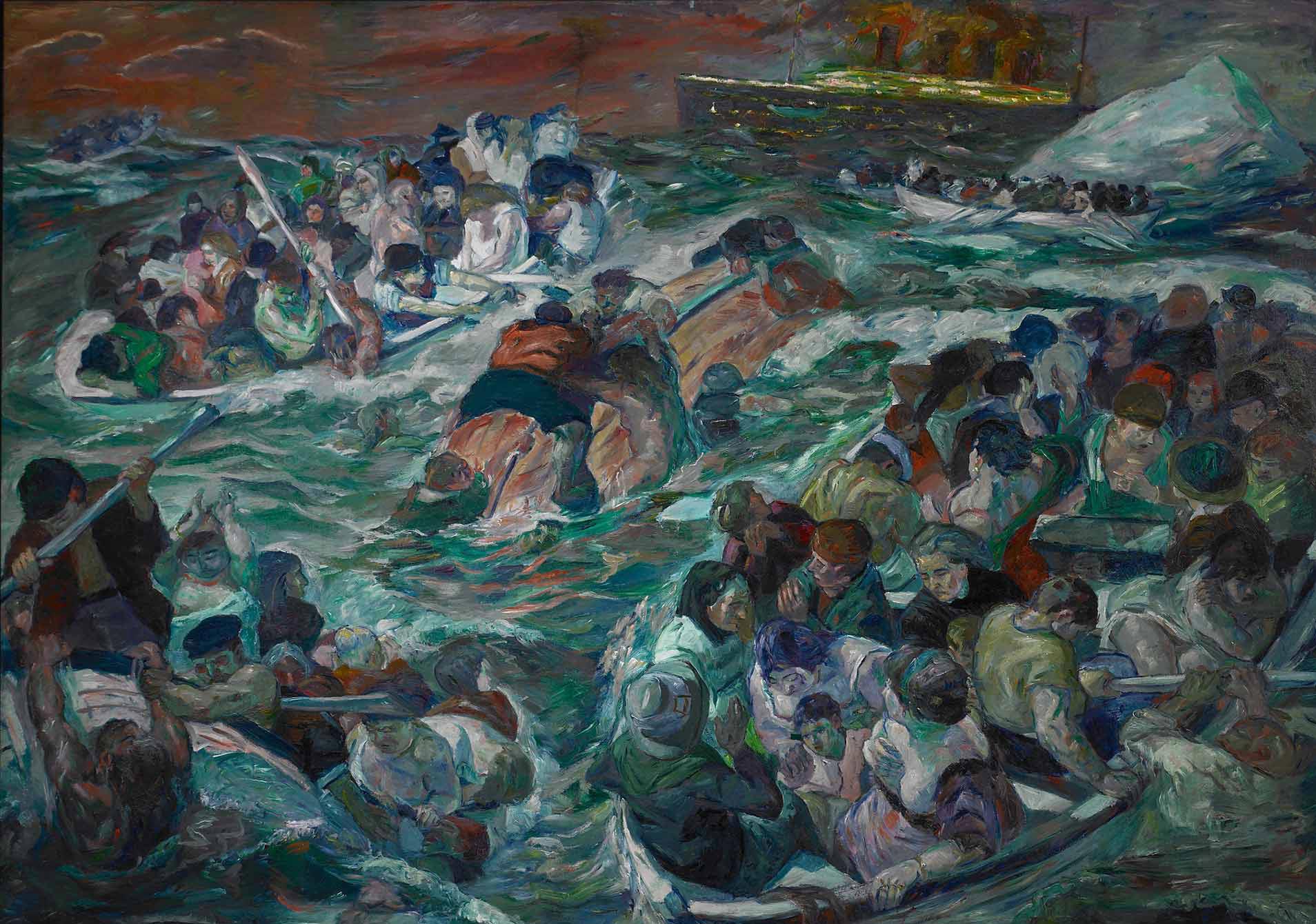
What is the main focus of this painting?
Required
1
List five words that describe the scene depicted in the painting.
Required
1
If you were asked to rename the painting, what would you call it?
Required
1
Which passengers ate their meals closest to the boiler room?