Copy of Frankenstein 11/18 (6/23/2025)
star
star
star
star
star
Last updated 6 months ago
21 questions
Review Solo
Volume I, Chapter 4, Pages 41-49
1 It was on a dreary night of November that I beheld the accomplishment of my toils. With an anxiety that almost amounted to agony, I collected the instruments of life around me, that I might infuse a spark of being into the lifeless thing that lay at my feet. The rain pattered dismally against the panes, and my candle was nearly burnt out, when, by the glimmer of the half-extinguished light, I saw the dull yellow eye of the creature open.
2 How can I describe my emotions at this catastrophe. His limbs were in proportion, and I had selected his features as beautiful. Beautiful!—Great God! His yellow skin scarcely covered the work of muscles and arteries beneath; his hair was of a lustrous black, and flowing; his teeth of a pearly whiteness; but these luxuriances only formed a more horrid contrast with his watery eyes, that seemed almost of the same colour as the dun white sockets in which they were set, his shriveled complexion, and straight black lips.
3 The different accidents of life are not so changeable as the feelings of human nature. I had worked hard for nearly two years, for the sole purpose of infusing life into an inanimate body. For this I had deprived myself of rest and health. I had desired it with an ardour that far exceeded moderation; but now that I had finished, the beauty of the dream vanished, and breathless horror and disgust filled my heart.
4 Unable to endure the aspect of the being I had created, I rushed out of the room, and threw myself on the bed in my clothes, endeavouring to seek a few moments of forgetfulness.
5 By the dim and yellow light of the moon, as it forced its way through the window-shutters, I beheld the wretch—the miserable monster whom I had created. He held up the curtain of the bed; and his eyes, if eyes they may be called, were fixed on me. His jaws opened, and he muttered some inarticulate sounds.
6 I took refuge in the court-yard belonging to the house which I inhabited; where I remained during the rest of the night, walking up and down in the greatest agitation, listening attentively, catching and fearing each sound as if it were to announce the approach of the demoniacal corpse to which I had so miserably given life.
1
Victor doesn't give his creation a name.
Consider the explicit meaning. What are some words Victor uses to talk about his creation instead of using a name.
Victor doesn't give his creation a name.
Consider the explicit meaning. What are some words Victor uses to talk about his creation instead of using a name.
1
Now think about the implicit meaning. How do you think Victor feels about his creation?
1
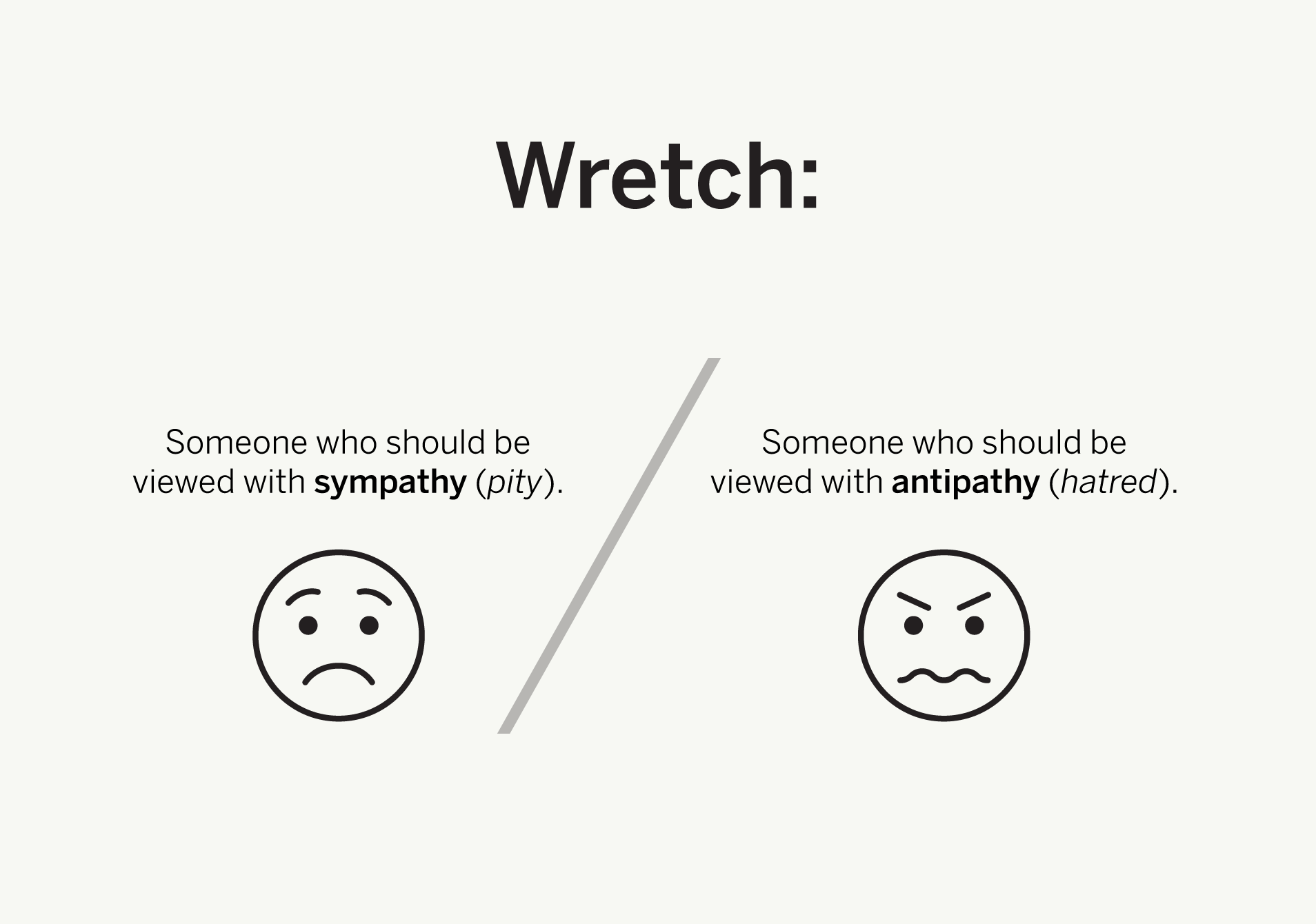
When Victor calls his creation a “wretch,” he means...
1
Select the FOUR underlined words or phrases in paragraph 6 that best communicate the tone, or attitude, that Victor has toward his creation.
I took refuge in the court-yard belonging to the house which I inhabited; where I remained during the rest of the night, walking up and down in the greatest agitation, listening attentively, catching and fearing each sound as if it were to announce the approach of the demoniacal corpse to which I had so miserably given life.
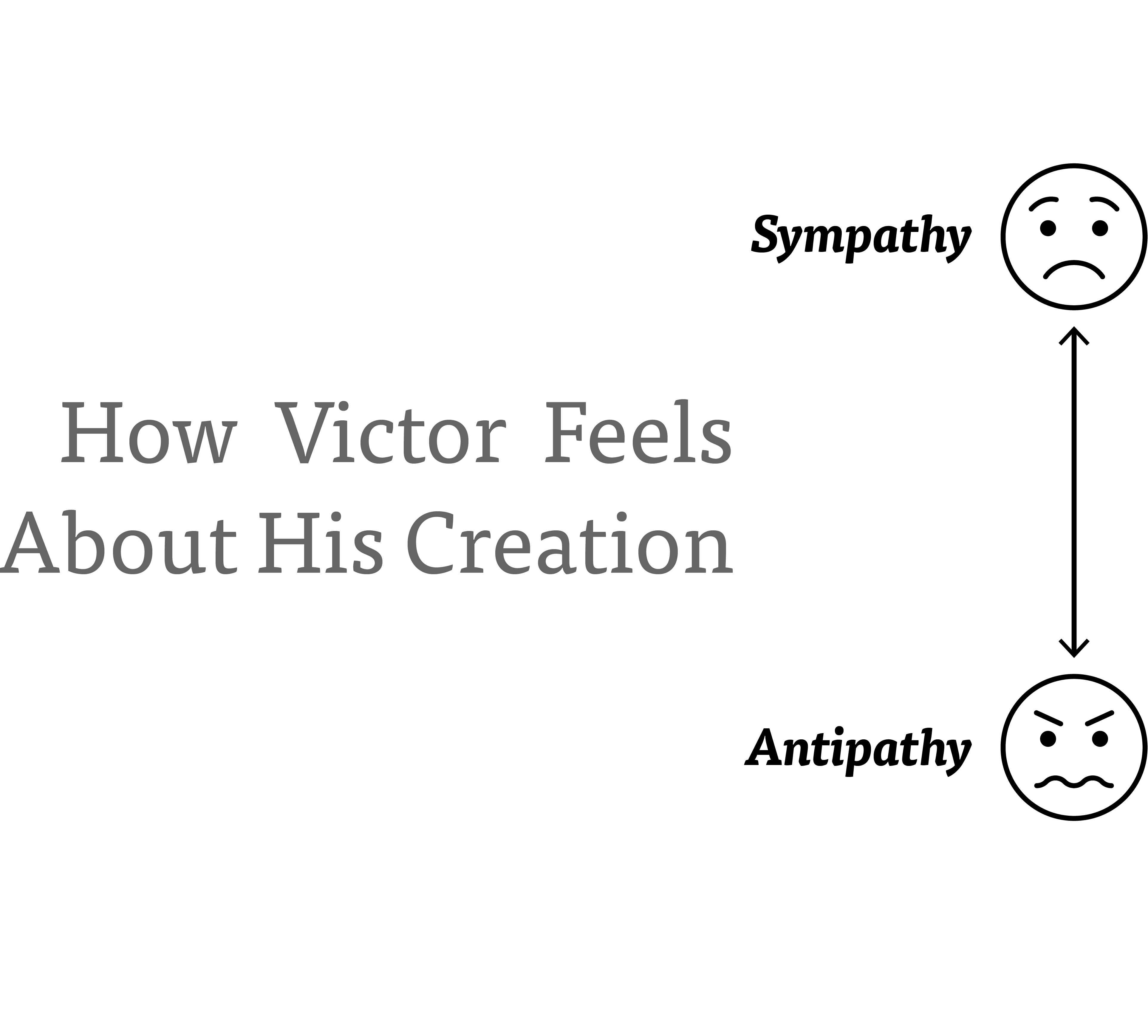
Sympathy or Antipathy?

1
Choose the quote that best reflects Victor's tone, or attitude, toward the creature. (From Volume I, Chapter 4, pages 41–49, paragraphs 5–6)
5 By the dim and yellow light of the moon, as it forced its way through the window-shutters, I beheld the wretch—the miserable monster whom I had created. He held up the curtain of the bed; and his eyes, if eyes they may be called, were fixed on me. His jaws opened, and he muttered some inarticulate sounds.
6 I took refuge in the court-yard belonging to the house which I inhabited; where I remained during the rest of the night, walking up and down in the greatest agitation, listening attentively, catching and fearing each sound as if it were to announce the approach of the demoniacal corpse to which I had so miserably given life.
1
How much sympathy or antipathy does Victor Frankenstein feel for the creature at this moment in the book? Think about whether he views the creature as unfortunate and deserving of sympathy, or as evil and deserving of hatred.Responses
How much sympathy or antipathy does Victor Frankenstein feel for the creature at this moment in the book? Think about whether he views the creature as unfortunate and deserving of sympathy, or as evil and deserving of hatred.
Responses
1
How does the quote you chose reveal how Victor feels about the creature?
1
Why is Victor’s point of view important to the reader's understanding of this scene?
Chapter 5
Pages 51 and 52
Victor receives a letter from Elizabeth. She gives him updates about each family member. Then she tells him about a girl named Justine Moritz, who has come to live with the Frankenstein family and work for them as a servant. Elizabeth is fond of Justine; they’ve become friends.
Pages 53 and 54
When Victor starts feeling better, he cleans up his laboratory and gets rid of the materials left over from his experiments. Then he and Henry go on a vacation, traveling around Europe. They have a good time, and all the sunshine and fresh air makes Victor feel much happier than he has in years.
1
Who is Justine Moritz?
1
What is her connection to Elizabeth?
1
How does Victor feel as he leaves his laboratory and travels with his friend Henry?
"Wretch" 2.0
Volume I, Chapter 6, Pages 55–56
1 My Dear Victor,
2 You have probably waited impatiently for a letter to fix the date of your return to us; and I was at first tempted to write only a few lines, merely mentioning the day on which I should expect you. What would be your surprise, my son, when you expected a happy and gay welcome, to behold, on the contrary, tears and wretchedness?
3 William is dead!—that sweet child, whose smiles delighted and warmed my heart, who was so gentle, yet so gay! Victor, he is murdered!
4 I will not attempt to console you; but will simply relate the circumstances of the transaction. Last Thursday (May 7th) I, my niece, and your two brothers, went to walk in Plainpalais. The evening was warm and serene, and we prolonged our walk farther than usual. It was already dusk before we discovered that William and Ernest, who had gone on before, were not to be found. Ernest came, and said that they had been playing together, that William had run away to hide himself, and did not return.
5 This account rather alarmed us, and we continued to search for him with torches; for I could not rest, when I thought that my sweet boy had lost himself, and was exposed to all the damps and dews of night. About five in the morning I discovered my lovely boy, whom the night before I had seen blooming and active in health, stretched on the grass livid and motionless: the print of the murderer’s finger was on his neck. He was conveyed home, and the anguish that was visible in my countenance betrayed the secret to Elizabeth. She was very earnest to see the corpse. Entering the room where it lay, she hastily examined the neck of the victim, and clasping her hands exclaimed, ‘O God! I have murdered my darling infant!’
6 She told me, that that same evening William had teazed her to let him wear a very valuable miniature that she possessed of your mother. This picture is gone, and was doubtless the temptation which urged the murderer to the deed.
7 Come, dearest Victor; you alone can console Elizabeth. She weeps continually, and accuses herself unjustly as the cause of his death; her words pierce my heart.
8 Your affectionate and afflicted father,
9 Alphonse Frankenstein
10 Geneva, May 12th
11 “My dear Frankenstein, are you always to be unhappy? My dear friend, what has happened? I can offer you no consolation, my friend, your disaster is irreparable. What do you intend to do?”
12 “To go instantly to Geneva.”
Volume I, Chapter 6, Pages 58–60
1 It was completely dark when I arrived in the environs of Geneva. The sky was serene; and, as I was unable to rest, I resolved to visit the spot where my poor William had been murdered.
2 During this short voyage I saw the lightnings playing on the summit of Mont Blanc in the most beautiful figures.
3 The storm appeared to approach rapidly; I ascended a low hill, that I might observe its progress. It advanced; the heavens were clouded, and I soon felt the rain coming slowly in large drops, but its violence quickly increased.
4 “William, dear angel! this is thy funeral, this thy dirge!”
5 As I said these words, I perceived in the gloom a figure which stole from behind a clump of trees near me; I stood fixed, gazing intently: I could not be mistaken.
6 A flash of lightning illuminated the object, and discovered its shape plainly to me; its gigantic stature; and the deformity of its aspect, more hideous than belongs to humanity, instantly informed me that it was the wretch, the filthy demon to whom I had given life. Could he be the murderer of my brother? He was the murderer!
7 I thought of pursuing the devil; but it would have been in vain, for another flash discovered him to me hanging among the rocks of the nearly perpendicular ascent of Mont Salêve. He soon reached the summit, and disappeared.
8 Two years had now nearly elapsed since the night on which he first received life; and was this his first crime? Alas! I had turned loose into the world a depraved wretch, whose delight was in carnage and misery.
9 The remainder of the night I spent, cold and wet, in the open air. My imagination was busy in scenes of evil and despair. I considered the being whom I had cast among mankind, and endowed with the will and power to effect purposes of horror, and forced to destroy all that was dear to me.
Required
1
Victor believes that the creature is William's murderer. What does he believe is the creature's motivation for this killing?
Required
1
Which sentence from the passage best supports the answer to the previous question?
Two years had now nearly elapsed since the night on which he first received life; and was this his first crime? Alas! I had turned loose into the world a depraved wretch, whose delight was in carnage and misery.
The remainder of the night I spent, cold and wet, in the open air. My imagination was busy in scenes of evil and despair. I considered the being whom I had cast among mankind, and endowed with the will and power to effect purposes of horror, and forced to destroy all that was dear to me.
Victor Returns Home
Volume I, Chapter 6, Pages 61–62
1 Day dawned; and I hastened to my father’s house. My first thought was to discover what I knew of the murderer, and cause instant pursuit to be made. But I paused when I reflected on the story that I had to tell. I remembered also the nervous fever with which I had been seized just at the time that I dated my creation, and which would give an air of delirium to a tale otherwise so utterly improbable.
2 Besides, of what use would be pursuit? Who could arrest a creature capable of scaling the overhanging sides of Mont Salêve? These reflections determined me, and I resolved to remain silent.
3 “Welcome, my dearest Victor. I wish you had come three months ago, and then you would have found us all joyous and delighted. But we are now unhappy; and, I am afraid, tears instead of smiles will be your welcome.”
4 “Do not welcome me thus; try to be more calm, that I may not be absolutely miserable the moment I enter my father’s house after so long an absence. How is my poor Elizabeth?”
5 “She indeed requires consolation; she accused herself of having caused the death of our brother, and that made her very wretched. But since the murderer has been discovered—”
6 “The murderer discovered! Good God! how can that be?”
7 “Indeed, who would credit that Justine Moritz, who was so amiable, and fond of all the family, could all at once become so extremely wicked?”
8 “Justine Moritz!”
9 He related that, the morning on which the murder of poor William had been discovered, Justine had been taken ill, and confined to her bed; and, after several days, one of the servants had discovered in her pocket the picture of my mother, which had been judged to be the temptation of the murderer.
10 I was firmly convinced in my own mind that Justine, and indeed every human being, was guiltless of this murder. I had no fear, therefore, that any circumstantial evidence could be brought forward strong enough to convict her.
1
Why doesn’t Victor tell anyone (his family or the police) about his creation? Find two reasons on page 61.
1
Who have the police accused of William’s murder and why?
Homework- Volume I, Chapter 7 (pgs 63-70)
Volume I, Chapter 7, Pages 63–70
1 We passed a few sad hours, until eleven o’clock, when the trial was to commence. My father and the rest of the family being obliged to attend as witnesses, I accompanied them to the court. During the whole of this wretched mockery of justice, I suffered living torture. It was to be decided whether the result of my curiosity and lawless devices would cause the death of two of my fellow-beings: one a smiling babe, full of innocence and joy; the other far more dreadfully murdered, with every aggravation of infamy that could make the murder memorable in horror.
2 The appearance of Justine was calm. She appeared confident in innocence, and did not tremble, for all the kindness which her beauty might otherwise have excited was obliterated in the minds of the spectators by the imagination of the enormity she was supposed to have committed. A tear seemed to dim her eye when she saw us; but she quickly recovered herself, and a look of sorrowful affection seemed to attest her utter guiltlessness.
3 The trial began; and after the advocate against her had stated the charge, several witnesses were called. Several strange facts combined against her, which might have staggered any one who had not such proof of her innocence as I had.
4 She had been out the whole of the night on which the murder had been committed, and towards morning had been perceived by a market-woman not far from the spot where the body of the murdered child had been afterwards found. She returned to the house about eight o’clock; and when one inquired where she had passed the night, she replied that she had been looking for the child. When shewn the body, she fell into violent hysterics, and kept her bed for several days. The picture was then produced, which the servant had found in her pocket; and when Elizabeth, in a faltering voice, proved that it was the same which, an hour before the child had been missed, she had placed round his neck, a murmur of horror and indignation filled the court.
5 “God knows how entirely I am innocent. But I do not pretend that my protestations should acquit me: I rest my innocence on a plain and simple explanation of the facts which have been adduced against me; and I hope the character I have always borne will incline my judges to a favourable interpretation, where any circumstance appears doubtful or suspicious.”
6 She then related that she had passed the evening at the house of an aunt. On her return, she met a man, who asked her if she had seen any thing of the child who was lost. She was alarmed, and passed several hours in looking for him. That she had been bewildered when questioned by the market-woman was not surprising, since she had passed a sleepless night. Concerning the picture she could give no account.
7 “I know how heavily and fatally this one circumstance weighs against me, but I have no power of explaining it. I believe that I have no enemy on earth, and none surely would have been so wicked as to destroy me wantonly. I commit my cause to the justice of my judges, yet I see no room for hope. I beg permission to have a few witnesses examined concerning my character; and if their testimony shall not overweigh my supposed guilt, I must be condemned, although I would pledge my salvation on my innocence.”
8 Several witnesses were called, but fear, and hatred of the crime of which they supposed her guilty, rendered them unwilling to come forward. Elizabeth saw even this last resource about to fail the accused when she desired permission to address the court.
9 “I am the cousin of the unhappy child who was murdered, for I was educated by and have lived with his parents ever since and even long before his birth. It may therefore be judged indecent in me to come forward on this occasion; but when I see a fellow-creature about to perish through the cowardice of her pretended friends, I wish to be allowed to speak, that I may say what I know of her character.
10 “I am well acquainted with the accused. I have lived in the same house with her. During all that period she appeared to me the most amiable and benevolent of human creatures. She nursed Madame Frankenstein, my aunt, in her last illness with the greatest affection and care; and afterwards attended her own mother during a tedious illness. She was warmly attached to the child who is now dead, and acted towards him like a most affectionate mother. For my own part, I do not hesitate to say, that, notwithstanding all the evidence produced against her, I believe and rely on her perfect innocence.”
11 Could the demon who had murdered my brother also in his hellish sport have betrayed the innocent to death and ignominy? When I perceived that the popular voice had already condemned my unhappy victim, I rushed out of the court in agony. The tortures of the accused did not equal mine; she was sustained by innocence, but the fangs of remorse tore my bosom, and would not forego their hold.
12 The ballots had been thrown; they were all black, and Justine was condemned.
13 Words cannot convey an idea of the heart-sickening despair that I then endured.
14 Soon after we heard that the poor victim had expressed a wish to see my cousin.
15 We entered the gloomy prison-chamber, and beheld Justine. She threw herself at the feet of Elizabeth, weeping bitterly. My cousin wept also.
16 “Do you also believe that I am so very, very wicked? Do you also join with my enemies to crush me?”
17 Her voice was suffocated with sobs.
18 "Rise, my poor girl, why do you kneel, if you are innocent? I believe you guiltless.”
19 “I confessed! The God of heaven forgive me!"
20 “Ever since I was condemned, my confessor has besieged me."
21 “He threatened and menaced, until I almost began to think that I was the monster that he said I was. He threatened excommunication and hell fire in my last moments. What could I do? In an evil hour I subscribed to a lie."
22 “Dear William! dearest blessed child! I soon shall see you again in heaven, where we shall all be happy.”
23 “Heaven bless thee, my dearest Justine, with resignation, and a confidence elevated beyond this world. Oh! how I hate its shews and mockeries! when one creature is murdered, another is immediately deprived of life in a slow torturing manner; then the executioners, their hands yet reeking with the blood of innocence, believe that they have done a great deed. They call this retribution. Hateful name! I would I were in peace with my aunt and my lovely William, escaped from a world which is hateful to me, and the visages of men which I abhor.”
24 I had retired to a corner of the prison-room, where I could conceal the horrid anguish that possessed me. The poor victim, who on the morrow was to pass the dreary boundary between life and death, felt not as I did, such deep and bitter agony. I gnashed my teeth, and ground them together, uttering a groan that came from my inmost soul. The poor sufferer gained the resignation she desired. But I, the true murderer, felt the never-dying worm alive in my bosom, which allowed of no hope or consolation. Elizabeth also wept, and was unhappy; but hers also was the misery of innocence, which, like a cloud that passes over the fair moon, for a while hides, but cannot tarnish its brightness. Anguish and despair had penetrated into the core of my heart; I bore a hell within me, which nothing could extinguish.
25 I was a wretch, and none ever conceived of the misery that I then endured.
Required
2
Who is Victor referring to in these quotes?
"It was to be decided whether the result of my curiosity and lawless devices would cause the death of my two fellow beings:"
1. "one a smiling babe, full of innocence and joy;" (1) ____________
2. "the other far more dreadfully murdered, with every aggravation of infamy that could make the murder memorable in horror." (1) ____________
Other Answer Choices:
William
Justine
Required
5
Decide whether each instance proves Justine's innocence/guilt.
Justine is guilty. | Justine is innocent. | |
|---|---|---|
She was out the whole night of the murder. | ||
Elizabeth testified that Justine loved William like a son. | ||
She was seen close to the spot where the body was found. | ||
Justine testified that she did not commit the murder. | ||
A picture from William's necklace was found in her pocket. |
Required
1
What is the meaning of this sentence? “Concerning the picture she could give no account” (6, 5)
Required
1
What does Victor mean when he says that “The tortures of the accused did not equal mine; she was sustained by innocence, but the fangs of remorse tore my bosom, and would not forego their hold” (11, 3)?
Required
1
Who does Victor think is suffering the most—Justine, Elizabeth, or himself?
Required
2
Why does Victor call himself a "wretch" (25)? What would be your advice to Victor if you found him in this mood?