1
Paraphrase the original text into more everyday language, without changing the meaning of the original text.
Paraphrase the original text into more everyday language, without changing the meaning of the original text.
Volume III, Chapter 7, Page 188 1 “Alas! the strength I relied on is gone; I feel that I shall soon die, and he, my enemy and persecutor, may still be in being. In a fit of enthusiastic madness I created a rational creature, and was bound towards him. The task of his destruction was mine, but I have failed. When actuated by selfish and vicious motives, I asked you to undertake my unfinished work. 2 “Yet I cannot ask you to renounce your country and friends, and now, that you are returning to England, you will have little chance of meeting with him. I dare not ask you to do what I think right, for I may still be misled by passion.
3 “That he should live to be an instrument of mischief disturbs me; in other respects this hour, when I momentarily expect my release, is the only happy one which I have enjoyed for several years. The forms of the beloved dead flit before me, and I hasten to their arms. Farewell, Walton! Seek happiness in tranquillity, and avoid ambition, even if it be only the apparently innocent one of distinguishing yourself in science and discoveries. Yet why do I say this? I have myself been blasted in these hopes, yet another may succeed.” 4 His voice became fainter as he spoke; and at length, exhausted by his effort, he sunk into silence. He pressed my hand feebly, and his eyes closed for ever, while the irradiation of a gentle smile passed away from his lips. 5 Margaret, what comment can I make on the untimely extinction of this glorious spirit? What can I say, that will enable you to understand the depth of my sorrow? All that I should express would be inadequate and feeble. My tears flow; my mind is overshadowed by a cloud of disappointment. But I journey towards England, and I may there find consolation. 6 Good night, my sister.
In paragraph 1, Victor tells Walton:
“In a fit of enthusiastic madness I created a rational creature, and was bound towards him.”
In this context, what does the word "madness" communicate about Victor?
Volume III, Chapter 7, Pages 189–193
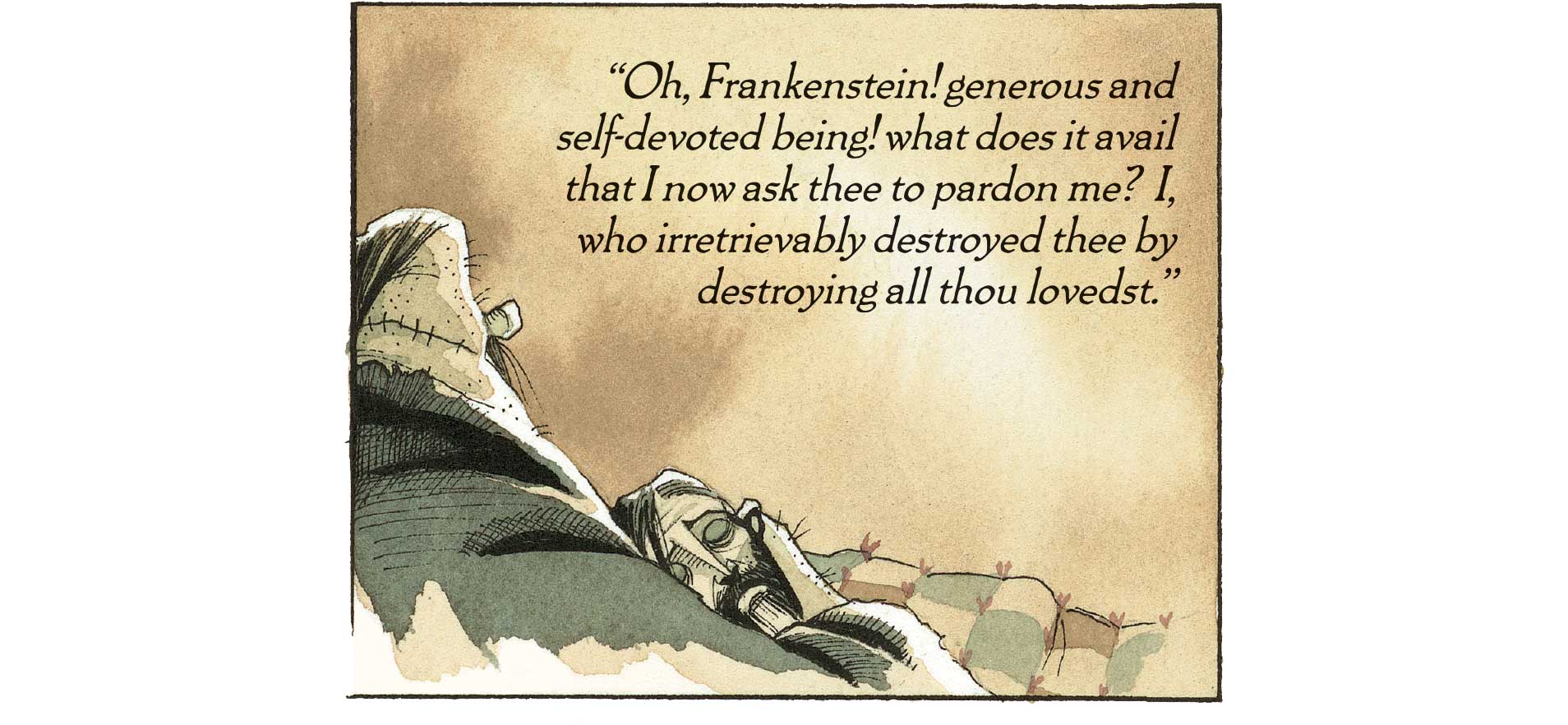
1 “Oh, Frankenstein! generous and self-devoted being! what does it avail that I now ask thee to pardon me? I, who irretrievably destroyed thee by destroying all thou lovedst.”
2 “Monster, your repentance is now superfluous. If you had listened to the voice of conscience, and heeded the stings of remorse, before you had urged your diabolical vengeance to this extremity, Frankenstein would yet have lived.”
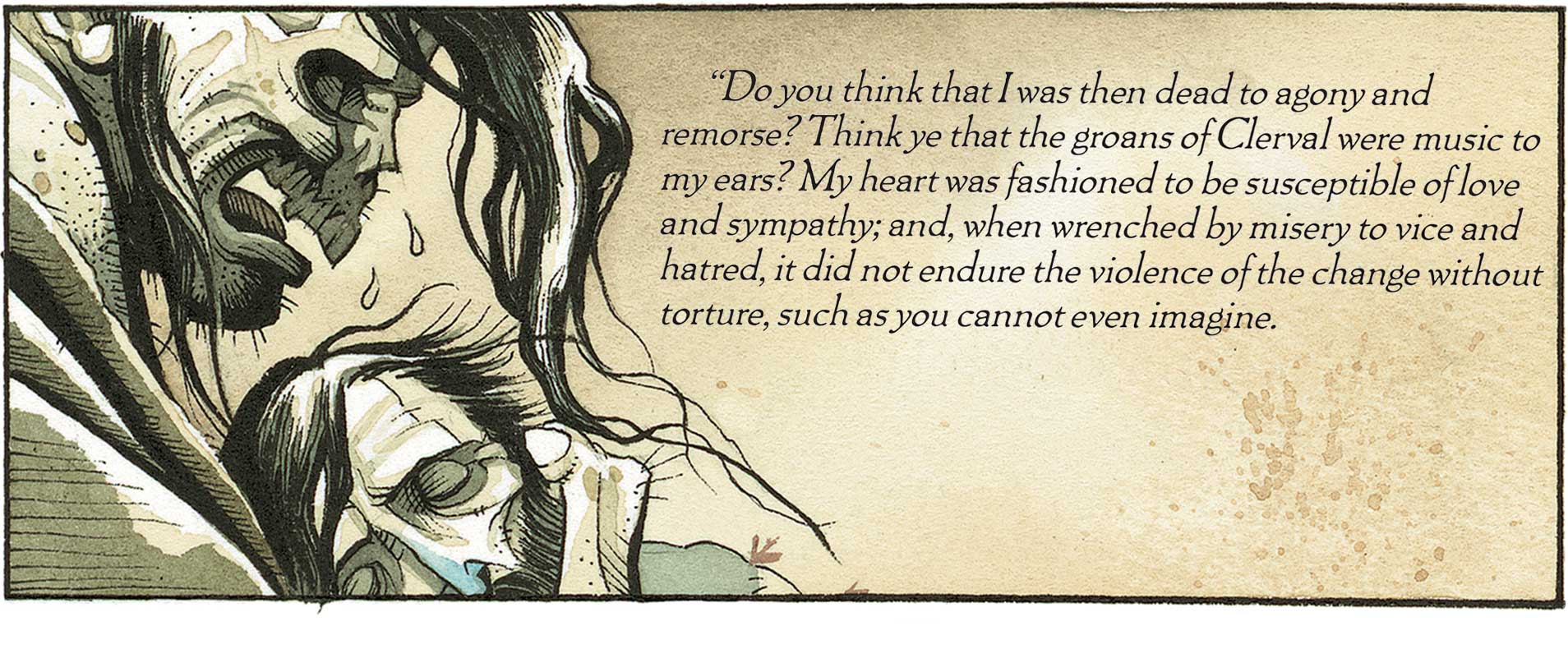
3 “Do you think that I was then dead to agony and remorse? Think ye that the groans of Clerval were music to my ears? My heart was fashioned to be susceptible of love and sympathy; and, when wrenched by misery to vice and hatred, it did not endure the violence of the change without torture, such as you cannot even imagine.
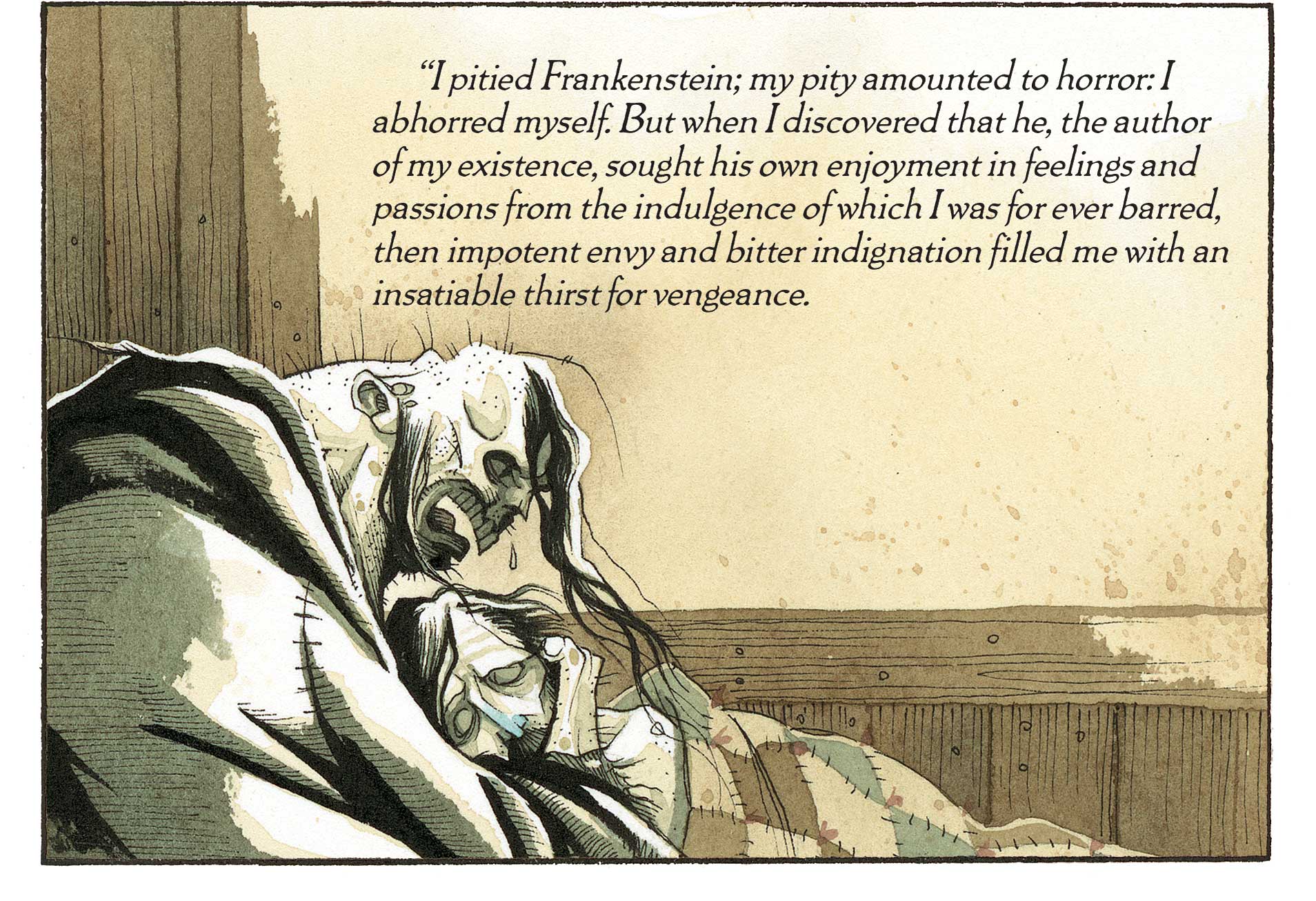
4 “I pitied Frankenstein; my pity amounted to horror: I abhorred myself. But when I discovered that he, the author of my existence, sought his own enjoyment in feelings and passions from the indulgence of which I was for ever barred, then impotent envy and bitter indignation filled me with an insatiable thirst for vengeance.
5 “Evil thenceforth became my good. Urged thus far, I had no choice but to adapt my nature to an element which I had willingly chosen. And now it is ended; there is my last victim.”
6 “Wretch! It is well that you come here to whine over the desolation that you have made. You throw a torch into a pile of buildings, and when they are consumed you sit among the ruins, and lament the fall. It is not pity that you feel; you lament only because the victim of your malignity is withdrawn from your power.”
7 “Oh, it is not thus—not thus, yet such must be the impression conveyed to you by what appears to be the purport of my actions. No sympathy may I ever find. When I first sought it, it was the love of virtue, the feelings of happiness and affection with which my whole being overflowed, that I wished to be participated.”
8 “But now, that virtue has become to me a shadow, and that happiness and affection are turned into bitter and loathing despair, in what should I seek for sympathy? I am content to suffer alone, while my sufferings shall endure.
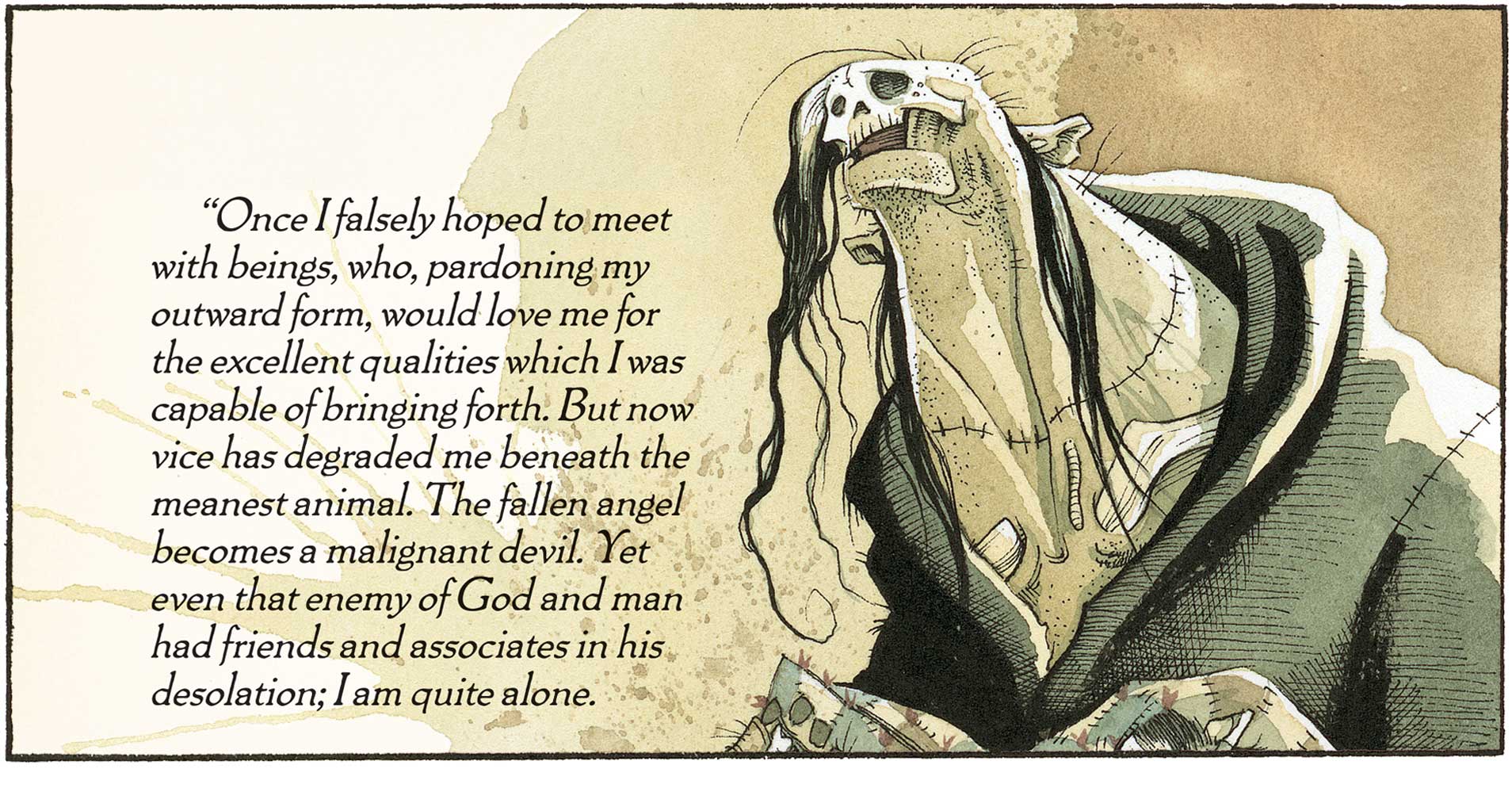
9 “Once I falsely hoped to meet with beings, who, pardoning my outward form, would love me for the excellent qualities which I was capable of bringing forth. But now vice has degraded me beneath the meanest animal. The fallen angel becomes a malignant devil. Yet even that enemy of God and man had friends and associates in his desolation; I am quite alone.
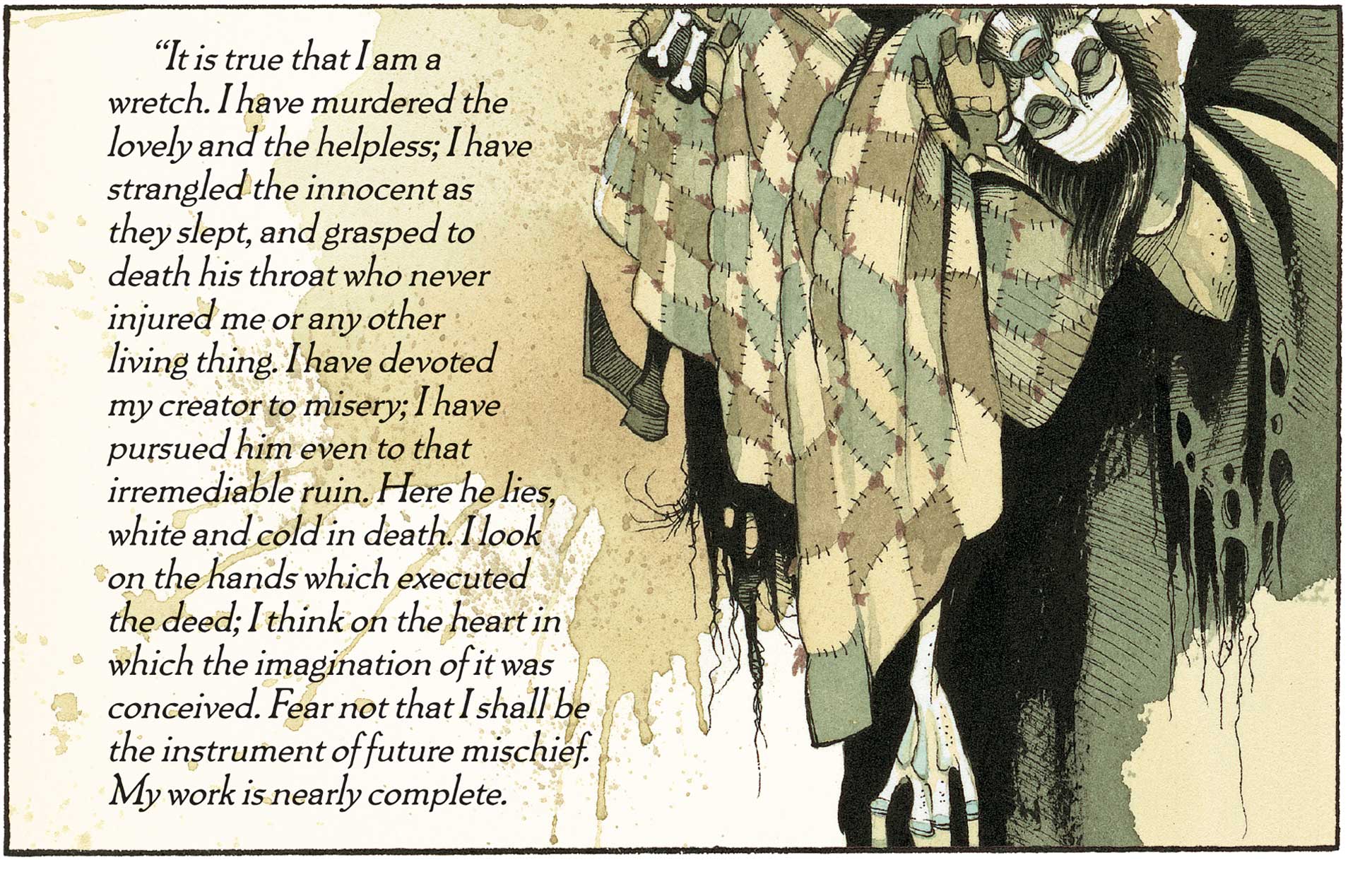
10 “It is true that I am a wretch. I have murdered the lovely and the helpless; I have strangled the innocent as they slept, and grasped to death his throat who never injured me or any other living thing. I have devoted my creator to misery; I have pursued him even to that irremediable ruin. Here he lies, white and cold in death. I look on the hands which executed the deed; I think on the heart in which the imagination of it was conceived. Fear not that I shall be the instrument of future mischief. My work is nearly complete.
11 “I shall quit your vessel on the ice-raft which brought me hither, and shall seek the most northern extremity of the globe; I shall collect my funeral pile, and consume to ashes this miserable frame, that its remains may afford no light to any curious and unhallowed wretch, who would create such another as I have been. I shall die.
12“He is dead who called me into being; and when I shall be no more, the very remembrance of us both will speedily vanish. I shall no longer see the sun or stars, or feel the winds play on my cheeks. Light, feeling, and sense, will pass away.
13 “Soon these burning miseries will be extinct. I shall ascend my funeral pile triumphantly. The light of that conflagration will fade away; my ashes will be swept into the sea by the winds. My spirit will sleep in peace; or if it thinks, it will not surely think thus.”
What does the creature plan to do with Victor's body?
Paraphrase the original text into more everyday language, without changing the meaning of the original text.
Paraphrase the original text into more everyday language, without changing the meaning of the original text.
Paraphrase the original text into more everyday language, without changing the meaning of the original text.
Paraphrase the original text into more everyday language, without changing the meaning of the original text.
Paraphrase the original text into more everyday language, without changing the meaning of the original text.
What has the creature learned from his experiences among men? And what does Shelley want her audience to understand about human nature?
Write a statement of a theme in Frankenstein and explain how this theme develops over the course of the creature's tale. (5 min, 50 words)
Volume III, Chapter 7, Page 188
1 “Alas! the strength I relied on is gone; I feel that I shall soon die, and he, my enemy and persecutor, may still be in being. In a fit of enthusiastic madness I created a rational creature, and was bound towards him. The task of his destruction was mine, but I have failed. When actuated by selfish and vicious motives, I asked you to undertake my unfinished work.
2 “Yet I cannot ask you to renounce your country and friends, and now, that you are returning to England, you will have little chance of meeting with him. I dare not ask you to do what I think right, for I may still be misled by passion.
3 “That he should live to be an instrument of mischief disturbs me; in other respects this hour, when I momentarily expect my release, is the only happy one which I have enjoyed for several years. The forms of the beloved dead flit before me, and I hasten to their arms. Farewell, Walton! Seek happiness in tranquillity, and avoid ambition, even if it be only the apparently innocent one of distinguishing yourself in science and discoveries. Yet why do I say this? I have myself been blasted in these hopes, yet another may succeed.”
What did Victor learn? Drag each answer option to the box for the quote that it interprets.
“In a fit of enthusiastic madness I created a rational creature, and was bound towards him.” (1)
“I dare not ask you to do what I think right, for I may still be misled by passion.” (2)
“Seek happiness in tranquillity, and avoid ambition, even if it be only the apparently innocent one of distinguishing yourself in science and discoveries.” (3)
In 1–2 sentences, state a theme that Shelley is developing through Victor's experiences.
Prometheus wants to humans, while Zeus wants to humans.
What does Victor feel when he looks back on his life’s work?
In paragraph 3, Victor tells Walton:
“Seek happiness in tranquillity, and avoid ambition, even if it be only the apparently innocent one of distinguishing yourself in science and discoveries.”
In this context, what does the word “apparently” communicate about Victor?
What advice does he give Walton and why?
Prometheus
1 PROMETHEUS WAS A YOUNG Titan, no great admirer of Zeus. Although he knew the great lord of the sky hated explicit questions, he did not hesitate to beard him when there was something he wanted to know.
2 One morning he came to Zeus, and said, “O Thunderer, I do not understand your design. You have caused the race of man to appear on earth, but you keep him in ignorance and darkness.”
3 “Perhaps you had better leave the race of man to me,” said Zeus. “What you call ignorance is innocence. What you call darkness is the shadow of my decree. Man is happy now. And he is so framed that he will remain happy unless someone persuades him that he is unhappy. Let us not speak of this again.”
4 But Prometheus said, “Look at him. Look below. He crouches in caves. He is at the mercy of beast and weather. He eats his meat raw. If you mean something by this, enlighten me with your wisdom. Tell me why you refuse to give man the gift of fire.”
5 Zeus answered, “Do you not know, Prometheus, that every gift brings a penalty? This is the way the Fates weave destiny—by which gods also must abide. Man does not have fire, true, nor the crafts which fire teaches. On the other hand, he does not know disease, warfare, old age, or that inward pest called worry. He is happy, I say, happy without fire. And so he shall remain.”
6 “Happy as beasts are happy,” said Prometheus. “Of what use to make a separate race called man and endow him with little fur, some wit, and a curious charm of unpredictability? If he must live like this, why separate him from the beasts at all?”
7 “He has another quality,” said Zeus, “the capacity for worship. An aptitude for admiring our power, being puzzled by our riddles and amazed by our caprice. That is why he was made.”
8 “Would not fire, and the graces he can put on with fire, make him more interesting?”
9 “More interesting, perhaps, but infinitely more dangerous. For there is this in man too: a vaunting pride that needs little sustenance to make it swell to giant size. Improve his lot, and he will forget that which makes him pleasing—his sense of worship, his humility. He will grow big and poisoned with pride and fancy himself a god, and before we know it, we shall see him storming Olympus. Enough, Prometheus! I have been patient with you, but do not try me too far. Go now and trouble me no more with your speculations.”
10 Prometheus was not satisfied. All that night he lay awake making plans. Then he left his couch at dawn, and standing tiptoe on Olympus, stretched his arm to the eastern horizon where the first faint flames of the sun were flickering. In his hand he held a reed filled with a dry fiber; he thrust it into the sunrise until a spark smoldered. Then he put the reed in his tunic and came down from the mountain.
11 At first men were frightened by the gift. It was so hot, so quick; it bit sharply when you touched it, and for pure spite, made the shadows dance. They thanked Prometheus and asked him to take it away. But he took the haunch of a newly killed deer and held it over the fire. And when the meat began to sear and sputter, filling the cave with its rich smells, the people felt themselves melting with hunger and flung themselves on the meat and devoured it greedily, burning their tongues.
12 “This that I have brought you is called ‘fire,’” Prometheus said. “It is an ill-natured spirit, a little brother of the sun, but if you handle it carefully, it can change your whole life. It is very greedy; you must feed it twigs, but only until it becomes a proper size. Then you must stop, or it will eat everything in sight—and you too. If it escapes, use this magic: water. It fears the water spirit, and if you touch it with water, it will fly away until you need it again.”
13 He left the fire burning in the first cave, with children staring at it wide-eyed, and then went to every cave in the land.
14 Then one day Zeus looked down from the mountain and was amazed. Everything had changed. Man had come out of his cave. Zeus saw woodmen’s huts, farm houses, villages, walled towns, even a castle or two. He saw men cooking their food, carrying torches to light their way at night. He saw forges blazing, men beating out ploughs, keels, swords, spears. They were making ships and raising white wings of sails and daring to use the fury of the winds for their journeys. They were wearing helmets, riding out in chariots to do battle, like the gods themselves.
15 Zeus was full of rage. He seized his largest thunderbolt. “So they want fire,” he said to himself. “I’ll give them fire—more than they can use. I’ll turn their miserable little ball of earth into a cinder.” But then another thought came to him, and he lowered his arm. “No,” he said to himself, “I shall have vengeance—and entertainment too. Let them destroy themselves with their new skills. This will make a long twisted game, interesting to watch. I’ll attend to them later. My first business is with Prometheus.”
16 He called his giant guards and had them seize Prometheus, drag him off to the Caucasus, and there bind him to a mountain peak with great chains specially forged by Hephaestus—chains which even a Titan in agony could not break. And when the friend of man was bound to the mountain, Zeus sent two vultures to hover about him forever, tearing at his belly and eating his liver.
17 Men knew a terrible thing was happening on the mountain, but they did not know what. But the wind shrieked like a giant in torment and sometimes like fierce birds.
18 Many centuries he lay there—until another hero was born brave enough to defy the gods. He climbed to the peak in the Caucasus and struck the shackles from Prometheus and killed the vultures. His name was Heracles.
Which statement best represents the view of Zeus?
Which statement best represents the view of Prometheus?
How does the debate between Zeus and Prometheus end?
Fire brought many great benefits to humanity, according to this story.
How does the story end for Prometheus?
Why do you think Mary Shelley subtitles her story "The Modern Prometheus"? Which character in Frankenstein is like Prometheus?