Log in
Sign up for FREE
arrow_back
Library

Newton's First Law of Motion (The Law of Inertia)

star
star
star
star
star
Last updated about 2 hours ago
24 questions
Untitled Section 1
Newton’s First Law of Motion
Newton’s Second Law of Motion
Questions to Consider

The English scientist Isaac Newton, who lived around 1700, was curious about how forces affect the motion of objects. After a lot of study and observation, he was able to explain the relationship between forces and Motion.
Required
1
Question 1
1.

What was one key interest of Isaac Newton?

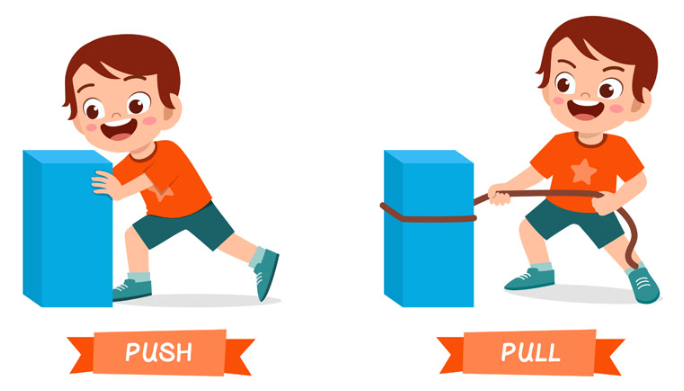
Newton observed a pattern in the relationship between force (a push or pull) and motion. He noticed that a force is needed to make a stationary object start moving. In other words, objects at rest stay at rest unless acted upon by an outside force. Newton also noticed that a moving object will only slow down, speed up, or change direction if an outside force pushes or pulls it. So, objects continue to do the same thing unless a force acts on them.


Required
1
Required
1
Required
1
Required
1

Newton’s First Law of Motion


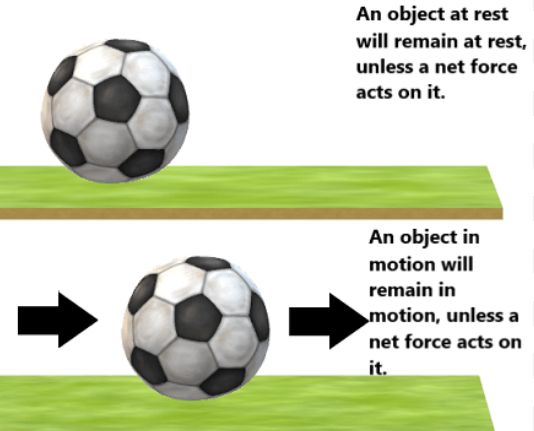
Inertia is the tendency of an object to resist a change in its motion. All objects have inertia, whether they are stationary or moving. Inertia explains Newton’s first law of motion, which states that an object at rest will remain at rest, and an object in motion will stay in motion unless it is acted on by an unbalanced force. Newton’s first law of motion is sometimes called the law of inertia.

Required
1
Required
1

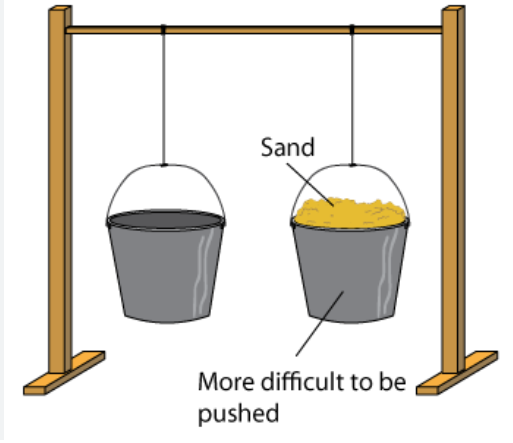
The inertia of an object depends on its mass. Mass is the amount of matter in an object. Objects with greater mass also have greater inertia. The measurement of an object’s inertia while at rest is the object’s mass.


Required
1
Required
1
Required
1
Required
1

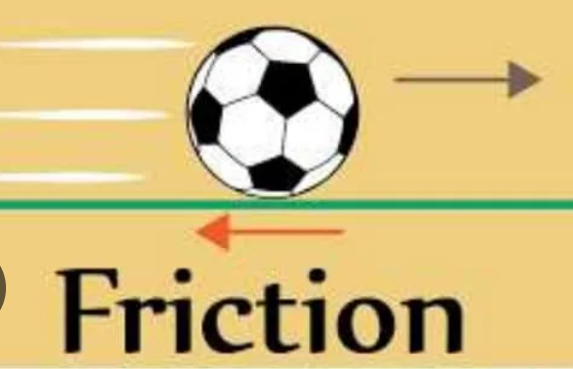
Consider what happens when you roll a ball across a floor. According to Newton’s first law, the ball should keep rolling until a force acts on it to make it stop rolling. What force makes the ball stop rolling? Friction is the resistance force that is created when the ball rubs on the ground. Friction is always in the opposite direction of motion. Friction is the force that makes the ball stop rolling.


Required
1
Required
1
Required
1

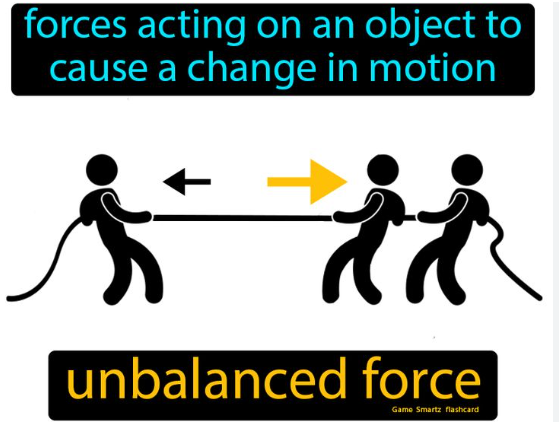
Any time there is a change in the motion, like speeding up or slowing down, there is an unbalanced force.

Required
1
Required
1
Required
1
Required
1

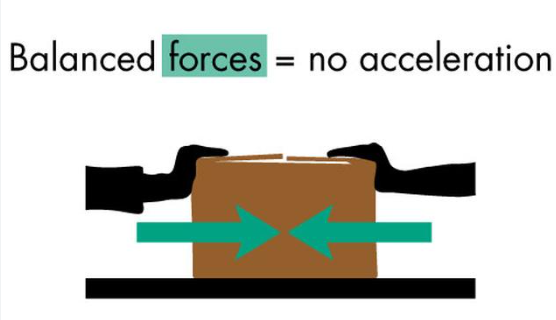
Any change in motion is known as acceleration. If there is no change in the motion of an object, meaning it is either at rest (not moving) or in motion at a continuous speed, then the forces acting on the object are balanced.


Required
1
Required
1
Required
1

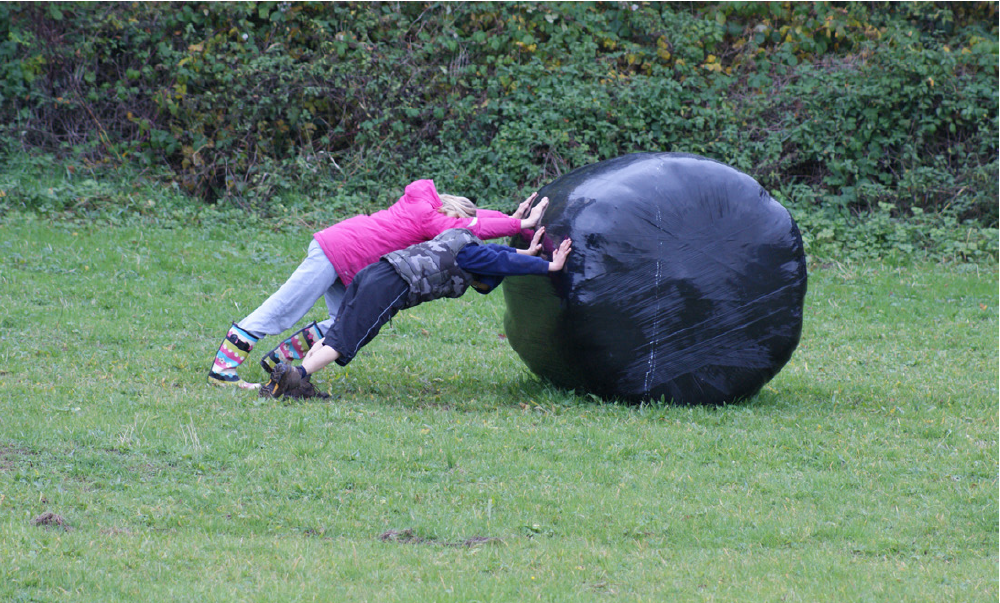
In the picture below you can see the two children exerting a force on the ball to move it across the grass. If they do not push on it, it will not move.


Required
1
Required
1
Required
1
Newton also observed another property that
an object’s mass affects how an object’s motion
changes with the the applicatino of an unbalanced
force. The relationship between the force on an
object, its mass, and how its motion changes
is called Newton’s Second Law. How would
the force needed to push a full shopping cart be
different from the force needed to push an empty
shopping cart? How is the amount of force needed
to move an object related to the object’s mass?
The motion of an object is determined by all
of the forces acting on it. The greater the mass of
the object, the greater the force needed to achieve
the same change in motion. Newton’s Second Law
summarizes this with the formula F = ma, where F
is the force, m is the mass, and a is the acceleration.
If we want to solve for acceleration, we change the
formula around so that a = F/m. This shows the
relationship between force and mass on acceleration.
If mass is held constant (not changed), then as force increases, the
acceleration increases. These are directly related. Mass and acceleration are
inversely related. This means that if force is held constant, then as the mass
increases, the acceleration would decrease.
Think about two vehicles – one is a small sports car and the other is a dump truck. According to this formula, the vehicle with more mass (the dump truck)
would accelerate more slowly than the vehicle with less mass (the sports car) if
the same force is applied. For now, we don’t need to understand about motion
involving direction, so for acceleration, we will just think of this as a change in the
motion of the object.
As an object accelerates (changes speed or direction), an unbalanced
force is acting on it. If there are multiple forces on the object, the acceleration
is proportional to the overall force. One important force to consider is the force
of gravity. Gravity will be discussed in Chapter 12, but for now, you need to
understand that gravity is a force of attraction between things that have mass.
Gravity is the force that pulls you towards the center of the planet.
How can you use what you know about mass,
force and motion to explain why you can pull a
tablecloth from under the dishes on the table?

Why would it be easier to do this trick if
there was a full platter of food on the table than if
there was an empty platter on the table.
Explain how much force would be needed to keep a 0.2 kg hockey puck
moving at a constant speed of 8 m/s across frictionless ice. Use Newton’s
First Law of Motion to help you answer this question.
Suppose an experiment is designed to test Newton’s Laws of Motion.
By keeping the system mass constant, the relationship between net force
and acceleration can be observed by changing net force and measuring
acceleration. For this experiment, force and acceleration were graphed
in order to have a slope
equal to the system mass.
Carl and his friends,
Carlotta and Carlo, are
on a boat outing. Carl is
towing Carlo and Carlotta
behind in a large tube.


Use the data below to determine the relationship between force applied
and acceleration.


Carl, a very studious young teen, is experimenting with Newton’s Second
Law of motion. He is timing a moving vehicle on a flat track. The force
of friction remains constant as does the amount of force used to move the
car. Carl changes how much mass is inside the car each time it goes down
the track. Use the information in the data table and graph below. Create a
claim of how the motion (acceleration) of the car is affected by the mass.
Cite evidence from the graph to support your claim.


How forces affect motion
Chemical reactions
Question 2
2.

What action is needed to move an object that is not moving?

Question 3
3.

When is a force required on a moving object?

Question 4
4.

Which action shows an example of force?

Question 5
5.

What happens when no force acts on an object?

Question 6
6.

According to Newton’s first law, what happens to an object at rest?

Question 7
7.

What is required for an object in motion to change its motion?

Question 8
8.

Which bucket is more difficult to push?

Question 9
9.

What does mass affect in an object?

Question 10
10.

Why is the sand bucket harder to move?

Question 11
11.

Which statement is true about mass and inertia?

Question 12
12.

What role does friction play when a ball rolls on the ground?

Question 13
13.

In which direction does friction act on a rolling ball?

Question 14
14.

What causes the ball to eventually stop rolling on the floor?

Question 15
15.

What happens when two people pull on a rope with different strengths?

Question 16
16.

Which of the following describes unbalanced forces?

Question 17
17.

Why is it important to understand unbalanced forces?

Question 18
18.

In the image, which action demonstrates an unbalanced force?

Question 19
19.

What indicates that forces on an object are balanced?

Question 20
20.

What occurs when forces acting on an object are unbalanced?

Question 21
21.

If a box is not moving, what can be concluded about the forces on it?

Question 22
22.

What causes the ball to move in the image?

Question 23
23.

Which of the following statements is true based on the image?

Question 24
24.

What does the image show about forces?