Log in
Sign up for FREE
arrow_back
Library

Newton's Second Law of Motion (F = ma and a = F/m)

star
star
star
star
star
Last updated about 4 hours ago
24 questions
1

Newton also observed another property that an object’s mass affects how an object’s motion changes with the application of an unbalanced force.

The relationship between the force on an object, its mass, and how its motion changes is called Newton’s Second Law.

1
Question 1
1.

1

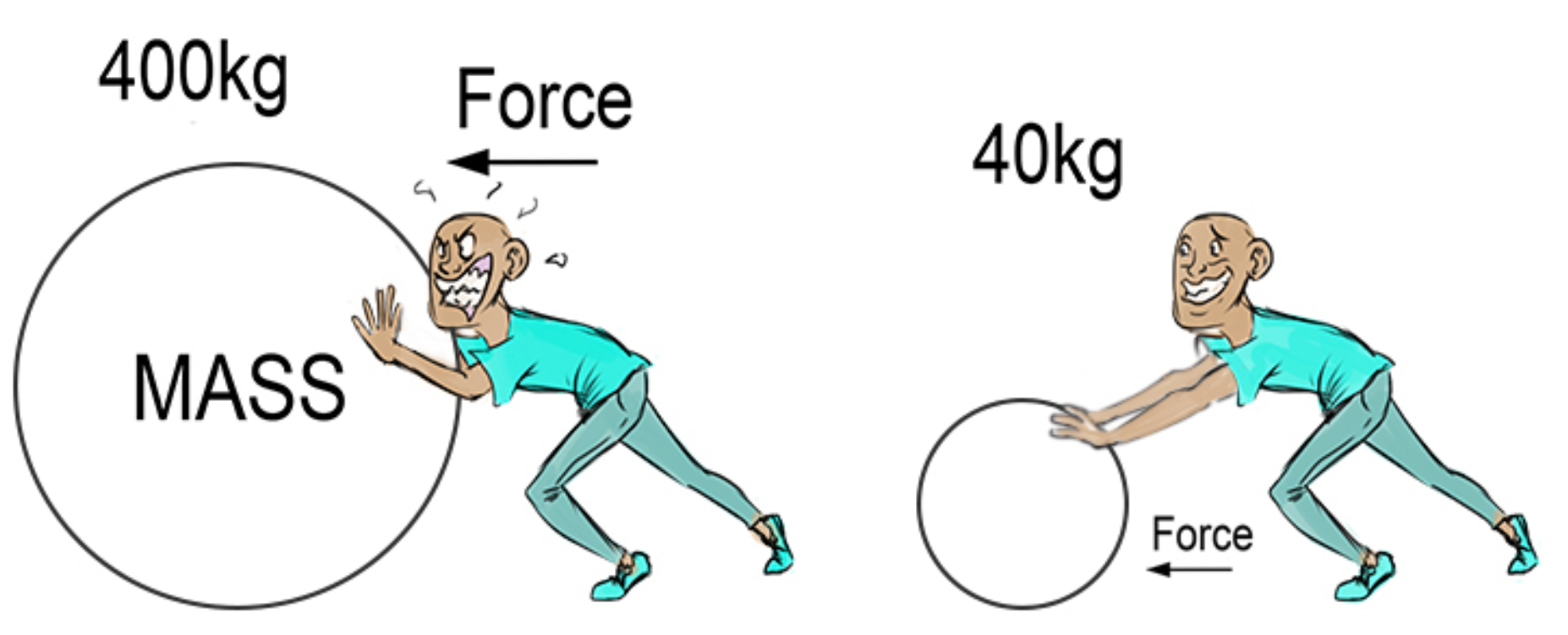
The motion of an object is determined by all of the forces acting on it. The greater the mass of the object, the greater the force needed to achieve the same change in motion.

1
1

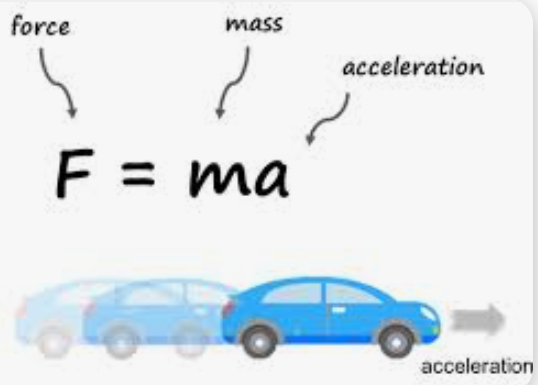
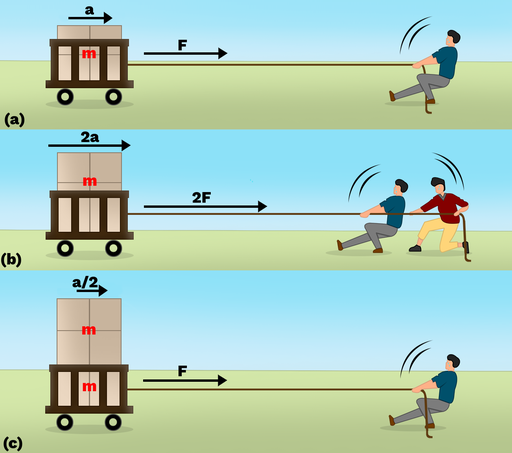
Newton’s Second Law summarizes this with the formula F = ma, where F is the force, m is the mass, and a is the acceleration.


1
1
1

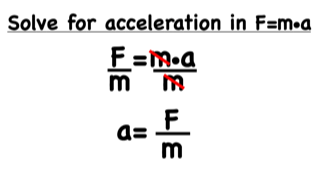
If we want to solve for acceleration, we change the formula around so that a = F/m. This shows the relationship between force and mass on acceleration.


1
1

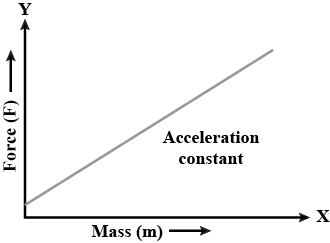
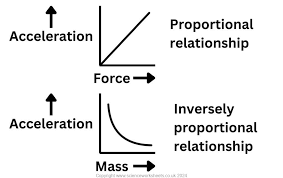
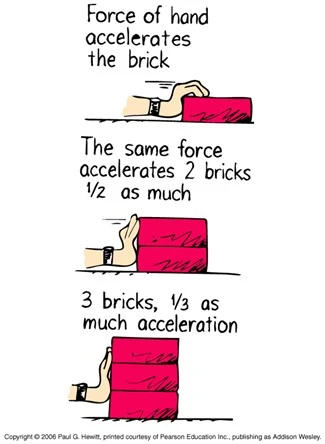
If mass is held constant (not changed), then as force increases, the acceleration increases. These are directly related.


1
1
1
1

Mass and acceleration are inversely related. This means that if force is held constant, then as the mass increases, the acceleration would decrease.


1
1

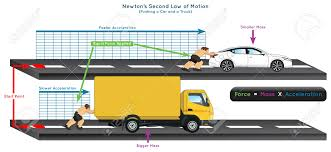
Think about two vehicles – one is a small sports car and the other is a dump truck. According to this formula, the vehicle with more mass (the dump truck) would accelerate more slowly than the vehicle with less mass (the sports car) if the same force is applied.

1
Question 16
16.

1

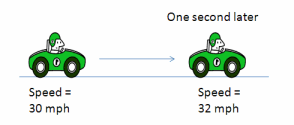
For now, we don’t need to understand motion involving direction (velocity), so for acceleration, we will just think of this as a change in the motion of the object.


Question 18
18.

What does acceleration refer to in simple terms?

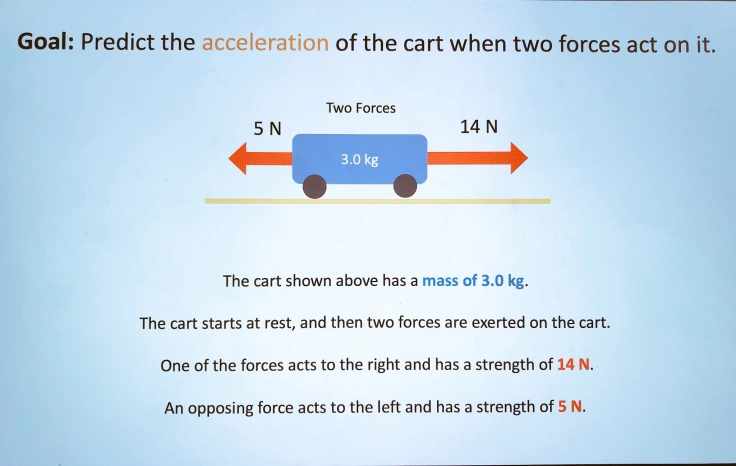
As an object accelerates (changes speed or direction), an unbalanced force is acting on it. If there are multiple forces on the object, the acceleration is proportional to the overall force.


1
1
1

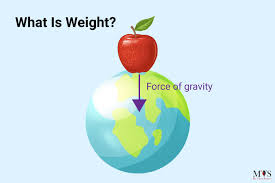
One important force to consider is the force of gravity. Gravity will be discussed later, but for now, you need to understand that gravity is a force of attraction between things that have mass. Gravity is the force that pulls you towards the center of the planet.


1
1
1
What does mass affect in Newton's Second Law?
The speed of light only.
The color of the object.
The object's temperature changes.
How an object's motion changes with an unbalanced force.
Question 2
2.

What does Newton’s Second Law describe?

Question 3
3.

What is needed for a greater mass to move?

Question 4
4.

Which statement is true about mass and motion?

Question 5
5.

What does 'F' represent in Newton's Second Law F = ma?

Question 6
6.

In the equation F = ma, what does 'm' stand for?

Question 7
7.

What does 'a' mean in the formula F = ma?

Question 8
8.

If mass increases, what happens to acceleration?

Question 9
9.

In the equation a = F/m, what does m represent?

Question 10
10.

If mass is constant, what happens to acceleration as force increases?

Question 11
11.

With constant mass, if force doubles, what happens to acceleration?

Question 12
12.

If you apply more force to an object of constant mass, what changes?

Question 13
13.

What happens when force is constant but mass increases?

Question 14
14.

What happens to acceleration if mass increases with a constant force?

Question 15
15.

Which statement is correct about mass and acceleration under constant force?

What does 'mass' refer to in physics?
The speed of an object
The amount of matter in an object
The weight of an object
The shape of an object
Question 17
17.

What happens to acceleration with a heavier vehicle?

Question 19
19.

What happens when an object accelerates?

Question 20
20.

What is required for an object to change speed?

Question 21
21.

What is true about multiple forces on an object?

Question 22
22.

What does gravity pull you towards?

Question 23
23.

What type of force is gravity?

Question 24
24.

What does gravity affect?