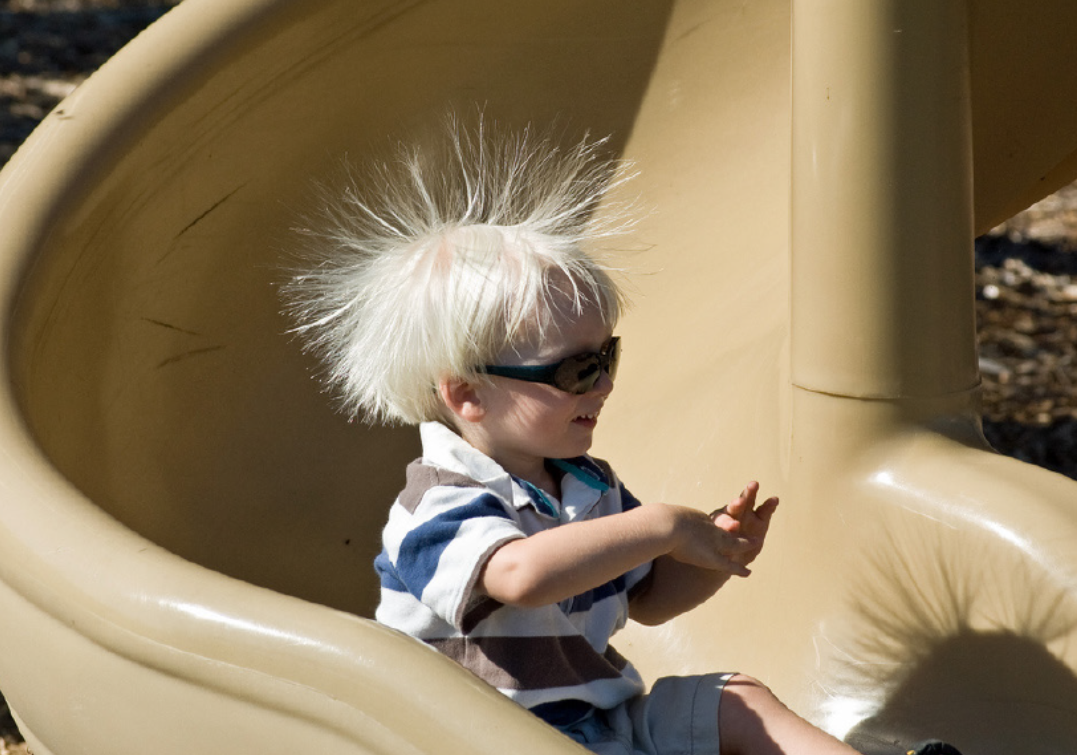
At the park, you see a child coming down the slide with hair sticking straight up. As you read the following section, think of possible models you could create to show what causes the child’s hair to stand up.
Electric charge is a physical property of matter. It occurs between particles or objects, and it causes the particles or objects to attract (pull together) or repel (push away) each other.
Like magnetic forces, electric charges can exert forces between particles or objects that aren’t even touching.
Required
1
Required
1
Required
1
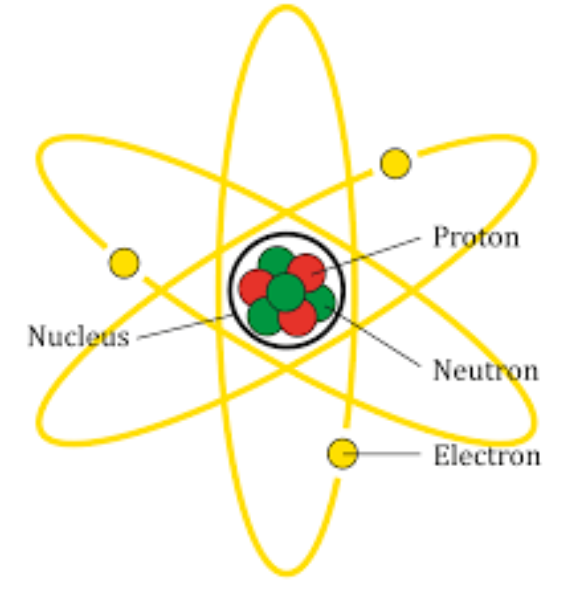
Before we dive too much into this topic, let’s talk about what an atom is. Atoms make up all matter- toilet paper, air, everything in your body and everything that is a thing. It consists of a few parts we’ll call subatomic particles. Subatomic means smaller than an atom. An electron is a negatively charged particle that moves around in the atom around the nucleus.
The nucleus is the center of the atom and consists of positively charged particles called the proton (pro for positive) and a neutrally charged particle called a neutron (for neutral, get it?).
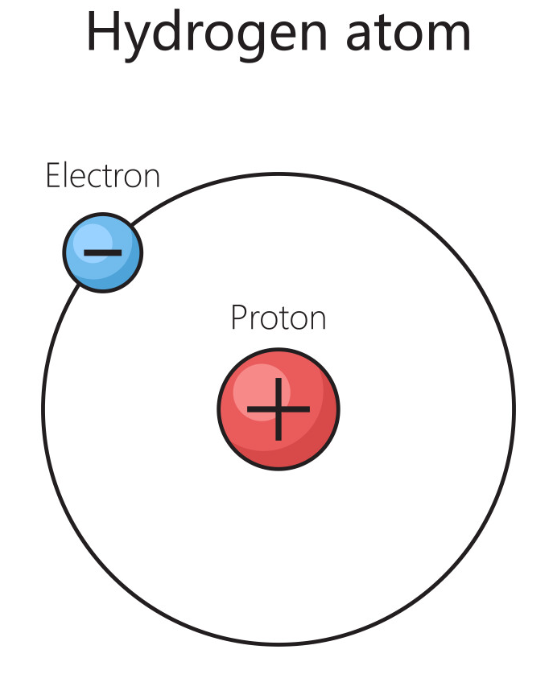
The diagram below is a very simplistic view of the most basic element we have - hydrogen. The hydrogen atom is the smallest atom and most of the time it doesn’t even have a neutron in the nucleus.
Different elements (different types of atoms) have differing amounts of electrons, protons, and neutrons.
Required
1
Required
1
Required
1
Okay, let’s get back to electric charge. All electric charge is based on the protons and electrons in atoms, nothing to do with the neutrons.
Atoms that have the same number of protons and electrons have a neutral electric charge because the positives cancel out the negatives, or in other words the charges are equal to zero. Neutral atoms are said to be balanced.
Required
1
Required
1
Required
1
Required
1
However, sometimes atoms can gain or lose electrons.
When this happens the atom is no longer balanced. Atoms that lose electrons become positively charged because they have more protons than electrons.
Atoms that gain electrons become negatively charged because they have more electrons than protons.
When atoms have an unbalanced number of electrons and protons, they carry an electric charge.
Required
1
Required
1
Required
1
Required
1
Electric Force
When it comes to electric charges, opposites attract.
In other words, positive and negative charged particles are attracted to each other while like charges repel.
If two positive charges are brought close to each other, they will repel or push away from each other.
The same is true with two negative charges. They too will repel each other.
What if a negative and a positive charge are brought near each other? They will be attracted to each other and the force of attraction will try to pull them closer together.
A diagram of this phenomenon is seen below. This sounds very similar to how magnets work, but it is important to realize that positive and negative charges are not the same as the north and south poles of a magnet!
Required
1
Required
1
Required
1
Required
1
The force of attraction or repulsion between charged particles is called electric force.
The strength of the electric force depends on several factors. It depends on how many negative and positively charged particles there are. It also depends on the distance between the charged particles.
How do you think the force will change if you increase or decrease the distance?
Required
1
Required
1
Required
1
Required
1
Static electricity is a buildup of electric charges on objects.
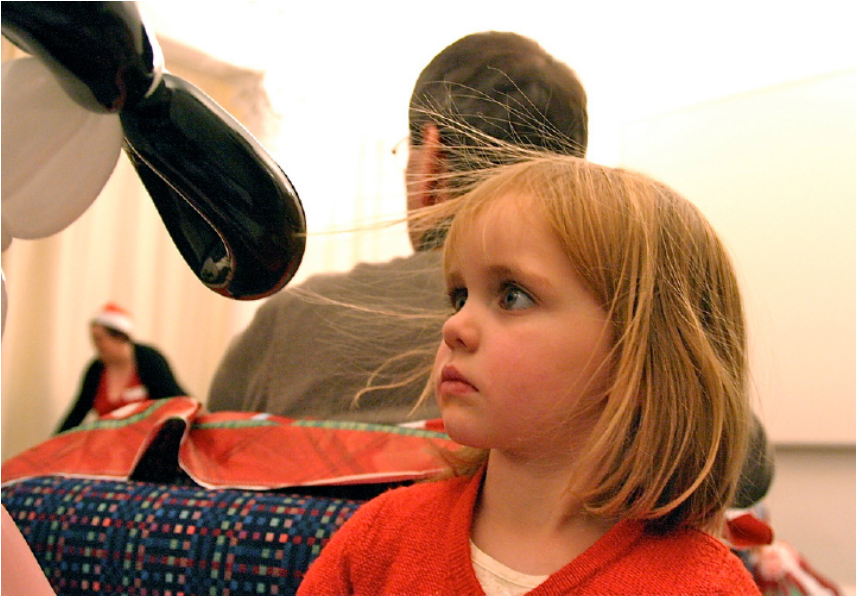
Charges build up when negative electrons are transferred from one object to another. This happens when you rub a balloon on your hair.
Electrons from atoms in your hair move to the balloon and take their negative charges with them. The balloon becomes negatively charged. The atoms in your hair lose electrons and become positively charged because now they have more protons than electrons.
Try drawing a diagram of what is happening in this scenario.
Required
1
Required
1
Required
1
Required
1
Current electricity
An electric current is a flow of electric charge.
When you think of the electricity in the wires that power your home, you are thinking of current electricity, where an electric charge is carried by electrons moving through wires.
Materials that easily carry electric charges are called conductors. Many metals are good conductors of electricity. Materials that do not easily allow electricity to flow through them are called insulators.
Required
1
Required
1
Required
1
Required
1
Question 1
1.
What is electric charge defined as?
Question 2
2.
What do electric charges do to objects?
Question 3
3.
What is similar between electric and magnetic forces?
Question 4
4.
What is the charge of a proton?
Question 5
5.
What particle orbits the nucleus of an atom?
Question 6
6.
What is the charge of the electron?
Question 7
7.
What subatomic particles determine electric charge in atoms?
Question 8
8.
What happens to the electric charge of an atom with equal protons and electrons?
Question 9
9.
Why are neutral atoms considered balanced?
Question 10
10.
Which subatomic particle does NOT affect electric charge?
Question 11
11.
What happens when an atom loses electrons?
Question 12
12.
Why does a negatively charged atom occur?
Question 13
13.
What is needed for an atom to carry an electric charge?
Question 14
14.
What charge do atoms have when they gain electrons?
Question 15
15.
What happens when two positive charges are near each other?
Question 16
16.
What occurs when negative charges are brought close together?
Question 17
17.
What is the interaction between a positive and a negative charge?
Question 18
18.
How do like charges behave when near each other?
Question 19
19.
What is the force between charged particles called?
Question 20
20.
What does the strength of electric force depend on?
Question 21
21.
How does increasing distance affect electric force?
Question 22
22.
How does the quantity of charged particles influence electric force?
Question 23
23.
What causes the girl's hair to stand up?
Question 24
24.
What happens to hair electrons when rubbing a balloon?
Question 25
25.
After rubbing the balloon, what charge does hair have?
Question 26
26.
What is the balloon's charge after rubbing it on hair?
Question 27
27.
What is an electric current?
Question 28
28.
What carries electric charges in wires?
Question 29
29.
What do we call materials that easily conduct electricity?
Question 30
30.
What are materials that do not allow electricity to flow?