Magnets and electrical forces can exert different amounts of strength. In this section pay special attention to how making changes to the magnets and electrical forces can cause a change in the strength or effect of these forces.
Required
1
Question 1
1.
What should you pay special attention to?
Connection between Electricity and Magnetism
Long ago, sailors noticed that sometimes, when lightning struck a ship, the polarity of the ship’s compass might be reversed: suddenly, the needle on the compass pointed south instead of north! This was one of many observations that gave scientists clues that the phenomena of electricity and magnetism might be related. Our modern knowledge of the relationship between electricity and magnetism has allowed us to create many technologies using powerful electromagnets, but it took many observations and experiments for this to happen.
Required
1
Required
1
Historic Experiments
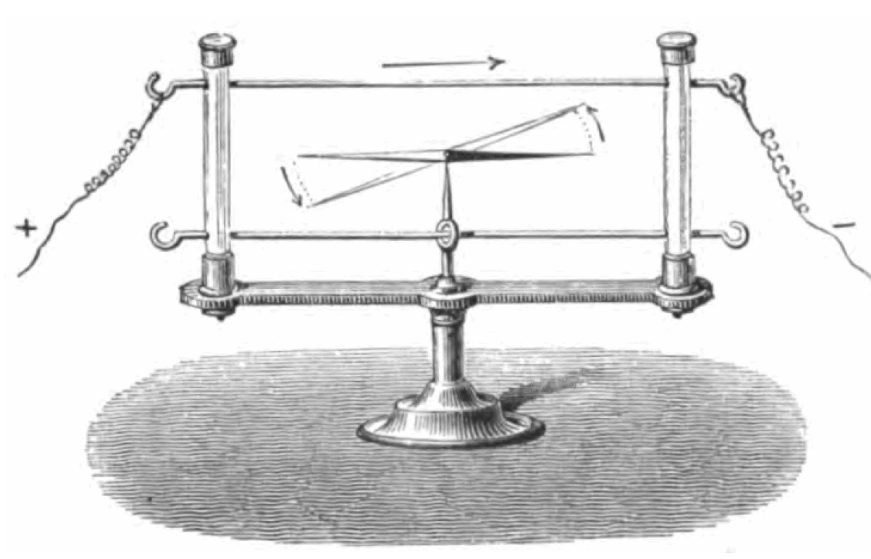
In 1820, Hans Christian Oersted was giving a public demonstration to show that electricity, heat, and light were related. He connected a source of electricity to a platinum wire and demonstrated that the wire became hot and began to glow. He happened to have a compass on hand for another experiment he was planning and decided to see if the electricity had any effect on the compass needle. He observed that when the current was running through the wire, it made the compass needle turn so it was perpendicular to the wire. A drawing of this is seen below. Apparently, his audience was unimpressed, but Oersted realized that the cause of the compass moving was the result of a magnetic field produced by the electric current in the wire.
William Sturgeon and Joseph Henry were two of these engineers. William Sturgeon was a British electrical engineer who made the first practical electromagnet. In 1825, he demonstrated a 200 gram magnet that could lift 4 kilograms of iron using a single electrical cell. His electromagnet involved wrapping a wire around an iron core. He heavily varnished the iron core so that it would be insulated from the wire. This had to be done to prevent a short circuit.
Required
1
Required
1
Fun With Math!
Sturgeon’s electromagnet was 200 grams and it could lift a 4 kilogram weight. How many times its own weight did the electromagnet pick up? Don’t forget to convert units of grams to kilograms, and happy calculating.
Required
1
Question 11
11.
How many times its own weight did the electromagnet pick up?
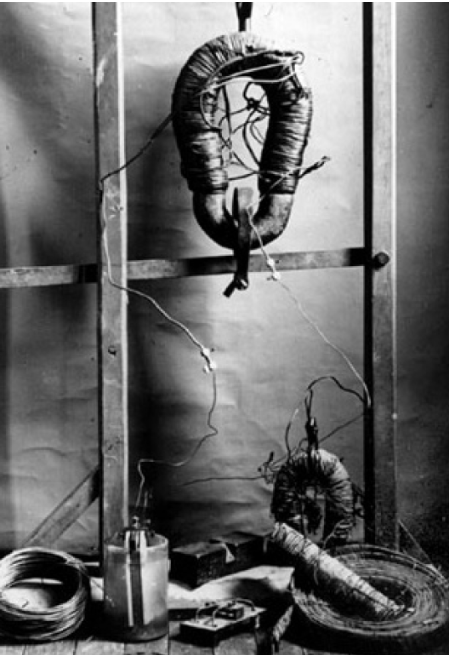
Joseph Henry was an American. At one time he was a physics professor at Princeton and he also served as the Secretary of the Smithsonian Institution. Henry improved upon William Sturgeon’s design by conducting a series of experiments. He insulated the wire so that more coils could be wrapped around the core and he measured the effect of having more coils. He tried changing the voltage supplied to the electromagnet. He tried changing the current. He tried changing the arrangement of the coils. He even tried different arrangements of the battery cells powering the electromagnet. In one published paper He described twenty separate experiments! Eventually, he was able to build electromagnets that could lift over 100 times their weight. A photograph of that setup is seen below.
Required
1
Required
1
Required
1
Required
1
Electromagnets
Modern electromagnets can create even stronger magnetic fields than those created by Joseph Henry. Plus, when compared to permanent magnets, electromagnets have the advantage that the magnetic field can be turned on and off. When the current flows through the coil, it is a powerful magnet. When the current is turned off, the magnetic field essentially disappears.
Required
1
Required
1
Required
1
in many practical applications. They can lift large masses of magnetic materials such as scrap iron, rolls of steel, and auto parts. The overhead portion of the machine shown in the image on the left is a lifting electromagnet crane. When electricity is applied the magnetic field is induced. This 555-metric ton island was lifted to be installed in place on the aircraft carrier being built for the U.S. Navy. When lowered into position, the electricity is turned off, which in turn switches off the magnetic field.
Required
1
Required
1
Required
1
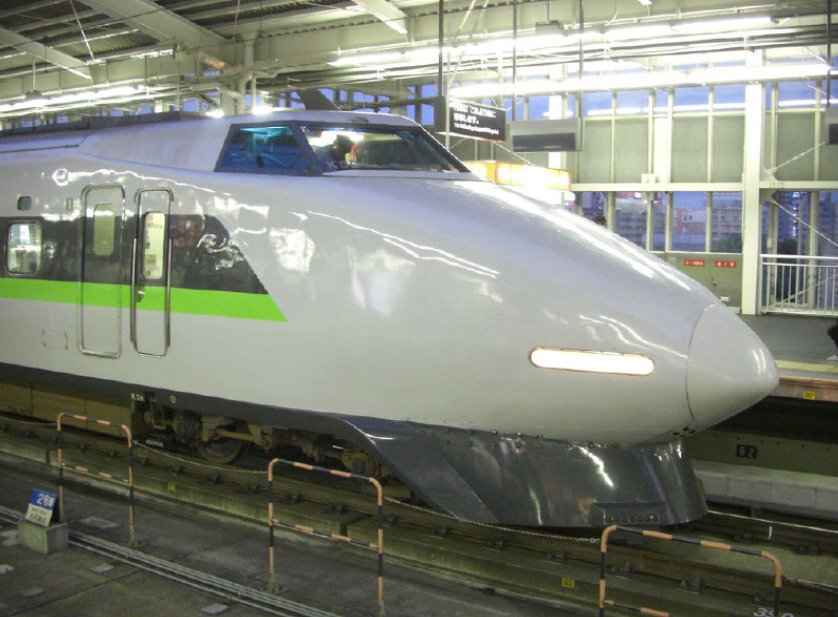
Electromagnets are essential to the design of the electric generator and electric motor and are also employed in doorbells, circuit breakers, television receivers, loudspeakers, electric deadbolts, car starters, clothes washers, atomic particle accelerators, and electromagnetic brakes and clutches. Electromagnets are commonly used as switches in electrical machines. A recent use for industrial electromagnets is to create magnetic levitation systems for bullet trains as seen in the picture below.
Required
1
Required
1
Electric Generators
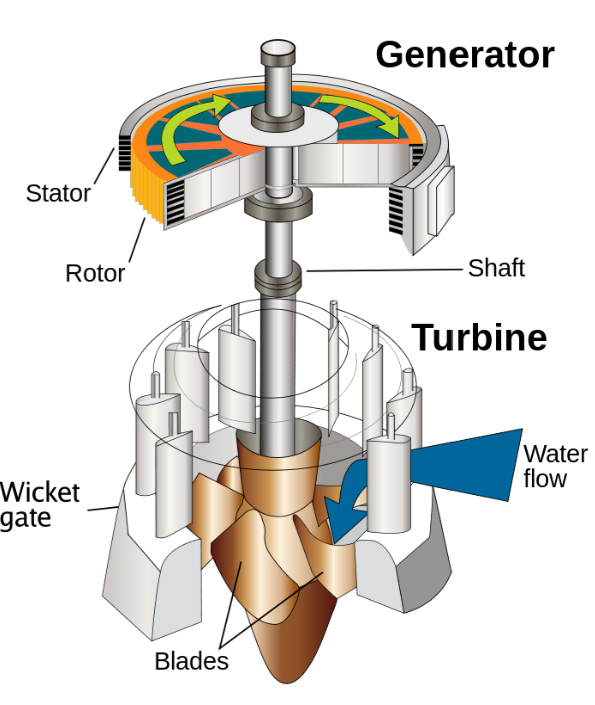
An electric generator is a device that generates an electric current using a magnetic field. Electricity can be generated when a magnetic field and an electric conductor, such as a coil of wire, move relative to one another. This is the basic idea behind turbines and other generators. A diagram of how this works is seen below. In any electric generator, some form of energy is applied to turn a shaft (water or wind are examples). The turning shaft causes a coil of wire to rotate between the opposite poles of a magnet. Because the coil is rotating in a magnetic field, electric current is generated in the wire. This allows the generator to convert mechanical energy to electric energy. An electric motor is a device that converts electrical energy to mechanical energy.
Required
1
Required
1
Question 25
25.
What does an electric generator do?
Question 2
2.
What can happen to a ship's compass during a lightning strike?
Question 3
3.
What did sailors' observations help scientists understand?
Question 4
4.
What happens to the compass needle when electricity flows through a wire?
Question 5
5.
What does the experiment demonstrate about electricity?
Question 6
6.
Who conducted this historic experiment?
Question 7
7.
What was Ampere able to describe with a mathematical formula?
Question 8
8.
Why is Ampere's work important for future scientists?
Question 9
9.
Who created the first practical electromagnet?
Question 10
10.
What material did Sturgeon wrap around the iron core?
Question 12
12.
What is the main purpose of the device in the image?
Question 13
13.
What improves the strength of an electromagnet?
Question 14
14.
What was Joseph Henry's role at Princeton?
Question 15
15.
What did Henry experiment with to enhance electromagnets?
Question 16
16.
What is a key advantage of electromagnets over permanent magnets?
Question 17
17.
What happens when the current through an electromagnet is turned off?
Question 18
18.
What do electromagnets use to create a magnetic field?
Question 19
19.
What happens when electricity is turned off for the crane?
Question 20
20.
What type of materials can the crane lift?
Question 21
21.
What is induced when electricity is applied to the crane?
Question 22
22.
What is the purpose of electromagnets in bullet trains?
Question 23
23.
Where are electromagnets used besides trains?
Question 24
24.
What is the main function of the rotor in a generator?
An electric generator is a device that generates an electric current using a magnetic field.
Uses static electricity to create a magnetic field.