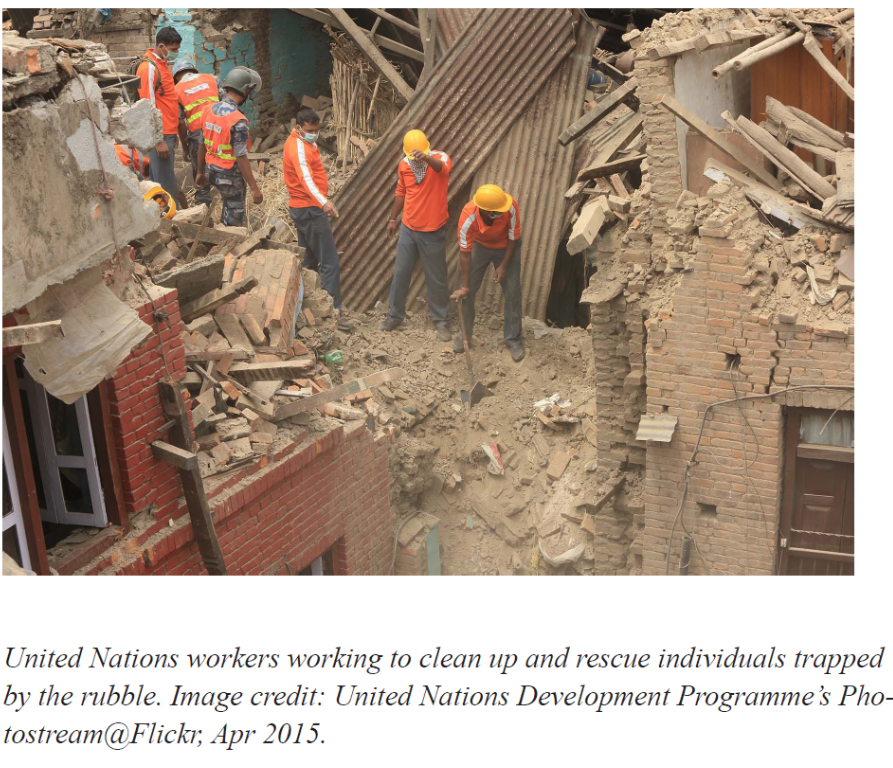
On April 25th at 11:56 AM the ground began to shake violently in Nepal. It started as a low rumble and then the ground violently tore back and forth, and up and down. Bricks from structures flew through the air. The sounds of buildings groaning and tumbling roared over the sounds of people screaming. Nearby, on Mount Everest and in Langtang Valley, the quake triggered avalanches that rumbled down the slopes, killing many in its path. More than 250 people were caught in the snow and never made it out alive.
The 7.8 magnitude quake shook the region for approximately 50 seconds and was followed by many aftershocks (smaller earthquakes that follow the major quake). The quake occurred, as most quakes do, because of a build up of stress in the Earth’s rocks as heat driven convection currents in the Earth’s mantle push and pull on crustal rocks. Once enough energy builds up to fracture the crustal rocks, waves of energy flow through the Earth. About 9,000 people lost their lives in the quake and more than 21,000 people were injured, primarily due to collapsing structures.
Halfway around the world, in November of the same year, two 7.6 magnitude earthquakes hit the border of Peru and Brazil within minutes of each other. The ground shook violently, and the ground surface ruptured in places. However, not one building collapsed and only minor damage was reported. Although a few people reported injuries, not one death resulted from the quakes. What was the difference? The answer is engineering.
Engineers work to create solutions to problems through designing, building, and using of engines, machines, and structures. Engineering is a branch of science combined with technology. Many of the buildings that fell in Nepal were centuries or more old, manufactured out of brick and mud. In Brazil, newer structures had been specifically designed to sway and bend without breaking and older buildings had been retrofitted to reduce damage.
All sorts of geologic and natural hazards exist. A hazard, in this case, is a danger or risk in a given area or location from a natural phenomenon. Earthquakes, as well as volcanoes, mass wasting (landslides, rock fall, mudslide, and avalanches), natural fires, floods, high winds, tornadoes, tsunamis, and hurricanes/ typhoons are all examples of natural hazards that affect human-made structures and threaten human life and livelihoods. When building structures, engineers must consider hazards, or devastation can happen.
We live in the Basin and Range Province. This means the land is broken up with valleys and mountains. The southwestern part of the state includes part of the Colorado Plateau as well. The mountain ranges have been built by millions of years of faulting and earthquakes. Such hilly topography coexists with hazards. The main hazards here in Utah are mass wasting activities (avalanches, land and mudslides, rock falls), earthquakes, and floods. (Floods are rare in Northern Utah, but flash floods are a common occurrence in Southern Utah during the late summer and early fall months.)
The risk of fire is increased because broken gas lines can ignite. In the picture above is an image from the
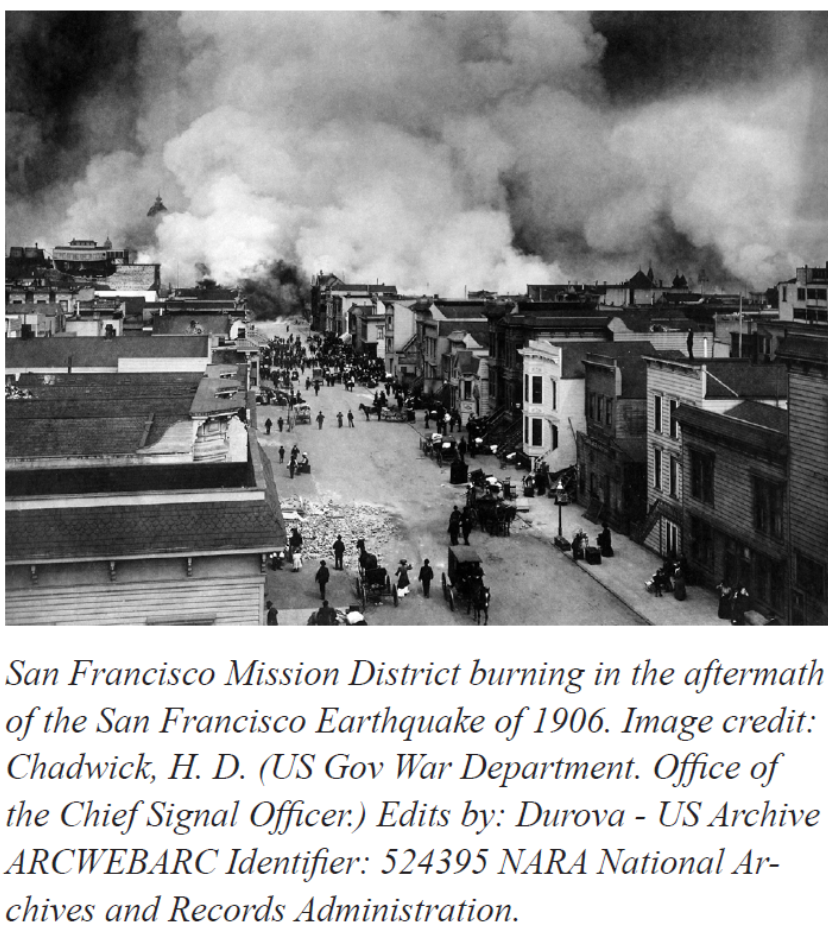
1906 San Francisco earthquake in California where fires broke out and caused more damage than the ground shaking itself.
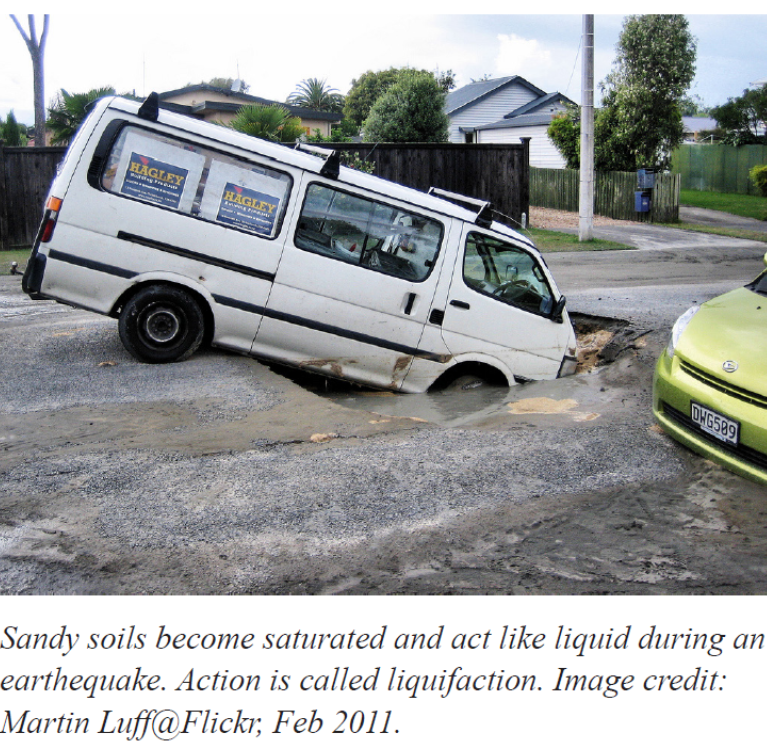
Another earthquake risk is liquefaction. Some regions in Utah are more susceptible to liquefaction than others. For this you can blame Lake Bonneville (an ancient freshwater lake that existed over much of Utah and Idaho about 14,500 years ago). When a region is built up of loose sediments, especially sandy sediments, shaking the ground can bring water up from underground to these sediments. While the shaking occurs the usually solid ground liquefies into quicksand. This liquefaction can cause cars to sink into the mud. It can also cause the foundations of a building to sink and crack, making the building unsafe. The image at left shows a van that has sunken into the ground along with part of the road surface during an earthquake in Christchurch, New Zealand.
Below are some considerations that need to be addressed when selecting a building site.
1. Is the building site appropriate for what the land is going to be used for? Examples: Is the rock sturdy for building a massive dam wall? Is the risk of liquefaction abnormally high in this region? Is there evidence of past landslide activity in the area? Is the site on a known floodplain for a river?
2. Can hazards that may exist be reduced through engineering?
3. Will the advantages of engineering outweigh the risk to human life and property?
Once a site has been chosen we can build structures that are specificallydesigned to withstand the local geologic hazards.
1. Skyscrapers and other large structures built on soft ground must be anchored to bedrock, even if it lies hundreds of meters below the ground surface.
2. The correct building materials must be used. Houses should bend and sway. Wood and steel are better than brick, stone, and adobe, which are brittle and will break.
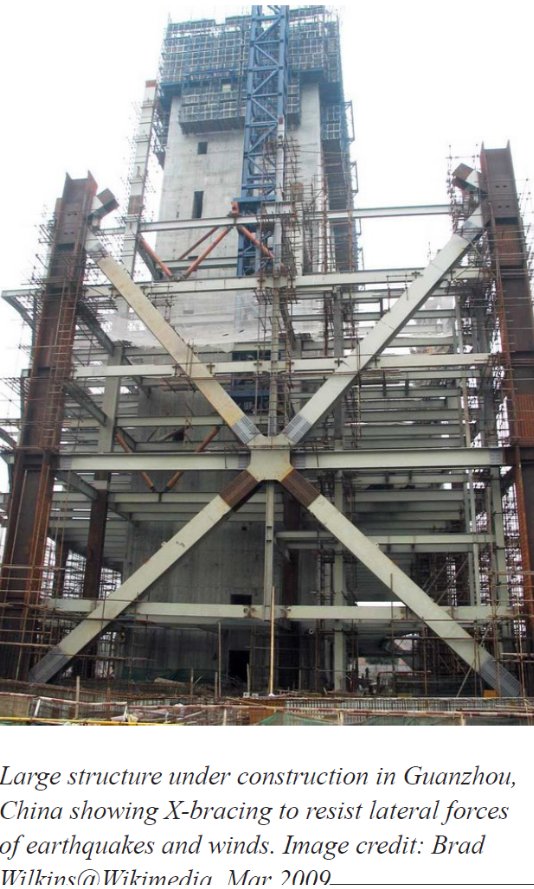
3. Larger buildings must sway, but not so much that they touch nearby buildings. Counter weights and diagonal steel beams (seen at right) are used to reduce swaying of the building.
4. Large buildings can be placed on rollers so that they move with the ground.
5. Buildings may be installed with base isolation (see this in action at the following website: “How Do Base Isolators Work?” Science Learning Hub. https://www.sciencelearn.org.nz/ resources/ 1022-how-do-base-isolators-work)
6. In a multi-story building, the first story must be well supported.
7. In areas where flooding is common, homes may be raised and placed on stilts.
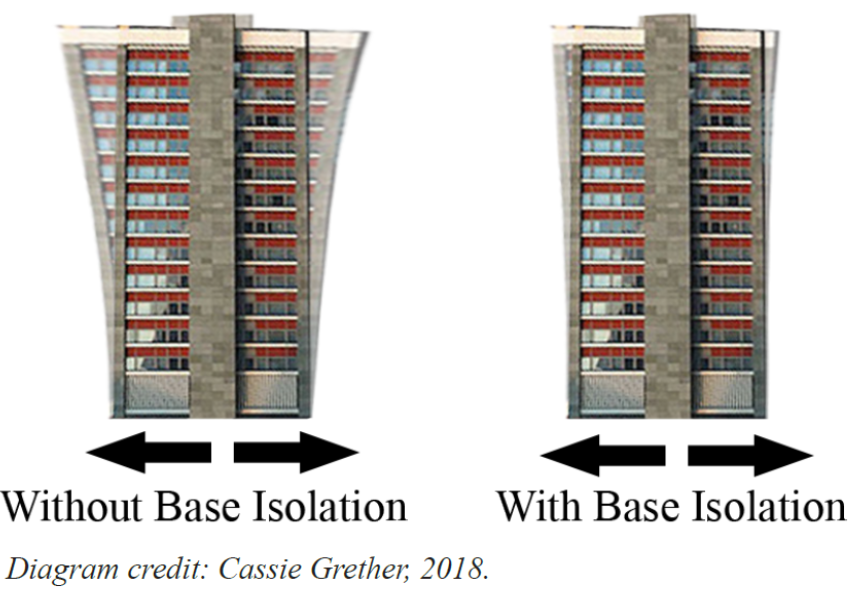
In base isolation, a building is built on flexible structures that allow the building to move while some of the energy is absorbed by the base isolation equipment. It runs on an idea that is similar to the shocks in a car. When you go over a bump in the road, occupants in the car are not thrown about wildly because shock absorbers between the wheels and the car frame allow the energy to be absorbed so the car moves very little. The diagram above shows the movement of a building with and without base isolation. Structures that have already been built, especially ones where the walls have been constructed entirely out of brick and mud are at high risk during an earthquake. However, they can be retrofitted to reduce their risks.
Retrofitting means to add something to a preexisting structure that was not there when it was built. Older buildings must be retrofitted to make them more earthquake safe. Retrofitting with steel or wood can reinforce a building’s structure and its connections. Elevated freeways and bridges can also be retrofitted so that they do not collapse.
After briefly learning about some engineering techniques, do some research and construct two six-story buildings. Create them the same except apply one of these engineering techniques like cross bars, rollers, or base dampening. When your structures are built, test them on an earthquake shake table if your classroom has one. If not, you can glue the bases down on a piece of cardboard and shake them both together. Take observations of how they move during shaking. Try out different earthquake intensities too! Some suggested building materials: hot glue/ marshmallows, spaghetti noodles.
Most buildings can be constructed strong enough to withstand most earthquakes, however, to do so may incur considerable costs that make building impractical. The same goes for maximizing engineering safety techniques for each building. The cost for most structures is just too high. So communities must weigh the risk of the hazard against the cost of different builidng strategies, and make an informed decision.
Here in Utah, we have a large earthquake (6.0 magnitude or higher) about every 300 years or so. This is just an average, and earthquakes don’t follow timely patterns. If you look at the past earthquake data you’ll see that a major quake occurred and then 1,000 years later another. Then 150 years went by before another major quake rocked Utah. The risk of an earthquake that will cause substantial damage is much lower here than that in California where the San Andreas Fault is much more active than our own Watscach Fault. However, that doesn’t mean we shouldn’t take care to prepare, but it does put in perspective the cost/benefit analysis of retrofitting techniques.