Log in
Sign up for FREE
arrow_back
Library

Relative Dating with Fossils

star
star
star
star
star
Last updated 1 day ago
10 questions
Fossils

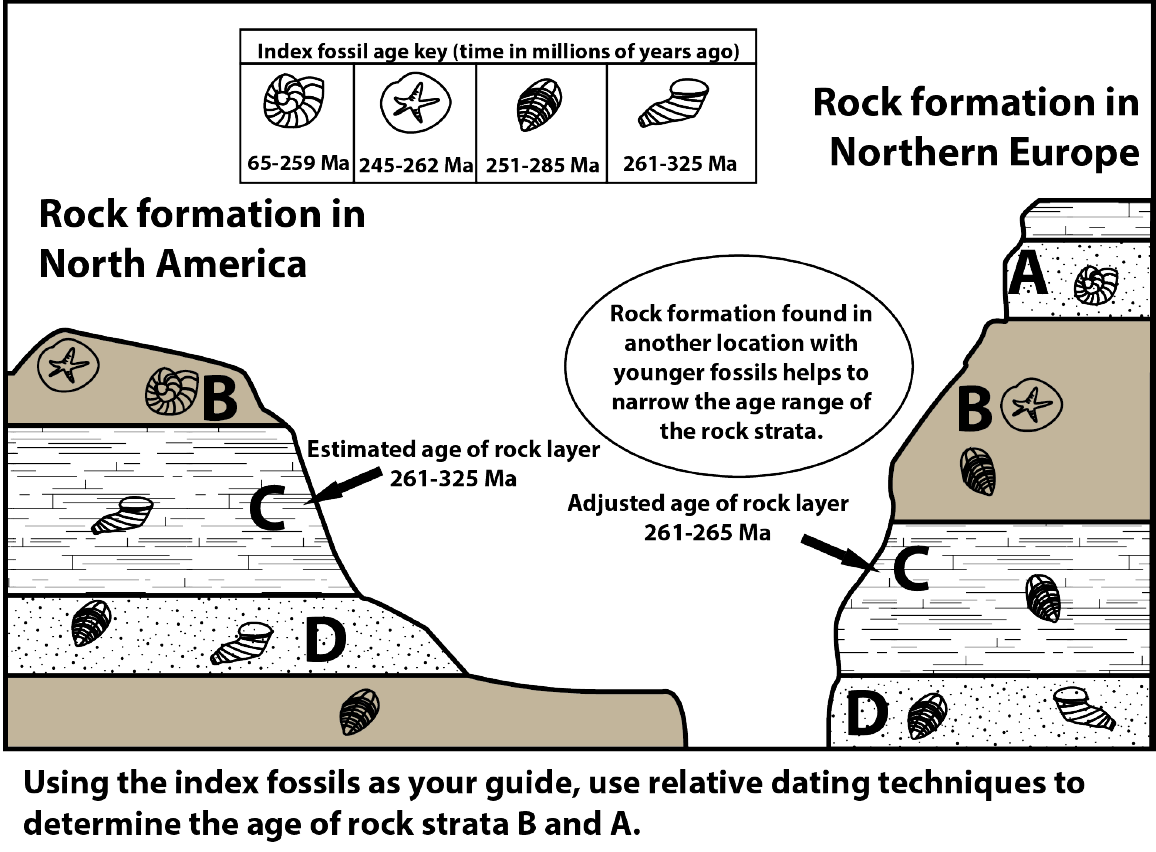
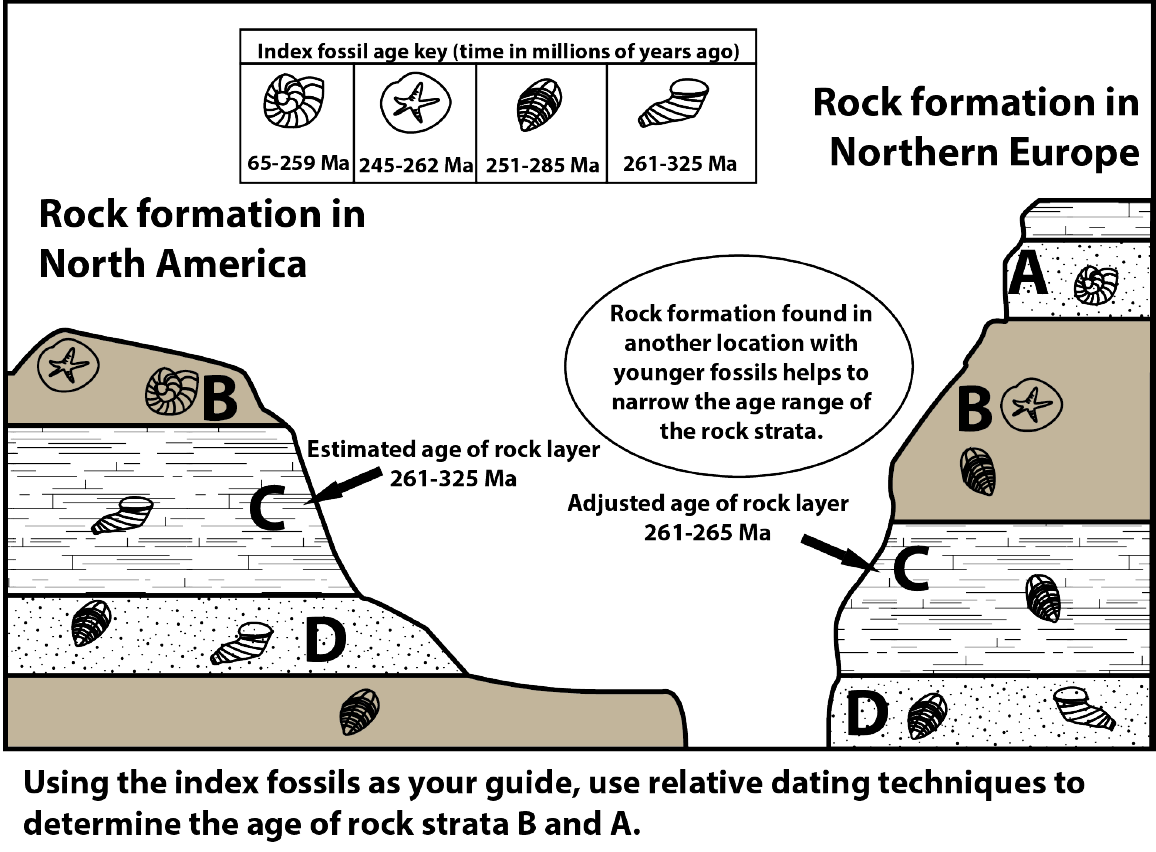
The diagram below is set up to help us understand how index fossils can be used. In the diagram there are two locations where the same rock strata have been found. In Layer C, a fossil is found from a horn coral that lived between 261-325 million years ago. This could give us a very large range of time for the relative age of this rock. However, the same rock formation is found in another location with a trilobite that lived between 251-285 million years ago. Because they formed in the same rock we can make the assumption that their species lived at the same time period. We can, therefore, narrow our age estimate of the rock formation by including only the time frame that overlaps from both species. In this case, that time frame is 261-265 million year ago.


Age of the Earth

Fossils

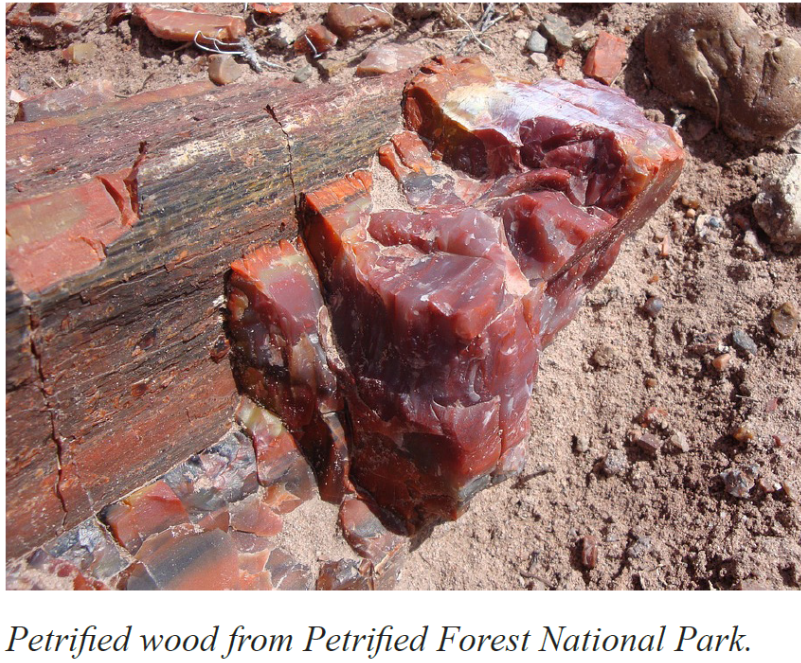
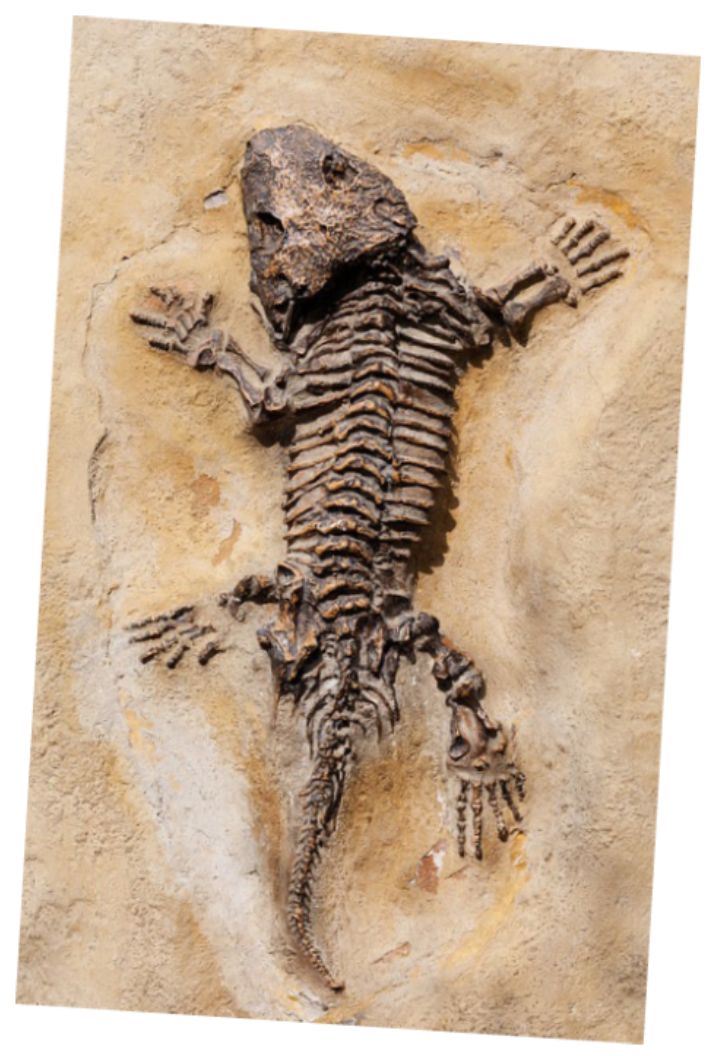
The history of Earth can be read in the rocks of the crust. Sedimentary rocks are really helpful in understanding Earth’s past because as deposition occurs, plants, animals, pollen, even the movements of organisms can become buried and cemented in the rock. We call these remnants fossils. Sometimes fossils can be preserved hard parts like teeth, shells, and bones. Sometimes specimens can be preserved in amber (sap of a tree that has crystallized into mineral).
1
1

However, for the most part, as in the case of petrified wood, organisms that died have gone through a mineralization process where their body parts have been altered and become stone. Sometimes most of an organism will decay after being buried and leave behind just an imprint of carbon. Lastly, sometimes organisms will become buried and as they slowly decay, sediments will fill the cavity that was made by their remains and this becomes the fossil. Several examples of these types of fossils are shown in the image on the right. For any organism to be fossilized, however, it first has to become buried by sediment, the oxygen allowing it to decay rapidly must be reduced, and the sediment must lithify (turn into rock). Because of this, most organisms that have lived have not been fossilized.


1
1
1
1

Fossils tell us what it was like in the past-if the climate was tropical, if it was cold, and they also help us tell time. Footprints can tell us about how organisms moved, and nests tell us details about how organisms cared for their young. Index fossils are fossils that lived only during certain periods of time. When different index fossils overlap it helps us narrow down the age of the rock strata. Armed with tools of geology we can count back in time to understand how life on Earth was long ago.


1
1

Now it’s your turn. Identify the age range of rock layers B and A.


1
Question 9
9.

1

Age of the Earth

So how old is the Earth anyhow? That is something that Lord Kelvin, a mathematical physicist and engineer who lived in the late 1800’s and early 1900’s, set out to calculate. Using how massive the Earth was and using equations to estimate how fast the Earth should lose heat, Lord Kelvin estimated that the Earth’s age was somewhere between 20 and 100 million years old.

That is a really long time, especially on the human time scale, but geologists and biologist knew he was wrong. Relative dating techniques of the time told a very different story. Limestone, a sedimentary rock that forms in very large seas and oceans, takes millions of years to build up enough sediment, compact, and then cement into stone. The sheer amount of rock strata with fossils that we have uncovered showed there was much more time than this.

So how was he wrong? It was the early 1900’s when Marie Curie discovered radioactive isotopes. These atoms give off particles from themselves as they decay into more stable forms of matter. As these radioactive elements decay, they also give off energy. Lord Kelvin was missing this part of the equation. Inside the Earth there are these radioactive isotopes, particularly uranium and plutonium. As they decay, the energy they give off is absorbed by the surrounding material, and the Earth heats.

Currently our internal heat energy is in a steady state or stable. This means that the amount of heat given off to space each day, equals the heat being generated by these radioactive materials inside Earth. If Lord Kelvin had had this information, he may have been able to calculate a much different number.

So how old is the Earth? Since the early 1900’s, we have also discovered a way to date material through absolute dating. In absolute dating techniques, the age of igneous rocks can be determined by the rate of radioactive decay of isotopes inside the rocks. This allows us to use igneous rocks and ash layers deposited among the sedimentary rocks to get a pretty good estimate of the age of the Earth. This combined with relative dating techniques puts the estimated age of the Earth and the solar system at about 4.6 billion years old.

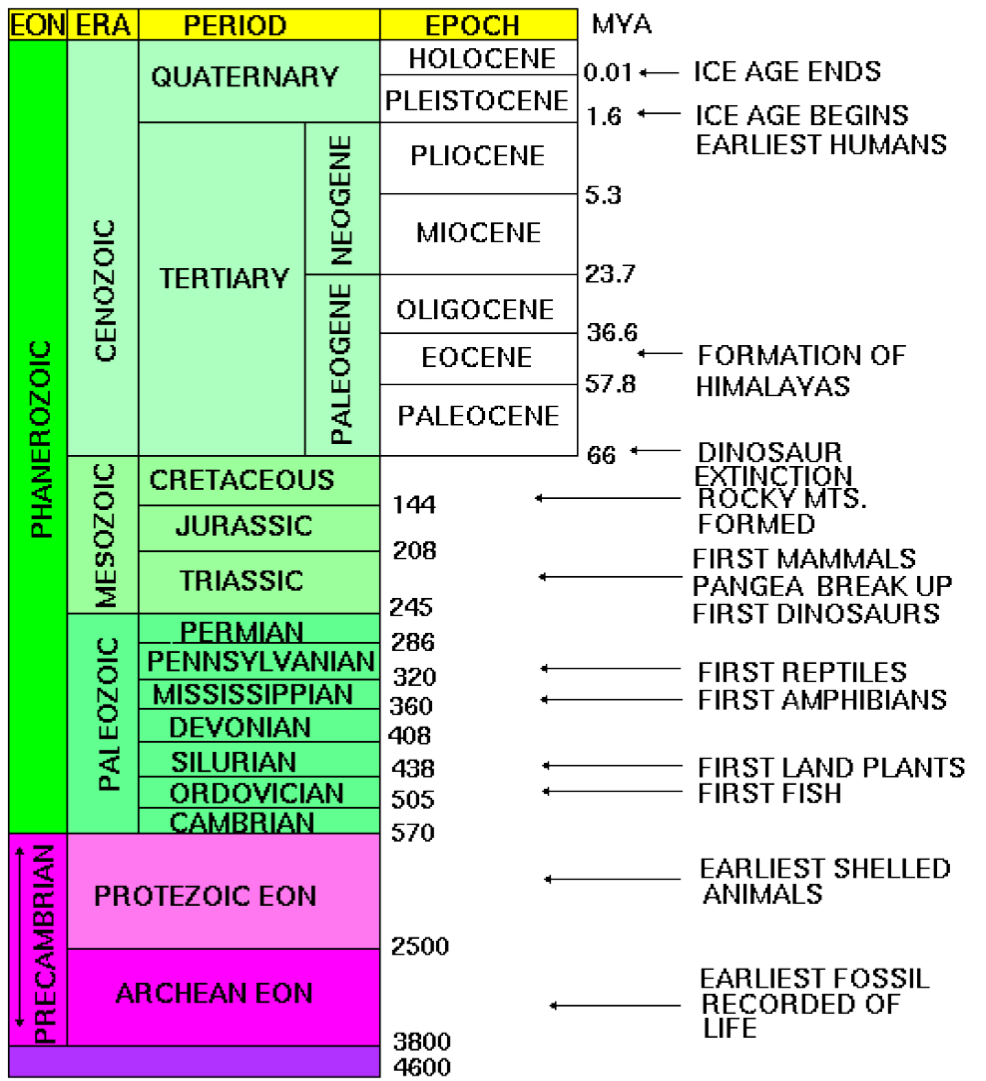
Below is a copy of the geologic time scale that includes all of the time of Earth. It is broken up into eons, eras, periods, and epochs (although there are epochs throughout time, this chart only includes the most recent epochs). Each section of time (eon, era, etc.) in the previous list is a smaller section of time. Different sections of time are not broken up equally over Earth’s history, but instead broken up through sections of major change on the Earth. Much of these are divided due to mass extinctions where many different species went extinct at the same time (extinctions occur when a species has no more living individuals on the planet).


The time we are in now, according to this chart, would be the Phanerozoic Eon, Cenozoic Era, during the Quaternary Period, and the Holocene Epoch. Some scientists are trying to get the current Epoch’s name changed to the Anthropocene meaning the time of man. The reasoning is that we are altering the Earth by disrupting the land surface and causing mass extinctions on a massive scale so much that this new time, the time of man, will show up very visibly in the rock record.

Question 1
1.

What type of rock preserves fossils like petrified wood?

Question 2
2.

What substance can trap organisms to form fossils?

Question 3
3.

What type of fossil is shown in the image on the left?

Question 4
4.

What process must happen for organisms to become fossils?

Question 5
5.

What happens to the sediment around a buried organism that becomes a fossil?

Question 6
6.

Why aren’t all organisms fossilized?

Question 7
7.

What do fossils help us learn about the past?

Question 8
8.

What are index fossils used for?

What is the age range of layer B?
Between 65 and 259 mya
Between 245 and 262 mya
Between 261 and 325 mya
Between 245 and 259 may
Question 10
10.

What is the age range of layer B?