Twa kɔ nsɛm atitiriw so
Log in
Sign up for FREE
arrow_back
Laabri

Week 3.1: Dream Big

star
star
star
star
star
Last updated about 3 hours ago
30 Nsɛmmisa
Danny's Cleaning Crew
Jasmine Makes the Team
Let's Play Pickleball!
Ed Dwight: The First African American Astronaut Trainee

Click submit when finished with all questions and check your answers. You may not be able to make corrections at this time.

1
1
1
1
1
1
1
1
1
1
1
1
1
1
1
1
1
1
1
1
1
1
1

Ed Dwight: The First African American Astronaut Trainee

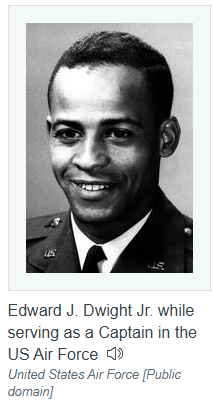
Do you dream of becoming an astronaut when you grow up? Ever since he was little, Ed Dwight dreamed of flying in the air. He became the first African American to be trained as an astronaut.

Ed Dwight was born on September 9, 1933. He joined the United States Air Force in 1953 to pursue his dream of becoming a pilot. He earned his engineering degree from Arizona State University. Then, President John F. Kennedy’s administration selected him out of many people to train as the first-ever African American astronaut. He instantly became a household name; everyone knew who Ed Dwight was! His face was on many magazines around the world.

Ed Dwight did not have an easy path to becoming an astronaut. Unfortunately, he faced a lot of of racial discrimination while training as an astronaut. Some news broadcasters and politicians questioned his intelligence. Even people in the Air Force and NASA, the agency in charge of choosing astronauts, questioned him on the basis of race. Their ignorance affected Ed Dwight, but he continued to work toward his goal. During his training, he worked with cutting-edge technology. He went through numerous tests and flew experimental aircraft carriers. He watched as NASA chose astronauts from the Air Force, leaving him out, but he kept training.

Then, in 1963, John F. Kennedy was killed. Dwight felt he had lost a role model, and someone who had been rooting for him. Dwight soon left the Air Force. He never made it to space. But he did not let that disappointment stop him from pushing forward in life. He started businesses of his own and became incredibly successful.

Ed Dwight’s dream changed after leaving the Air Force. He had always loved making art. He began sculpting and has now made over 18,000 sculptures. Many of them are of important African American figures from history. Many of his sculptures are now on public display throughout the United States.

Ed Dwight broke many barriers throughout his life. He had many talents in both the arts and engineering. His life took many twists, and he did not always succeed, but he always tried again. And in the end, he found a way to pursue his passions.

1
1
1
1
1
1
1

Danny's Cleaning Crew

"KNOCK! KNOCK! KNOCK!" Danny hurried down the stairs to answer the door. His friends were waiting outside for him with a football in hand to go and play a game. It had been raining all week long, and Danny was itching to get some of his energy out. "Mom!" he shouted. "I'm going outside to play with my friends." "Sure, you are," his mom replied. "You cleaned your room like I asked, right?"

Danny rolled his eyes and told the guys he would be out in a few minutes. He closed the front door behind him, hastily turned around, and headed to his room.

Danny scanned his bedroom. Heaps of laundry, dirty dishes and toys were scattered everywhere. Even his trashcan was filled to the brim. He immediately felt overwhelmed by the mess and ran to his mother's room.

"Hey Mom, you sure look stunning today," he started to say. "Do you think I can get to my room a little later? I want to hang out with the guys," he continued.

Danny's mother smirked at her son's comment but stuck to her guns.

"Danny, this is the fifth time I have asked you to clean your room this week. Do it now!" she demanded.

"UGH," Danny scoffed and exited her room.

"You should feel fortunate to have a mom as great as me," she interjected as he walked away.

"Ya, I am really lucky," Danny muttered under his breath.

Danny went back to his room to see the gargantuan mess everywhere. He could hear his friends playing ball outside of his window. "How am I going to ever get my room clean?" Danny thought. Just then, he has an idea and ran back down the stairs and outside to his friends. "Danny," they yelled. "C'mon, we need another player." "Guys, I need you to help me clean my room quickly. My mom won't let me come play until it is spotless," Danny stated.

"Oh, that sounds awesome," Billy declared.

"Please help, guys," Danny continues. "If you help me, I can come to join the game faster."

The friends exchanged glances and went inside to help Danny with his chore. Danny's mom walked by the room a few minutes later to see several boys holding trash bags, wearing gloves, and using cleaning spray to help her son. She chuckled and said, "Any of you boys for hire?" The boys waved hello to Danny's mother and continues tidying up. "How about when you boys are all done, you come downstairs for a snack. That way, you can have some energy to play football," Mom said. "I just baked a fresh batch of chocolate chip cookies, and they have your names on them," Mom continued.

"Danny, you didn't say there was payment involved," Adam said to the guys. "I thought I was working for free."

The friends had a laugh and hurried to finish the room. Everyone knew Danny's mom made the best chocolate chip cookies on the block.

Asemmisa {{asɛmmisaAhyɛnsode}}
1.

Which of the following words is the best definition for the word itching in paragraph 1?

Asemmisa {{asɛmmisaAhyɛnsode}}
2.

Which statement from Paragraph 1 shows sarcasm?

Asemmisa {{asɛmmisaAhyɛnsode}}
3.

What can the reader infer when Danny says the following?

"Hey, Mom, you sure look stunning today," he started to say.

Asemmisa {{asɛmmisaAhyɛnsode}}
4.

Read the sentence from paragraph 3.

"My mom won't let me come outside until it is spotless," Danny stated. "Oh, that sounds really awesome," Billy declared. "Please help, guys," Danny continued. "If you help me, I can come outside faster."

Which of the following words is a synonym for how Billy is feeling in getting help from his friends?

Asemmisa {{asɛmmisaAhyɛnsode}}
5.

Which statement shows a character's sense of humor about helping Danny clean his room?

Asemmisa {{asɛmmisaAhyɛnsode}}
6.

How did Danny's mom feel about the boys helping him?

Asemmisa {{asɛmmisaAhyɛnsode}}
7.

How did Danny feel about his messy room at first?

Jasmine Makes the Team

Jasmine Jones is a petite, quiet, brainy fifth-grader known for rocking a braided bun with a bow. For two years straight, she’s won first place in the spelling bee at Frederick Douglass Elementary School. Most classmates think she’s smart and cool. But an athlete? Nobody saw that coming.

In fact, the first time that Jasmine showed up on the school basketball court, a few fifth-grade boys greeted her with, “You kidding me, shorty?”

Jasmine has always been the shortest among her friends, but her height never seemed a problem till she wanted to try out for the girls’ basketball team. She knew that being short was a disadvantage, but Jasmine enjoyed a challenge.

She also had a secret weapon. Her tough-but-sweet aunt Kinika, her mom’s sister, had been a pretty good college basketball player. Although Jasmine’s mom was on the small side, Kinika was an impressive 5’10.” Kinika had even had dreams of playing professionally in the WNBA… till she smashed up her knee.

“Hey, auntie,” Jasmine texted Kinika one September afternoon, “any chance you can help me become a better b-ball player?”

“Yes! How about Skyland Park tomorrow at 4?” Kinika texted back.

“See you there.”

The next afternoon, Kinika worked with Jasmine on the fundamentals—dribbling, bringing the ball down court, playing defense. She also laid down some advice: “Practice is important. The harder you work, the more you will have to show for it,” Kinika said. “But the biggest thing about basketball, Jas, is to play together. It’s a team sport. Leave your ego on the bench.”

Jasmine listened and learned with the same intensity that had made her the spelling bee queen. After school, three times per week, Kinika met her at the park for practice.

In late September, the Douglass Dragons’ basketball teams conducted tryouts. Fifth grader boys Tyler, DJ, and Keshon were in the gym when Jasmine showed up. “You again, short stuff?”

Jasmine ignored their trash talk. During the tryout, she focused on the court, hit a few three-point shots, and impressed Coach Simone with her willingness to pass the ball. When the Dragon Girls team list was posted the next day, Jasmine’s name was on it, along with Maria, Whitney, Rachel, Tasha, Shannon, Lavera, and Rhonda.

The Dragon Girls lost their first three games by lopsided scores, leading Jasmine to ask her aunt for some extra help. The day after the third game, Kinika stopped by to watch the team practice. With Coach Simone’s permission, Kinika worked with the players in an hour-long session, helping Maria improve her outside shots, encouraging Rachel to pass more, and showing Whitney a better way to set up before free throws. As for Jasmine, her real asset was her speed, so Kinika focused on teaching her how to get to the basket quickly.

“Your aunt is the best!” Maria told Jasmine afterwards. Maria was the star player, so Jasmine felt like making her better really mattered. Jasmine’s main goal for herself was just to prove that she belonged on the team.

The fourth game of the season was against the McMeen Elementary Coyotes. During the pre-game practice, Dominique, the McMeen center, shouted, “Anybody have a measuring tape? We didn’t sign up to play with little kids!” —and then unexpectedly launched a hard pass right at Jasmine.

Jasmine caught it, shot it back to Dominique, and said, “Maybe you should look for that measuring tape in the same place where you left your skills.”

“Oooh, shorty schooled you!” a McMeen teammate yelled at Dominique.

That school should have been named McMean, Jasmine thought, because those girls are downright rude.

In the first quarter, the McMeen Coyotes pulled way ahead, and by halftime the score was 25-12. But in the second half, the Dragons played with improved defense and felt themselves clicking, and McMeen’s big bad center Dominique began missing a lot of shots. Then Maria stole the ball! Jasmine flew down the court to the other end and smoothly caught Maria’s long pass. The littlest Dragon Girl swiftly swished a three-pointer from the corner.

“That girl can play!” yelled one of Douglass kids in the stands.

The Dragon Girls fought back fiercely. With just 10 seconds left, the Coyotes’ lead was down to one point. Every Douglass player secretly wished she’d get the ball to take the winning shot, but no one wanted it more than Jasmine. She zipped toward the basket but got knocked to the ground when the game-ending buzzer went off, just as Maria’s last shot missed the net.

Final score: McMeen Coyotes 41, Douglass Dragons 40.

The McMeen crowd roared with excitement, but Jasmine was surprised to hear ‘Dragon Girls Rock!’ coming from the Douglass section. Then her aunt Kinika appeared at the bench where Jasmine was trying to hide her tears.

“Congratulations,” Kinika said to Jasmine, loud enough for the other players to hear.

“What? Why?” Jasmine responded glumly. “We lost… again.”

“You did, but in that second half, you were really thinking and playing… together. Today, I saw a team, and that team almost won.”

Jasmine wiped her tears and smiled. “Thanks, auntie. And next time, we will win!”
Asemmisa {{asɛmmisaAhyɛnsode}}
8.

Who does Jasmine text about helping her become a better basketball player?

Asemmisa {{asɛmmisaAhyɛnsode}}
9.

How does the author describe Jasmine’s approach to learning a new skill?

Asemmisa {{asɛmmisaAhyɛnsode}}
10.

Read the following sentences from the text.

“The Dragon Girls lost their first three games by lopsided scores, leading Jasmine to ask her aunt for some extra help. The day after the third game, Kinika stopped by to watch the team practice. With Coach Simone’s permission, Kinika worked with the players in an hour-long session, helping Maria improve her outside shots, encouraging Rachel to pass more, and showing Whitney a better way to set up before free throws. As for Jasmine, her real asset was her speed, so Kinika focused on teaching her how to get to the basket quickly.”

What can you conclude based on this information?

Asemmisa {{asɛmmisaAhyɛnsode}}
11.

How is Kinika’s advice to “leave your ego on the bench” related to the Dragon Girls’ game against the McMeen team?

Asemmisa {{asɛmmisaAhyɛnsode}}
12.

What is one main theme from this text?

Asemmisa {{asɛmmisaAhyɛnsode}}
13.

Words have different forms when we use them in different ways. Choose the right vocabulary word to each blank. See if and how the word changes to fit the sentence!

The new student's skill in math _____________the teacher.

Asemmisa {{asɛmmisaAhyɛnsode}}
14.

Words have different forms when we use them in different ways. Choose the right vocabulary word to each blank. See if and how the word changes to fit the sentence!

She has ___________ as an artist.

Asemmisa {{asɛmmisaAhyɛnsode}}
15.

Words have different forms when we use them in different ways. Choose the right vocabulary word to each blank. See if and how the word changes to fit the sentence!

They successfully __________ the rocket that morning.

Let's Play Pickleball!

Do you like net sports, such as tennis, badminton, and ping pong? If you do, then pickleball might be the game for you. Pickleball is a fairly new sport that combines many features of all three. It is played with a paddle and a plastic ball. It is played on a court (either indoor or outdoor) that is about the size of that used for badminton. A low net, similar to one used on a tennis court, separates the players on opposite sides.

The first question most people ask is, “How did pickleball start?” Pickleball was invented in 1965 as a game that all family members could play. The inventors were two dads from Washington state. They had been out playing golf on a summer day. They returned home to find their kids sitting around, bored and looking for something to do. They told the kids to go find their old ping pong paddles. They headed out to a local badminton court. They tried to hit a light plastic ball over the high net. Later they discovered that, by lowering the net to the ground, they could bounce the ball on the hard surface of the court. Before they knew it, the mix of adults and kids had a pretty exciting game going on.

A week later, another dad joined the group. Together, the three of them drew up some rules. They focused on the new game's primary goal -- to involve the whole family in a competitive but fun activity. An official court was constructed. A few years later, a national newspaper and a tennis magazine published articles about “America's newest racquet sport.”

The second question most people ask is, “How did pickleball get its name?” Believe it or not, the sport has no connection to pickles. One theory suggests the sport was named for the dog of one of the inventors. However, it seems that the dog joined the family after the game was started. In fact, the dog may have been named for the game.

Another theory says the name came from a term used in the rowing sport of crew, since the wife of one of the inventors was a frequent rower. This might make sense. In crew, a rowing team that is made up of the leftover rowers from other boats is called a “pickle boat.” Since the new sport used leftover odds and ends from three other sports, it would have been organized in the same random way.

However, the strange name hasn't hurt the popularity of the sport. If anything, it seems to make people more curious about the game. “There is something about the name,” said Hillary Brown, a YMCA Fitness Director. “It interests people and catches their attention.” According to pickleball ambassador Lisa Brochetti, “You get a good sweat. You're active. It's fun and really enjoyable. It's competitive, but there's friendship.”

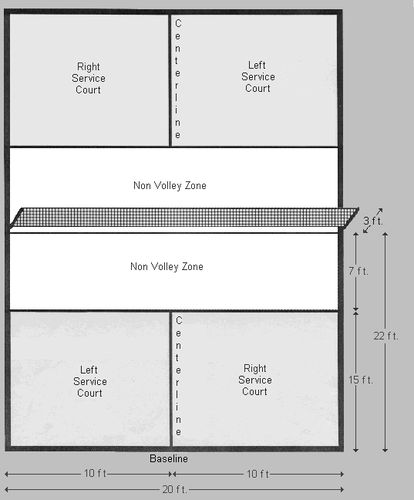
Pickleball court layoutThis is how a pickleball court is laid out.

Pickleball can be played with either ‘singles’ or ‘doubles’. Singles means there are two players total, with one player on each side of the net. Doubles means there are four players total, with a team of two players on each side of the net. The game is played on a rectangular court that is 44 feet long and 20 feet wide. The net is 36 inches high at the ends but decreases to 34 inches at the center. The court is divided into four different areas called service courts. It also has a no-volley zone. The service courts are areas where players serve the ball. The no-volley zone is a stretch of court on either side of the net. For some reason, this zone is also called “the kitchen” (no one knows why). Players may not enter the kitchen to return a ball
unless the ball bounces there first. This prevents tall, strong players from taking over the game. This feature of the game is important because the inventors wanted the sport to be enjoyed by players at all levels and ages.

Another rule of the game has to do with the underhand serve. A player must serve the ball while holding the paddle below their waist. This rule also shows the inventors' idea that the game is not about power. In many net sports, such as tennis, the serve is done high up. This makes for a more powerful serve. A player with a powerful serve usually wins the game. In pickleball, the ball must bounce once on each side after the serve before players can volley the ball back. This makes the play longer and more enjoyable for a wider range of levels and experience. The first side to score 11 points is the winner, and the winning team must win by at least two points.

In the warm, southern states, there are many adults who are retired. This means they have finished working and have the chance to enjoy other things. Many adults who are retired are in their 60s and 70s. Many of these folks have used pickleball to help bridge the gap between generations and connect with younger people.

For instance, in Arizona, many retired adults are volunteers who play pickleball with local students. As one person stated, these adults are “extending their mission of fun and exercise” to young students at places like the Apache Junction elementary schools. “We start by showing them how to hit the ball, and just a few basic rules,” explained one of the volunteers. “After five or ten minutes of hitting the ball, it's amazing how their eye-hand coordination comes around just by focusing. They improve so much in a short period of time.”

The school district did not have extra money to pay for the necessary equipment. So, the volunteers were able to get funds from the USA Pickleball Association (USAPA). This money was used to purchase equipment such as nets, balls, and paddles. In addition, a local professional pickleball player and business owner donated 60 paddles for the students.

“I figure we'll have a little over 1,000 kids trained in pickleball, or at least familiar with it,” observed the volunteer. “We're already planning a tournament for the kids, open to any of the students in Apache Junction.” As for closing the generation gap, he adds, “The younger kids (early teens) can play with guys who are 70 and 80, and they get along great. They have a good time. They have no trouble playing together. It's a great way to bridge that gap. It shows the old people that not all the kids are smart-mouthed, and it shows the young people that not all the old people are grouchy. It just goes beyond all that.”

After the first rulebook was published, the USAPA was organized, and pickleball has now spread to all 50 states. Today, the fast-paced, low-impact sport is spreading like wildfire. It has become a popular sport at community centers, retirement communities, YMCA facilities, campgrounds, and middle and high school physical education classes.

The popularity of pickleball has extended to other countries, too. Canada and India now have their own national governing bodies for pickleball. There have been very few changes in the rules and the court layout. However, the paddles, which originally were made of heavy wood, now are available in materials such as graphite or aluminum. These materials are extremely light and sturdy.

The USAPA, now called USA Pickleball, has a website where it lists pickleball tournaments around the country. More and more sports magazines are including pickleball as a regular feature. The sport has over 3 million players in the United States and Canada. Its popularity is spreading to European and Asian countries. It's easy to learn and fun to play, which makes it fun for people of nearly any age and ability. So grab a paddle and a ball, mark out a court with some tape or chalk, and give pickleball a try!

Asemmisa {{asɛmmisaAhyɛnsode}}
16.

Who invented pickleball?

Asemmisa {{asɛmmisaAhyɛnsode}}
17.

What does the author describe in the first paragraph of this text?

Asemmisa {{asɛmmisaAhyɛnsode}}
18.

Read the following sentences from the text.

“After the first rulebook was published, the USAPA was organized, and pickleball has now spread to all 50 states. Today, the fast-paced, low-impact sport is spreading like wildfire. It has become a popular sport at community centers, retirement communities, YMCA facilities, campgrounds, and middle and high school physical education classes.”

What can you conclude based on this information?

Asemmisa {{asɛmmisaAhyɛnsode}}
19.

Read the following sentences from the text.

“Another rule of the game has to do with the underhand serve. A player must serve the ball while holding the paddle below their waist. This rule also shows the inventors' idea that the game is not about power.”

How does this information support the idea that dads made this game to play with their families?

Asemmisa {{asɛmmisaAhyɛnsode}}
20.

What is the main idea of this text?

Asemmisa {{asɛmmisaAhyɛnsode}}
21.

Which sport did pickleball NOT derive features from?

Asemmisa {{asɛmmisaAhyɛnsode}}
22.

What is one reason pickleball is unique from other racquet sports?

Asemmisa {{asɛmmisaAhyɛnsode}}
23.

What is a benefit of pickleball for older adults?

Asemmisa {{asɛmmisaAhyɛnsode}}
24.

Ed Dwight was the first African American to do what?

Asemmisa {{asɛmmisaAhyɛnsode}}
25.

How does the author of this text describe Dwight’s time training as an astronaut?

Asemmisa {{asɛmmisaAhyɛnsode}}
26.

Dwight turned his passion for art into a successful career.

What evidence from the passage supports this conclusion?

Asemmisa {{asɛmmisaAhyɛnsode}}
27.

How might you describe Dwight’s approach to his goals throughout his life?

Asemmisa {{asɛmmisaAhyɛnsode}}
28.

What is the main idea of this passage?

Asemmisa {{asɛmmisaAhyɛnsode}}
29.

How did Ed Dwight respond to failure in his astronaut career?

Asemmisa {{asɛmmisaAhyɛnsode}}
30.

What motivated Ed Dwight to keep trying despite setbacks?