Twa kɔ nsɛm atitiriw so
Log in
Sign up for FREE
arrow_back
Laabri

Week 4.2: Dinosaurs

star
star
star
star
star
Last updated about 3 hours ago
42 Nsɛmmisa
An Extinct Species
Piecing Together the Story of Dinosaurs from Fossils
Tiny Terror
The Dino Express
The Chicken and the Egg
Protecting the Platypus

Click submit when finished with all questions and check your answers. You may not be able to make corrections at this time.

1
1
1
1
1
1
1
1
1
1
1
1
1
1
1
1
1
1
1
1
1
Asemmisa {{asɛmmisaAhyɛnsode}}
21.

the markings can offer clues about the animals' sizes and diets.

1
1
1
1
1
1
1
Asemmisa {{asɛmmisaAhyɛnsode}}
35.

Choose the answer that best completes the sentence below.

A chick comes out of an egg the supermarket will probably be built anyway.
An Extinct Species

The Scoop on Dinosaurs

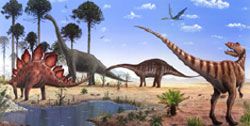
Even though they were extinct, dinosaurs are still around. We have all seen movies with long-toothed dinosaurs running through the forest looking for lunch. These movies have become popular because people were obsessed with dinosaurs. For over 165 million years, dinosaurs lived on the Earth. With people only being around for 2 million years, dinosaur existence has so far outlived humans. Although dinosaurs have not roamed Earth for millions of years, the intrigue is still there for many. The word dinosaur means 'giant lizard'. Dinosaurs have been found on every continents of the world, including Antarctica. While there are around 700 known species of dinosaurs, many scientists believe many more species are yet to be discovered.

Carnivore vs. Herbivore

Most of the dinosaurs were herbivores. However, many of us envision dinosaurs like the Tyrannosaurs Rex (T-REX) that had 8-inch teeth when we think about the species. Since herbivores were sometimes prey to the carnivorous dinos, they found many ways to protect themselves. One form of protection was to travel in herds. When the dinosaurs traveled in pack, they trampled the land leaving superhighways where they walked. Dinosaurs often had spikes or other defensive armor on their body. Some dinosaurs also had beautiful colored skins due to mineral and calcium deposits. Plant-eating dinosaurs, like the Triceratops had eyes looking out to each side, so they could watch for danger while they fed. Some dinosaurs needed up to a ton of vegetation a day to survive. That is like eating enough vegetables to fill a bus! Herbivores also usually walked on all four feet to support their heavy body weight.

Most meat eaters walked on two feet, unlike herbivores. This allowed them to be faster and have their hands free to grab their prey. While most meat-eating dinosaurs had short arms, their hand were generally large. Carnivorous dinosaurs also had serrated teeth. Their teeth resembled knives, making it easier for them to rip meat apart. Although meat-eating dinosaurs had large bones, they were usually filled with air. This meant that carnivore dinosaurs were generally lighter than they looked.

The Dinosaurs Disappear

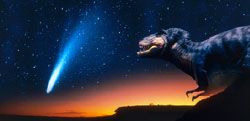
So what happened to all the dinosaurs? There are many theories on why the dinosaurs went extinct. When around 70% of animal life dies, it is called mass extinction. The dinosaur extinction is the first known mass extinction, but scientists think it may not be the last. One theory on dinosaur extinction is that an asteroid hit the Earth. Scientists believe that the asteroids was about 6 miles (10 km) bit and left a crater called the Chicxulub crater. The Chicxulub crater is approximately 110miles (180km) from rim to rim. The asteroid may have caused an enormous dust cloud blocking the sun. Without the sun, the climate changes and killed all the wildlife leaving the dinosaurs with nothing to eat. Another theory of extinction is the ice age. Many dinosaurs were considered cold-blooded, and with such severe temperatures, it would have been hard for them to survive. Massive volcanic eruptions occurred 65 to 67 million years ago, especially in western India. With multiple volcanic eruption, the climate may also have changes, making dinosaur survival impossible. Lastly, some scientist believe that a disease may have spread though the dinosaur population, resulting in extinction. While we may never know the true cause of dinosaur extinction, we know that these giant no longer roam the Earth.
Asemmisa {{asɛmmisaAhyɛnsode}}
1.

Which sentence best states the main idea of the article?

Asemmisa {{asɛmmisaAhyɛnsode}}
2.

Which section would the detail below best fit in?

Many dinosaur skulls had big holes that made them lighter as well as helped them keep cool.

Asemmisa {{asɛmmisaAhyɛnsode}}
3.

Which of the following details below do not help to support the main idea in the Carnivore vs. Herbivore section of the text?

Asemmisa {{asɛmmisaAhyɛnsode}}
4.

The author wrote the section 'The Dinosaurs Disappear' mainly because...

Asemmisa {{asɛmmisaAhyɛnsode}}
5.

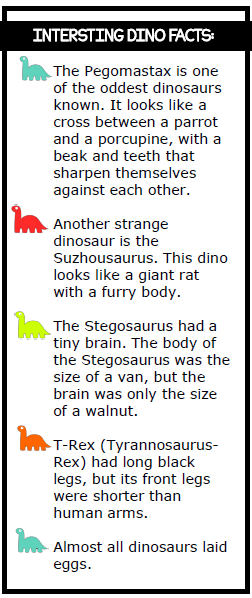
Which titles would make a good alternative for the Interesting Dino Facts section?

Asemmisa {{asɛmmisaAhyɛnsode}}
6.

What type of dinosaur has teeth that resemble knives?

Asemmisa {{asɛmmisaAhyɛnsode}}
7.

What did most herbivores need to eat daily?

Piecing Together the Story of Dinosaurs from Fossils

This text is provided courtesy of the American Museum of Natural History.

You’ve probably seen pictures, models, or movies about dinosaurs that lived millions of years ago. But how do we know so much about these animals? How do we know what they looked like and how they lived? Since the early 1800s, scientists have been piecing together this mystery with fossils.

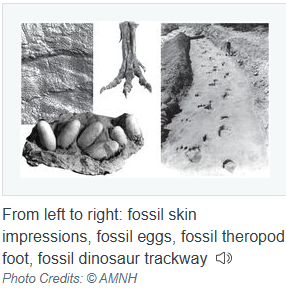
Fossils are the remains of ancient life that are usually buried in rock. Most fossils formed from the hard parts of organisms such as teeth, shells, and bones. They also form from things a plant or animal leaves behind, like a footprint, a leaf print, and even eggs. Fossils show us what Earth was like long ago. They give us a picture of ancient environments. Scientists compare fossils from different time periods to investigate how life on Earth has changed over time.

Think of fossils like puzzle pieces. The more pieces you have, the easier it is to put them together and tell what the whole picture looks like. And sometimes when you find and add new pieces, the picture looks very different from how you thought it would be.

Egg Thief or Egg Protector?

In 1923, a team of paleontologists from the American Museum of Natural History made a surprising discovery in Mongolia’s Gobi Desert. They found three large rocks that turned out to be fossilized dinosaur eggs. Then they discovered another fossil nearby: a toothless dinosaur.

The leader of the expedition, Roy Chapman Andrews, guessed that the dinosaur had been stealing the eggs from the nest. He named it Oviraptor (OH-vee-rap-tor) or “egg thief.”

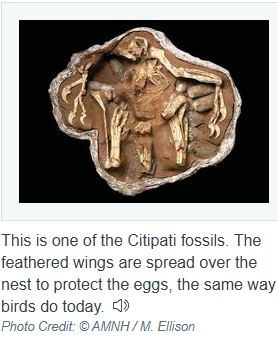
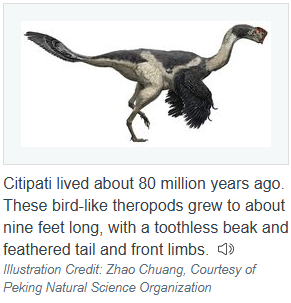
Seventy years later, in 1993, another team from the Museum found very similar fossil eggs in the same desert. One of the eggs held an embryo, or developing baby dinosaur. It turned out to be a baby Citipati (sit-uh-PAH-tee), a kind of dinosaur very similar to Oviraptor. Later, the team discovered an adult Citipati over a nest. It was brooding, or sitting on the nest, the same way birds do: with its arms spread to protect the eggs. And if its arms were covered with feathers, as scientists suspected, these wings would have shielded the eggs from heat and cold. Paleontologists realized that these dinosaurs nested like birds living today.

These dinosaurs didn’t steal eggs. They were caring parents!

When the discovery was made, the group of dinosaurs that includes Citipati and Oviraptor had already been named “oviraptorids.” Even though scientists no longer think these dinosaurs were “egg thieves,” the name stuck.

The Link Between Ancient Dinosaurs and Birds

Over 100 years ago, scientists started to notice similarities between birds and a group of dinosaurs called theropods (THERE-uh-pods).

This group included Tyrannosaurus rex, Velociraptor, and Citipati. As new theropod fossils were discovered, the link with birds became even clearer. Scientists discovered that like birds, theropods laid eggs. And they walked on two feet with their legs directly underneath them. They also had three-toed feet with claws, an s-shaped neck, and hollow bones. Some even had sharp, bird-like beaks. And many theropods had feathers!

Because birds are so similar to these animals, scientists have placed them in the same group. Birds are theropods. This means birds are a kind of dinosaur! By piecing together fossils of extinct dinosaurs, we’ve learned that dinosaurs aren’t extinct after all.

Asemmisa {{asɛmmisaAhyɛnsode}}
8.

What are fossils?

Asemmisa {{asɛmmisaAhyɛnsode}}
9.

To organize this text, the author has divided it into sections. In the section called "Egg Thief or Egg Protector?" what does the author compare to Citipati?

Asemmisa {{asɛmmisaAhyɛnsode}}
10.

Birds are theropod dinosaurs.

What is one piece of evidence that supports this theory?

Asemmisa {{asɛmmisaAhyɛnsode}}
11.

The author describes Citipati dinosaurs as “caring parents.” What evidence supports this description?

Asemmisa {{asɛmmisaAhyɛnsode}}
12.

What is the main idea of this text?

Asemmisa {{asɛmmisaAhyɛnsode}}
13.

Read these sentences from the text.

“Scientists compare fossils from different time periods to investigate how life on Earth has changed over time.

“Think of fossils like puzzle pieces. The more pieces you have, the easier it is to put them together and tell what the whole picture looks like. And sometimes when you find and add new pieces, the picture looks very different from how you thought it would be.”

Why might the author have compared fossils to puzzle pieces?

Asemmisa {{asɛmmisaAhyɛnsode}}
14.

Read these sentences from the text.

“Scientists discovered that like birds, theropods laid eggs. And they walked on two feet with their legs directly underneath them.”

What or whom does "they" refer to here?

Tiny Terror

Scientists unearth one of the oldest known dinosaurs.

Millions of years ago, a bloodthirsty dinosaur roamed Earth. The rough reptile terrorized its prey, viciously ripping apart animals with its sharp claws and knife-like teeth. Who was this fierce hunter? No, not Tyrannosaurus rex. It was Eodromaeus—a dinosaur the size of a dog!

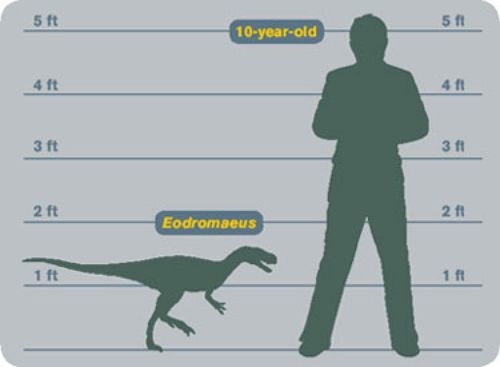
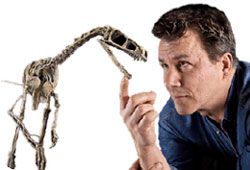
comparison of a small dinosaur and a 10 y.o. child scale

Scientists recently introduced the teeny meanie, which they discovered in Argentina. That is a country in South America. Experts say Eodromaeus (ee-oh-DROH-mee-uhss) is one of the oldest dinosaurs ever discovered. It lived during the Triassic Period about 230 million years ago. The dinosaur’s name means “dawn runner.”

The pint-sized predator was four feet long from nose to tail and weighed less than fifteen pounds. Though Eodromaeus was small, it may hold big clues about the world’s first dinosaurs.

“We’re looking at a snapshot of early dinosaur life,” says Paul Sereno. He is a paleontologist who helped find the reptile.

A Meaty History

Eodromaeus has a history that scientists can really sink their teeth into. The dinosaur was one of the very first theropods. A theropod was a meat-eating dino that walked on two legs.

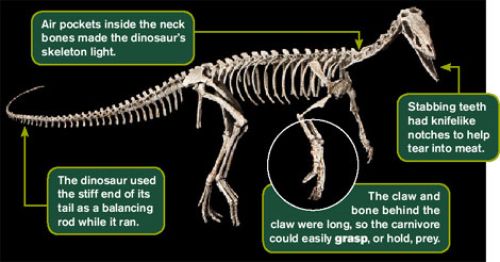
The great-granddaddy of T. rex shared some key features with later carnivores, or meat eaters. The reptile had sharp, narrow teeth. “They have small, steak knife-like [edges] so that when they are jabbed into flesh, they open a wound,” Sereno explained to WR News. Eodromaeus most likely chowed down on small dinosaurs and the young of other reptiles.

Also like later meat eaters, the dinosaur had hands that were perfect for grabbing its dinner. “The bones behind the claws are very long, so it can get the claw around something,” Sereno explains.

In addition, the end of the dino’s tail was stiff to let Eodromaeus keep its balance while running.

The Big Reveal

Eodromaeus is helping scientists learn about other early dinosaurs. The reptile shared its turf with a similar-looking dinosaur called Eoraptor (ee-oh-RAP-tor). For years, experts suspected, or thought, that Eoraptor ate meat. But after comparing Eoraptor’s and Eodromaeus’s features, they determined that Eoraptor was an herbivore, or plant eater.

Despite the dinos’ different diets, they had a lot in common, including their size, experts say. “I think if they [ran] by, you might not even know the difference except that one might want to rip your arm off and the other one might … hide in a bush,” Sereno says.

The fact that the dinosaurs shared so many features could mean that they are also very similar to the world’s first dinosaur, Sereno says. Experts believe that dino roamed Earth ten million years earlier than Eoraptor and Eodromaeus did. That may seem like a long time, experts say, but it is relatively short compared with the 183 million years that dinosaurs existed.

Digging Deeper

Sereno and his team found both Eodromaeus and Eoraptor in northern Argentina. They believe the country may hold even more fossils—including the remains of the very first dinosaur.

“We’re going to go back,” Sereno says. He’s pretty sure some fossils will turn up. “They always come out to say hi when we come!”

Profile of a Predator

Small animals, beware! Eodromaeus’s skeleton shows certain features that are common in all meat-eating dinosaurs, including T. rex.

Eodromaeus’s skeleton fossilMike Hettwer

Dino Hunter

Paleontologist Paul Sereno is dino-mite at discovering dinosaurs. He has found the ancient reptiles on five continents! WR News talked to Sereno about his work.

Eodromaeus’s skeleton fossilMike Hettwer

WR News: How did it feel to find your first dinosaur, Herrerasaurus, in 1998?

Paul Sereno: It was unbelievable. … I was afraid it was going to disappear in front of my eyes. … There we were, … standing over something 230 million years old waiting for us to walk up and discover it.

WR News: How do you name the dinosaurs you discover?

PS: If there’s nothing like a giant horn or something that’s utterly peculiar [or unusual] on the animal you’re describing, then you have to think harder about what is its way of life, what’s special about it.

WR News: Why is patience important for paleontologists?

PS: It took years to find [Eodromaeus]. … If we had cut corners anywhere, at any point along the way, we would know less than we know now.

Asemmisa {{asɛmmisaAhyɛnsode}}
15.

What dinosaur did scientists recently introduce?

Asemmisa {{asɛmmisaAhyɛnsode}}
16.

To organize the text, the author divides it into sections with subheadings. What does the author describe in the section with the subheading “A Meaty History”?

Asemmisa {{asɛmmisaAhyɛnsode}}
17.

Read this sentence from the text:

"Eodromaeus was a carnivore, or meat eater."

What evidence from the text supports this conclusion?

Asemmisa {{asɛmmisaAhyɛnsode}}
18.


Read this sentence from the text:

"Though Eodromaeus was small, it may hold big clues about the world's first dinosaurs."

Based on this information, what can you infer about Eodromaeus and the world's first dinosaurs?

Asemmisa {{asɛmmisaAhyɛnsode}}
19.

What is the main idea of this text?

Asemmisa {{asɛmmisaAhyɛnsode}}
20.

The diagram on the first page compares the size of Eodromaeus to that of a ten-year-old human. Why might the author have included this diagram?

The Dino Express

Experts discover dinosaur footprints along an ancient route.

What do you get when you crowd dinosaurs, crocodiles, and flying reptiles onto the same route? A prehistoric traffic jam on a path known as the Dinosaur Freeway!

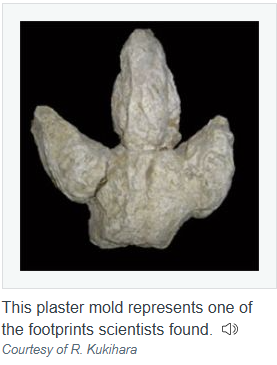
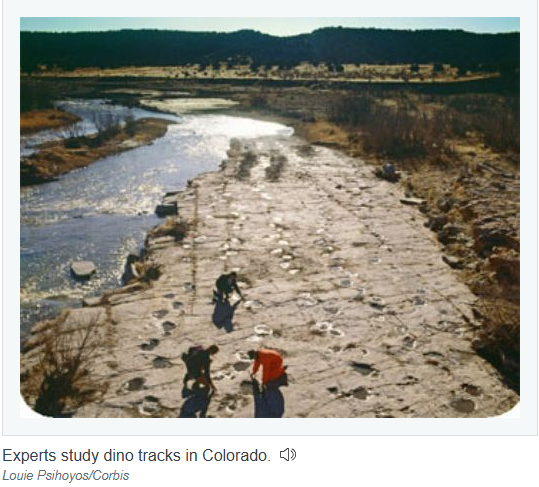
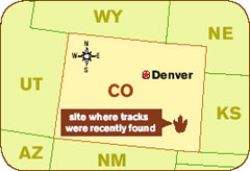
Paleontologists in Colorado recently announced that they found about 350 additional footprints on the pathway. A paleontologist is a scientist who studies dinosaurs. The Dinosaur Freeway is a large area of rocky roadways in Colorado and some nearby states. The site is covered with thousands of tracks from ancient creatures, including dinosaurs.

Paleontologist Martin Lockley and his team discovered the latest tracks. “When we first started looking at these tracks … we had no idea there were so [many],” he told WR News. “It’s very exciting when you find something new.”
Beasts of the Boulevard

The Dinosaur Freeway extends for hundreds of miles through what is now Colorado, New Mexico, Kansas, and Oklahoma. The prints were made about 100 million years ago during the Cretaceous Period. Many animals used the path to migrate, researchers say. To migrate is to move from one area to another.

Experts say many of the track marks were made by iguanodons (ih-GWAH-noh-dahnz). The plant-eating dinos are known for their thumb spikes, which they may have used to defend themselves.

Other tracks are from plate-backed dinos called ankylosaurs (ANG-kih-loh-sorz). They most likely lumbered along the route in search of food, Lockley says. To lumber is to walk heavily.

Location of dinosaur tracks in Colorado.Leigh Haeger

Scientists also noticed marks from pterosaurs’ (TEHR-uh-sorz) claws. The flying reptiles may have left the marks in the earth as they swooped down to catch fish, scientists say.

Rough Roadblocks

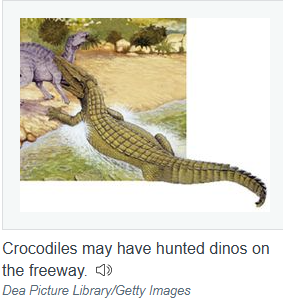
Life on the freeway wasn’t a walk in the park for dinosaurs, though. Lockley and his team also found footprints from giant crocodiles. They believe the killer crocodiles may have preyed on the plant-eating dinosaurs along the freeway.

There is no evidence of meat-eating dinosaurs near the route. Until recently, experts were not sure what could have hunted the plant-eating dinosaurs. “Suddenly, we began to realize that the main predators were the crocodiles,” Lockley explains.
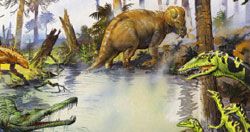
Many of the crocs were more than 13 feet long. That would have made the meat eaters big enough to take on iguanodons and other traveling dinosaurs.

“The crocodiles would ambush [or attack] them when they were crossing streams,” Lockley says.

The Road Ahead

Paleontologists are eager to study the footprints in greater detail. The markings can offer clues about the animals’ sizes and diets. They can also reveal how fast the creatures were, says Spencer Lucas. He is a paleontologist who has searched for dino tracks along the Dinosaur Freeway in New Mexico.

Lucas hopes that he and other scientists will continue to find tracks. That way, they can learn more about the dinosaurs.

“Dinosaurs were around for 150 million years, and there were many kinds living all over the planet,” Lucas told WR News. “That tells me there are many more dinosaur tracks out there waiting to be discovered.”

Dino Dates

Dinosaurs lived during the Mesozoic (meh-zuh-ZOH-ik) Era. That was a period that lasted for about 183 million years. Read on to learn more about the days of dinos.

Triassic Period paintingHighlights for Children/Getty Images

Triassic Period

Years: about 248 million to about 208 million years ago
Fact: The first dinosaurs roamed Earth during this period.

Jurassic period dinosaurs treesRichard Bizley/Photo Researchers, Inc.

Jurassic Period

Years: about 208 million to about 144 million years ago
Fact: The biggest dinos lived during this time. Many new types of dinosaurs appeared.

Cretaceous period dinosaur depiction comet skyMike Agliolo/Photo Researchers, Inc.

Cretaceous Period

Years: about 144 million to about 65 million years ago
Fact: Dinosaurs became extinct at the end of this period, possibly because a meteorite struck Earth.

The Dinosaur Tracker

Martin Lockley was one of the first paleontologists to study dinosaurs’ footprints. WR News recently tracked down the scientist to talk about his work.

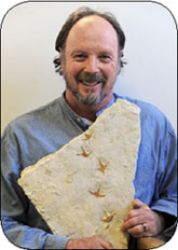
Martin Lockley balding beard hold stoneCourtesy of M. Lockley

WR News: What was one memorable discovery you made on the Dinosaur Freeway?


Martin Lockley: When we found the first pterosaur track … it gave us a whole new branch of study. Since we found that track a few years ago, we’ve been finding a bunch more. Just when you think you’re not going to find anything new … you find something.

WR News: What is a day searching for tracks like?

ML: It can be very hot and hard work, and other times it can be very pleasant. There are some days when we don’t collect anything. There was a day last year … we collected 300 to 400 pounds of rock!

WR News: Why did you decide to become a paleontologist?

ML: I was brought up hanging around nature. I like the outdoor life. [Then] in college I had a really inspiring teacher who got me excited about paleontology.

Asemmisa {{asɛmmisaAhyɛnsode}}
22.

What is a paleontologist?

Asemmisa {{asɛmmisaAhyɛnsode}}
23.

What does the author describe in this text?

Asemmisa {{asɛmmisaAhyɛnsode}}
24.

The discovery of additional footprints on the Dinosaur Freeway will help scientists learn more about dinosaurs.

What evidence in the text supports this statement?

Asemmisa {{asɛmmisaAhyɛnsode}}
25.

Paleontologists discovered about 350 additional footprints on the Dinosaur Freeway. These prints, made by dinosaurs and other ancient creatures, were made about 100 million years ago during the Cretaceous Period.

According to the section 'Dino Dates', what inference can be made about the dinosaurs that made these prints on the Dinosaur Freeway?

Asemmisa {{asɛmmisaAhyɛnsode}}
26.

What is the main idea of this text?

Asemmisa {{asɛmmisaAhyɛnsode}}
27.

Read these sentences from the text.

"Life on the freeway wasn't a walk in the park for the dinosaurs, though. Lockley and his team also found footprints from giant crocodiles. They believe the killer crocodiles may have preyed on the plant-eating dinosaurs along the freeway."

What does the phrase "a walk in the park" mean here?

The Chicken and the Egg

For her eighth birthday, Kit’s parents gave her a large purple box with holes in the top. Was there an animal inside the box that needed air to breathe? Was it a baby hamster, like the one in Mrs. Bernstein’s classroom? She held the box carefully, but it didn’t seem heavy enough. With her mother’s help she cut the ribbon off the top of the box and removed the lid. Inside was a scrawny, golden chick!

“What are you going to name it?” Mom asked.

“Is it a boy chick or a girl chick?” Kit asked.

“We asked at the farm, and they told us it’s a girl,” Dad said.

Kit thought for a minute. The chick’s feathers were yellow and bright, and reminded her of her best friend at school. “I’m going to name her Annabelle,” she said, “because they have the same color hair.”

Kit cradled Annabelle in her hands carefully, stroking the chick’s soft, fluffy feathers with her fingers. “She’s so soft,” Kit said to Mom.

“Annabelle is covered with special feathers called down. They keep the chick warm.”

Kit watched Annabelle grow week after week. She did not worry about letting Annabelle walk all over her hands and arms, because chicks do not have teeth. As Annabelle’s little body became bigger, she grew larger feathers. She pointed out the new feathers to her father.

“Those are called contour feathers, and the long ones on her sides are flight feathers,” Dad said.

It was becoming harder to play with Annabelle. She was 12 weeks old now and much faster on her feet. Annabelle would dart around the garden when Kit let her out of her coop and peck at everything on the ground in front of her. She was always clucking at everyone and would dip her head into the grass to grab a worm. Kit would run behind her and try to catch Annabelle with her hands, and it would take minutes to finally get ahold of her. Mom would watch Kit running around and laugh. Dad would make clucking sounds to distract Annabelle, and then Kit would catch her.

When Annabelle was 16 weeks old, Kit’s once little chick was now five times as big, a strong, healthy hen, with all kinds of beautiful feathers and a much larger beak, and laying eggs. One day, a rooster, an adult version of a boy chick, who belonged to Kit's neighbor, went to Annabelle's coop. After a few days, Kit saw Annabelle sitting on some eggs. When Annabelle moved, she used her beak to turn the eggs around underneath her. Kit understood what was going to happen. Annabelle was going to become a mom! Kit made sure Annabelle’s water and food were nearby, and she was excited.

Annabelle was a lot more patient than Kit. For 21 days she sat on her eggs, covering them with her feathers to keep them warm. Finally, Kit heard a crack. She looked closely. Annabelle had moved aside, and there was one of her eggs, white and grey, and a tiny, tiny beak poking through it. Kit wanted to watch the baby slowly poke its way out of the egg, but it was getting very late. Kit went to sleep and returned to watch the baby hatch the next day. By the time it came out, it looked very tired and wet. Kit watched Annabelle peck at her baby until the baby fell asleep.

Over dinner, Kit told her parents about Annabelle’s baby hatching. Mom and Dad explained that this was the life cycle of a chicken, starting as a baby that comes out of an egg, growing bigger and fluffier, becoming a hen, and then laying eggs. Kit picked at the vegetables on her plate—carrots, beans, and cabbage—and wondered, “Do vegetables lay eggs, too?”

“No, they don’t,” Mom said, “but it’s a good question. We plant seeds in the ground, where they stay warm and get water, and when they are ready to germinate, they begin growing out of the ground where we can see them, and get bigger and stronger, with more leaves and thicker stems, and then they produce fruits and flowers. Plants, like animals, have a life cycle that repeats and repeats.”

Kit nodded her head. The hamster in her classroom had gotten older and bigger; and now that Annabelle was a mother, she was excited to have a new baby chick to play with, all over again.

Asemmisa {{asɛmmisaAhyɛnsode}}
29.

What do Kit’s parents get her for her eighth birthday?

Asemmisa {{asɛmmisaAhyɛnsode}}
30.

What is the order of events in this story?

Asemmisa {{asɛmmisaAhyɛnsode}}
31.

The life cycles of chickens and vegetables are different.

What evidence from the passage supports this statement?

Asemmisa {{asɛmmisaAhyɛnsode}}
32.

Annabelle has special feathers called “down” to keep her warm as a chick. Later on, she sits on her eggs to keep them warm.

What does this information from the story suggest?

Asemmisa {{asɛmmisaAhyɛnsode}}
33.

What is this story mainly about?

Asemmisa {{asɛmmisaAhyɛnsode}}
34.

Read the following sentence:

“Annabelle would dart around the garden when Kit let her out of her coop and peck at everything on the ground in front of her.”

What does the word coop mean?

Asemmisa {{asɛmmisaAhyɛnsode}}
36.

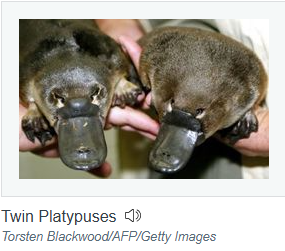
The platypus is unusual in many ways. Which of the following statements about the platypus is not true?

Asemmisa {{asɛmmisaAhyɛnsode}}
37.

Read the sentences:

1. “In summer 2005 the situation grew more intense as workers began clearing the land.”

2. “‘We're not moving until we save this place,’ protester John Woodlands told a reporter.”

How does sentence 2 relate to sentence 1?

Asemmisa {{asɛmmisaAhyɛnsode}}
38.

Platypus face multiple threats to their survival. What evidence best supports this conclusion?

Asemmisa {{asɛmmisaAhyɛnsode}}
39.

What would probably help the platypus population?

Asemmisa {{asɛmmisaAhyɛnsode}}
40.

What is this passage mostly about?

Asemmisa {{asɛmmisaAhyɛnsode}}
41.

Read the following sentences.

“It was here, along the Obi Obi Creek in Australia, that protesters tried to stop builders from digging up a platypus habitat to build a supermarket.”

What is the definition of “protestors” as used in this sentence?