Knighthood
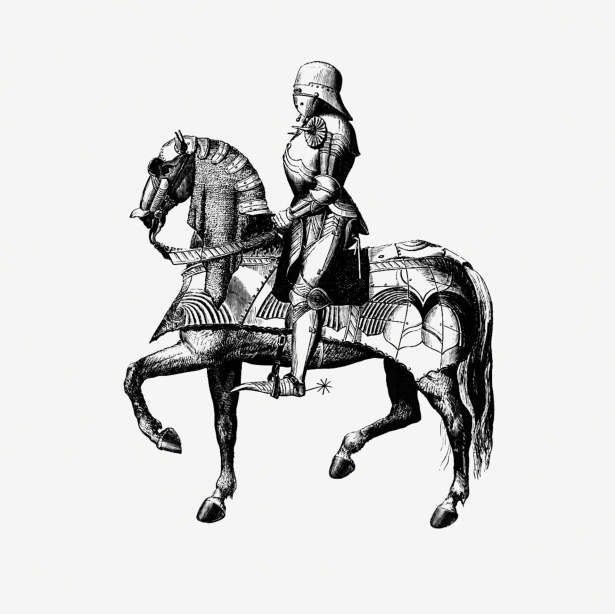
Medieval Europe was a turbulent place, dominated by disputes and battles over land, nobility, and honor. Soldiers on horseback fought with swords and wore protective armor and helmets. These warriors, called “knights,” owned land and pledged loyalty to a “lord” (a king, prince, or nobleman). Those to whom they pledged their loyalty would offer land and protection as long as these knights served in military duty against the enemies.
As landowners, these knights could not go away for extended periods of military duty since they had to take care of their land and families. Regardless, a nobleman needed soldiers to fight long wars. Because of these situations, a landowner’s son could fight in his father’s place. First, the son had to prove that he could use a sword and ride horseback. To practice these skills, young men participated in tournaments in which they fought against each other. After proving his skill, a young man would kneel in front of his nobleman. The nobleman would touch the man on the shoulder with his sword and say, “I dub thee Sir . . . [whatever the man’s name was].” By this, a young man would become a knight.
Later, a more complicated system for knighthood developed. At age seven or eight, a free landowner’s son would leave his family to become a page. A page lived in a nobleman’s castle to learn how knights became brave warriors. When the boy became a teenager, he would become a squire. A squire was a knight’s servant; he helped prepare a knight for battle by riding with him and carrying his equipment. If a squire was brave and faithful, he would be knighted.
When a man was knighted, he agreed to follow certain rules, called codes of chivalry. These codes included being courteous and helpful to women. During times of war, such as the Holy Crusades, knights made vows of poverty and obedience. Since fighting styles and military needs have changed greatly, knighthood is now reserved as an honor granted in recognition of great accomplishments.