Log in
Sign up for FREE
arrow_back
Library

Unit 1 Test on Scientific Method- Part 1

star
star
star
star
star
Last updated 2 months ago
33 questions
Required
1
Required
1
Required
1
Required
1
Required
1
Required
1
Required
1
Required
1
Required
1
Required
1
Required
1
Required
1
Required
1
Required
1
Required
1
Required
1
Required
1
Required
1
Required
1
Required
1
Required
1
Required
1
Required
1
Required
1
Required
1
Required
1
Required
1
Required
1
Required
1
Required
1
Required
1
Required
1
Required
1
Question 1
1.

Question 2
2.

Question 3
3.

Question 4
4.

Question 5
5.

Question 6
6.

Question 7
7.

Question 8
8.

Question 9
9.

Question 10
10.

Question 11
11.

Question 12
12.

Question 13
13.

Question 14
14.

Question 15
15.

Question 16
16.

Question 17
17.

Question 18
18.

Question 19
19.

Question 20
20.

Question 21
21.

Question 22
22.

Question 23
23.

Question 24
24.

Question 25
25.

Question 26
26.

Question 27
27.

Question 28
28.

Question 29
29.

Question 30
30.

Question 31
31.

Question 32
32.

Question 33
33.

What does a hypothesis represent in the scientific method?
The variables observed in the experiment
A proven fact about the experiment
The final conclusion of the research
A testable prediction about outcomes
What is the independent variable in the excerpt below?

Giovanni is doing an experiment to see what temperature produces the most mold on bread. Normally her bread sits at room temperature on the counter. She will try putting her bread in the refrigerator, in a warm incubator, and on the counter. She will measure how long it takes for mold to grow on each loaf of bread.
The type of bread she uses
The temperature
How long it take to grow mold on each loaf
The flavor of the bread
What is the dependent variable in the excerpt below?

Giovanni is doing an experiment to see what temperature produces the most mold on bread. Normally her bread sits at room temperature on the counter. She will try putting her bread in the refrigerator, in a warm incubator, and on the counter. She will measure how long it takes for mold to grow on each loaf of bread.
The temperature
How long it take to grow mold on each loaf
The type of bread she uses
The flavor of the bread
What are two constants in the excerpt below?

Giovanni is doing an experiment to see what temperature produces the most mold on bread. Normally her bread sits at room temperature on the counter. She will try putting her bread in the refrigerator, in a warm incubator, and on the counter. She will measure how long it takes for mold to grow on each loaf of bread.
Locations the bread is placed
The temperature
Same ingredients to make the bread
The same person making the bread
What is a good hypothesis based on the except?

Giovanni is doing an experiment to see what temperature produces the most mold on bread. Normally her bread sits at room temperature on the counter. She will try putting her bread in the refrigerator, in a warm incubator, and on the counter. She will measure how long it takes for mold to grow on each loaf of bread.
What temperature is best for growing mold on a loaf of bread?
If the temperature increases, mold growth will increase on bread
Mold will grow on bread in different temperatures
Mold will grow less in cold temperatures
What is the research question based on the except?

Giovanni is doing an experiment to see what temperature produces the most mold on bread. Normally her bread sits at room temperature on the counter. She will try putting her bread in the refrigerator, in a warm incubator, and on the counter. She will measure how long it takes for mold to grow on each loaf of bread.
What is the effect of mold growth on temperature of a room?
Temperature and mold growth
What temperature is needed for bread?
What is the effect of temperature on growing mold on a loaf of bread?
A scientist hypothesizes the the temperature at which an alligator's egg is incubated will determine whether the alligator will be male or female. The independent variable is
the temperature
the incubator
the male alligators
the gender of the alligator
A scientist who wants to study the affects of fertilizer on plants sets up an experiment. Plant A gets no fertilizer, Plant B gets 5 mg of fertilizer each day, and Plant C gets 10mg of fertilizer each day. Which plant is the control group?
All of them
Plant C
Plant A
Plant B
A scientist testing the affects of a chemical on apple yield sprays an orchard with the chemical. A second orchard does not receive the chemical. In the fall, the number of apples harvested from each forest is counted. Which of the following is the independent (manipulated) variable in the experiment?
the number of apples
the first orchard
the second orchard
the chemical
A scientist testing the affects of a chemical on apple yield sprays an orchard with the chemical. A second orchard does not receive the chemical. In the fall, the number of apples harvested from each forest is counted. Which of the following is the control group in the experiment?
the first orchard
the chemical
the number of apples
the second orchard
A scientist testing the affects of a chemical on apple yield sprays an orchard with the chemical. A second orchard does not receive the chemical. In the fall, the number of apples harvested from each forest is counted. What would be a constant in this experiment?
the amount of water provided to the plants
the amount of fertilizer
the second orchard
the number of apples
the chemical
the first orchard
A scientist testing the affects of a chemical on apple yield sprays an orchard with the chemical. A second orchard does not receive the chemical. In the fall, the number of apples harvested from each forest is counted. In order for the apple tree experiment to be valid scientifically, both orchards must:
have the same species of apple tree
receive the same amount of sunlight
receive the same amount of water
all of these
What's the difference between a hypothesis and a theory?
Hypotheses can't be proven; theories can.
"Theory" is another word for "fact;" "hypothesis" is another word for "guess."
Theories have been supported through test data; hypotheses have not been tested.
Theories contain many hypotheses; a hypothesis only contains one theory
A study was made of endangered birds to see if their populations were increasing by
being protected from hunters. Scientists went out into the field every ten years and
counted the number of Whooping Crane, California Condor, and Black Swans they
found in their spring feeding grounds. Review the data table below.
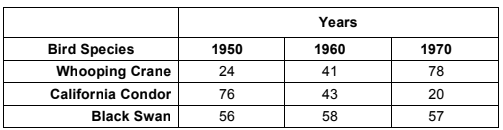

What is the dependent variable?
years
population sizes of bird species
bird species
ten years
A study was made of endangered birds to see if their populations were increasing by
being protected from hunters. Scientists went out into the field every ten years and
counted the number of Whooping Crane, California Condor, and Black Swans they
found in their spring feeding grounds. Review the data table below.


What type of graph is best to be used?
scatterplot
pie chart
bar graph
A study was made of endangered birds to see if their populations were increasing by
being protected from hunters. Scientists went out into the field every ten years and
counted the number of Whooping Crane, California Condor, and Black Swans they
found in their spring feeding grounds. Review the data table below.


What is a good title for the graph?
The effect of protection on the population of bird species
Bird species change over time
How bird species populations change
A study was made of endangered birds to see if their populations were increasing by
being protected from hunters. Scientists went out into the field every ten years and
counted the number of Whooping Crane, California Condor, and Black Swans they
found in their spring feeding grounds. Review the data table below.


What is the mean population of Black Swan?
57
156
171
52
Scientists have noted a decline in fungi species dating back to the early 1900’s. Hippies have noticed with concern that the annual crops of edible mushrooms in France and Germany have declined since 1950. One hypothesis to explain this decline is that edible fungi are being over-harvested and cannot replenish fast enough. Other factors could contribute to the decline. Which of the following findings would void (make incorrect) overharvesting as the cause of the decline?
Similar declines among edible North American species.
A parallel decline in non-edible species of mushrooms.
High fungal numbers in remote unpopulated areas.
Fungal population increases in tropical regions where mushrooms are not part of the diet.
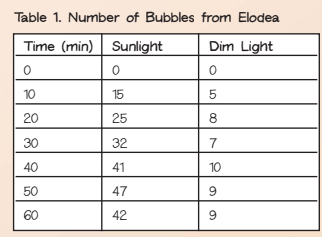
What is the mean number of bubbles in dim light?

8
28.9
6.9
48
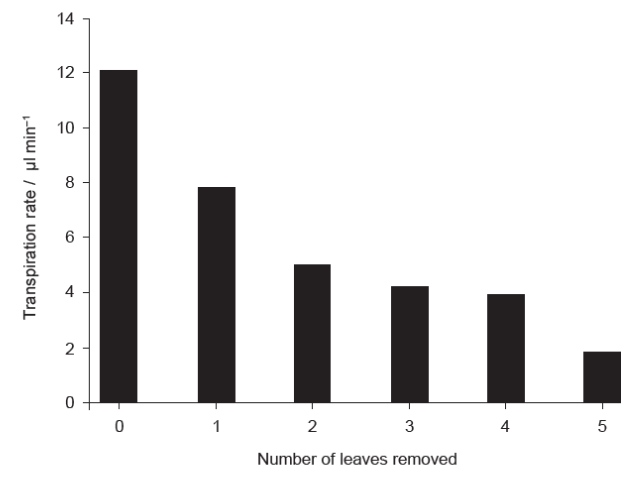
A student designed an experiment to study the transpiration through the leaves of a tomato plant (Solanum lycopersicum). Measurements were taken in the initial conditions with five leaves on a tomato shoot and then again after each of the five leaves was removed.


Describe the trend in the data.
As the number of leaves removed increases, the transpiration rate decreases
The more leaves, the less transpiration
As the number of leaves removed increases, the transpiration rate increases
Transpiration rate increases when there are more leaves removed
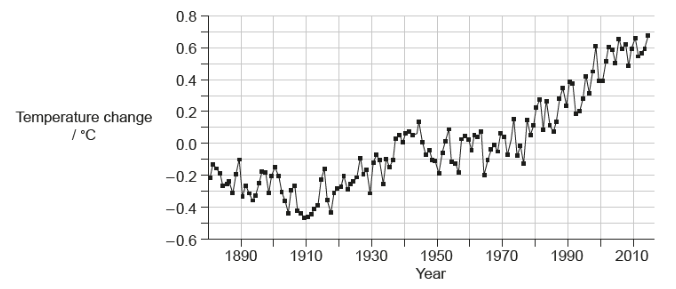
The graph shows the mean annual changes in global temperatures between 1880 and 2014. The mean temperature from 1951 to 1980 was used as the value of zero change in temperature.


Calculate the increase in mean global temperature between 1880 and 2010.
0.68 0C
0.88 0C
0.48 oC
5 0C
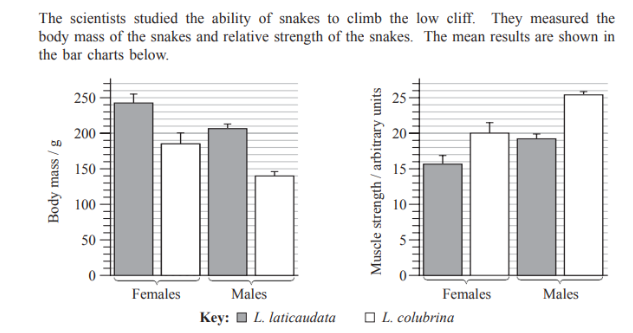
Which sex of snake has the greater mean mass?

males
females
Which species of snake is the strongest?

L. colubrina
L. laticaudata
For L. colubrina, calculate the difference between the strength of the male and female snakes.

25.5
20.0
5.5
45.5
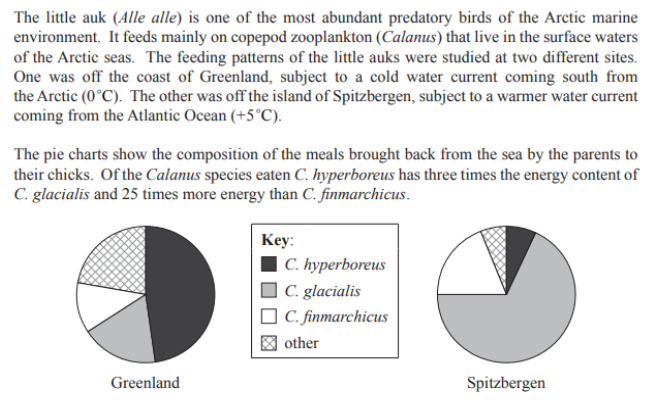
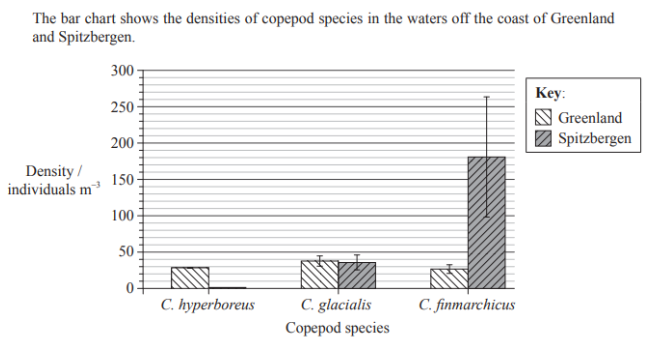
Estimate the proportion in % of C. hyperboreus present in the food given to the chicks at the Greenland site.


57%
85%
48%
30%
In a graph, the dependent variable is usually found on the
x- axis
y- axis
key
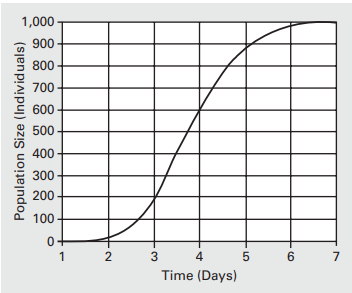
Examine the picture below and answer the following question.


What is the dependent variable?
population size
days
time
Examine the picture below and answer the following question.


What is the population size at 5 days?
900
1,000
8,800
880
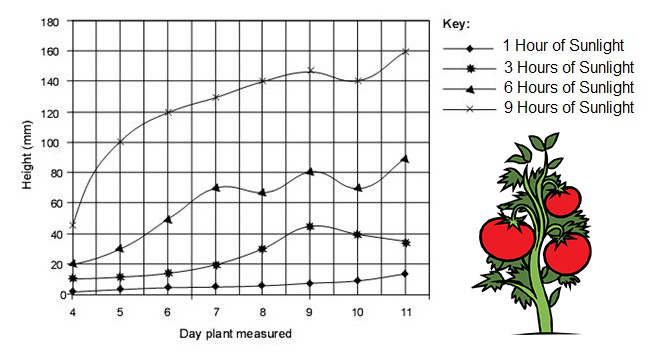
Examine the picture below.


On Day 7, the plants kept in the sun for 3 hours were how tall?
130 mm
8 mm
70 mm
20 mm
Examine the picture below.


On Day 7, the plants kept in the sun for 6 hours were how tall?
70 mm
8 mm
130 mm
20 mm
Examine the picture below.


On Day 10, the plants kept in the sun for 9 hours were how tall?
160 mm
40 mm
140 mm
10 mm
Examine the picture below.


Based on the graph, the plant grows best in what amount of sunlight?
1 hour
6 hours
9 hours
3 hours
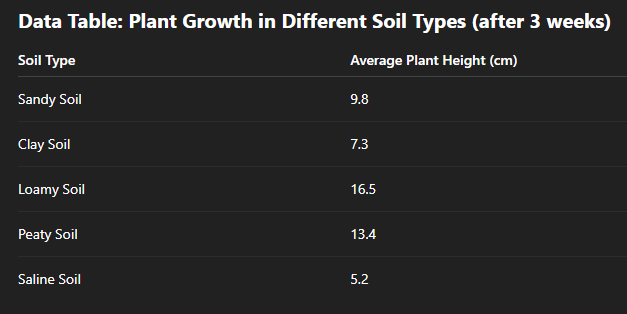
Examine the table below.


If a new soil type is tested and contains similar properties to loamy soil but retains slightly more moisture, what would be the most likely outcome?
Plant growth would be slightly higher or similar to that in loamy soil
Plant growth would decrease significantly due to overwatering
Growth would be lower than in sandy soil
Plants would fail to germinate