The diagram to the right is a representation of a carbon cycle.
Which arrow represents cellular respiration?
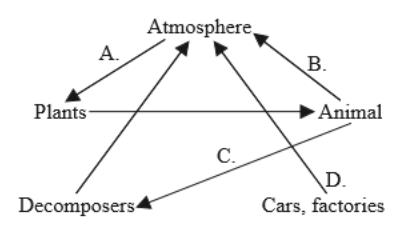
The diagram to the right is a representation of a carbon cycle.
Which arrow represents cellular respiration?
How do plants contribute to the carbon cycle?
What process releases carbon from organic matter?
Which human activity significantly increases atmospheric carbon?
What role do oceans play in the carbon cycle?
What carbon compound is formed during fossil fuel combustion?
Cellular respiration
How do volcanic eruptions affect the carbon cycle?
How does carbon flow from plants to animals?
What is the primary process by which nitrogen gas is converted into a usable form for plants?
True or False. Plants perform cellular respiration
What is the term for the conversion of nitrates back to nitrogen gas?
How do plants primarily take in nitrogen?
Which human activity can significantly disrupt the nitrogen cycle?
Which nitrogen compounds are most readily absorbed by plants?
What role do legumes play in the nitrogen cycle?
How does excess nitrogen enter water bodies?
In which stage does nitrogen become atmospheric gas?
What is the primary source of nitrogen in the atmosphere?
How do animals contribute to the nitrogen cycle?
What is the primary source of energy for the water cycle?
Which process in the water cycle involves vapor turning to liquid?
What is the process of water leaving plants through the leaves?
What is evaporation primarily driven by?
What happens during precipitation in the water cycle?
In the water cycle, what is the role of aquifers?
What is a rich source of phosphorus?
Which organisms primarily convert organic phosphorus back to inorganic forms?
Which aquatic process can lead to excess phosphorus and eutrophication?
What is one consequence of excessive phosphorus in water?
Which cycle does not have a gaseous phase?
Decomposers are important in the environment because they
Which statement best describes the flow of energy and the movement of chemical compounds in an ecosystem?
Which component of a stable ecosystem cannot be recycled?
The process in which liquid water changes into gas is called
The diagram to the right is a representation of a carbon cycle.
Which arrow represents cellular respiration?
Examine the diagram. Which arrow represents photosynthesis?
Examine the diagram. Which arrow represents combustion of fossil fuels?
Which organism is primarily responsible for nitrogen fixation in terrestrial ecosystems?
What process in the carbon cycle involves the breakdown of organic carbon compounds by decomposers, releasing CO2 into the atmosphere?
For each letter provided on the diagram below, state the process occurring in the water cycle.
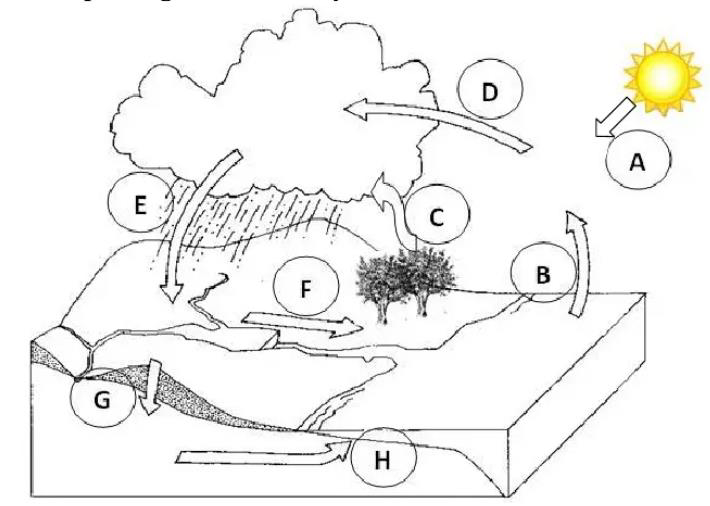
B c D E F H
Which biogeochemical cycle is necessary to recycle the only element unique to DNA?
Which biogeochemical cycle is necessary to recycle the element necessary to produce all molecules needed for life?
Which biogeochemical cycle is necessary to recycle the element necessary to proteins, amino acids, and DNA?
Our atmosphere is 20.9% oxygen (O2). Which provides most of the oxygen in the atmosphere?
Which of the following statements best explains how forests reduce atmospheric CO2 levels?
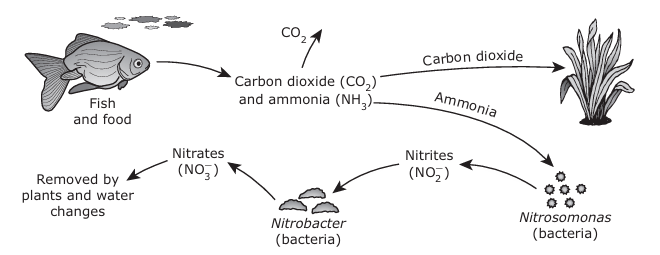
The diagram below represents the nitrogen cycle in a student’s aquarium. Ammonia, nitrites, and, to a lesser degree, nitrates can be harmful to fish. The student wants to keep the nitrogen in this aquarium cycling normally without having to continually change the water.
Which of the following should the student add more of to help remove nitrates and improve the natural cycling of nitrogen in this aquarium?
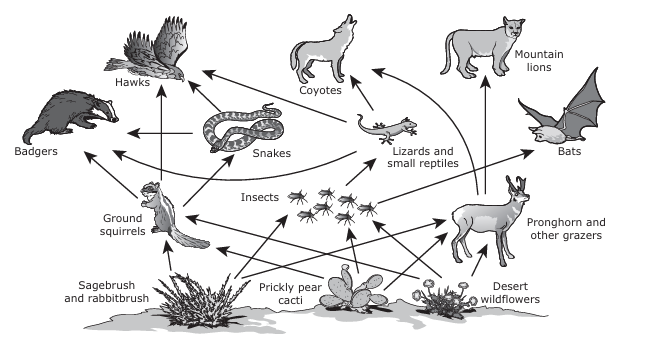
The food web shows the flow of energy through a sagebrush-steppe ecosystem.
Which of these organisms are in a trophic level that receives a larger percentage of the energy captured by the producers than the percentage received at the bats’ trophic level?
A student is asked to draw a food web in which the same organism is a primary consumer as well as a secondary consumer. How should the organism be represented in the food web?