Science: Grade 4 (2024)
star
star
star
star
star
Last updated 4 months ago
8 questions
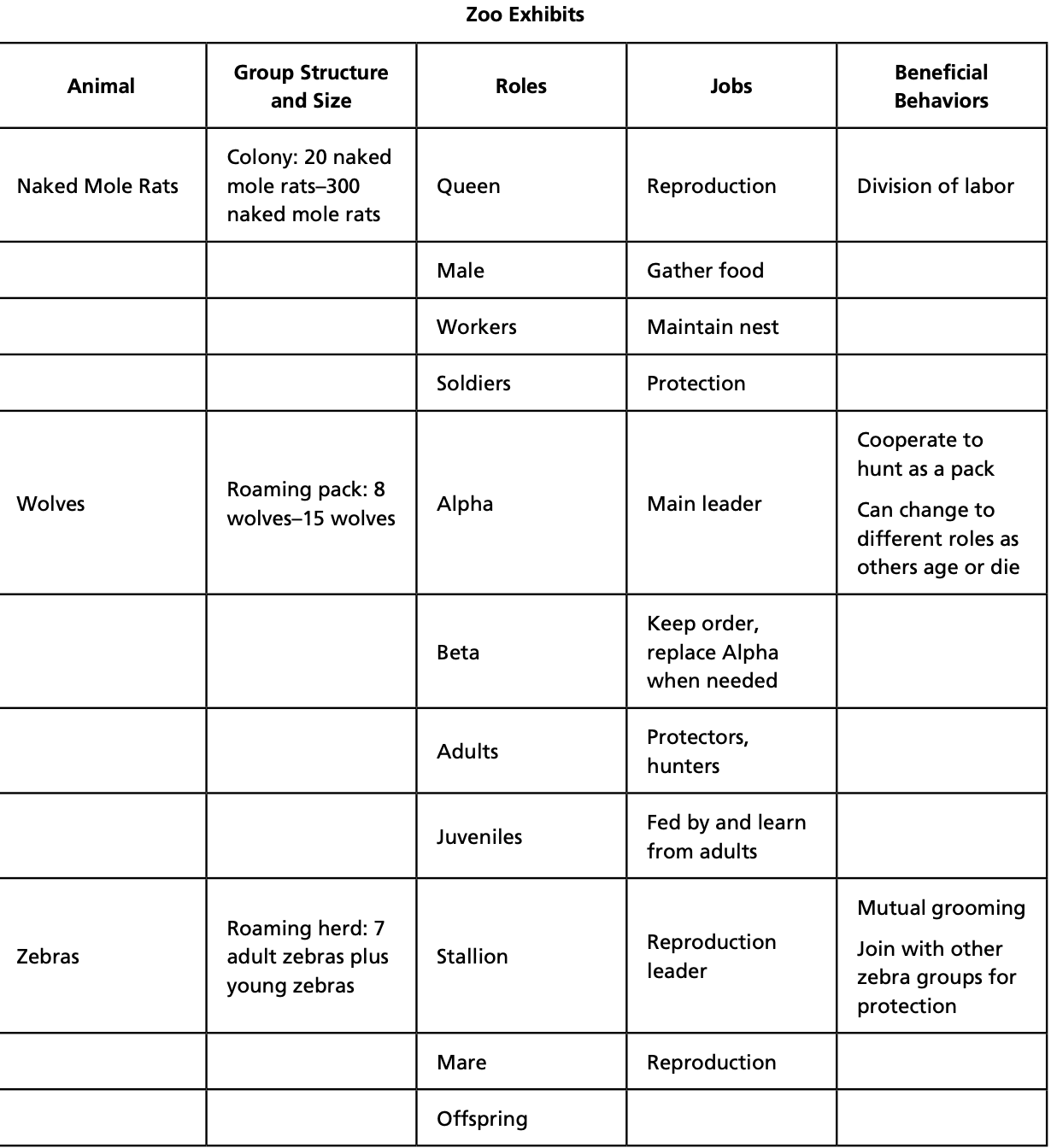
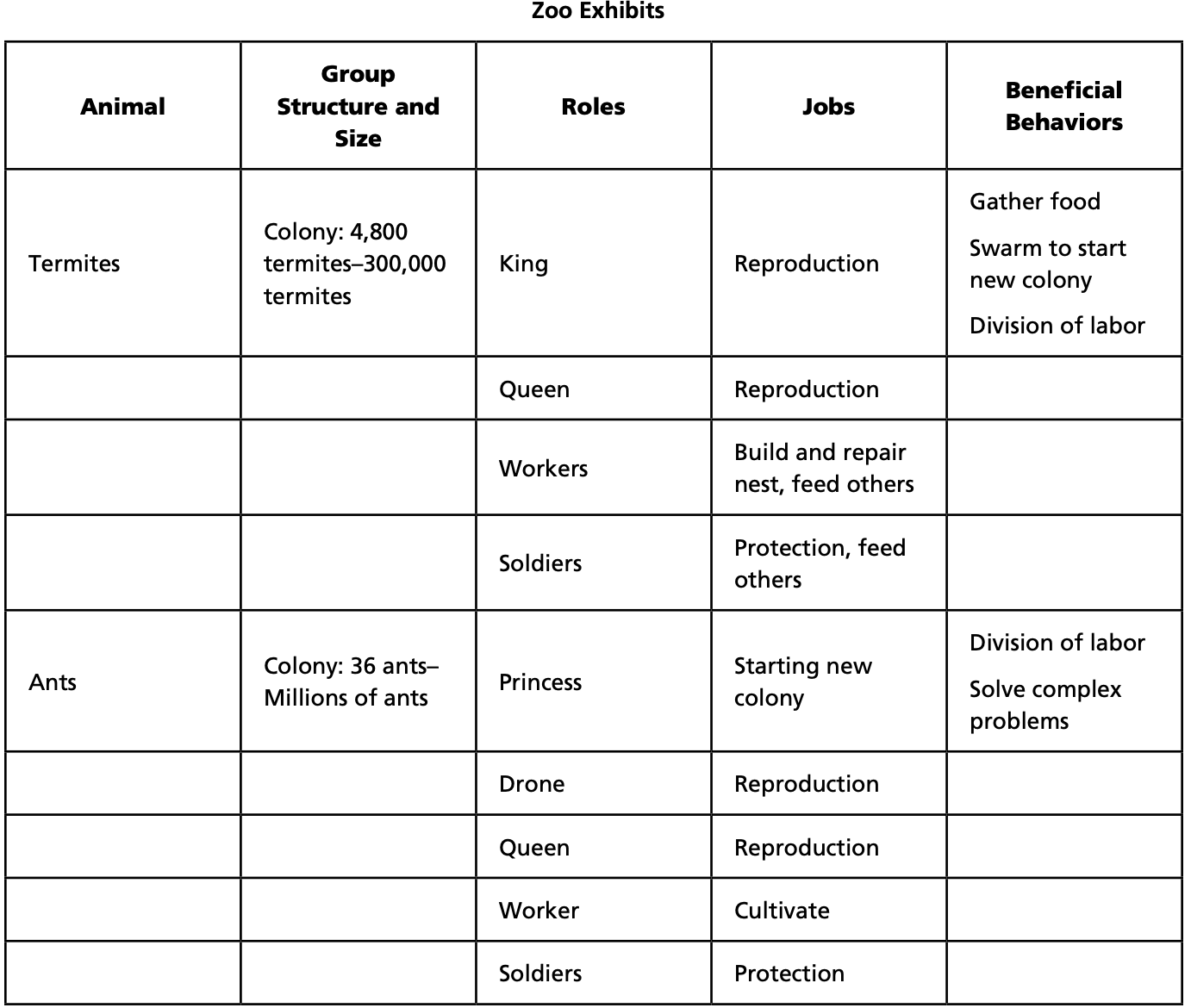
The zoo had an exhibit called “Living and Working Together” that showed different organisms that form groups to help themselves survive. Cindy visited the zoo and observed a number of different groups on exhibit. She learned the different ways they interact to help themselves survive. The charts describe the exhibits she saw.
1
Which of these claims about the behaviors of organisms that form groups is supported by the charts? Select the two best answers.
1
Cindy saw that the sizes of the groups vary greatly. She asked if organisms that live in smaller groups depend on each other less than organisms that live in larger groups.
What one piece of new information would Cindy most likely need in order to make a claim about whether organisms that live in smaller groups depend on each other less than the ones living in larger groups?
Cindy saw that the sizes of the groups vary greatly. She asked if organisms that live in smaller groups depend on each other less than organisms that live in larger groups.
What one piece of new information would Cindy most likely need in order to make a claim about whether organisms that live in smaller groups depend on each other less than the ones living in larger groups?

1
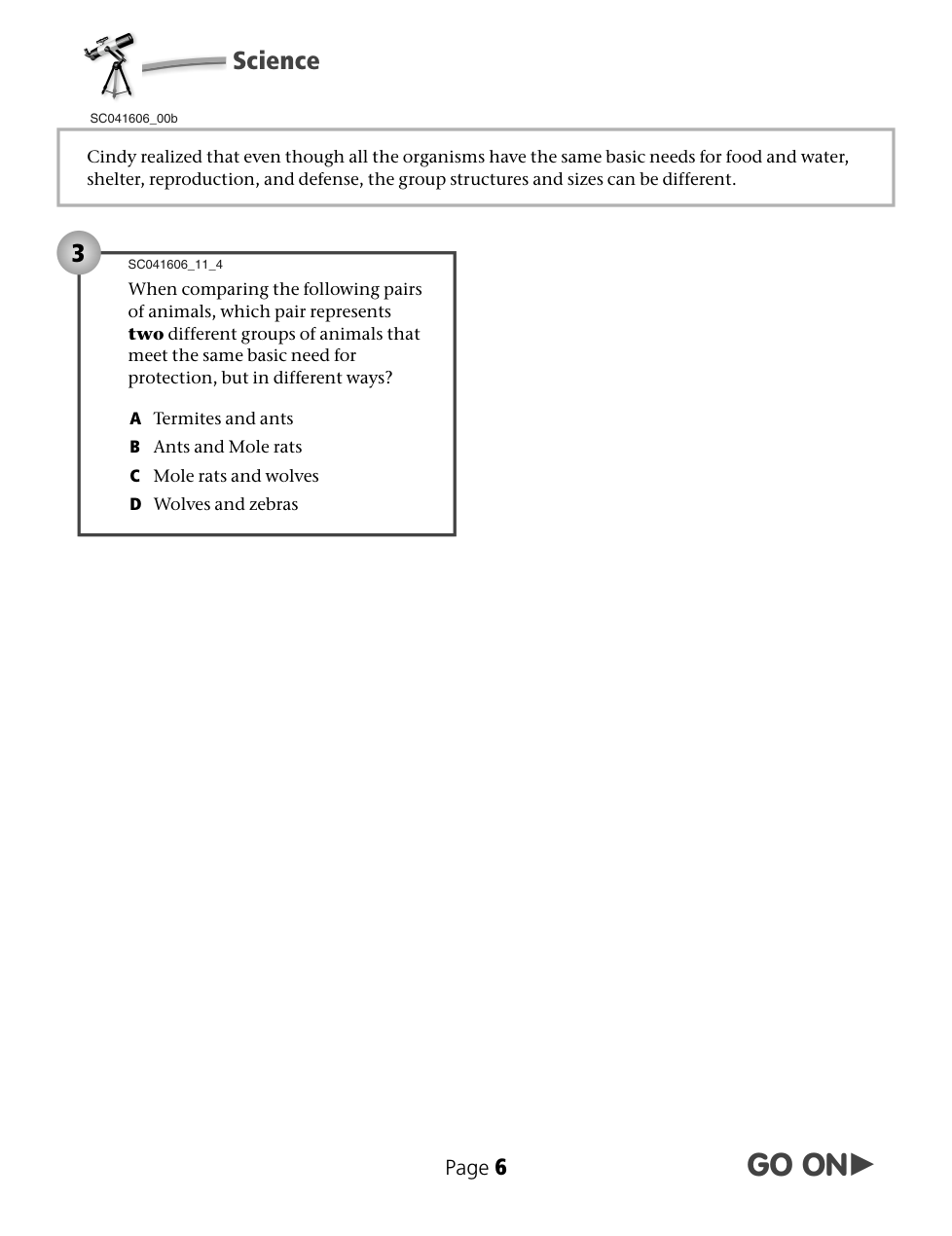
Cindy realized that even though all the organisms have the same basic needs for food and water, shelter, reproduction, and defense, the group structures and sizes can be different.
When comparing the following pairs of animals, which pair represents two different groups of animals that meet the same basic need for protection, but in different ways?
Cindy realized that even though all the organisms have the same basic needs for food and water, shelter, reproduction, and defense, the group structures and sizes can be different.
When comparing the following pairs of animals, which pair represents two different groups of animals that meet the same basic need for protection, but in different ways?
After coming home, Cindy observed her neighbor’s backyard beehive and realized that the bees were also part of a group. She decided to study the bees more closely. She discovered that not all bees are the same and that bees all work together in the group.
Things Cindy saw:
There were lots of bees. Some were flying in and out of the hive. Some were crawling around the opening of the hive. Cindy saw a bee much larger than the others. One bee landed close to Cindy, and she could see a yellow substance on its legs.
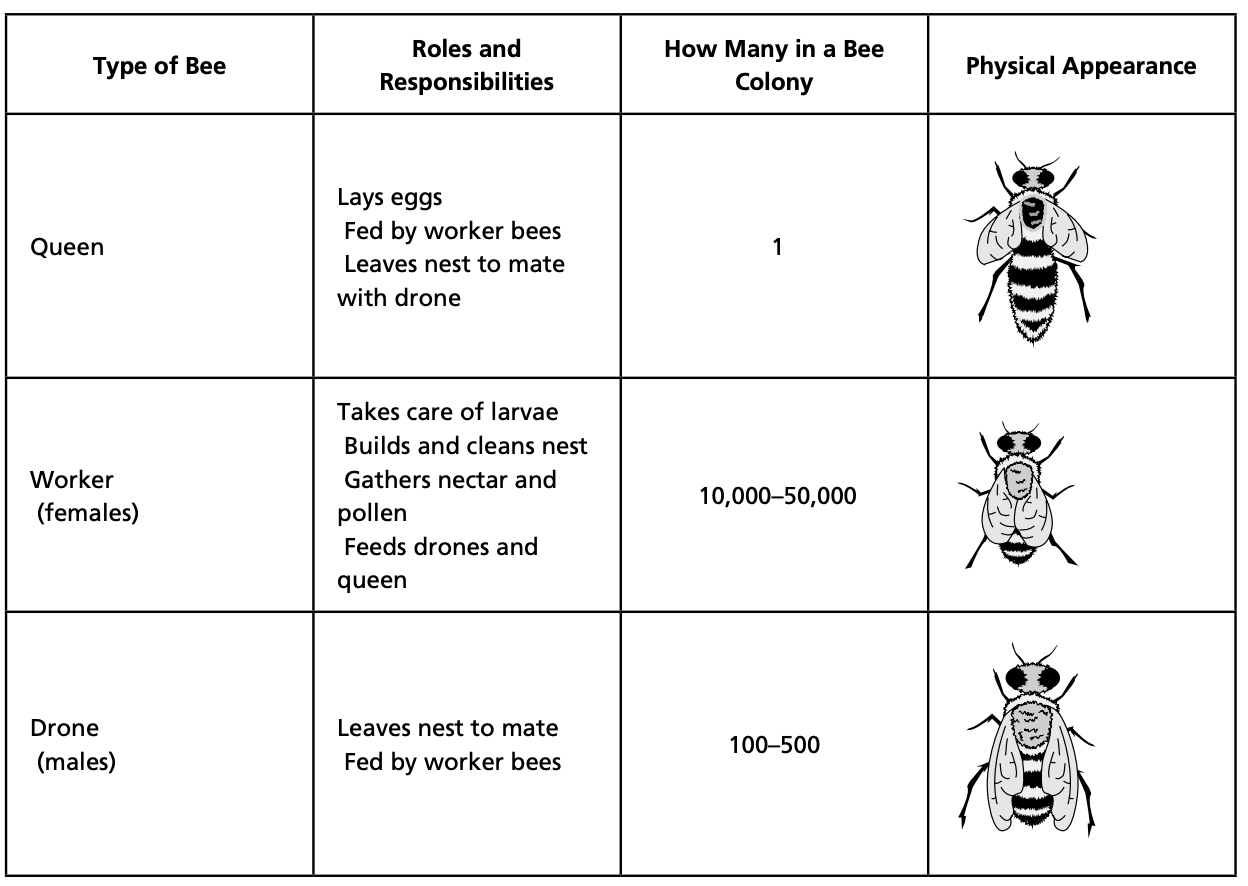
Things Cindy learned from reading:
1
Based on Cindy’s observations and the data from the bee colony chart, what one claim can Cindy most likely make about how the different types of bees in a group help each other survive?
1
Which one statement provides the best evidence to support Cindy’s claim about how a beehive works as a group to help the bees survive?
Cindy learned that the worker bee role is complex. Each worker bee goes through a sequence of jobs throughout its life. Not all bees are at the same stage in the sequence at the same time because bees continue to hatch through the season.
Timeline of a Worker Bee’s Life:
- Day 1–2: House Bee- cleans empty cells so they can be used again
- Day 3–7: Beginning Nurse Bee- feeds pollen and honey to worker larvae
- Day 8–11: Advanced Nurse Bee- feeds royal jelly to the queen larva and feeds drone and worker larvae
- Day 12–17: Wax Bee- builds honeycomb cells from wax, stores pollen and nectar
- Day 18–21: Guard Bee- stays near the hive entrance to protect from intruders
- Day 22–42: Forager Bee- flies away from the hive to gather nectar and pollen
She thought about this pattern and why each bee does so many different jobs during its life.
1
Which of these statements explains how the changing roles of worker bees benefit the colony?Select the two best answers.
Which of these statements explains how the changing roles of worker bees benefit the colony?
Select the two best answers.
1
Cindy learned that honeybees do not hibernate during the winter, but they do other things to improve the chances of the group surviving over the winter.
Which one behavior most likely has the purpose of helping the group increase the chance of the hive’s survival by conserving resources?
Cindy learned that honeybees do not hibernate during the winter, but they do other things to improve the chances of the group surviving over the winter.
Which one behavior most likely has the purpose of helping the group increase the chance of the hive’s survival by conserving resources?
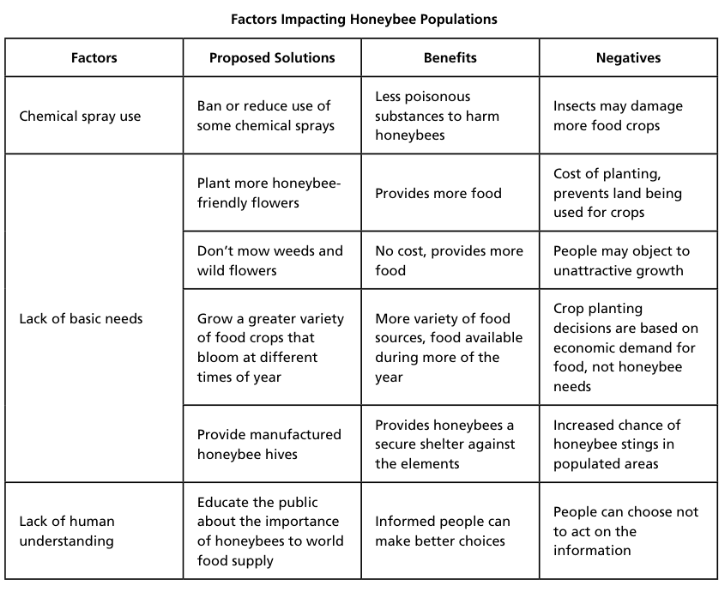
Cindy discovered that the number of honeybees in the world is dropping as a result of environmental changes. The chart shows some of the changes to the honeybees’ environment and some proposed solutions.
Cindy would like to find a way for her local community to improve the health of honeybees. She knows that some of these proposed solutions can be done locally, while others would require help from outside her community.
1
Identify two of the proposed solutions that could be done in Cindy’s neighborhood.
Make a claim about why each solution is a good choice of something to do in her neighborhood to improve the health of the local bee population.
Identify two of the proposed solutions that could be done in Cindy’s neighborhood.
Make a claim about why each solution is a good choice of something to do in her neighborhood to improve the health of the local bee population.