Log in
Sign up for FREE
arrow_back
Library

Version B CP Bio BM3 - Cell Transport (7/23/2025)

star
star
star
star
star
Last updated 24 days ago
18 questions
Note from the author:
NGSS HS-LS1-1, HS-LS1-2 CCC: Stability and Change DCI LS1.A
100 total points
Multiple Choice are worth 3 pts each.
NGSS HS-LS1-1, HS-LS1-2 CCC: Stability and Change DCI LS1.A
100 total points
Multiple Choice are worth 3 pts each.
Required
3
Required
3
Required
3
Required
3
Required
3
Required
3
Required
3
Required
3
Required
3
Required
3
Required
3
3
Required
3
Required
3
Required
3
Required
6
Required
9
Required
15
Question 1
1.

A key property of cell membranes is selective permeability. This enables them to:

Question 2
2.

What's the name for water moving through a selectively permeable membrane?

Question 3
3.

When a cell is in an isotonic solution, how does it maintain its internal balance (homeostasis)?

Question 4
4.

Given that all cells have cell membranes, what describes their composition and function?

Question 5
5.

According to the fluid mosaic model, the plasma (cell) membrane is composed of...

Question 6
6.

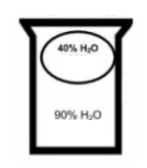
David's science class is doing a lab on cell transport. He puts some red blood cells into a beaker that's 90% water and watches them under a microscope. What's the most likely change David will see in the cells?


Question 7
7.

Protein channels are a key component of the cell membrane's phospholipid structure. Explain why their presence is absolutely essential for facilitated diffusion to occur.

Question 8
8.

Membrane phospholipids

Question 9
9.

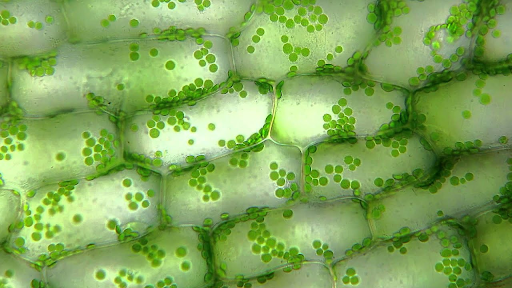
A researcher found a mysterious green slime in a pond and observed it under a microscope.
What visual evidence from the microscopic image of the slime would help the scientist determine if it is a living organism or a non-living substance?

Question 10
10.

In her cell transport experiment, Susan made a salt and water solution to observe how molecules move in and out of a potato cell. Which component of her solution is the solute?

Question 11
11.

How is equilibrium achieved during osmosis?

Question 12
12.
The phospholipid's __________ region keeps water molecules at bay.
Question 13
13.

Identify the correct statement regarding passive transport.

Question 14
14.

Osmosis refers to the...

Question 15
15.

Why does an animal cell burst in tap water, while a plant cell remains intact?

Question 16
16.

CCC: Cause and effect/Patterns: Mechanisms and explanation.

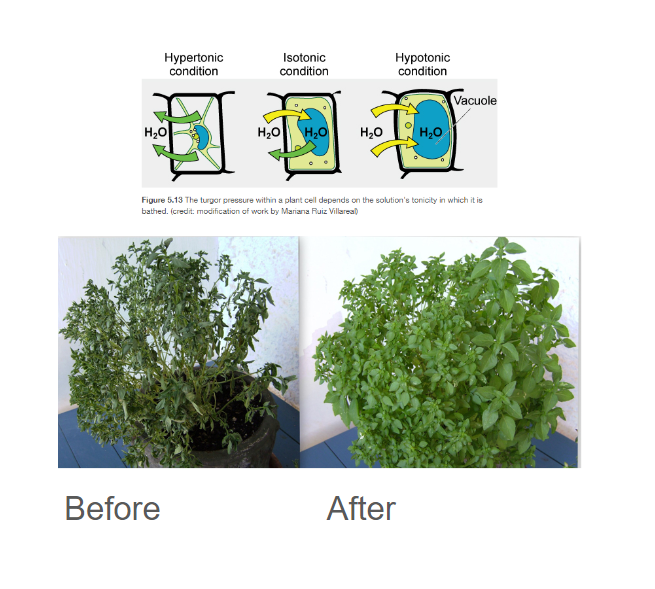
You are presented with two images: Image A shows a wilted plant, and Image B shows the same plant after being watered, now appearing vibrant and upright.

a. Using these images as a visual guide, explain the cellular process by which adding water to the plant in Image A results in the revitalization seen in Image B. Your explanation must incorporate how water affects the plant cells, specifically referencing the concept of osmosis and the role of the central vacuole and cell wall.

b. How does this same water process, the one you talked about in part A, make other things happen in nature that you can see? Give a couple of examples.

Question 17
17.

PE: Cell Transport

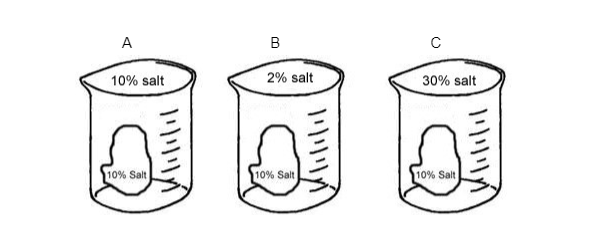
Scenario: Imagine three containers, called beakers, each holding salty water. One has a little salt (2%), another has a medium amount (10%), and the third has a lot of salt (30%). In each beaker, there's a tiny fake cell. These fake cells have a special skin (membrane) that lets water in and out, but it won't let salt pass through. The water inside each fake cell starts at 10% salt.

a. How Salty is the Water Around the Cell Compared to Inside? (3 points)
For each beaker, tell whether the salty water outside the "cell" is more salty, less salty, or just as salty as the water inside the "cell." Use these words: "hypertonic" (more salty), "hypotonic" (less salty), or "isotonic" (just as salty).

b. Where Will the Water Go? (3 points)
Explain why and how water will move. Will it go into the "cell" or out of the "cell"? You can draw arrows to show the direction of the water's movement.

c. What Will Happen to the Cell's Size? (3 points)
Tell us if the "cell" will get bigger, smaller, or stay the same size in each beaker.
Question 18
18.

CER: Claim, Evidence, and Reasoning:

The cell membrane is like a gatekeeper for every living cell. It's a vital part that controls what goes in and out. Because it's selectively permeable, it only lets certain things pass through, keeping others out. This ability to choose what enters and exits is super important for keeping the cell's inside just right.

The cell membrane also uses proteins to help things move across. This process, called facilitated diffusion, is like having special doorways that specific molecules can use to get in. This clever system makes sure the cell gets the nutrients it needs to work correctly and stay healthy.


Question:
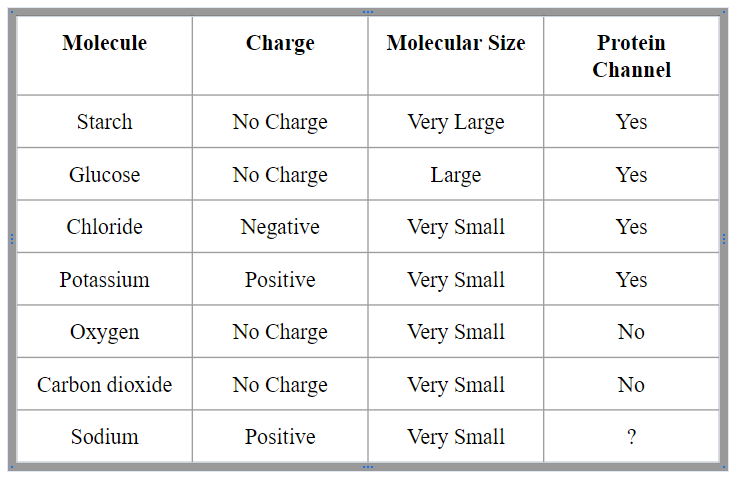
Would sodium need a protein channel for facilitated diffusion?
  1. Make a CLAIM by answering the above question. (3 pts)
  2. What facts or information did you use to support your answer? Be sure to include at least three specific examples from the table. (6 pts)
  3. Now, explain why the evidence you listed helps prove your claim. Use your evidence to show how and why sodium would need facilitated diffusion and a protein channel. It's a good idea to compare it to other situations or molecules. (6 pts)
See the rubric to ensure you get the greatest amount of points for your answer.