Log in
Sign up for FREE
arrow_back
Library

Version B CP Bio BM6 - Ecology

star
star
star
star
star
Last updated 24 days ago
19 questions
Note from the author:
(NGSS HS-LS2-1, HS-LS2-2, DCI LS2.A, LS2.C, CCC Stability and Change)
Multiple choice are worth 3 points each.
(NGSS HS-LS2-1, HS-LS2-2, DCI LS2.A, LS2.C, CCC Stability and Change)
Multiple choice are worth 3 points each.
Required
3
Required
3
Required
3
Required
3
Required
3
Required
3
Required
3
Required
3
Required
3
Required
3
Required
3
Required
3
Required
3
Required
3
Required
3
Required
3
Required
3
8
Required
15
Question 1
1.

A mushroom gains its energy by decomposing (feeding on) the tissues of dead organisms. Based on this, which of the following statements must be TRUE for mushrooms?

Question 2
2.

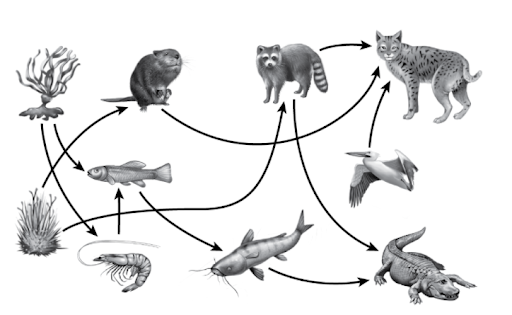
The diagram shows a model of feeding relationships in an ecosystem.
What is shown by the arrows that lead to and from the raccoon?

Question 3
3.

Which statement is the most precise description of primary producers?

Question 4
4.

Which of the following BEST describes the flow of energy through a food chain?

Question 5
5.

Which statement best illustrates the movement of matter within and among ecosystems?

Question 6
6.

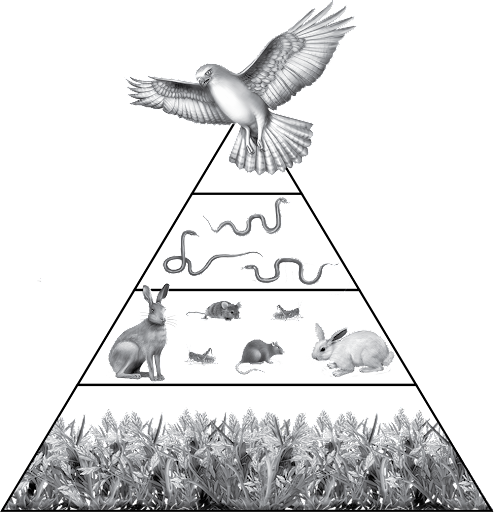
The diagram represents four trophic levels in an ecosystem.


Which statement most accurately explains the flow of energy in this ecosystem?

Question 7
7.

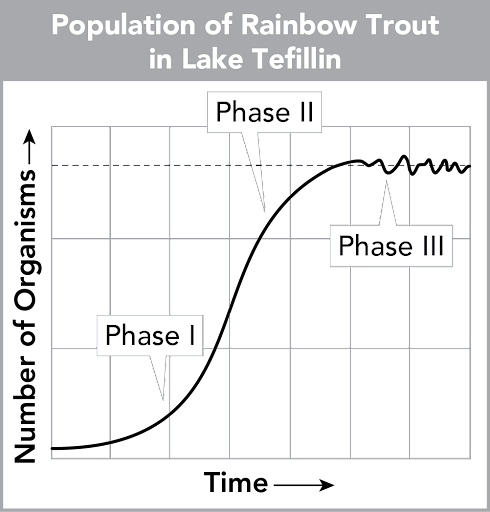
Lake Tefillin, a sizable freshwater lake known for recreation, received a new population of rainbow trout one year. The accompanying graph chronicles the expansion of this trout population over the subsequent years.


Which BEST describes the growth pattern of the rainbow trout?

Question 8
8.

In a forest ecosystem, a variety of predators compete with one another for the same prey. The predators include wolves, coyotes, foxes, and hawks. Their prey include deer, rabbits, mice, and the chickens that live outdoors on nearby farms and backyards.

If human hunting significantly reduces wolf, coyote, and fox populations, how would this likely impact the hawk population?

Question 9
9.

Which of the following would be a limiting factor for growth of a population of downy woodpeckers living in the Ozark Mountains of southwestern Missouri?

Question 10
10.

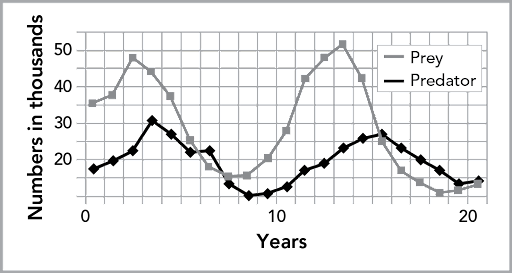
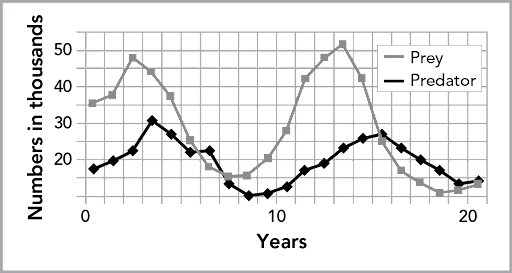
Dr. Osgood and her team are using a computer simulation to study the relationships between predator and prey. The simulation assumes that both predator and prey populations are minimally affected by other animals. The results of one version of the simulation are shown in the graph.

Graph 1

The data in Graph 1 MOST STRONGLY support which two explanations about the predator-prey relationship of the model? Select TWO (2) answer choices.

Question 11
11.

Dr. Osgood claims that despite the varying population sizes of predator and prey, the ecosystem described by the model in Graph 1 is stable. If the simulation is allowed to continue, what result would support her claim?

Graph 1

Question 12
12.

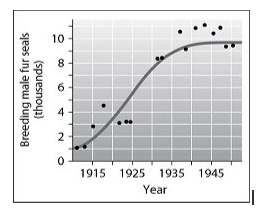
According to this graph of the population growth of fur seals, in what year did the population first reach its carrying capacity?

Question 13
13.

Which of the following populations probably exhibits exponential growth?

Question 14
14.

An ecologist hypothesizes that predation by a particular owl species is the major factor controlling the population of a particular rabbit species. If this is the case, which of the following population effects would be expected on this rabbit-owl pair?

Question 15
15.

In a certain ecosystem, field mice are preyed on by snakes and hawks. The entry of wild dogs into the system adds a third mouse predator. The most likely short-term result of this addition is

Question 16
16.

Which process does not occur in ecosystems?

Question 17
17.

When you eat an apple, you are serving as a __________.

Question 18
18.

Data Question and CCC (Stability and Change)

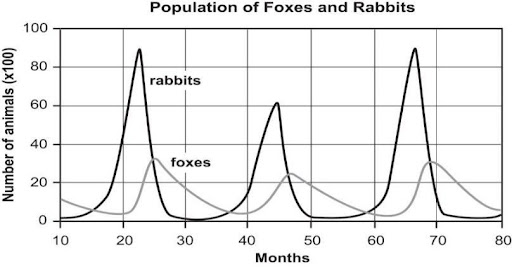
A scientist is studying the populations of foxes and rabbits in a forest ecosystem. The graph shows how the populations changed over time. (8 pts TOTAL)


  1. According to the graph, how does the fox population influence the rabbit population? Provide details. (2 points)
  2. Using the graph as evidence, explain how changes in the rabbit population impact the fox population. (2 points)
  3. Hypothesize what would likely occur to the rabbit population if the fox population were eliminated from the forest ecosystem. (2 points)
  4. Describe both the short-term (within months) and long-term (over years) ecological changes expected if foxes are no longer present in the forest. (2 points)

Question 19
19.

CER & PE (15 pts TOTAL)

Examine the diagram below, which shows a typical food web that could be found in the Great Lakes area.
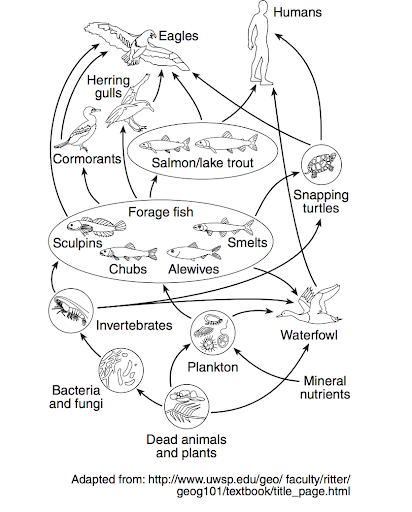
Adult cormorants (a bird in the food web) eats an average of one pound of fish per day, usually small bottom-dwelling or schooling fish that are less than 6 inches long. Cormorant numbers in the Great Lakes area have increased in recent years which alarms many fishermen. Some people have argued that cormorants should be removed from the shores of the Great Lakes area due to their negative effects on the fishing industry (human fishing for food).

Question: Should Cormorants Be Removed from the Ecosystem?

CLAIM: Clearly state your conclusion (to remove or not to remove). (3 pts)

EVIDENCE: Cite at least three specific examples from the food web and given text to bolster your claim, detailing effects on three distinct populations. (6 pts)

REASONING: Elaborate on the connection between your evidence and your claim, using appropriate ecological terms and concepts. (6 pts)
Vocabulary: predator, prey, competition, carrying capacity, limiting factors, food chain, food web, producers, consumers, energy flow, population size

See the rubric to ensure you get the greatest amount of points for your answer.