This diagram shows two closed, insulated compartments, where no energy can escape. Both compartments contain water of equal volume but varying temperatures of 50°C and 25°C respectively.
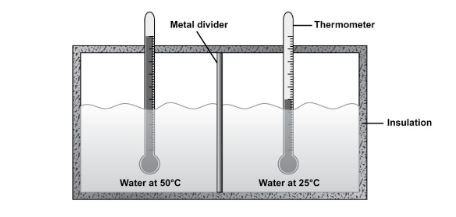
If the temperature of the water measuring 50°C decreased by 5°C, the temperature of the water measuring 25°C would
none of the options
increase by approximately 5°C.
remain the same.
also decrease by approximately 5°C.
What is always the direction of heat transfer?
From an object of greater mass to an object of less mass
From matter at higher temperature to matter at lower temperature
From an object with less thermal energy to an object with greater thermal energy
From matter at lower temperature to matter at higher temperature
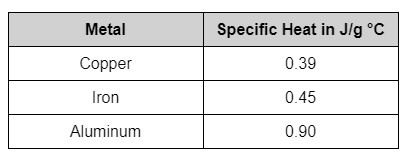
A celebrity chef is looking for a metal-plated pan that she can heat to as high a temperature as possible for a given input of energy. Her different pan options are copper, iron, and aluminum. All of the pans have the same mass. Observe the specific heat capacities of the metals shown in the table below. Which metal pan should the chef choose because it undergoes the largest temperature change for a given input of energy?
The chef should choose the aluminum pan.
The chef should choose the copper pan.
The chef should choose the iron pan.
The chef can choose any of the three pans, because all three pans will undergo the same amount of temperature change.
During a lab, a student stirs crushed ice into warm water. How will this system behave, according to the second law of thermodynamics?
The ice cubes will gain heat and the warm water will lose heat until the temperature in the system is uniform throughout.
The ice cubes will lose heat and the warm water will gain heat until the temperature in the system is uniform throughout.
Both the ice cubes and the warm water will lose heat. Thermal equilibrium will not be reached.
Both the ice cubes and the warm water will gain heat. Thermal equilibrium will not be reached.
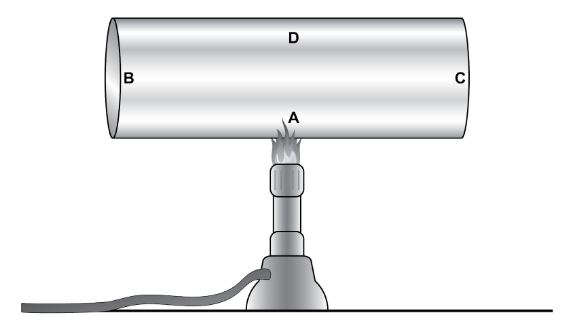
The diagram shows a copper cylinder being heated by a Bunsen burner. Point A is at the heat source. In which direction will the heat flow?