Log in
Sign up for FREE
arrow_back
Library

Copy of CI Skill Check #4.4 (Investigation 4 Experience 4) (7/30/2025)

star
star
star
star
star
Last updated 9 months ago
5 questions
Required
3
Required
3
Required
2
Required
2
Required
2
Question 1
1.

Question 2
2.

Question 3
3.

Question 4
4.

Question 5
5.

Which of the following are NOT bulk properties of substances are affected by intermolecular forces? Select all that apply. Pick 2
Ductility
Melting point
Boiling point
Malleability
Volatility
Which of the following statements about volatility are true? Select all that apply. Pick 3
Volatility is a measure of how easily a liquid evaporates.
Volatile liquids have a large number of molecules in the gas phase above the liquid.
Stronger intermolecular forces result in lower volatility.
Volatile liquids have a small number of molecules in the gas phase above the liquid.
Stronger intermolecular forces result in higher volatility.
Volatility is a measure of how easily a liquid condenses.
Which of the following options correctly ranks solid iodine, liquid bromine and chlorine gas in the order of decreasing intermolecular force strength? (strongest to weakest)
chlorine gas < liquid bromine <solid iodine
solid iodine < liquid bromine < chlorine gas
solid iodine < chlorine gas < liquid bromine
liquid bromine < solid iodine < chlorine gas
The boiling points of pentane, hexane, heptane, and octane are below.

Look at the graph.
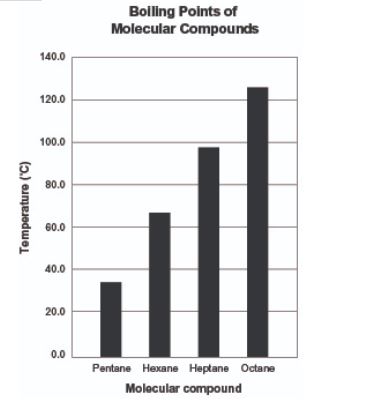
Which of the four molecular compounds has the strongest intermolecular forces?
Octane
Heptane
Pentane
Hexane
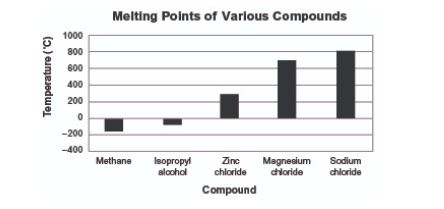
The melting points of methane, isopropyl alcohol, zinc chloride, magnesium chloride, and sodium chloride are below. Look at the graph.


The graph shows that molecular substances (methane and isopropyl alcohol) tend to melt at _________ temperatures. This is because intermolecular attractions are _________ than ionic bonds.

Which terms best complete the sentences?
lower, weaker
lower, stronger
higher, stronger
higher, weaker