Log in
Sign up for FREE
arrow_back
Library

Version B CP Biology Final

star
star
star
star
star
Last updated about 2 hours ago
27 questions
Note from the author:
Multiple choice are worth 3 points each.
Required
3
Required
3
Required
3
Required
3
Required
3
Required
3
Required
3
Required
3
Required
3
Required
3
Required
3
Required
3
Required
3
Required
3
Required
3
Required
3
Required
3
Required
3
Required
3
Required
3
Required
8
Required
15
Question 1
1.

What were Mendel's key findings regarding how traits (or genes) are passed from parents to their offspring?(LS3.A)

Question 2
2.

What is the source of all cells in a mature tree? (LS1.A)

Question 3
3.

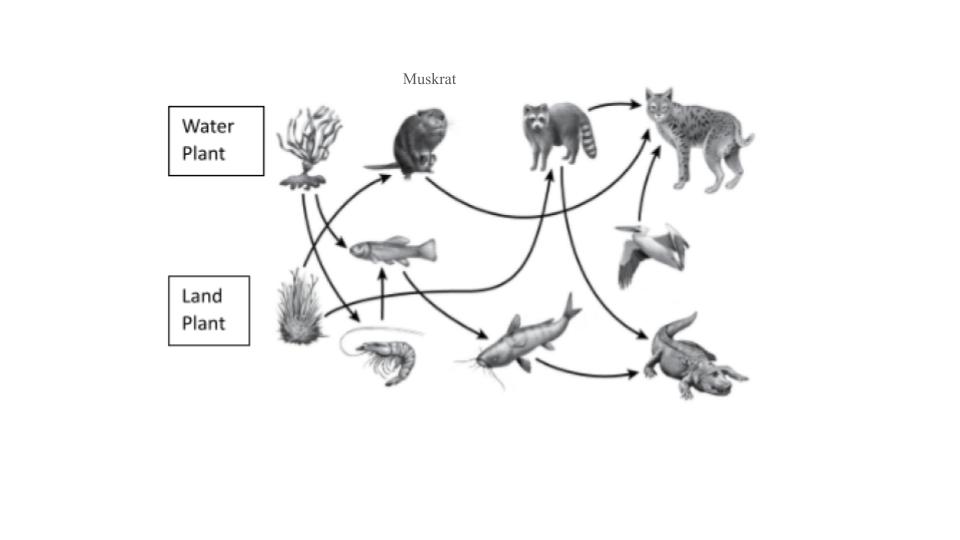
Carla is studying the relationships among the organisms in a nature preserve. To represent land plants, she has drawn a tuft of grass in her diagram. To represent water plants, she has drawn a type of algae.


A disease is killing many kinds of land plants. What can you predict will happen as a result of the plant disease? (LS2.C)

Question 4
4.

Chargaff's rule says A always equals T, and G always equals C in DNA. How does the shape of DNA explain why this is true? (LS1.A)

Question 5
5.

A cell is placed in an isotonic solution. How does the cell maintain homeostasis in this environment? (LS1.A)

Question 6
6.

Which of the following accurately characterizes the primary constituents of the cellular membrane? (LS1.A)

Question 7
7.

How does the exchange of gases (O2 vs CO2) compare between the two processes of photosynthesis and cellular respiration? (LS1.C)

Question 8
8.

How is DNA involved in the production of proteins? (LS1.A)

Question 9
9.

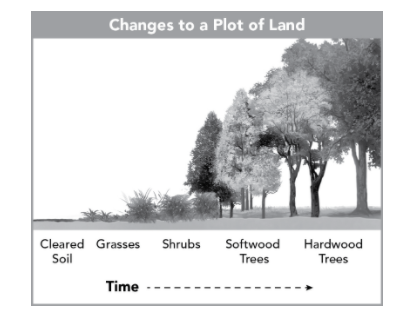
The diagram shows an example of ecological succession.


What can be assumed about the mature Hardwood Trees forest shown in the diagram?

Question 10
10.

What specific research methods or techniques did Gregor Mendel employ in his pioneering studies of inheritance in pea plants?

Question 11
11.

Robert wants to find the amino acid sequence from the mRNA: AUGCCACAGGUUCAUCCGAA... What's the very first thing he should do to figure it out? (LS1.A)

Question 12
12.

The rabbits eat grasses, clover, as well as roots, seeds, and tree bark. What defines the organisms that share the same trophic level as the rabbits?

Question 13
13.

Which of these subjects is MOST LIKELY to be studied in ecology?

Question 14
14.

A heron (a type of bird) is affected by many factors in its environment. What distinguishes the biotic factors from the abiotic factors?

Question 15
15.

What cell structures are common to both plant and animal cells?

Question 16
16.

If a bison population is at carrying capacity and its birth rate equals its death rate, what must be true about the movement of bison into (immigration) and out of (emigration) the population?

Question 17
17.

When does a cell make an exact copy of all its DNA so that new cells have everything they need?

Question 18
18.

How would the genetic content of daughter cells be affected if the parent cell divides before successfully replicating all of its DNA?

Question 19
19.

Which statement BEST describes primary producers?

Question 20
20.

Which option most accurately explains the movement of both matter and energy within ecosystems and across different ecosystems?

Questions 21- 25 Worth 3 pts each (LS1.A)
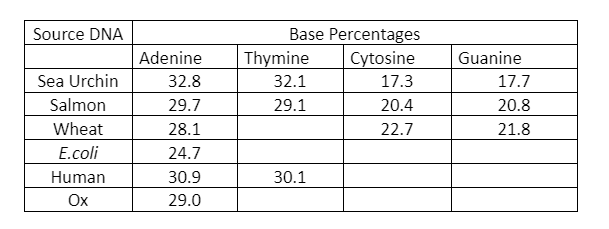
Data Questions: Answer the following multiple choice questions based on the table that follows Chargaff’s results:


Required
3
Required
3
Required
3
Required
3
Required
3
Question 26
26.

CCC: Systems and System Models
PE: (Worth 8 points)

Part A: The Energy Connection (2 pts)Explain how the processes of photosynthesis and cellular respiration are fundamentally interconnected and together provide the necessary energy for all living things on Earth.

Part B: Ecosystem Model (6 pts)Design and create a labeled diagram (model) that illustrates the intricate relationship between photosynthesis and cellular respiration, demonstrating how these two processes form a larger system beneficial to entire ecosystems.

Your model must include:
  • Arrows clearly showing the flow of reactants and products between photosynthesis and cellular respiration.
  • All of the following vocabulary terms, either as words or appropriate symbols, integrated into your diagram: Glucose Water O2 (Oxygen) CO2 (Carbon Dioxide) Mitochondria Chloroplasts Sunlight ATP

  • Representations of plants and animals within the ecosystem to further illustrate the larger interconnectedness of these processes.

Question 27
27.

CER QUESTION (worth 15 points)

Scenario:Imagine a special breed of "mystery flowers" where petal color is determined by a single gene. A botanist performs two crosses and observes the following:

Cross 1: A pure-breeding red flower is crossed with a pure-breeding white flower. All of their 50 offspring have red petals.

Cross 2: Two of the red-petaled offspring from Cross 1 are then crossed with each other. From this second cross, the botanist observes 100 flowers, and they have both red petals and white petals.

Your Task (CER Format):
a. Claim: Determine the dominant and recessive petal colors in these mystery flowers, and state the genotypes of the parents used in Cross 1 and Cross 2.

b. Evidence: *Explain how the results of Cross 1 provide evidence to identify the dominant and recessive petal colors. *Create a Punnett Square for Cross 1 to show the genotypes of the parent flowers and their offspring. *Create a Punnett Square for Cross 2 to show the genotypes of the parent flowers and their offspring, and explain how its results support your claim about dominance/recessiveness and parental genotypes. *For Cross 2, state the expected genotypic and phenotypic probabilities/ratios of the offspring.
c.Reasoning: *Explain why your evidence from both crosses logically supports your claim about the dominant and recessive traits and the parental genotypes.
*Discuss how the observed outcomes in both crosses are consistent with Mendel's Law of Dominance.
Use appropriate genetic vocabulary throughout your explanation (e.g., allele, trait, phenotype, genotype, homozygous, heterozygous, pure-breeding, probability, ratio, Punnett square).

See the rubric to ensure you get the greatest amount of points for your answer.
Question 21
21.

Which of these relationships did Chargaff find within the DNA of each organism he studied?

Question 22
22.

Chargaff’s data helped Waton and Crick determine the structure of DNA because

Question 23
23.

Applying Chargaff’s data, what would the complementary strand of DNA be for the following?

AAT TCG TGG CTA

Question 24
24.

Using the table, what would the percentage of T be for wheat?

Question 25
25.

Using the table, what would the percentage of C be for the ox? (assume the pairing is perfect)