756LRIS WS #16 (Gold) Sample Space of Compound Events & Fundamental Counting Principle
star
star
star
star
star
Last updated about 1 month ago
23 questions

1
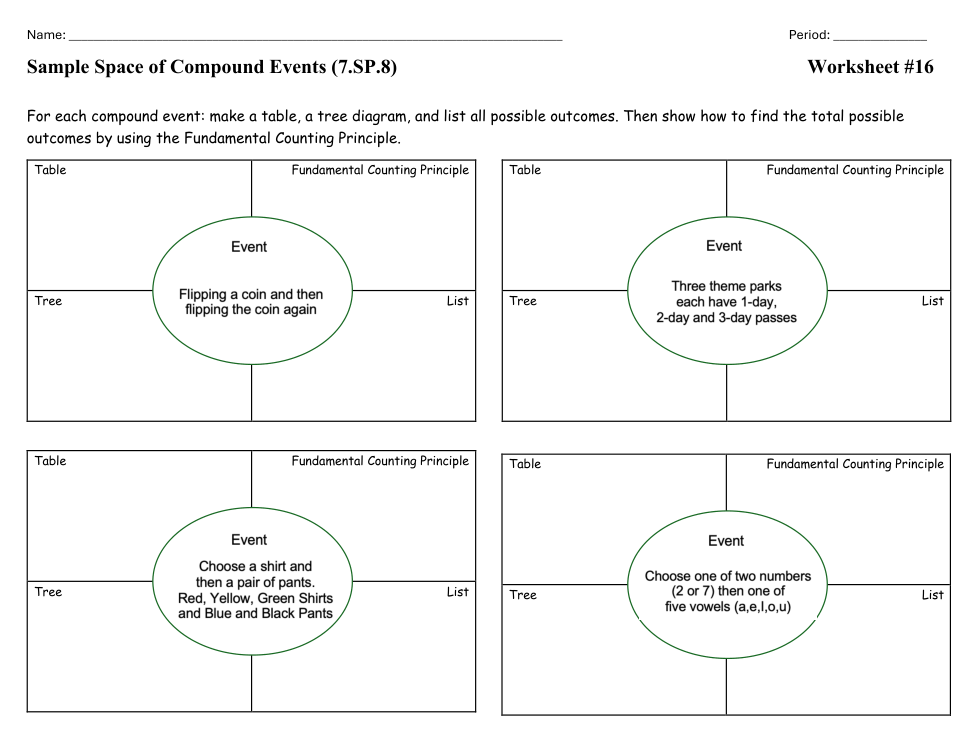
For each compound event make a tree diagram for the event: Flipping a coin and then flipping the coin again.
- Heads
- Tails
- Heads
- Tails
1
For each compound event choose the correct list for the event: Flipping a coin and then flipping the coin again.
1
For each compound event use the Fundamental Counting Principle to find the total possible outcomes for the event: Flipping a coin and then flipping the coin again.
1
For each compound event make a tree diagram for the event: Three theme parks each have 1-day, 2-day, and 3-day passes.
- 1-day pass
- 2-day pass
- 3-day pass
- Theme Park 1
- Theme Park 2
- Theme Park 3
5
For each compound event choose the correct list for the event: Three theme parks each have 1-day, 2-day, and 3-day passes.
1
For each compound event use the Fundamental Counting Principle to find the total possible outcomes for the event: Three theme parks each have 1-day, 2-day, and 3-day passes.
5
For each compound event make a tree diagram for the event: Choose a shirt and then a pair of pants. Red, Yellow, Green Shirts and Blue and Black Pants.
- Blue Pants
- Black Pants
- Red Shirt
- Yellow Shirt
- Green Shirt
1
For each compound event choose the correct list for the event: Choose a shirt and then a pair of pants. Red, Yellow, Green Shirts and Blue and Black Pants.
0
For each compound event use the Fundamental Counting Principle to find the total possible outcomes for the event: Choose a shirt and then a pair of pants. Red, Yellow, Green Shirts and Blue and Black Pants.
1
For each compound event make a tree diagram for the event: Choosing one of two numbers (2 or 7) than one of five vowels (a, e, i, o, u)
- A
- E
- I
- O
- U
- 2
- 7
1
For each compound event choose the correct list for the event: Choosing one of two numbers (2 or 7) than one of five vowels (a, e, i, o, u)
0
For each compound event use the Fundamental Counting Principle to find the total possible outcomes for the event: Choosing one of two numbers (2 or 7) than one of five vowels (a, e, i, o, u)

1
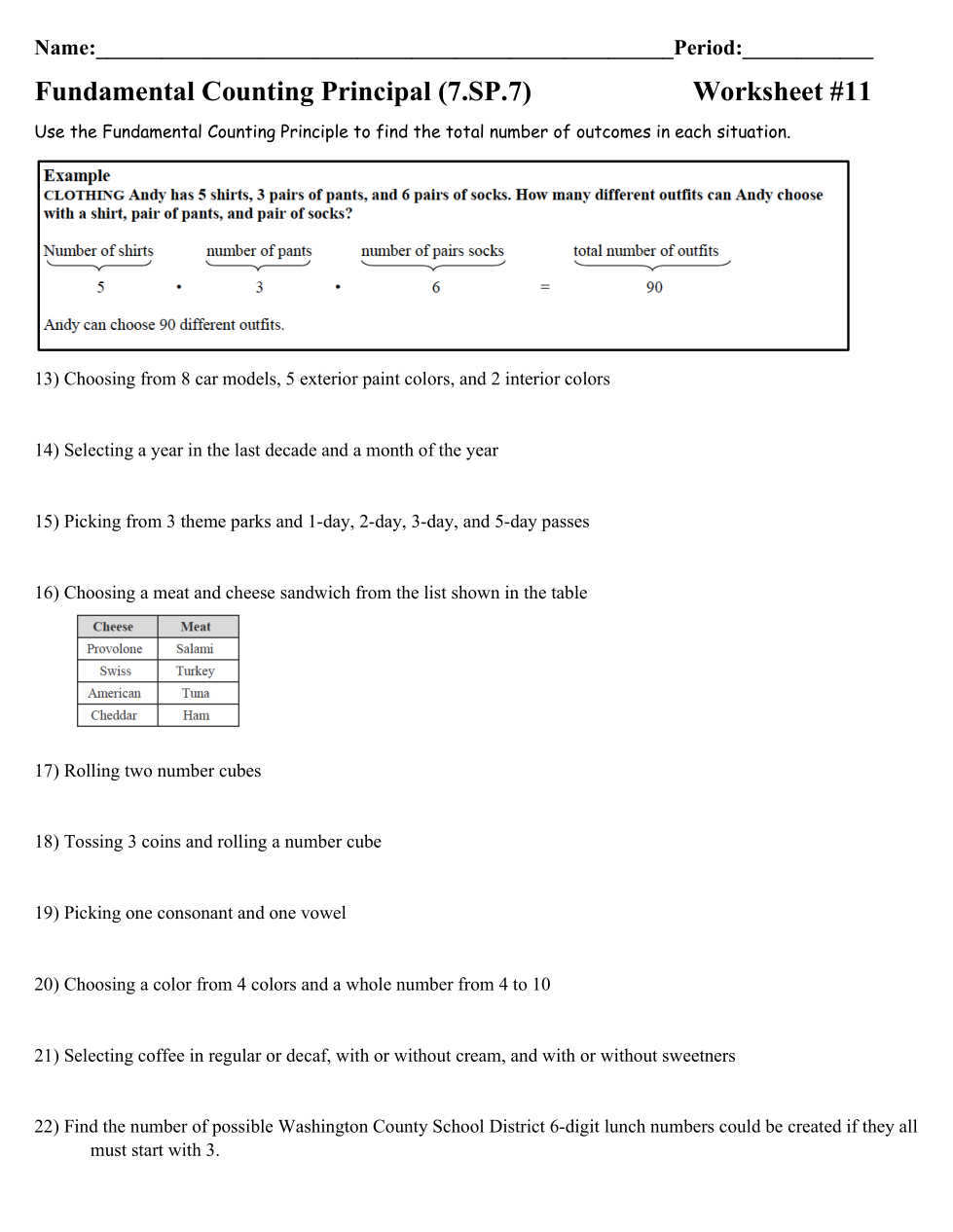
Use the fundamental counting principle to find the total number of outcomes.
1
Use the fundamental counting principle to find the total number of outcomes.
1
Use the fundamental counting principle to find the total number of outcomes.
1
Use the fundamental counting principle to find the total number of outcomes.
1
Use the fundamental counting principle to find the total number of outcomes.
1
Use the fundamental counting principle to find the total number of outcomes.
1
Use the fundamental counting principle to find the total number of outcomes.
1
Use the fundamental counting principle to find the total number of outcomes.
1
Use the fundamental counting principle to find the total number of outcomes.
1
Use the fundamental counting principle to find the total number of outcomes.
0
I will know I am successful when:*I can find the sample space of compound events.
I will know I am successful when:
*I can find the sample space of compound events.