Preskoči na glavni sadržaj
Prijava
Sign up for FREE
arrow_back
Biblioteka

Lesson 9: Sections Intro & 1

star
star
star
star
star
Posljednje ažuriranje 5 months ago
18
Obavezno
15

Section Introduction: (Part 1) 


In ancient Egypt, powerful leaders called pharaohs controlled the lands. The people of ancient Egypt honored these rulers both during their reign and during their believed afterlife.

In 1922, archaeologists discovered the tomb of a pharaoh. Inside a small burial chamber, they found three coffins nested inside each other. The smallest coffin was made of solid gold and held the king’s mummy. A mummy is a body that has been preserved after death to prevent it from decaying.

On the mummy’s head was a magnificent golden mask. Jewelry and good luck charms lay on the mummy and in the wrappings that protected it. Other rooms of the tomb were filled with statues, weapons, furniture, and even a chariot.

Obavezno
1
Pitanje 1
1.

How did the people of ancient Egypt honor their rulers?

Obavezno
2
Obavezno
7

Section Introduction (Part 2)


These artifacts have much to teach us about this ancient civilization. For example, the objects left behind told archaeologists that this tomb belonged to the famous pharaoh called King Tutankhamun, whom historians often refer to by his nickname, King Tut.

The treasures in King Tut’s tomb provided a unique glimpse into ancient Egypt. Other pharaohs also left behind rare riches and artwork. Many of these pharaohs ordered great monuments to be built to celebrate their lives and accomplishments.

In this lesson, you will learn about three significant periods in ancient Egyptian history. Then you will meet four pharaohs who ruled during these periods, learn what ancient Egyptians accomplished, and explore some of the monuments they left behind.

Obavezno
3
Obavezno
2
Pitanje 5
5.

Click on the word that is a synonym for "gave". Then click on the word that is a synonym for "honor."

Obavezno
1

Section 1: The Ancient Egyptian Pharaohs (Part 1)


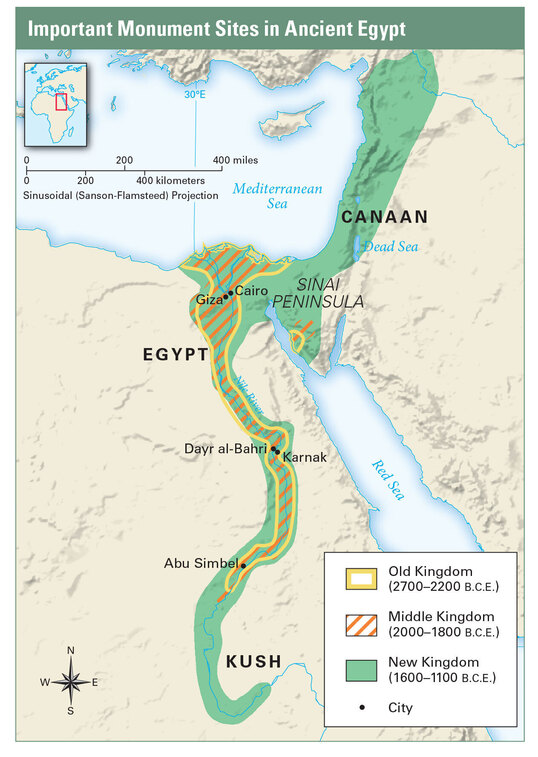
Ancient Egypt had three periods of stability and unity under the rule of pharaohs. Historians call these periods the Old Kingdom, the Middle Kingdom, and the New Kingdom.

The Old Kingdom lasted from about 2700 to 2200 B.C.E. During this time, early pharaohs set up a strong central government. They also had great pyramids built as tombs for themselves. Some historians call this time the Age of the Pyramids.

The Middle Kingdom (about 2000 to 1800 B.C.E.) is sometimes called the Period of Reunification because it followed years of chaos and disunity. During this era, Egyptians enjoyed many great achievements in literature, art, and architecture.

The New Kingdom (about 1600 to 1100 B.C.E.) is often called Egypt’s Golden Age. During this time of peace and stability, ancient Egypt’s power reached its height. Rulers, like Thutmose III, expanded the empire far up the Nile River into modern-day Sudan and into the Levant, which is the coastal region at the eastern end of the Mediterranean Sea.
Obavezno
1
Pitanje 7
7.

Which kingdom brought Ancient Egypt back together from when it was out of control?

Obavezno
3
Obavezno
3
Pitanje 10
10.

Drag the characteristic on the left to its proper Egyptian kingdom on the right.

  • Egyptians enjoyed many great achievements in literature, art, and architecture.

  • Nickname: Age of the Pyramids

  • The first Egyptian kingdom

  • Egypt’s power reached its height.

  • The pharaohs had great pyramids built as tombs for themselves.

  • A time of peace and stability.

  • Lasted from about 2700 to 2200 B.C.E

  • Nickname: Period of Reunification

  • Lasted from about 1600 to 1100 B.C.E.

  • Nickname: Egypt’s Golden Age

  • The empire far up the Nile River into modern-day Sudan and into the Levant.

  • The pharaohs set up a strong central government.

  • Thutmose III ruled during this kingdom.

  • Lasted from about 2000 to 1800 B.C.E.

  • This kingdom followed years of chaos and disunity.

  • Old Kingdom

  • Middle Kingdom

  • New Kingdom

Section 1: The Ancient Egyptian Pharaohs (Part 2)


Religion played a central role in Egypt’s social and political order. Pharaohs were believed to be gods. They owned all the land and were responsible for their people’s well-being. They were kings, generals, and religious leaders, all combined.

During the Old Kingdom, only pharaohs were thought to enter an eternal afterlife, so their tombs were built to last. Many objects were buried with the pharaoh for use in the next world.

The pharaohs directed the building of other monuments to glorify their power. Let’s learn more about these structures and the pharaohs who ordered their creation.

Obavezno
2
Pitanje 11
11.

Click on the word that is a synonym for "everlasting". Then click on the word that is a synonym for "graves."

Obavezno
5
Obavezno
3
Obavezno
1
Pitanje 14
14.

Study this map closely to find the best answers. (Zoom in on it for a better look, or go to TCI, Lesson 9: Section 1.)

Obavezno
1
Obavezno
1
Obavezno
1
Obavezno
1
Pitanje 2
2.

Click on the word that is a synonym for "scientists". Then click on the word that is a synonym for "fitted inside."

Pitanje 3
3.

What things were found in the tomb discovered in 1922? (Hint: There's more than one)

Pitanje 4
4.

According to the paragraphs above, what have pharaohs left behind? (Hint: There's more than one)

Pitanje 6
6.

What will we be learning about in this Lesson?

Pitanje 8
8.

Click on the 2 words that are synonyms for "turmoil and division". Then click on the word that is a synonym for "period."

Pitanje 9
9.

Which statements are true about the kingdoms of Ancient Egypt? (Hint: There's more than one)

Pitanje 12
12.

What is true of the pharaohs? (Hint: There's more than one)

Pitanje 13
13.

How was religion important in ancient Egypt? (Hint: There's more than one)

Pitanje 15
15.

What is the correct order below for the size of the three kingdoms, from largest to smallest?

Pitanje 16
16.

If you lived in Cairo, what direction would you walk to get to Giza?

Pitanje 17
17.

If you lived in Kush, what direction would you travel to get to Egypt?

Pitanje 18
18.

When was the Middle Kingdom?