Log in
Sign up for FREE
arrow_back
Library

Columbus/Revolutionary War Formative

star
star
star
star
star
Last updated 4 months ago
15 questions
Required
1
1
1
1
1
1
1
1
1
1
1
2
1
1
1
Question 1
1.

Name?

Question 2
2.

Question 3
3.

Question 4
4.

Question 5
5.

Question 6
6.

Question 7
7.

Question 8
8.

Question 9
9.

Question 10
10.

Question 11
11.

Question 12
12.

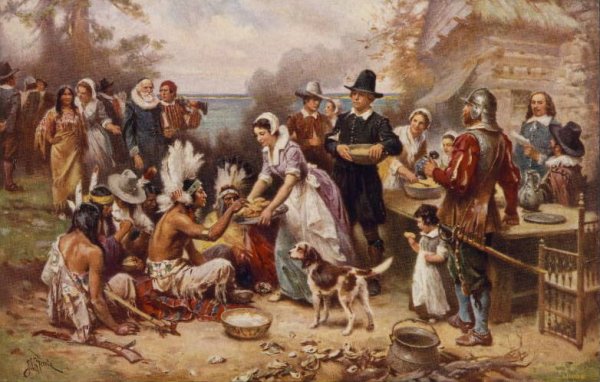
11. The painting The First Thanksgiving 1621 helps historians understand the relationship between the Wampanoag and the Pilgrim settlers in 1621. Do you agree or disagree? Briefly support your answer:

Columbus
“For I knew that they were a people who could be more easily freed and converted to our holy faith by love than by force, gave to some of them red caps, and glass beads to put round their necks, and many other things of little value, which gave them great pleasure, and made them so much our friends.…It appeared to me to be a race of people very poor in everything.…They have no iron, their darts being wands without iron, some of them having a fish’s tooth at the end….They should be good servants and intelligent, for I observed that they quickly took in what was said to them, and I believe that they would easily be made Christians as it appeared to me that they had no religion.” Christopher Columbus upon reaching the West Indies, 1492The Journal of Christopher Columbus (during his First Voyage, 1492–93) and Documents Relating to the Voyages of John Cabot and Gaspar Corte Real (London: Hakluyt Society, 1893), 37–38
Question 13
13.

Question 14
14.

Question 15
15.

1. In the 1700's the major reason that there were more Africans enslaved in the South than in the North was that
enslaved could not tolerate the climate of the North
the Southern economy required a larger number of field labors
the Southern economies were dependent upon slave labor for survival
Native Americans were mostly used as slaves in the northern colonies
2. According to Mercantilism a nation could increase its wealth by obtaining as much silver and gold as possible and
establish a favorable balance of trade
taxing its citizens
conquer wealthy countries
import more than they export
3. The Proclamation of 1763 was an attempt by the British to
encourage settlement west of the Appalachians
claim Canada and North America east of the Mississippi
force France off the North American continent
stop the colonial settlement west of the Appalachians
4. Change in the colonial policy due to the French Indian War by the British government that helped lead to the American Revolution involved
forcing the American colonists to shoulder some of the financial costs of the empire.
removing the majority of the British navy from the American waters
beginning a war with Spain
removing British troops from American soil
5. During the 1760s and 1770s the most effective American tactic in gaining the repeal of the Stamp and Townshend Acts was
destroying private property, such as tea, on which a tax was to be levied
boycotting British goods
sending petitions to the king and parliament
using death threats to intimidate the British agents
6. As the war for Independence began, Britain had the advantage of
overwhelming national wealth and naval power
a well-organized and united home government and population
all of the above
first-rate generals and well-supplied professional army
7. As the war for independence began, the Colonists had the disadvantage of
great difficulty in raising money
all of the above
poor organization
no central government
8. The Battles of Lexington and Concord were significant because
they convinced the British that the colonies could not be defeated militarily and led to the British abandonment of the port of Boston
the proved superiority of the European military tactics as well as the superiority of British regulars t the ragtag American militias
they marked the first organized battle between British regulars and colonial militiamen and ended any hopes for a peaceful resolution to the disagreement between England and its' colonies
they marked the turning point of the American Revolution. After Concord, the British were never again to regain the offensive against the Americans
9. Thomas Paine's pamphlet Common Sense was significant in that it
called for a strong central government to rule the newly independent American states and foresaw difficulties inherent within the Article of Confederation
rallied American spirits during the bleak winter of 1776, when it appeared in Washington's forces, freezing and starving at Valley Forge, had no hope of surviving the winter much less defeating the British
asserted to its British readers that they could not beat the American colonists militarily unless they could isolate New England from the rest of American colonies
emotionally aroused thousands of colonists to the abuses of British rule, the oppressiveness of the monarchy, and the advantages of colonial independence
10. During the American war of Independence, the Battle of Saratoga was most significant because it
persuaded France to begin supporting the American colonists
left the British with inadequate resources to carry not the war
prevent the British from ever mounting another successful invasion of American territory
allowed American forces to seize large portions of Canada
12. In the passage above, Columbus likely mentioned the American Indians’ interest in glass beads and weapons
to prove the cultural inferiority of racially mixed populations
as an example of their largely mobile and nomadic lifestyles
to demonstrate the social diversification among societies in these areas
because it exemplified the very different worldview of American Indians
13. After Columbus' arrival in the West Indies, Spanish religion and Christian conversion were often used as a rationale to
trigger extensive demographic change
transform the diverse environment
racially mix populations
justify the subjugation of American Indians
14. The sentiments expressed by Columbus in the excerpt above best support which future Spanish goal?
shifting the Spanish economy from feudalism to capitalism.
attempting to change American Indians' beliefs and world views.
organizing new methods for conducting international trade
implementing a plantation-based agricultural system