Ɛhia
2
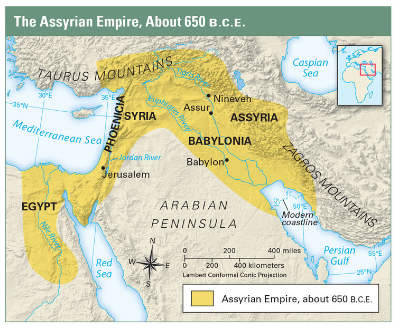
Study the map to answer the questions below.
Study the map to answer the questions below.
Ɛhia
1
Ɛhia
1
Ɛhia
1
Section 5: The Assyrian Empire (Part 1)
The line of royalty Hammurabi initiated did not continue to rule Babylonia for long. Over the next several hundred years, a number of groups governed sections of what had previously been the Babylonian Empire. However, a warlike people called the Assyrians created the next great empire in Mesopotamia.
Assyria lay to the north of Babylon. The Assyrians had lived in Mesopotamia for a long time, briefly establishing their own empire before Hammurabi conquered them. They rose to power again toward 900 B.C.E., when a series of Assyrian rulers began training an army for war in hopes of expanding their territory.
Read the paragraphs from this section to answer the questions below. Don't be afraid to re-read!
Click on the word that is a synonym of "creating." Then click on the word that is a synonym for "growing."
Section 5: The Assyrian Empire (Part 2)
The Assyrians were feared for their military might and their cruelty. Their greatest achievements were their new weapons and war strategies. They perfected the use of horses and iron weapons in battle. They also became greatly skilled at siege warfare, a strategy in which army soldiers camp outside a city and repeatedly attack it until the city falls. The Assyrians developed new ways of attacking cities. For instance, they developed new types of battering rams. These long, heavy, wheeled beams were used for breaking down walls. The Assyrians also built moveable towers that were rolled up to a city's walls so that soldiers could climb over the walls.
The Assyrians were often ruthless. They might force entire populations to leave areas they had recently conquered. The Assyrians spread tales of their cruelty far and wide and creating fear among their enemies became part of the Assyrian military strategy.
Read the paragraphs from this section to answer the questions below. Don't be afraid to re-read!
Click on the 2 words that are synonyms for "brutal."
Study the map to answer the questions below.
Section 6. Life Under Assyrian Rule (Part 1)
Powerful kings ruled the Assyrian Empire. Religion, however, remained extremely crucial to social and political order. Even kings were obliged to obey the gods.
The Assyrians believed that their kings were special beings, so they built beautiful, elaborate palaces to honor their rulers. The great palace in the capital city of Nineveh (NIH-nuh-vuh) had many rooms. Some palaces were built on tall mounds, to raise them above the surrounding buildings. Huge sculptures of winged bulls or lions, with human faces, stood at the entrances.
Like other societies in Mesopotamia, the Assyrians dug canals to irrigate their land and keep it fertile for farming. They also developed some of the first aqueducts, which are pipes or channels used to carry water. A system of canals and aqueducts brought drinking water to Nineveh from 30 miles away.
Read the paragraphs above to answer the questions below. Don't be afraid to re-read!
Click on the 2 words that are synonyms for "gorgeous."
Section 6. Life Under Assyrian Rule (Part 2)
Like other societies in Mesopotamia, the Assyrians dug canals to irrigate their land and keep it fertile for farming. They also developed some of the first aqueducts, which are pipes or channels used to carry water. A system of canals and aqueducts brought drinking water to Nineveh from 30 miles away.
Assyrian artisans were known for their two-dimensional sculptures called bas-reliefs. Many of their most famous bas-reliefs were on palace walls. Amazingly realistic, they often depicted scenes of the king hunting, fighting in battle, or enjoying family life. The Assyrians used ivory to decorate thrones, beds, and chairs.
The Assyrian Empire lasted about 300 years. At its height, it stretched from Egypt to the Persian Gulf, but its weakness lay in being too vast a territory to control. The army was stretched thin, and the Assyrians could not fight off opposing neighbors. In 612 B.C.E., a combined army of Babylonians, Scythians, and a group called the Medes attacked Nineveh, permanently breaking the Assyrians' reign over the land.
Read the paragraphs from this section to answer the questions below. Don't be afraid to re-read!
Click on the 3 armies that finally defeated the Assyrians and ended their empire.
Match the word below with its correct meaning on the right.
| Draggable item | arrow_right_alt | Corresponding Item |
|---|---|---|
battering rams | arrow_right_alt | 2 dimensional sculptures |
Assyrians | arrow_right_alt | Pipes or channels used to carry water |
Aqueducts | arrow_right_alt | Capital city of the Assyrian Empire |
Nineveh | arrow_right_alt | Strategy in which army soldiers camp outside a city and repeatedly attack it until the city falls |
Siege warfare | arrow_right_alt | Long, heavy, wheeled beams were used for breaking down walls |
Bas-reliefs | arrow_right_alt | a warlike people who briefly establishing their own empire before Hammurabi conquered them |
Drag the Assyrian accomplishment to the correct category.
Bas Reliefs
Moveable Towers
Ivory Thrones
Irrigation Canals
Aqueducts
Winged Lions with Human Faces
Battering Ram
Cruelty
Beautiful Palaces
Siege warfare
Military Accomplishment
Cultural Accomplishment
The Assyrians had lived in
Right after Babylonian rule ended, who ruled Mesopotamia for the next several hundred years?
What is true of the Assyria? (Hint: There is more than one)
The Assyrians were often
What is the main idea of these paragraphs?
According to the paragraphs above, what did the Assyrians do to conquer their enemies? (Hint: There's more than one)
Which sea is farthest west?
Which mountains are farthest north?
What direction would you need to travel to go from Assur to the Mediterranean Sea?
The
In what ways did the Assyrians show that their kings were important? (Hint: There's more than one)
What did the Assyrians develop that the earlier Mesopotamian empires did not?
What is true about the Assyrian's bas-reliefs? (Hint: There's more than one)
At its height, it stretched from
Why did the Assyrians' empire end? (Hint: There's more than one)