Ɛhia
3
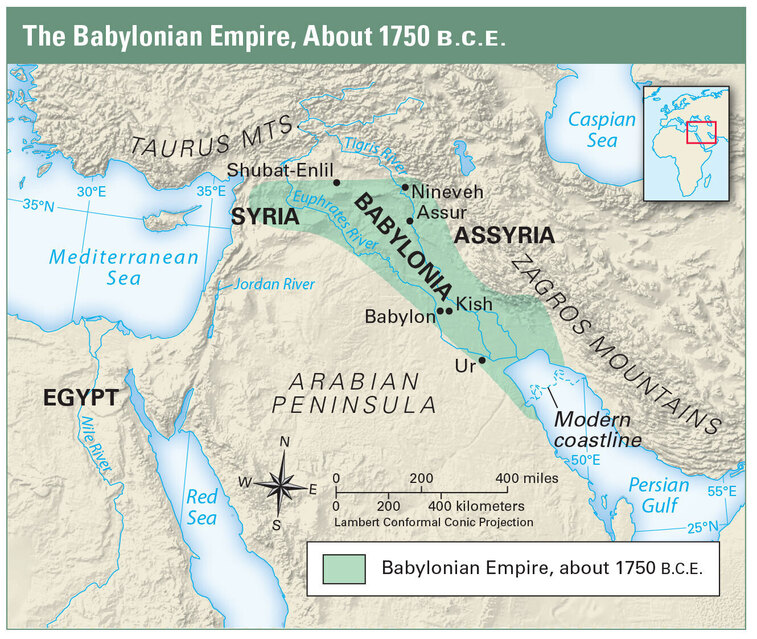
Study the map to answer the questions below.
Study the map to answer the questions below.
Ɛhia
1
Ɛhia
1
Ɛhia
1
Section 3: Hammurabi and the Babylonian Empire (Part 1)
For a while after the fall of the Akkadians, Sumer was once again a group of city-states. The next ruler to unite all of Mesopotamia was a king named Hammurabi (hah-muh-RAH-bee).
Hammurabi ruled Babylon (BAH-buh-luhn), a small city-state in central Mesopotamia. After conquering the rest of Mesopotamia, he named Babylon the capital of his empire, so the region became known as the Babylonian Empire, or Babylonia.
Read the paragraphs above to answer the questions below. Don't be afraid to re-read!
Click on the word that is a synonym for "defeating." Then click on the word that is a synonym for "area."
Section 3: Hammurabi and the Babylonian Empire (Part 2)
Hammurabi is best known for his code of laws, which he wrote during his reign from 1792 to 1750 B.C.E. He used the code of laws to unify his empire and to preserve order, basing the laws not merely on his own authority, but on the word of the gods. He declared the Babylonian god, Marduk (MAHR-dook), supreme over other gods. Hammurabi claimed that the gods had instructed him to create laws that applied to the entire empire. Since the laws were based on the gods' will, they could never be changed. The code of laws was written on a stele and put on public display in a temple.
Hammurabi's code was detailed, covering many situations, such as trade, payment for work, marriage, and divorce. The code spelled out punishments for crimes, such as stealing or causing injury. For example, if a poorly assembled house were to collapse and kill its owner, then the builder could be put to death. However, if the owner's son rather than the owner were killed in the collapse, the builder's son could be sentenced to death.
Laws like this one seem harsh to us now, but Hammurabi's code was a notable achievement. Although the laws and punishments did not treat all people equally, the code did apply to everyone living in the empire.
Read the paragraphs above to answer the questions below. Don't be afraid to re-read!
Match the description on the lest to the correct answer on the right.
| Draggable item | arrow_right_alt | Corresponding Item |
|---|---|---|
A set on laws written down | arrow_right_alt | Ruler of the Babylonian Empire |
Hammurabi | arrow_right_alt | The Babylonian God |
Marduk | arrow_right_alt | Hammurabi's code |
Study the map to answer the questions below.
Section 4. Life in the Babylonian Empire (Part 1)
Babylonia thrived under Hammurabi. He worked to unite the people of his empire. The roads he built and the postal service he created helped connect Babylonians of all social statuses.
Agriculture and trade flourished. Hammurabi was careful to properly maintain irrigation systems so that land remained fertile and provided enough food. Because the city of Babylon was on the banks of the Euphrates River, it became an important center of trade. Babylonians traded grain and woven cloth for wood, gold, silver, precious gems, and livestock (animals) with people throughout the Persian Gulf.
Trade helped the empire's economy. Many types of artisans used materials brought from distant lands like Egypt. The arts also flourished. Writers wrote historical poems, some of which survive today.
Read the paragraphs above to answer the questions below. Don't be afraid to re-read!
Section 4. Life in the Babylonian Empire (Part 2)
Most significantly, Babylonian society was unusually fair for its time. The laws treated the various classes differently, but even enslaved people had some rights. Those enslaved could work elsewhere and keep their wages, own property, and even buy their freedom if they saved enough money.
Babylonian women also had more rights than in most other ancient societies. Even though their fathers chose their husbands, women could own property and keep money of their own.
Hammurabi was proud of his achievements, once writing:
I rooted out the enemy above and below.
I made an end of war. I promoted the welfare of the land . . .
I have governed them [the people] in peace.
I have sheltered them in my strength.
Read the paragraphs above to answer the questions below. Don't be afraid to re-read!
Click on the word that is a synonym for "importantly." Then click on the word that is a synonym for "multiple."
Check the box next to the people who these facts were true for.
Enslaved People | Women | Both Enslaved People and Women | |
|---|---|---|---|
Could work other places... | |||
Could keep their wages... | |||
Own property... | |||
Keep their own money... | |||
Could buy their freedom... | |||
Fathers chose their husbands... |
Who was the ruler of Mesopotamia after the Akkadians?
How did the Babylonian Empire get its name?
What is true about Hammurabi's Code of laws? (Hint: There's more than one)
Click on the word that is a synonym for "declared." Then click on the word that is a synonym for "have to do with."
Hammurabi
According to the paragraphs above, what is types of situations were covered in Hammurabi's code? (Hint: There's more than one)
Which sea is farthest north?
Which mountains are farthest south?
What direction would you need to travel to go from Nineveh to the Red Sea?
Click on the word that is a synonym for "grew." Then click on the word that is a synonym for "supplied."
In what ways did Hammurabi help the people of the Babylonian Empire? (Hint: There is more than one)
What is the main idea of these paragraphs?
Most
In what ways was Babylonia fair for its time? (Hint: There's more than one)
What did Hammurabi believe he did as the leader of the Babylonian Empire?