Log in
Sign up for FREE
arrow_back
Library

1.05 Big Bang Lab

star
star
star
star
star
Last updated about 3 hours ago
16 questions
Note from the author:
Required
0
Required
1
HS-ESS1-2
Required
1
HS-ESS1-2
Required
1
HS-ESS1-2
Required
1
HS-ESS1-2
Required
1
HS-ESS1-2
Required
1
HS-ESS1-2
Required
1
HS-ESS1-2
Required
1
HS-ESS1-2
Required
1
HS-ESS1-2
Required
1
HS-ESS1-2
Required
2
Required
2
HS-ESS1-2
Required
1
HS-ESS1-2

If you need help with this lab, please watch the recording. (updated 9.17.25)

To complete this lab, you will need to be signed up for our Gizmos class.

Go to https://go-el.com/join

Enter code ELSFDHHS

If you have used Gizmos before at ISWA, you can sign in with the same account. Otherwise, create a new username and password (write these down!)

If you need help with this lab, please watch the recording. (updated 9.17.25)

To complete this lab, you will need to be signed up for our Gizmos class.

Go to https://go-el.com/join

Enter code ELSFDHHS

If you have used Gizmos before at ISWA, you can sign in with the same account. Otherwise, create a new username and password (write these down!)

Question 1
1.

Question 2
00:57
keyboard_arrow_down
Required
0
Question 2
2.

How does the sound of the horn change when the car approaches the observer compared to when it moves away?

How does the sound of the horn change for the driver of the car?

Background Information
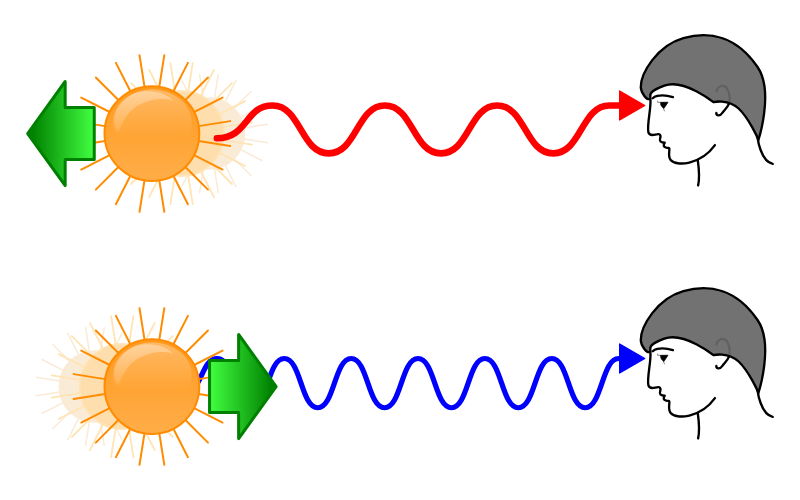
A similar effect occurs if a star or galaxy is moving relative to Earth. When a star approaches Earth, the light waves it emits are compressed, causing its light to be shifted toward the blue end of the spectrum. This is called blueshift. When a star moves away from Earth, its light is shifted toward the red end of the spectrum, a phenomenon called redshift.
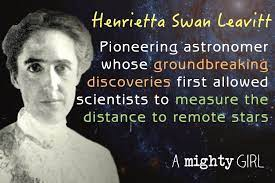

In 1912, an astronomer named Henrietta Swan Leavitt studied a class of stars called Cepheids. These stars change from bright to dim to bright again. Her discoveries led to a method of measuring distances to other galaxies and eventually helped to support the Big Bang theory of the origin of the universe.

Stars emit light at a variety of wavelengths. Just as white light is separated into a rainbow when it passes through a prism, starlight can be separated into its constituent colors when it passes through an instrument called a spectrograph. The result is a pattern of colors and black bars called an absorption spectrum. The bars represent wavelengths of light that are absorbed in the star’s atmosphere. Each star’s unique spectrum depends on the temperature and composition of its atmosphere.

This is the spectrum of star A-091. Each star has a unique spectrum, just like every human has unique fingerprint. Notice the dark lines.

Collect Data

You will need the Big Bang Theory - Hubble's Law Gizmo to complete the lab.

First, you need to collect the spectra (plural of spectrum) of the Cepheids in Regions A-I under the "Stars" tab.
  1. Click on a region.
  2. Find a pulsing star that gets targeted when you click it. There are 2 stars in Region A, the rest all have 1 star.
  3. Click the "Collect data" button.
  4. Click the "Record spectrum" button.
  5. Repeat until you find all 10 Cepheid stars and record their spectra.
Analyze Data

Click on the "Spectra" tab in the Gizmo. You should see a reference spectrum and 10 spectra below. Check the "Redshift calculator" box.

  1. Move Star A-171's spectrum to the box to measure redshift
  2. Drag the green probes to equivalent lines in each spectrum. Then, zoom in on the graph by clicking +. Adjust the probes so they are exactly on each absorption line.
  3. Record your findings below.
  4. Repeat the procedure for each star.
Question 3
3.
Star A-171
Which way have the lines shifted? __________
What is the value of the redshift calculator? __________
Which way is the star moving? __________
Question 4
4.
Star A-091
Which way have the lines shifted? __________
What is the value of the redshift calculator? __________
Which way is the star moving? __________
Question 5
5.
Star B-618
Which way have the lines shifted? __________
What is the value of the redshift calculator? __________
Which way is the star moving? __________
Question 6
6.
Star C-197
Which way have the lines shifted? __________
What is the value of the redshift calculator? __________
Which way is the star moving? __________
Question 7
7.
Star D-819
Which way have the lines shifted? __________
What is the value of the redshift calculator? __________
Which way is the star moving? __________
Question 8
8.
Star E-429
Which way have the lines shifted? __________
What is the value of the redshift calculator? __________
Which way is the star moving? __________
Question 9
9.
Star F-520
Which way have the lines shifted? __________
What is the value of the redshift calculator? __________
Which way is the star moving? __________
Question 10
10.
Star G-958
Which way have the lines shifted? __________
What is the value of the redshift calculator? __________
Which way is the star moving? __________
Question 11
11.
Star H-716
Which way have the lines shifted? __________
What is the value of the redshift calculator? __________
Which way is the star moving? __________
Question 12
12.
Star I-450
Which way have the lines shifted? __________
What is the value of the redshift calculator? __________
Which way is the star moving? __________
Question 13
13.

Draggable itemarrow_right_altCorresponding Item
arrow_right_alt
arrow_right_alt
arrow_right_alt
Question 14
14.
From the data you collected and analyzed, more stars are __________ which means they are moving __________ the Earth.
Question 15
15.

Required
5
Question 16
16.

In your own words, describe how the balloon analogy helps explain the concept of the Big Bang and the expansion of the universe.

Warm up

Standing by the side of a lonely highway at night, you see two motorcycle headlights, one in each direction. The headlight on your left appears brighter than the one on your right.


If you know that the headlights are equally bright, which motorcycle is closer?
The left motorcycle
The right motorcycle
What does the redshift value indicate?
Zero
Galaxy moving away from Earth
Negative number
No movement
Positive number
Galaxy moving toward Earth
The Big Bang Theory is the main scientific idea that explains how the universe started about 13.8 billion years ago. It suggests that the universe began from a very dense and hot point that quickly expanded and cooled down. This process created space, time, matter, and energy.

Which statement does your data and analysis support?
The universe is expanding
The universe is not changing
The universe is shrinking