How does the sound of the horn change when the car approaches the observer compared to when it moves away? __________
How does the sound of the horn change for the driver of the car? __________
Background Information
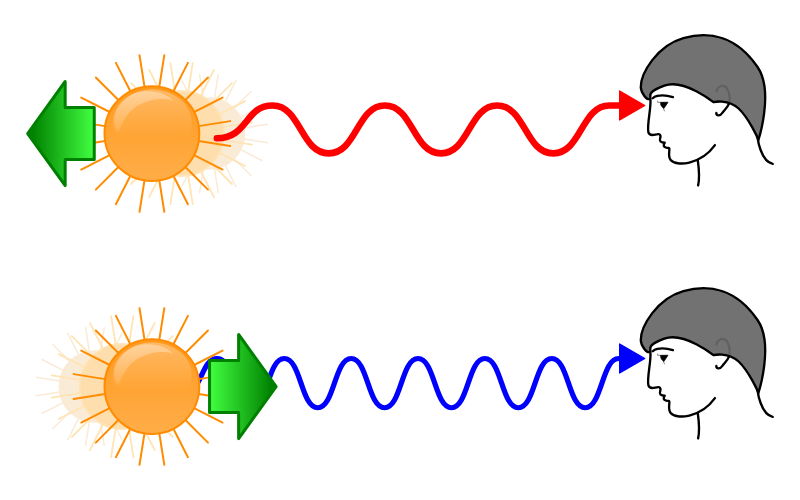
A similar effect happens when a star or galaxy is moving in relation to Earth. When a star comes closer to Earth, the light waves it sends out are squeezed together, which makes its light shift toward the blue side of the spectrum. This is called blueshift. When a star moves away from Earth, its light shifts toward the red side of the spectrum. This is known as redshift.
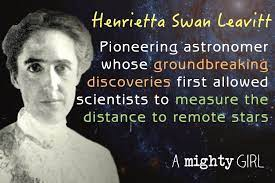
In 1912, an astronomer named Henrietta Swan Leavitt studied a type of stars called Cepheids. These stars change from bright to dim and then back to bright again. Her findings led to a way of measuring distances to other galaxies and helped support the Big Bang theory about how the universe began.
Stars give off light in many different wavelengths. Just like white light becomes a rainbow when it goes through a prism, starlight can be split into its colors when it goes through a tool called a spectrograph. This creates a pattern of colors with dark lines known as an absorption spectrum. The dark lines show the wavelengths of light that are absorbed in the star’s atmosphere. Each star has a unique spectrum based on the temperature and materials in its atmosphere.
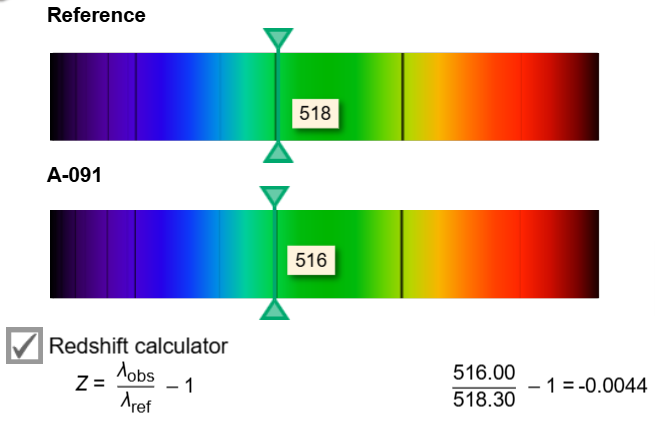
This is the spectrum of star A-091. Each star has its own special spectrum, just like everyone has a unique fingerprint. Look closely at the dark lines.

Question 3
3.
Question 4
4.
Star A-091
Which way have the lines shifted? __________
What is the value of the redshift calculator? __________
Which way is the star moving? __________
Question 5
5.
Star B-618
Which way have the lines shifted? __________
What is the value of the redshift calculator? __________
Which way is the star moving? __________
Question 6
6.
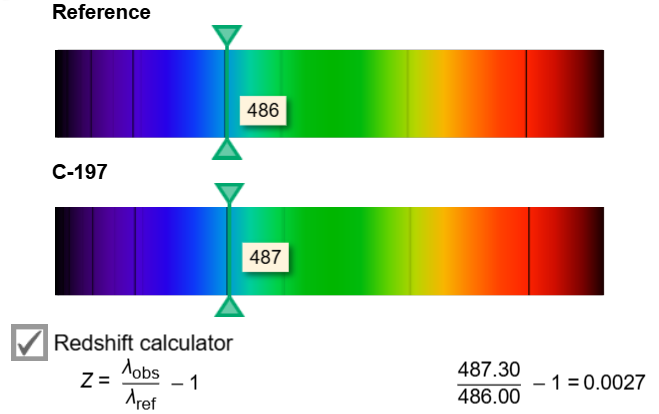
Star C-197
Which way have the lines shifted? __________
What is the value of the redshift calculator? __________
Which way is the star moving? __________
Question 7
7.
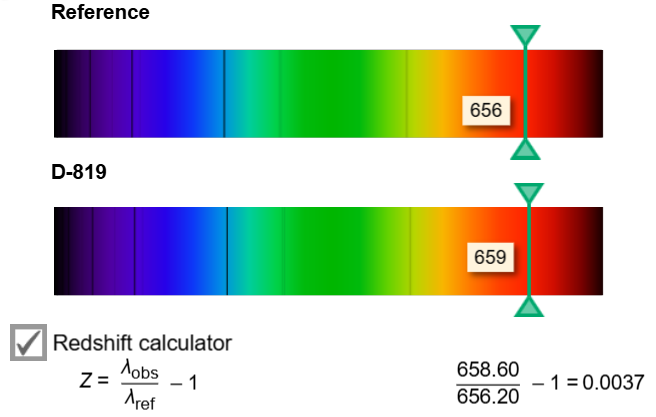
Star D-819
Which way have the lines shifted? __________
What is the value of the redshift calculator? __________
Which way is the star moving? __________
Question 8
8.
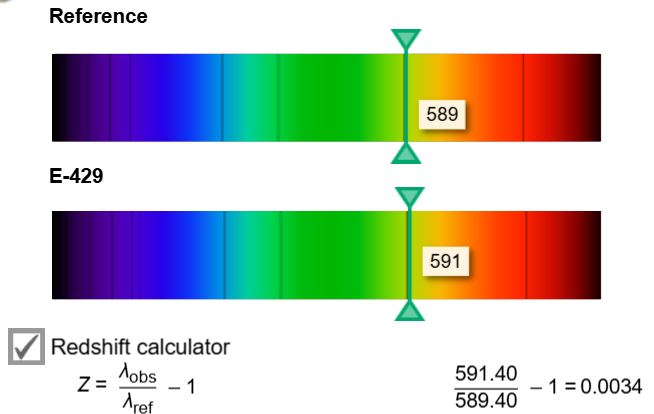
Star E-429
Which way have the lines shifted? __________
What is the value of the redshift calculator? __________
Which way is the star moving? __________
Question 9
9.
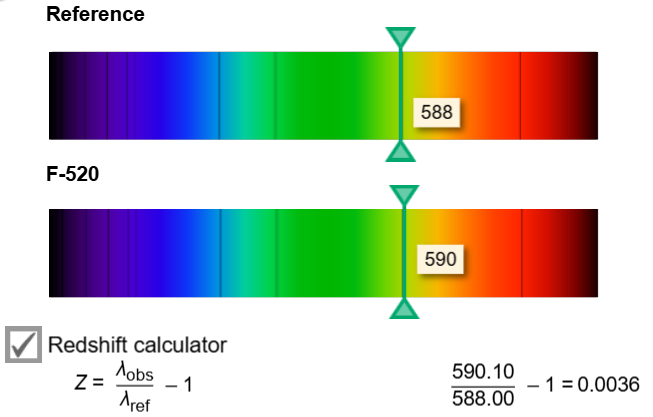
Star F-520
Which way have the lines shifted? __________
What is the value of the redshift calculator? __________
Which way is the star moving? __________
Question 10
10.
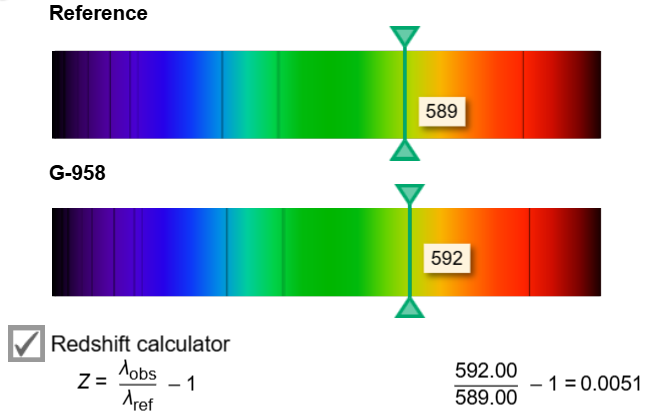
Star G-958
Which way have the lines shifted? __________
What is the value of the redshift calculator? __________
Which way is the star moving? __________
Question 11
11.
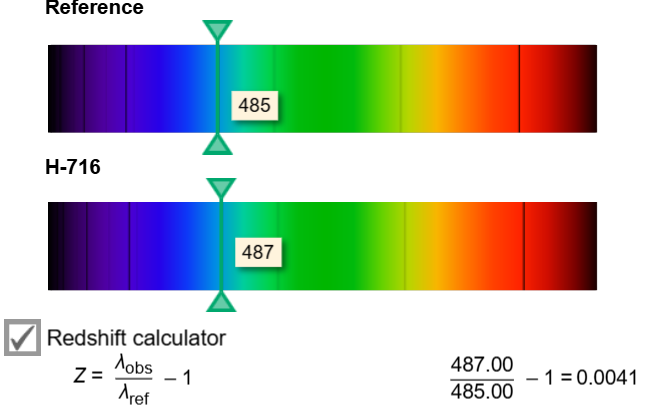
Star H-716
Which way have the lines shifted? __________
What is the value of the redshift calculator? __________
Which way is the star moving? __________
Question 12
12.
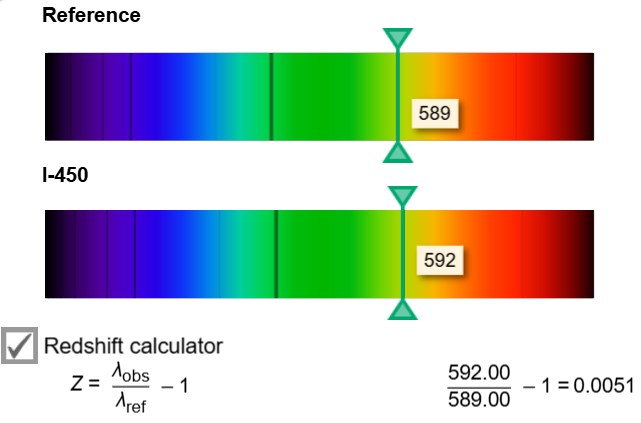
Star I-450
Which way have the lines shifted? __________
What is the value of the redshift calculator? __________
Which way is the star moving? __________
Question 13
13.
Draggable item
arrow_right_alt
Corresponding Item
arrow_right_alt
arrow_right_alt
arrow_right_alt
Question 14
14.
From the data you analyzed, more stars are __________ which means they are moving __________ the Earth.
Question 15
15.
Required
5
Warm up
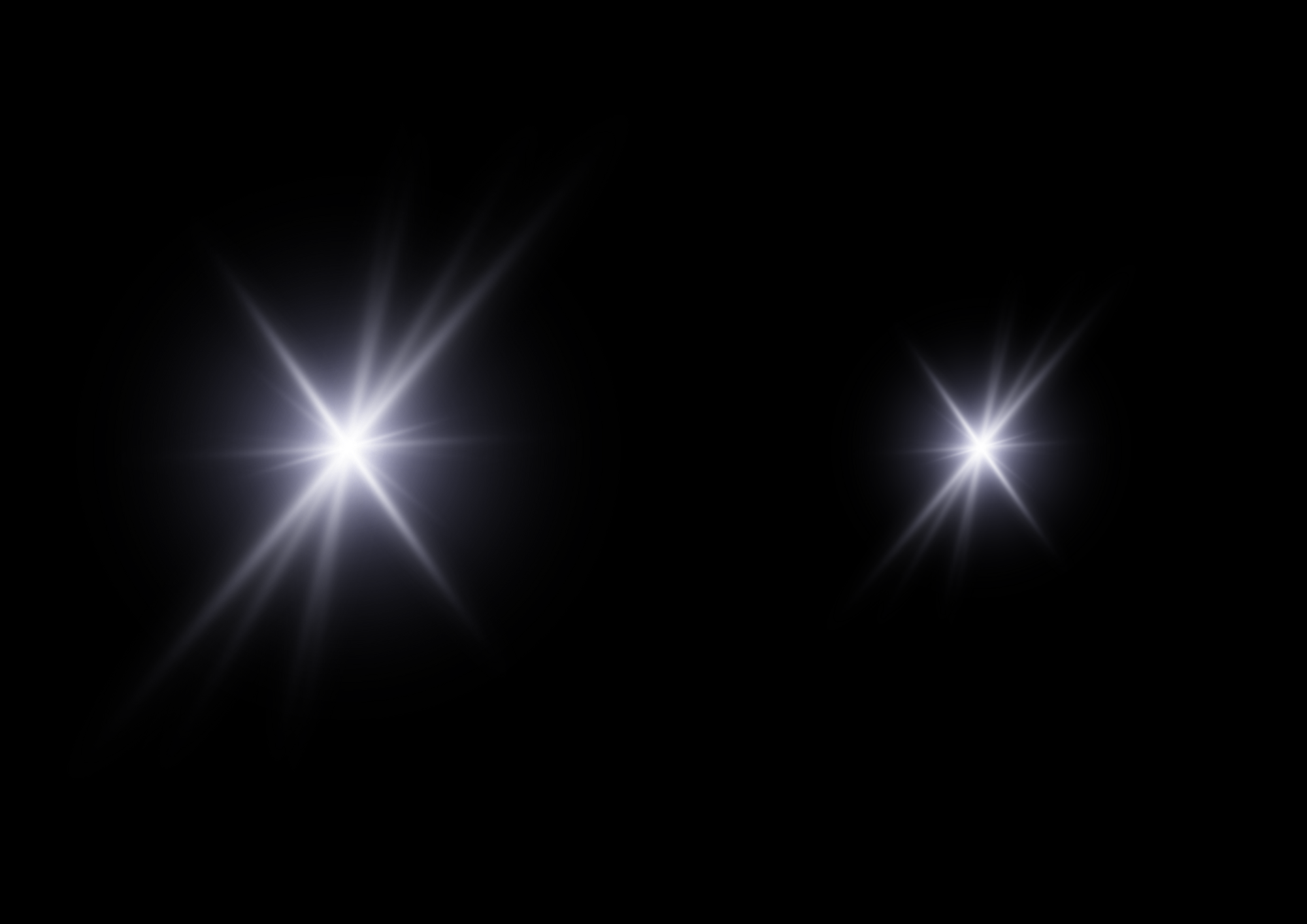
Standing by the side of a lonely highway at night, you see two motorcycle headlights, one in each direction. The headlight on your left appears brighter than the one on your right.
If you know that the headlights are equally bright, which motorcycle is closer?
The left motorcycle
The right motorcycle
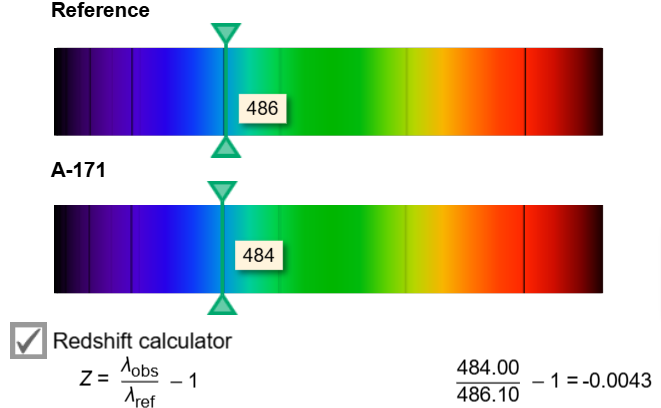
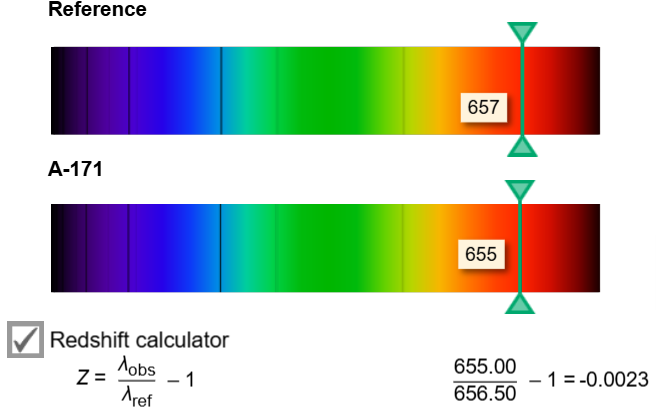
We can compare the absorption lines to a reference spectrograph. Use the green probes to help you see the values of each line.
If the star's absorption lines are left of the reference lines (towards the blue end of the spectrum), the star is moving closer or blueshifted.
If the star's absorption lines are right of the references lines (towards the red end of the spectrum, the star is moving further away or redshifted.
We can also use a redshift calculator to determine how the star is moving.
If the value is negative, the star is moving closer or blueshifted
If the value is zero, the star is not moving
If the value is positive, the star is moving closer or redshifted
Star A-171
Which way have the lines shifted? __________
What is the value of the redshift calculator (lower right corner)? __________
Which way is the star moving? __________
What does the redshift value indicate?
Negative number
Galaxy moving away from Earth
Positive number
No movement
Zero
Galaxy moving toward Earth
The Big Bang Theory is the main scientific idea that explains how the universe started about 13.8 billion years ago. It suggests that the universe began from a very dense and hot point that quickly expanded and cooled down. This process created space, time, matter, and energy.
Which statement does your data and analysis support?
The universe is expanding
The universe is not changing
The universe is shrinking
Question 16
16.
How does the balloon analogy help explain the concept of the Big Bang and the expansion of the universe?
As the balloon contracts, the "galaxy" dots move closer and closer to each other
As the balloon expands, the "galaxy" dots move farther away from each other
As the balloon expands, the "galaxy" dots move closer and closer to each other