Where would expect to find the majority of stars on the Hertzsprung-Russel diagram?
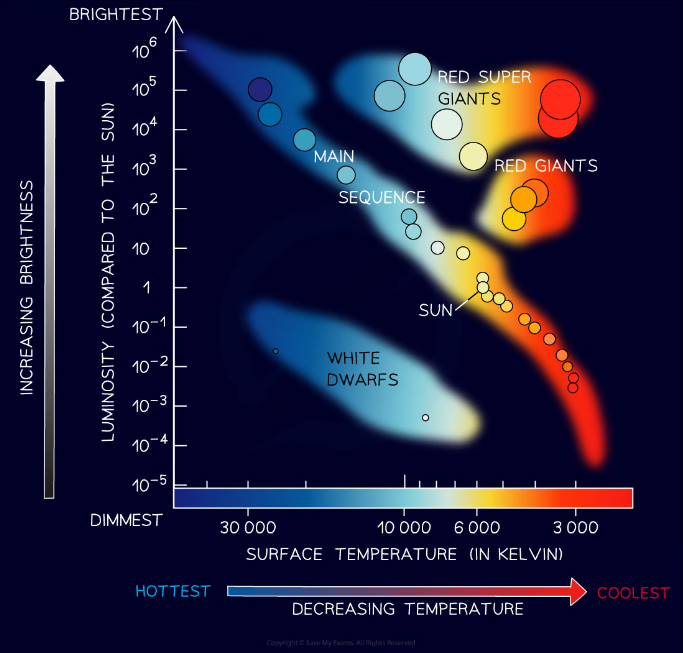
Where would expect to find the majority of stars on the Hertzsprung-Russel diagram?
Where would expect to find the majority of stars on the Hertzsprung-Russel diagram?
Where are stars "born"?
Order the following stars from coolest to hottest.
Which one of these stars would be the least bright if they were all the same distance from the Earth?
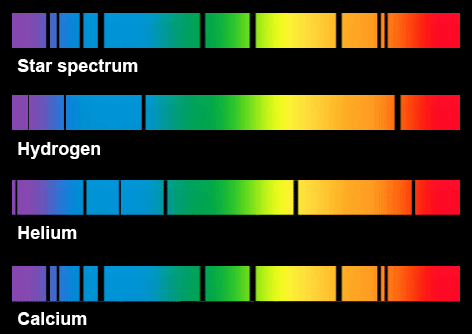
Which of the following elements is/are represented in the star's spectrum below?
Which process powers stars?
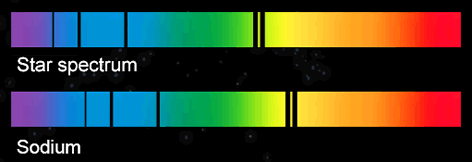
The spectrum of a distant star contains sodium lines that have shifted from their normal position towards the red end of the visible light spectrum, as shown. What is the most likely explanation?
Which stars will use up their fuel much more quickly?
During nuclear fusion, stars fuse into
What is apparent magnitude?
How do white dwarfs compare with supergiants, in terms of temperature and luminosity?
Low mass stars can fuse elements all the way up to Iron (Fe).
Low mass stars have a longer lifetime that high mass stars.
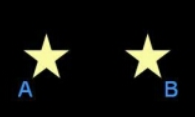
Stars A and B appear to have the same brightness from Earth, but Star B is much smaller than Star A. Which of the following must be true?
What do low mass stars spend the ends of their lives as?
What do high mass stars spend the ends of their lives as?
What are young stars that have not yet begun nuclear fusion?
What state of matter is the sun (and other stars) made of?
What will the Sun become when it runs out of hydrogen and begins fusing helium into carbon and oxygen?
Which of the following describes the Sun?
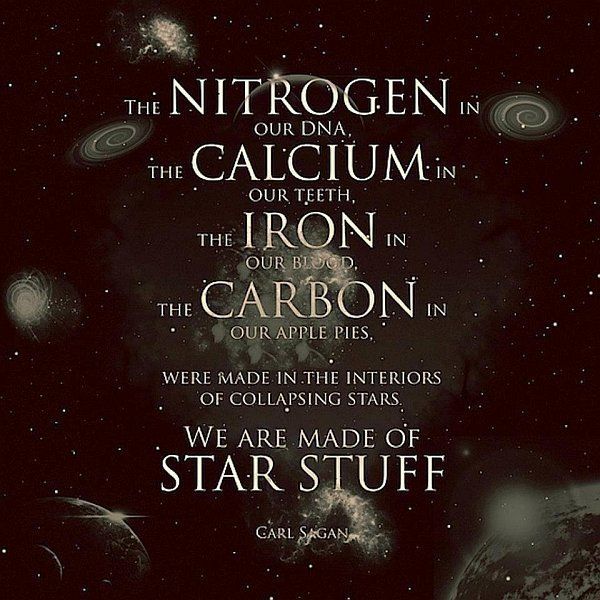
The astronomer Carl Sagan famously said, "The nitrogen in our DNA, the calcium in our teeth, the iron in our blood, the carbon in our apple pies were made in the interiors of collapsing stars. We are made of star stuff."
In your own words, what does it mean to say we are made of "star stuff"?
Now that we have completed Unit 2, please rate yourself on the Unit 2 objectives from 1 (just starting) to 5 (mastered it!)
You may need to scroll horizontally to see all options
1 - getting started | 2 | 3 | 4 | 5 - mastered it | |
|---|---|---|---|---|---|
Describe the composition and characteristics of stars | |||||
Analyze and characterize stars by their physical and chemical properties | |||||
Analyze the evidence that supports the Big Bang theory | |||||
Explain the use of diagrams and models in obtaining physical data on stars | |||||
|
What parts of this unit did you enjoy?
Whats parts of this unit could be improved?