Twa kɔ nsɛm atitiriw so
Log in
Sign up for FREE
arrow_back
Laabri

4.04 Kepler Lab 25-26

star
star
star
star
star
Last updated about 1 month ago
10 Nsɛmmisa
Hyɛ no nsow a efi ɔkyerɛwfo no hɔ:
2
Ɛhia
0
Ɛhia
4
HS-ESS1-4
1
Ɛhia
2
HS-ESS1-4
Ɛhia
2
HS-ESS1-4
Ɛhia
0
Ɛhia
2
HS-ESS1-4
Ɛhia
2
HS-ESS1-4
5
HS-ESS1-4

If you need help, please watch the class recording

Gizmo Instructions

If you have not yet signed up for Gizmos, follow these instructions:

  1. Go to http://go-el.com/join

  2. Use code ELSFDHHS

  3. Click next

  4. If you've used Gizmos before and remember your login information, log into your account. Otherwise, create a new account

  5. Write down your username and password and put this information in a safe place

If you need help, please watch the class recording

Gizmo Instructions

If you have not yet signed up for Gizmos, follow these instructions:

  1. Go to http://go-el.com/join

  2. Use code ELSFDHHS

  3. Click next

  4. If you've used Gizmos before and remember your login information, log into your account. Otherwise, create a new account

  5. Write down your username and password and put this information in a safe place

Asemmisa {{asɛmmisaAhyɛnsode}}
1.

Part 1: First Law

Johannes Kepler (1571–1630) was a German astronomer who spent years poring over a vast store of planetary data compiled by his predecessor, Tycho Brahe. After many incorrect theories and other setbacks, Kepler at last determined the beautifully simple physical laws that govern orbiting bodies. These rules are now known as Kepler’s laws.
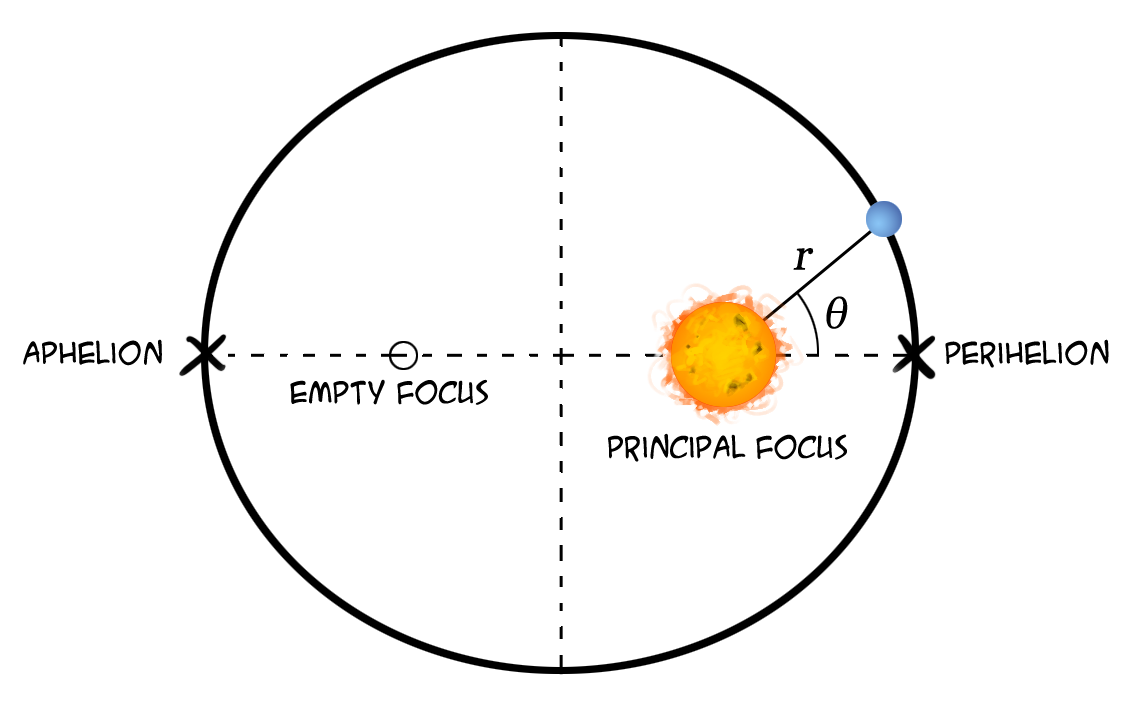
Kepler’s first law states that an orbit is in the shape of a slightly flattened circle, or ellipse. While a circle contains a single point at its center, an ellipse contains two critical points, called foci (singular: focus). The Sun is located at one focus of a planet’s orbit.

You will be using the Solar System Explorer Gizmo for this lab.

Check the Additional data and Show orbital paths boxes on the lefthand side.

Use the dropdown to select Mercury. Click play.

Is Mercury always the same distance from the sun?
Asemmisa {{asɛmmisaAhyɛnsode}}
2.

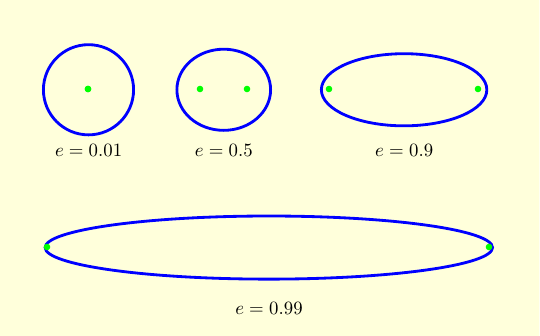
The eccentricity of an ellipse describes how “flattened” it is. A circle has an eccentricity of 0, and a flat line segment has an eccentricity of 1.

In the image above, when eccentricity = 0.01, the ellipse is almost a perfect circle. The closer the eccentricity gets to 1, the more flattened the ellipse becomes.

Collect the eccentricity of each planet (plus Pluto), located in the 4th row of the additional data

Eccentricity

Mercury

Venus

Earth

Mars

Jupiter

Saturn

Uranus

Neptune

Pluto

Asemmisa {{asɛmmisaAhyɛnsode}}
3.

Which has the least eccentric (most circular) orbit?

Asemmisa {{asɛmmisaAhyɛnsode}}
4.

Part 2: Second Law

Zoom in all the way, and select Mercury again. Check that the simulation speed is Slow and click Play. Observe the speed of Mercury as it goes around the Sun.

When does Mercury's speed increase?

Asemmisa {{asɛmmisaAhyɛnsode}}
5.

Kepler’s second law states that a planet speeds up as it gets closer to the Sun, and slows down as it moves farther away.

Change the speed to Fast and zoom out to observe Pluto. Does Pluto follow Kepler’s second law?

Asemmisa {{asɛmmisaAhyɛnsode}}
6.

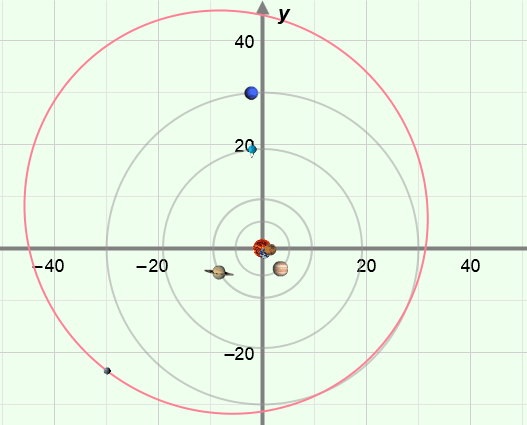
The image below shows Pluto in its counterclockwise orbit around the Sun. Pluto's orbit is highlighted in red and Pluto is in the lower left quadrant.

Which of the following statements best describes Pluto's speed at this location?

Asemmisa {{asɛmmisaAhyɛnsode}}
7.

Part 3: Third Law

Kepler’s third law describes the relationship between a planet’s orbital radius, or its average distance from the Sun, and the planet’s period, or amount of time to complete an orbit.

Use the Additional data display to find the orbital radius (1st row) and period (2nd row) of each planet. Record this data below.

Orbital radius is measured in Astronomical Units (AU). 1 AU = the distance from the Earth to the Sun

Period is measured in Earth years. 1 Earth year = 365 Earth days

Orbital Radius (AU)

Period (Earth years)

Mercury

Venus

Earth

Mars

Jupiter

Saturn

Uranus

Neptune

Pluto

Asemmisa {{asɛmmisaAhyɛnsode}}
8.

What happens to the period as the orbital radius increases?

As the orbital radius increases, the period

Asemmisa {{asɛmmisaAhyɛnsode}}
10.

Summarize Kepler's Laws.

Draggable itemarrow_right_altCorresponding Item

2nd Law (Law of Equal Areas)

arrow_right_alt

Planets orbit the Sun in ellipses with the Sun at one focus.

3rd Law (Law of Harmonies)

arrow_right_alt

A planet sweeps out equal areas in equal times, so it moves faster when it’s nearer the Sun and slower when it’s farther away.

1st Law (Law of Ellipses)

arrow_right_alt

A planet’s orbital period is proportional to its average distance from the Sun (so farther planets take much longer to orbit).