Log in
Sign up for FREE
arrow_back
Library

4.04 Kepler Lab MOD 25-26

star
star
star
star
star
Last updated about 3 hours ago
9 questions
Note from the author:
Required
2
Required
4
HS-ESS1-4
2
HS-ESS1-4
Required
2
HS-ESS1-4
Required
2
HS-ESS1-4
Required
0
Required
3
HS-ESS1-4
Required
2
HS-ESS1-4
3
HS-ESS1-4
Question 1
1.

Question 2
2.
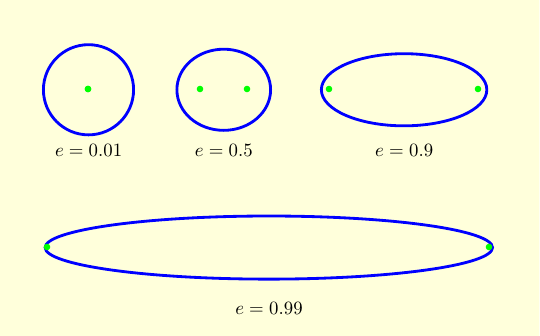
The eccentricity of an ellipse describes how “flattened” it is.
A circle has an eccentricity of 0.
A flat line segment has an eccentricity of 1.
In the image above, when eccentricity = 0.01, the ellipse is almost a perfect circle. The closer the eccentricity gets to 1, the more flattened the ellipse becomes.
Examine the eccentricity of each planet's orbit.
Eccentricity
Mercury 0.206
Venus 0.007
Earth 0.093
Mars 0.048
Jupiter 0.054
Saturn 0.046
Uranus 0.046
Neptune 0.01
Pluto 0.248

Which has the least eccentric (most circular) orbit? __________
Which has the most eccentric (most elliptical) orbit? __________
Question 3
3.

Question 4
4.

Question 5
5.

Question 6
6.

Question 7
7.
Orbital radius (distance from the Sun) is measured in Astronomical Units (AU).

1 AU = the distance from the Earth to the Sun

Period is measured in Earth years. 1 Earth year = 365 Earth days

Orbital radius (AU) Period (Earth years)
Mercury 0.387 0.24
Venus 0.723 0.62
Earth 1 1
Mars 1.52 1.88
Jupiter 5.2 11.86
Saturn 9.55 29.46
Uranus 19.2 84.01
Neptune 30.1 164.79
Pluto 39.529 248.54

What happens to the period as the orbital radius increases?

As the orbital radius increases, the period __________
Question 8
8.

Question 9
9.

Draggable itemarrow_right_altCorresponding Item
arrow_right_alt
arrow_right_alt
arrow_right_alt
Part 1: First Law

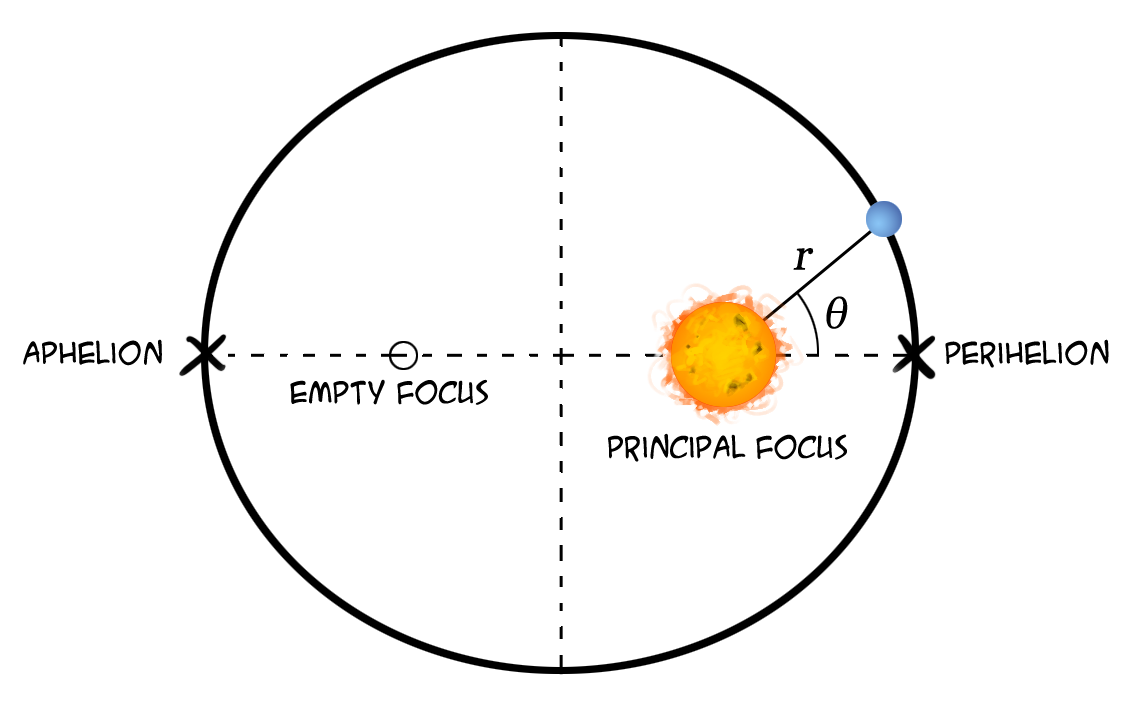
Kepler’s first law states that an orbit is in the shape of a slightly flattened circle, or ellipse. While a circle contains a single point at its center, an ellipse contains two critical points, called foci (singular: focus). The Sun is located at one focus of a planet’s orbit.

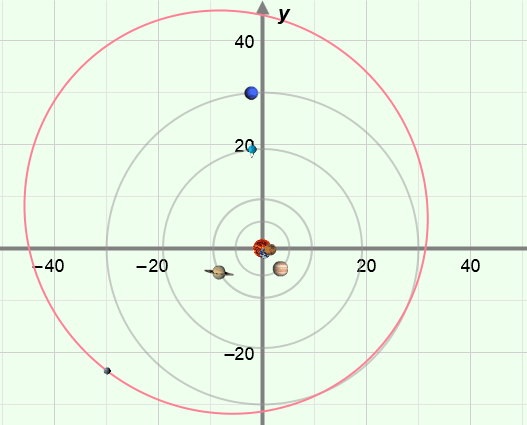
Observe the orbits of the inner planets around the Sun. Mercury's orbit is in red.
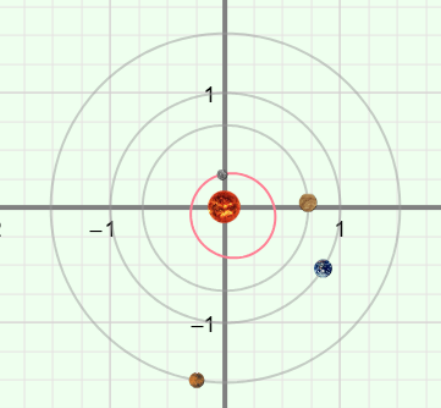

What do you notice about Mercury's orbit?

Is Mercury always the same distance from the sun?
Yes
No
Part 2: Second Law

Observe Mercury's orbit played at different speeds:


What do you notice about Mercury's speed as it orbits the Sun?
Mercury travels at a constant speed
Mercury speeds up when it gets closer to the Sun and slows down when it is farther away from the Sun
Mercury slows down when it gets closer to the Sun and speeds up when it is farther away from the Sun
Kepler’s second law states that a planet speeds up as it gets closer to the Sun, and slows down as it moves farther away.

Observe Pluto (orbit in red). Does Pluto follow Kepler’s second law?

Yes
No
The image below shows Pluto in its counterclockwise orbit around the Sun. Pluto's orbit is highlighted in red. Which of the following statements is true?

Pluto is speeding up.
Pluto is slowing down.
Pluto travels at the same speed throughout its orbit.
Part 3: Third Law

Kepler’s third law describes the relationship between a planet’s orbital radius, or its average distance from the Sun, and the planet’s period, or amount of time to complete an orbit.

How do you think the period of a planet will change as its distance from the Sun increases?
Increases
Decreases
Stays the same
Suppose a new planet was discovered orbiting the Sun between Neptune and Uranus. What would you predict its period would be?
Between 29 and 84 Earth years
Between 84 and 164 Earth years
Between 11 and 29 Earth years
Summarize Kepler's Laws.
3rd Law (Law of Harmonies)
1st Law (Law of Ellipses)
2nd Law (Law of Equal Areas)