Log in
Sign up for FREE
arrow_back
Library

5.04 Solar Cycles

star
star
star
star
star
Last updated about 3 hours ago
21 questions
Required
0.5
Required
0.5
1
Required
1.75
Required
0.5
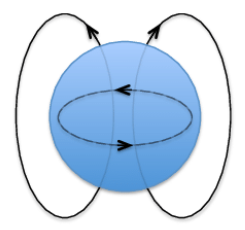
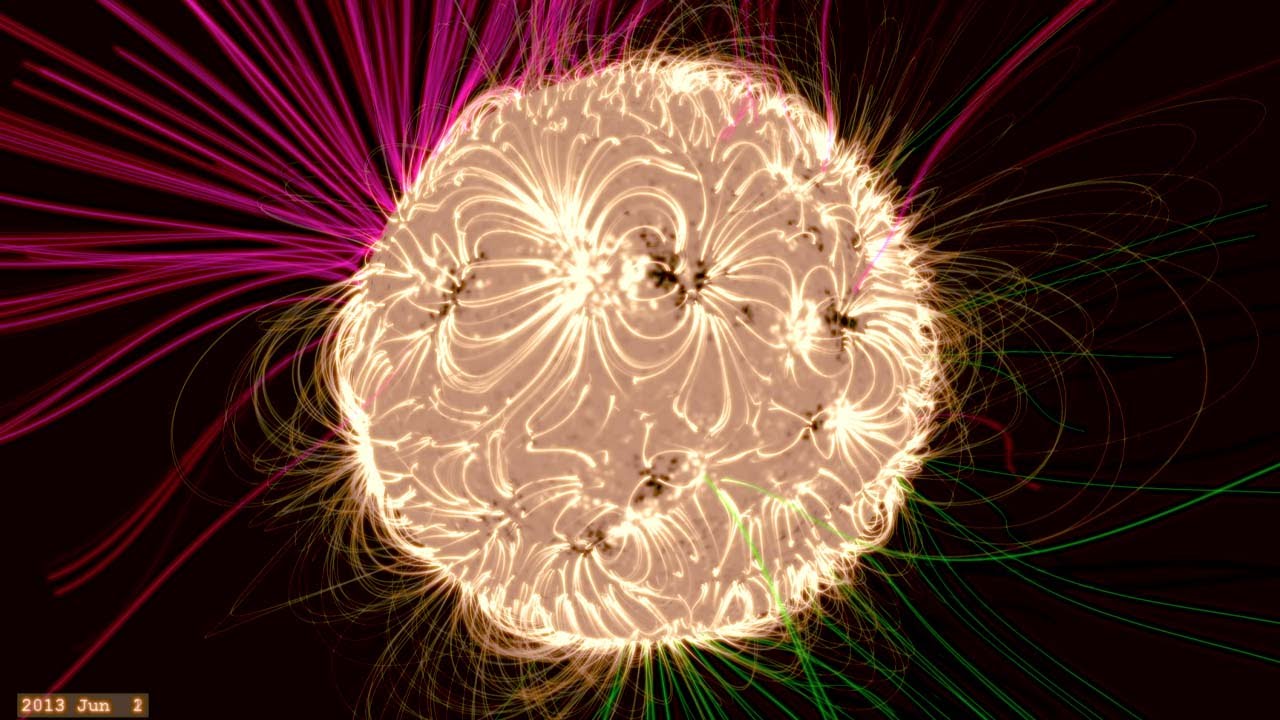
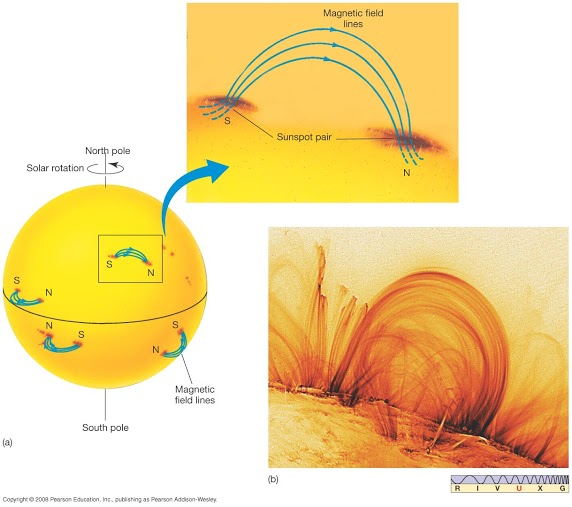
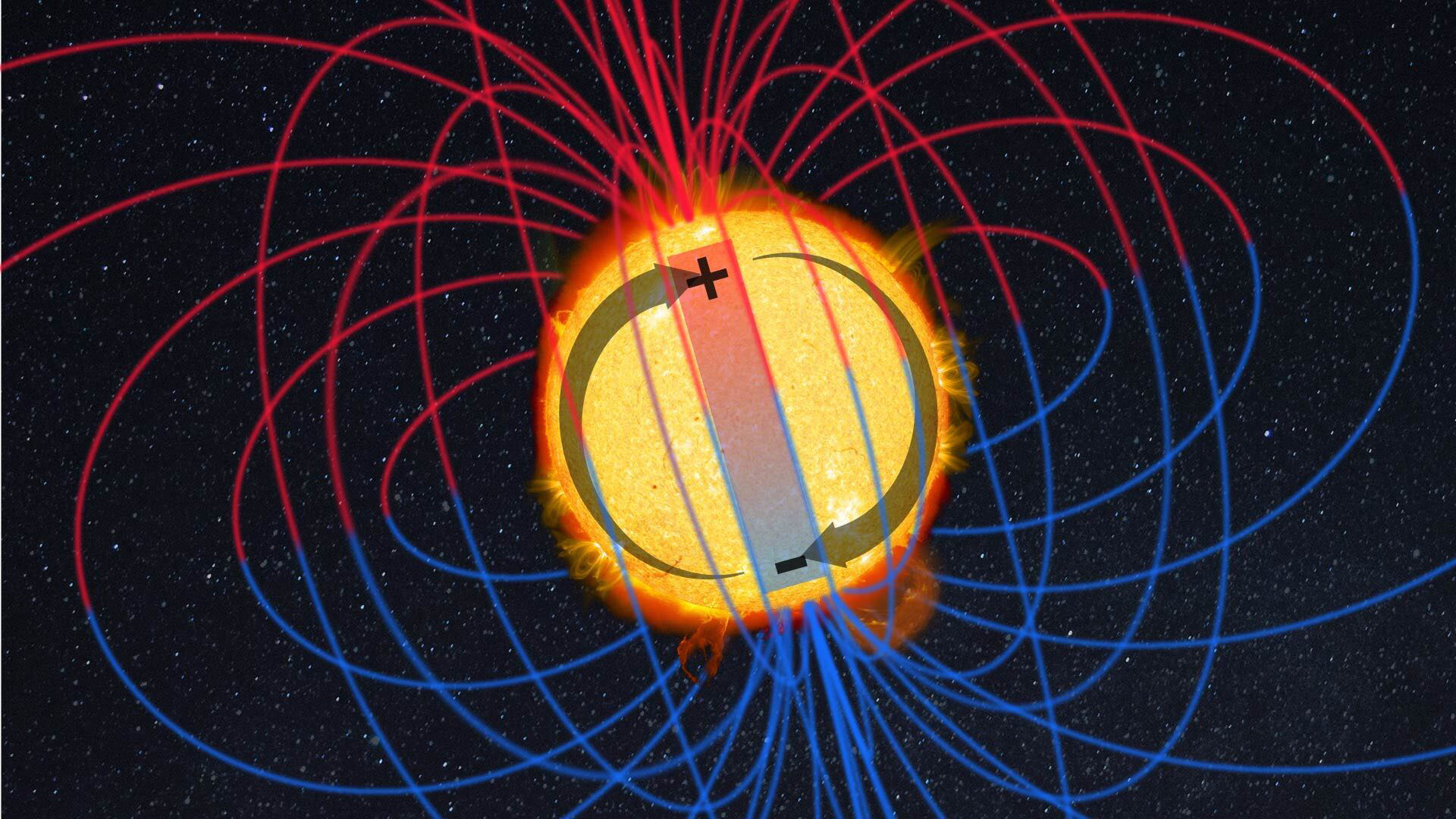
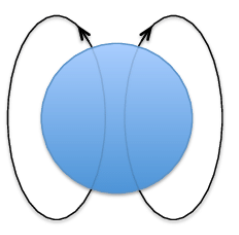
The Sun acts like a giant magnet. It has a magnetic north pole and a magnetic south pole, and invisible magnetic field lines connect the two. These lines come out of one pole, loop through the Sun’s atmosphere, and go back into the other pole.

Here is one way to visualize it:

This is another way to visualize it:
Required
0.5
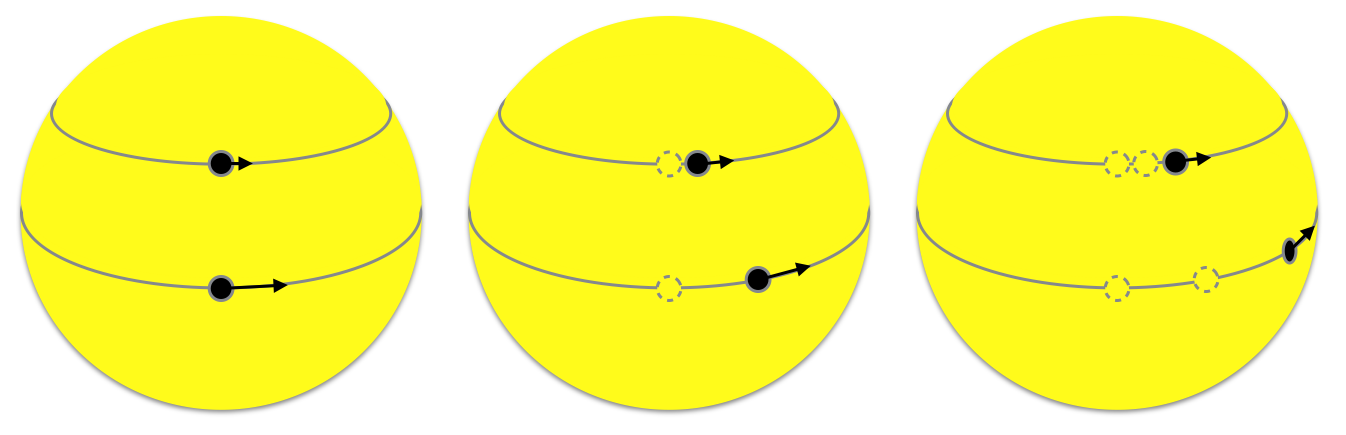
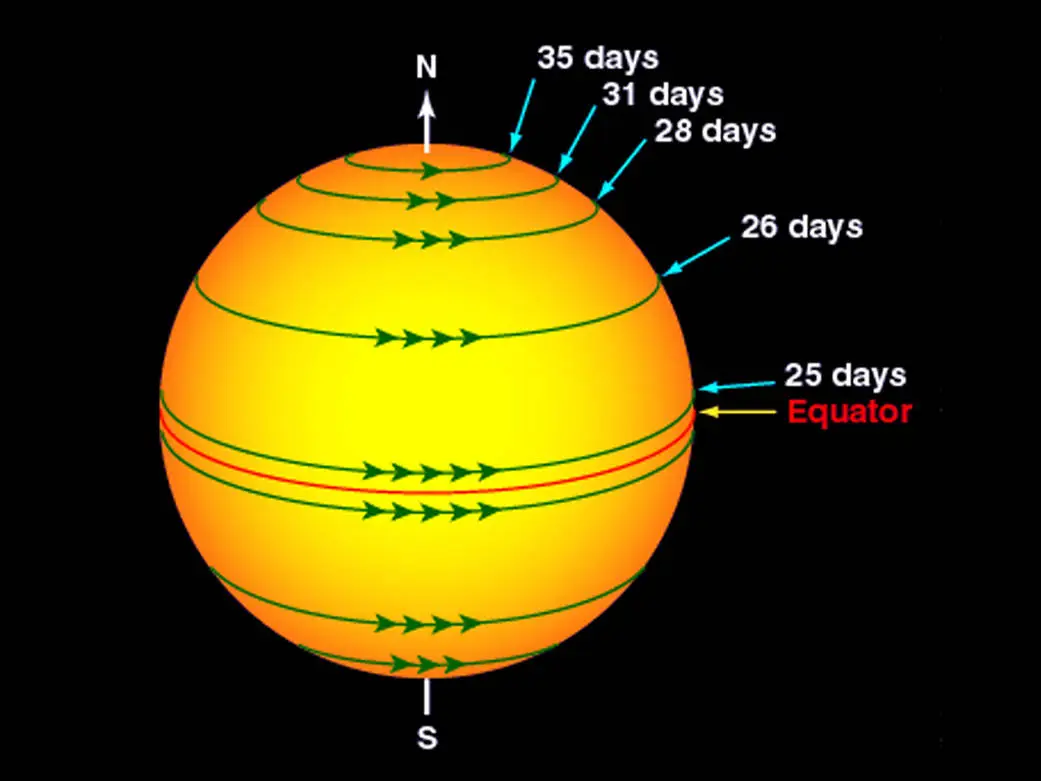
The Sun does not spin like a solid ball. Its equator turns faster than its poles — this is called differential rotation. Because the Sun is made of hot, flowing gas (plasma), different latitudes can rotate at different speeds.

Here is one way to visualize it:


Here is another way to visualize it:

Required
0.5
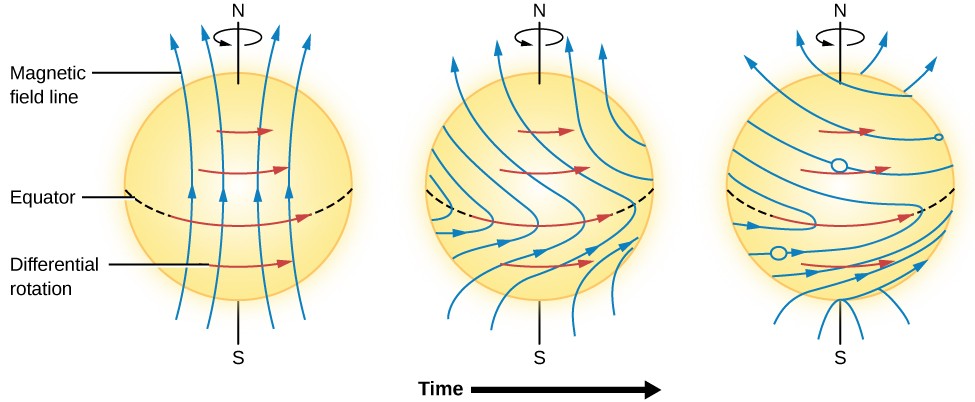
Differential rotation stretches and twists the Sun’s magnetic field lines. Picture drawing a straight line on a rubber ball and then spinning the middle faster than the top and bottom — the line would wrap around the ball. On the Sun, north–south field lines get wrapped into east–west bands. These twisted, concentrated fields can push up through the surface as sunspots and cause more solar activity.

Here's one way to visualize this:


Here's another way to visualize the 2 sets of movement:

Required
0.5
These twisted, concentrated fields can push up through the surface to form sunspots and cause more solar activity.

Here's one way to visualize this:


Here's another way to visualize this:

Required
0.5
Question 5
00:56
keyboard_arrow_down
Required
0.25
Question 6
02:15
keyboard_arrow_down
Required
0.25
Question 7
02:39
keyboard_arrow_down
Required
0.25
Question 8
03:47
keyboard_arrow_down
Required
0.25
Question 9
04:56
keyboard_arrow_down
Required
1
Question 10
10.
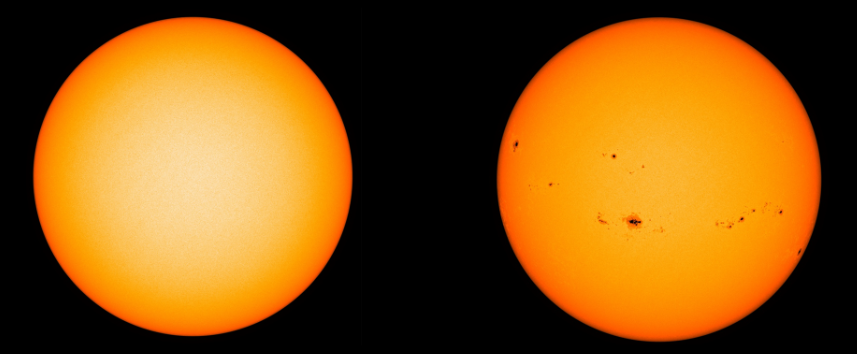
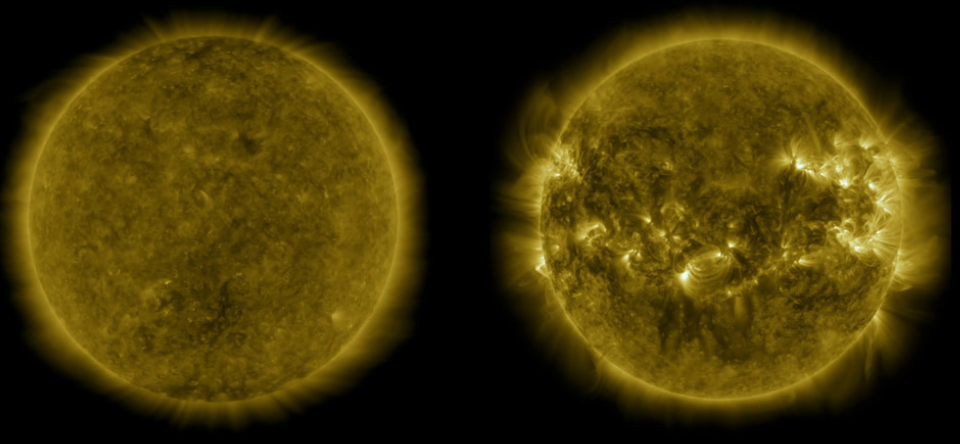
Solar maximum is the term for the period when sunspot counts, solar flares, and overall magnetic activity peak, producing more storms and enhanced space weather.

Solar minimum is the opposite phase, with few sunspots, minimal flaring, and quieter space‑weather conditions.

Compare these visible light images of the Sun. Which one represents each period?
Other Answer Choices:
Solar Maximum
Solar Minimum
Question 11
11.
Compare these x-ray images of the Sun. Which one represents each period?
Other Answer Choices:
Solar Minimum
Solar Maximum
Question 12
12.
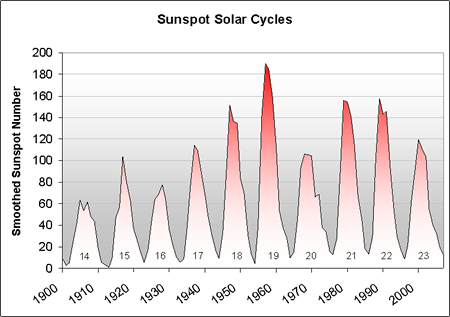
Scientists have been recording the number of sunspots since the mid 1700s! Consider this graph of sunspots since 1900:

Which part of the graph represents solar minimums? __________
Which part of the graph represents solar maximums? __________

Based on this data, how long would estimate each solar cycle lasts? __________
Question 13
13.
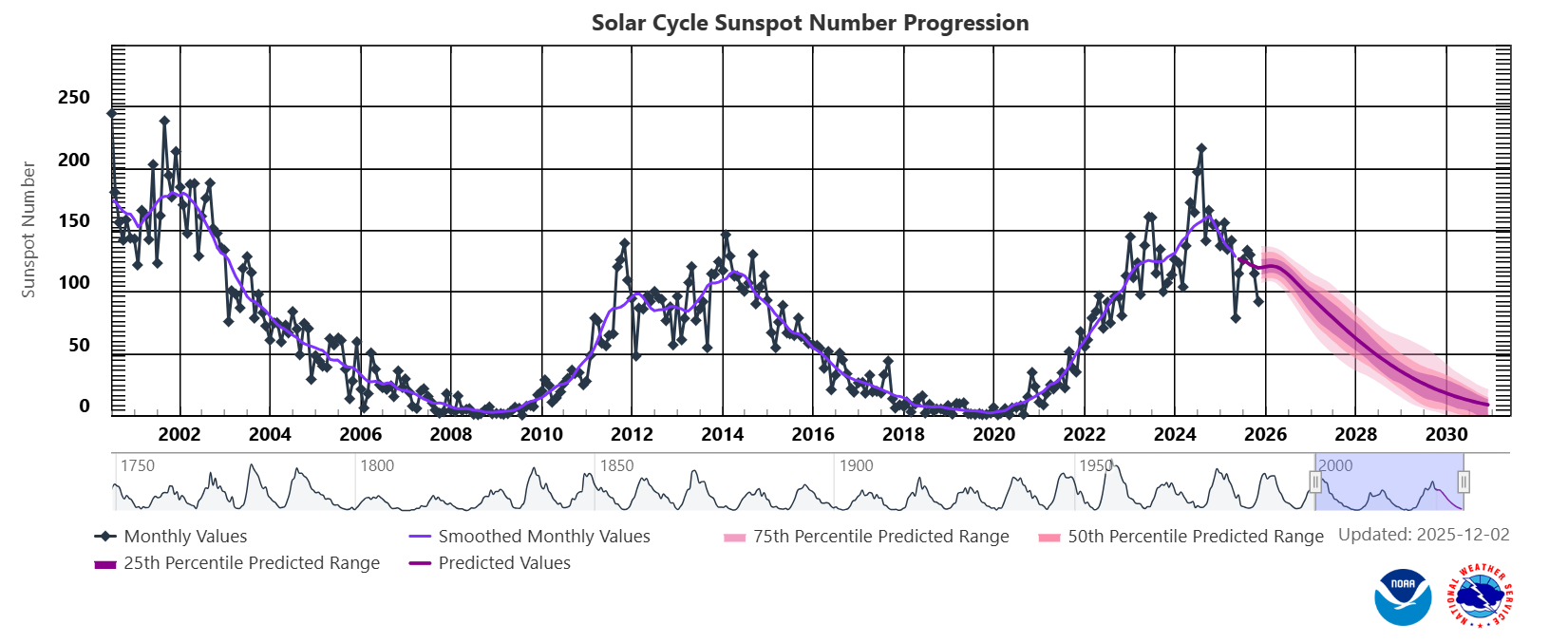
Examine the sunspot data from since 2000. You can view current data here.

On the graph label the last solar maximum, the last solar minimum, and the current solar maximum, as well as next potential solar minimum.
Other Answer Choices:
Current solar maximum
Last solar maximum
Last solar minimum
Next solar minimum
Question 14
14.

Question 15
00:18
keyboard_arrow_down
Required
0.25
HS-ESS1-1
Question 16
01:49
keyboard_arrow_down
Required
0.25
HS-ESS1-1
Question 17
02:21
keyboard_arrow_down
Required
0.25
HS-ESS1-1
Question 18
03:27
keyboard_arrow_down
Required
0.25
HS-ESS1-1
Question 19
03:50
keyboard_arrow_down
Required
0.25
HS-ESS1-1
Question 20
04:36
keyboard_arrow_down
Required
0.25
HS-ESS1-1
Question 21
05:29
keyboard_arrow_down
Required
0.25
HS-ESS1-1
Question 1
1.

Question 2
2.

Question 3
3.

Question 4
4.

Question 5
5.

Question 6
6.

Question 7
7.

Question 8
8.

Question 9
9.

If a solar cycle is 11 years and the next solar minimum will occur in 2032, when can we expect the next solar maximum?
2054
2027
2043
Question 15
15.

Question 16
16.

Question 17
17.

Question 18
18.

Question 19
19.

Question 20
20.

Question 21
21.

Which statement best describes the Sun’s magnetic field?
The Sun has no magnetic poles and its field is random.
The Sun has visible magnetic field lines connecting its north and south pole.
The Sun has magnetic north and south poles, and field lines loop from one pole through the atmosphere to the other.
Which statement best explains differential rotation of the Sun?
The Sun spins as one solid object so all latitudes rotate at the same speed.
The Sun’s equator rotates faster than its poles because it is made of hot, flowing gas.
The Sun stops rotating at the equator but spins at the poles.
Which statement best describes what differential rotation does to the Sun’s magnetic field?
It makes the Sun rotate as a solid ball so field lines stay straight.
It removes magnetic fields from the Sun entirely.
It stretches and wraps north–south field lines into east–west bands.
Which happens when twisted, concentrated magnetic fields push up through the Sun’s surface?
The Sun’s rotation stops temporarily.
Sunspots form and solar activity increases.
The Sun cools uniformly and all activity decreases.
What technique did Koyama use to study the sun during daytime?
Directly looking at the sun through binoculars
Photographing the sun with early film cameras
Projecting the sun’s image through a telescope onto paper
Why do sunspots appear darker than surrounding areas on the sun’s surface?
They are holes in the sun’s surface
Magnetic activity reduces heat there, producing less light
They are cooler because of shadowing by solar flares
What made counting and tracking sunspots challenging before modern tools?
Clustering and observer perception affected counts
Sunspots were invisible to the naked eye at night
Sunspots only appear for a second
Why were Koyama’s drawings particularly valuable to researchers?
They were the first-ever images of the sun
They allowed precise tracking of specific sunspots and clusters
They recorded the sun’s chemical composition
What long-term impact did Koyama’s consistent drawings have for scientists?
They allowed reconstruction of 400 years of sunspot activity and extended her legacy
They replaced all satellite data for solar activity
They showed that solar flares cannot affect Earth
What is the solar cycle?
A period of solar eruptions lasting 11 years
A cycle of activity in the solar system
The time it takes the Sun to rotate on its axis
What do scientists use to track sunspots?
Telescopes and hand drawings
Computers and simulations
Satellites only
When do sunspots typically peak during the solar cycle?
Randomly
Solar minimum
Solar maximum
Which region of the Sun rotates fastest?
Mid-latitudes
Poles
Equator
What happens to the Sun's magnetic field at the peak of the solar cycle?
It flips, with the north and south poles switching
It disappears completely
It becomes stable
What do scientists look for to declare a new solar cycle?
The disappearance of all sunspots
A consistent increase in new sunspots
Changes in the sun's temperature
What can strong magnetic fields at the Sun's poles indicate?
A weak solar cycle
An active solar cycle
A stable solar cycle