A student graphed each star's distance verses its red shift value for each star:
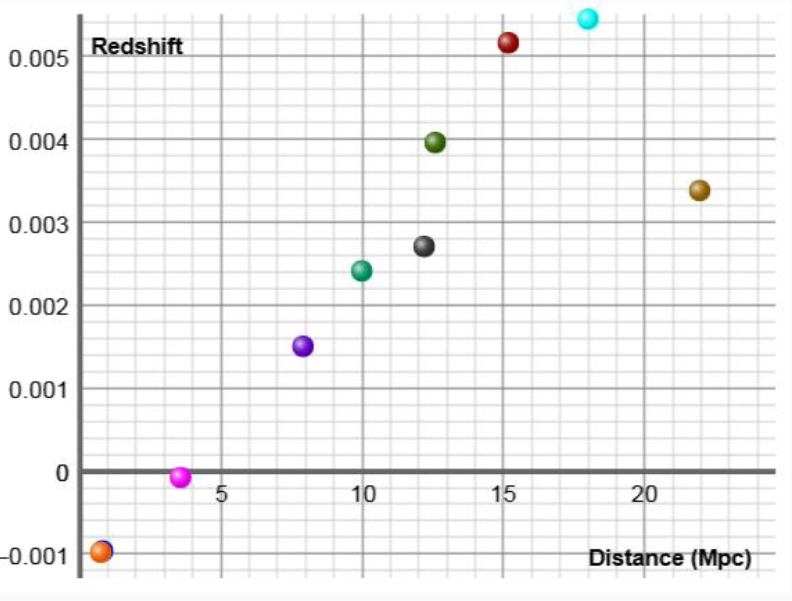
What pattern is appearing in the graph?
The greater the distance of the star from Earth, the its redshift will be.
Match the theory to its description.
| Draggable item | arrow_right_alt | Corresponding Item |
|---|---|---|
Big Crunch | arrow_right_alt | Universe's expansion accelerates so repeatedly that even atoms are torn apart |
Big Rip | arrow_right_alt | Universe will continue to expand forever, eventually becoming too cold to support life |
Big Bounce | arrow_right_alt | Universe will stop expanding and collapse back on itself due to gravity |
Big Freeze | arrow_right_alt | Combines elements of the Big Crunch and Big Bang, suggesting a cyclical universe |
A student graphed each star's distance verses its red shift value for each star:
What pattern is appearing in the graph?
The greater the distance of the star from Earth, the its redshift will be.
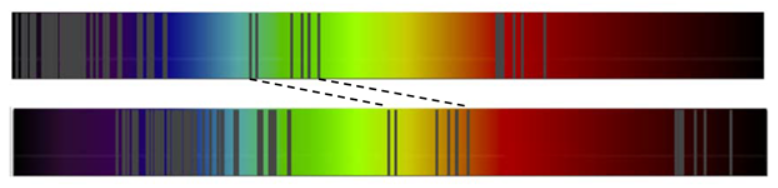
The top spectra in the image is the reference.
The bottom spectra in the image is from a star.
This star's spectrum is meaning that it is moving Earth.
What is the most abundant element in the universe?
According to the Big Bang Theory, the universe is
What is the cosmic microwave background (CMB) radiation?
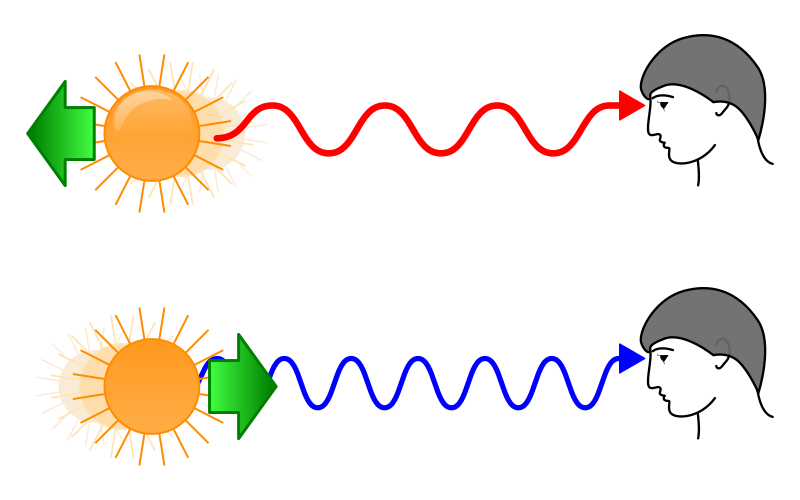
During red shift, the wavelength of visible light from an object
Images of outer space are created only using visible light.
The majority of light astronomers observe from distant stars and galaxies is which supports the idea that the universe is .
What is dark matter?
What is the main difference between dark matter and dark energy?
How does dark energy affect the universe?
What is the current state of our understanding of dark matter and dark energy?

Consider a jar of jelly beans that represents all the matter and energy in the universe.
What do the black jelly beans represent?
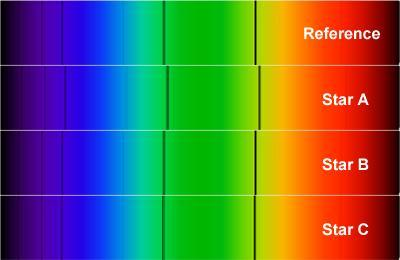
An astronomer records the spectra from three stars in three different galaxies. Which star is probably farthest away?
Why did you select the star in the previous question?
What is the universe?
Who discovered that galaxies are moving away from us?
What is spectroscopy used for in astronomy?
Now that we have completed Unit 1, please rate yourself on the Unit 1 objectives from 1 (just starting) to 5 (mastered it!)
You may need to scroll horizontally to see all options
1 - getting started | 2 | 3 | 4 | 5 - mastered it | |
|---|---|---|---|---|---|
Describe the study of the cosmos | |||||
Discuss the theory of the origin of the universe | |||||
Analyze the evidence that supports the Big Bang theory | |||||
Examine the composition of matter and how it is distributed within the universe | |||||
Describe the theories of evolution and fate of the universe |
What parts of this unit did you enjoy?
What parts of this unit could be improved?