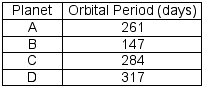
According to this diagram, at which letter is the planet moving fastest?
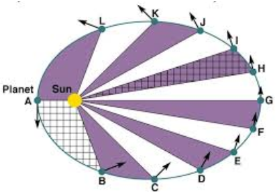
According to this diagram, at which letter is the planet moving fastest?
Which diagram shows a planet with the least eccentric orbit?
Which diagram shows a planet with the most eccentric orbit?
According to this diagram, at which letter is the planet moving fastest?
According to this diagram, at which letter is the planet moving slowest?
Four planets, called A, B, C, and D, have orbital periods as shown in the table below. Which planet is closest to the sun?
Four planets, called A, B, C, and D, have orbital periods as shown in the table below. Which planet is farthest to the sun?
Which shape is used to describe the orbit of a planet around the Sun?
Which surface is likely to be older?
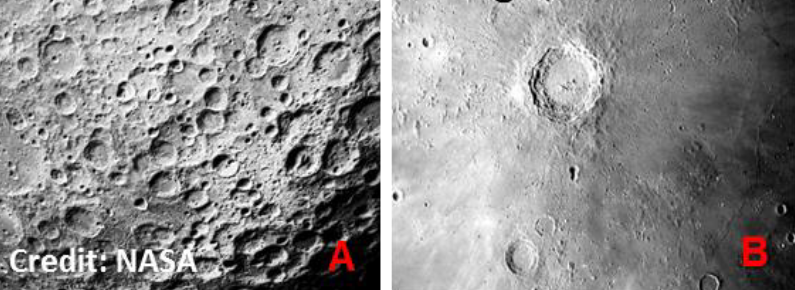
What does the presence of water on Earth likely indicate about its early history?
A collision with another small planet likely explains the formation of:
The geocentric model of the solar system places at the center while the heliocentric model has as its center.
What does 1 astronomical unit (AU) represent?
Scientists think water may exist elsewhere in our Solar System besides Earth.
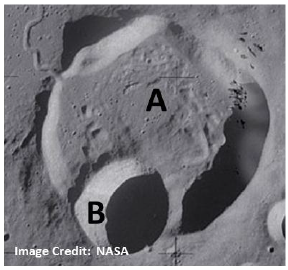
Which crater in the image is younger?
Which planet would you expect to have the longest year (time it takes to go around the Sun once)?
Which planet would you expect to have the shortest year (time it takes to go around the Sun once)?
What have scientists used to determine how the Moon was formed?
Match the meteroid to its description.
| Draggable item | arrow_right_alt | Corresponding Item |
|---|---|---|
Meteor | arrow_right_alt | can be described as a "dirty snow ball" |
Comet | arrow_right_alt | small rocky remnants from the formation of the solar system |
Meteorite | arrow_right_alt | "shooting star" that burns up in Earth's atmosphere |
Asteroid | arrow_right_alt | Pieces of space rocks that reach the Earth's surface |
Which crater is likely to be the oldest?
Categorize each description as a characteristic of "terrestial planets" or "ice giants."
Rocky, solid surface
Gasous, non-solid surface
Closer to the Sun
Farther from the Sun
Small
Large
Terrestial planets
Ice giants
What separates the terrestial planets from the ice giants?
Why do scientists study lunar rocks and meteorites to understand Earth's formation?
Planets orbit the Sun in perfect circles.
What is the purpose of scientific models?
Give an example of a scientific model that we have used in this Astronomy class.
How do models connect what happens on a small scale (like molecules, cells, or parts of a machine) to what happens on a larger scale (like ecosystems, human health, or whole devices)?
Categorize the statements about scientific models into two categories by dragging the statement to each correct category. (Statements can only be used once and all are used)
oversimplify reality
represent complex phenomena in understandable ways
be incomplete
guide experiments
be uncertain
predict outcomes
Limitation (Weakness)
Advantage (Strength)
Now that we have completed Unit 4, please rate yourself on the Unit 1 objectives from 1 (just starting) to 5 (mastered it!)
You may need to scroll horizontally to see all options
1 - getting started | 2 | 3 | 4 | 5 - mastered it | |
|---|---|---|---|---|---|
Analyze the components of the solar system, exploring their formation processes and interrelationships. | |||||
Evaluate and compare the historical theories of geocentrism and heliocentrism, assessing their impact on our understanding of the universe. | |||||
Apply and interpret Kepler's three laws of planetary motion in real-world scenarios. | |||||
Differentiate between asteroids, meteroids, meteors, meteorites, and comets. | |||||
Investigate the Earth and Moon's formation and early history |
What parts of this unit did you enjoy?
Whats parts of this unit could be improved?