When light goes through a prism, it separates into many colors. This band of colors is called a spectrum. A rainbow is an example of a spectrum: red, orange, yellow, green, blue, violet.
The interior of a star produces a continuous spectrum of light, like a rainbow. Cooler gases in the outer layers of the star absorb certain wavelengths of light, causing dark lines to appear in the spectrum.
The resulting absorption spectrum can tell astronomers a great deal about the star. It's like a finger print or bar code that tells information about the star's color, composition, and surface temperature.
Turn on Show labels. Select star 1 to see its absorption spectrum.
How many lines do you see in the spectrum?
Drag the neutralHydrogen spectrum next to the Star spectrum so that the edges line up. Do some of the lines on the two spectra match up?
Drag the neutral Helium spectrum next to the Star spectrum. Do some lines match?
Try out the other available spectra. Make sure to check both the neutral spectra and ionic spectra. Do any others have lines that match?
Asemmisa {{asɛmmisaAhyɛnsode}}
2.
Based on your results from #1, which elements have contributed to the spectrum of Star 1?
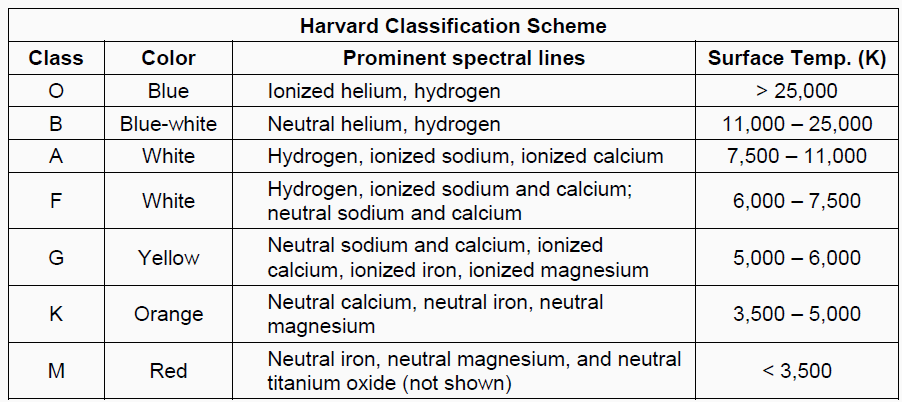
Late in the 19th century, Harvard astronomer Edward Pickering wanted to sort and catalog the thousands of star spectra that had been collected by the Harvard Observatory. He hired several women to do the work, paying them 25 cents a day. The most prominent of these women was Annie Jump Cannon, who devised a classification system still used today.
Watch the video to learn more about Jump Cannon's work and how star spectra is used to classify stars.
Asemmisa {{asɛmmisaAhyɛnsode}}
3.
Question: How are stars classified?
Use the elements you determined in Star 1's spectrum to classify it.
Hint: Look at the color of the star in the gizmo to help narrow down the possibilities so you know which spectra to test. For example, if a star appears white, look for whether the spectral lines match Class A or Class F.
Color:
Surface temperature (K):
Class:
Asemmisa {{asɛmmisaAhyɛnsode}}
4.
Which elements have contributed to the spectrum of Star 2?
Asemmisa {{asɛmmisaAhyɛnsode}}
5.
Use the elements you determined in Star 2's spectrum to classify it.
Color:
Surface temperature (K):
Class:
Asemmisa {{asɛmmisaAhyɛnsode}}
6.
Which elements have contributed to the spectrum of Star 3?
Note: The elements in a star’s spectrum do not necessarily reflect what the star is made of. The absorption spectrum is mostly determined by the surface temperature of the star.
Asemmisa {{asɛmmisaAhyɛnsode}}
7.
Use the elements you determined in Star 3's spectrum to classify it.
Color:
Surface temperature (K):
Class:
Asemmisa {{asɛmmisaAhyɛnsode}}
8.
Which elements have contributed to the spectrum of Star 4?
Note: The elements in a star’s spectrum do not necessarily reflect what the star is made of. The absorption spectrum is mostly determined by the surface temperature of the star.
Asemmisa {{asɛmmisaAhyɛnsode}}
9.
Use the elements you determined in Star 4's spectrum to classify it.