Log in
Sign up for FREE
arrow_back
Library

1.03 Light & Gravity

star
star
star
star
star
Last updated about 2 hours ago
19 questions
Note from the author:
Required
0
Required
1
Required
1
Required
1
HS-ESS1-2
Required
1
HS-ESS1-2
Required
2
HS-ESS1-2
Required
0

If you need help on this assignment, please watch the class recording (updated 9.16.25)

If you need help on this assignment, please watch the class recording (updated 9.16.25)

Question 1
1.

Question 2
2.

Question 3
3.

Answer one or more of these questions about the Scale of the Universe interactive:
  • What did you find interesting?
  • Did anything surprise you?
  • What does this tell you about the size of the universe?

To understand how scientists determine astronomical distances, we first need to discuss light and the electromagnetic spectrum.

Wavelength and frequency are two important characteristics of light.

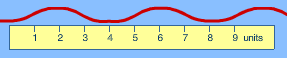
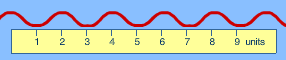
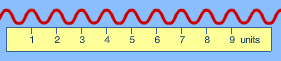
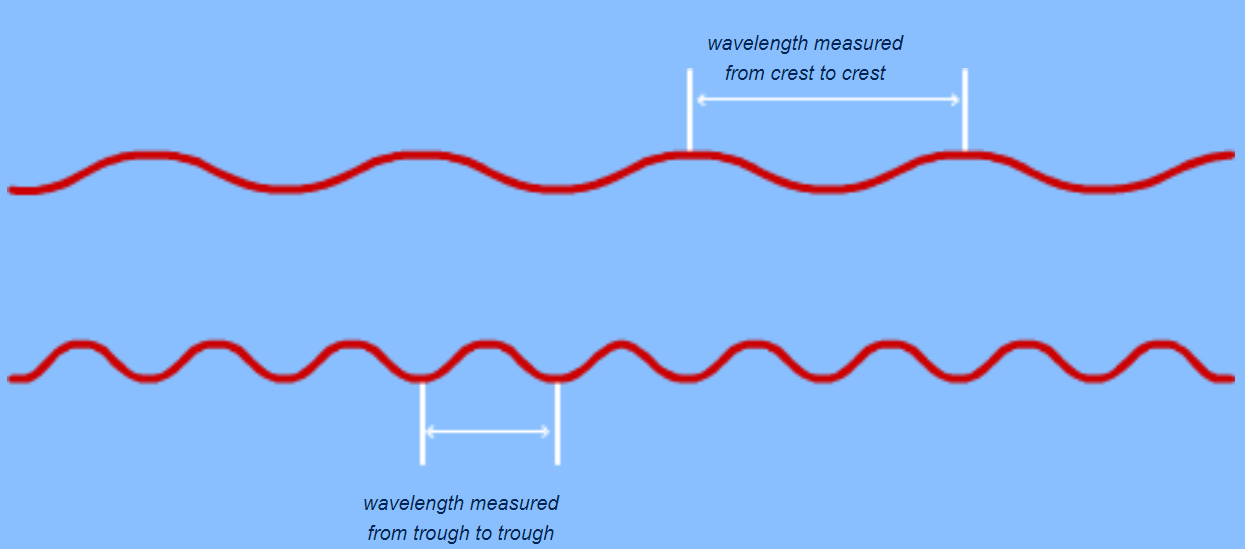
Wavelength is the distance between two consecutive peaks or two consecutive troughs of a wave.
Question 4
4.
Use the ruler provided to determine the wavelength of each wave:
_______ units

_______ units

_______ units
Frequency refers to the number of wavelengths that pass a given point in one second.

High frequency has many wavelengths each second.

The closer together the wavelengths are, the higher the frequency.

Low frequency has fewer wavelengths each second.

The further apart the wavelengths are, the lower the frequency.
Question 5
5.

Question 6
6.
These properties are inversely related which means as wavelength increases, frequency decreases, and vice versa.

To summarize:
Waves with a short wavelength have a __________ frequency
Waves with a long wavelength have a __________ frequency
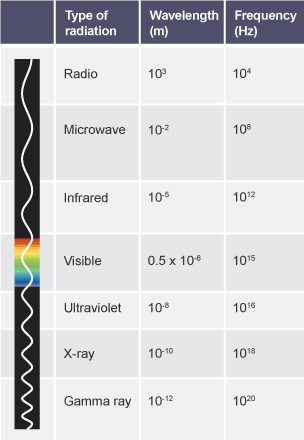
So far we have only looked at visible light, the light our eyes are able to detect. There are more types of light that our eyes can't detect that we can use to study the universe.
Question 7
01:02
keyboard_arrow_down
Required
1
HS-ESS1-2
Question 8
01:06
keyboard_arrow_down
Required
1
HS-ESS1-2
Question 9
01:40
keyboard_arrow_down
Required
1
HS-ESS1-2
Question 10
02:18
keyboard_arrow_down
Required
1
HS-ESS1-2
Question 11
04:20
keyboard_arrow_down
Required
1
HS-ESS1-2
Question 12
04:47
keyboard_arrow_down
Required
1
HS-ESS1-2
Watch how images of outer space are created using data from x-ray, radio, and visible light waves.

Later in the semester, you'll have an opportunity to create your own image from satellite data.
Question 13
13.


What IS gravity?

You probably know what gravity does, but why does gravity exist?

No right or wrong answers as long as they are your own! :)

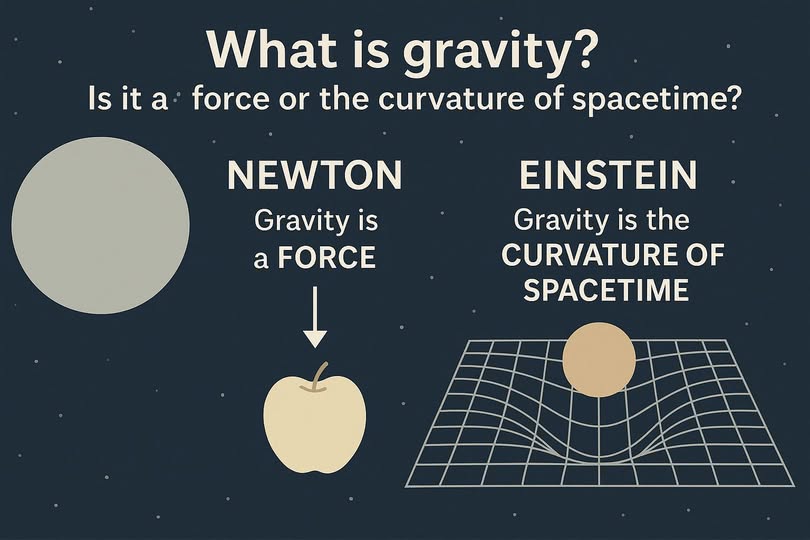
Newton viewed gravity as a force acting on objects in a 3 dimensional universe (length, width, and depth).

Einstein proposed the idea of spacetime, or a 4 dimensional universe (length, width, depth, and time). Massive objects bend spacetime, and gravity it the result of the curvature of spacetime.

Think of spacetime like stretchy fabric and gravity is the result of placing massive objects on it. The demos below will help you visualize this.
Question 14
00:23
keyboard_arrow_down
Required
0.5
Question 15
00:35
keyboard_arrow_down
Required
0.5
Question 16
00:51
keyboard_arrow_down
Required
0.5
Question 17
01:11
keyboard_arrow_down
Required
0.5
Question 18
01:57
keyboard_arrow_down
Required
0.5
Question 19
02:21
keyboard_arrow_down
Required
0.5

Bonus: Play with gravity in this simulator https://lab.nationalmedals.org/gravity.php

Before we jump into Unit 1, please rate yourself on the Unit 1 objectives from 1 (just starting) to 5 (mastered it!)

You may need to scroll horizontally to see all options
1 - getting started
2
3
4
5 - mastered it
Describe the study of the cosmos
Discuss the theory of the origin of the universe
Analyze the evidence that supports the Big Bang theory
Examine the composition of matter and how it is distributed within the universe
Describe the theories of evolution and fate of the universe
Using the interactive above to help you (or opening it in a new window) order the following from smallest (1) to largest (6)
Milky Way Galaxy
The Sun
Earth
Moon
The Universe
The Solar System
Put these waves in order from lowest (longest wavelength) to highest frequency (shortest wavelength).
Question 7
7.

Question 8
8.

Question 9
9.
Long wavelengths have __________ energy and short wavelengths have __________ energy
Question 10
10.

Question 11
11.

Question 12
12.

Question 14
14.

Question 15
15.

Question 16
16.

Question 17
17.

Question 18
18.

Question 19
19.

What is the size of a wave?
frequency
amplitude
wavelength
How often a wave goes by is called its...
wavelength
amplitude
frequency
What do we call the range of light we are able to see with our eyes?
visible
observable
obvious
Our universe only gives off visible light.
True
False
To see the universe in its full spectrum, we need to use special telescopes that can help us see beyond visible light.
True
False
In this demonstration, the fabric represents spacetime and the marble represents an object.

How do objects move through space?
Randomly
In curved lines
In straight lines
How did the larger purple mass affect spacetime (the fabric)?
Spacetime remained the same
The shape of spacetime was changed
Why did the two masses move towards each other?
Because they are attracted by magnetic force
Because the spandex pushes them together randomly
Because spacetime curves downward under them, causing them to roll toward each other
How did the purple mass affect the movement of the smaller white mass (ping pong ball)?
The ping pong ball's path was affected by the purple ball's curvature of spacetime
The ping pong ball still traveled in a straight line
What can happen when a smaller mass gets close to a larger mass?
The two masses don't affect each other
The smaller mass will begin to orbit the larger mass
The larger mass will be pulled in to the smaller mass
Why did the "Earth" and the "Moon" end up crashing into the "Sun" in this demo?
Friction between the spandex and the masses slowed down the "Earth" and "Moon" so they couldn't maintain their orbit
Because that's what going to happen and we're all going to die!!!