Log in
Sign up for FREE
arrow_back
Library

Interstellar Inquiry #06: Milky Way 25-26

star
star
star
star
star
Last updated about 2 hours ago
10 questions
Note from the author:
Required
1
HS-ESS1-2
Required
1
HS-ESS1-2
0
Required
1
HS-ESS1-2
1
HS-ESS1-2
Required
1
HS-ESS1-2

If you need help with this assignment, please click here to watch the recording (updated 5/20/25)

If you need help with this assignment, please click here to watch the recording (updated 5/20/25)

Question 1
1.
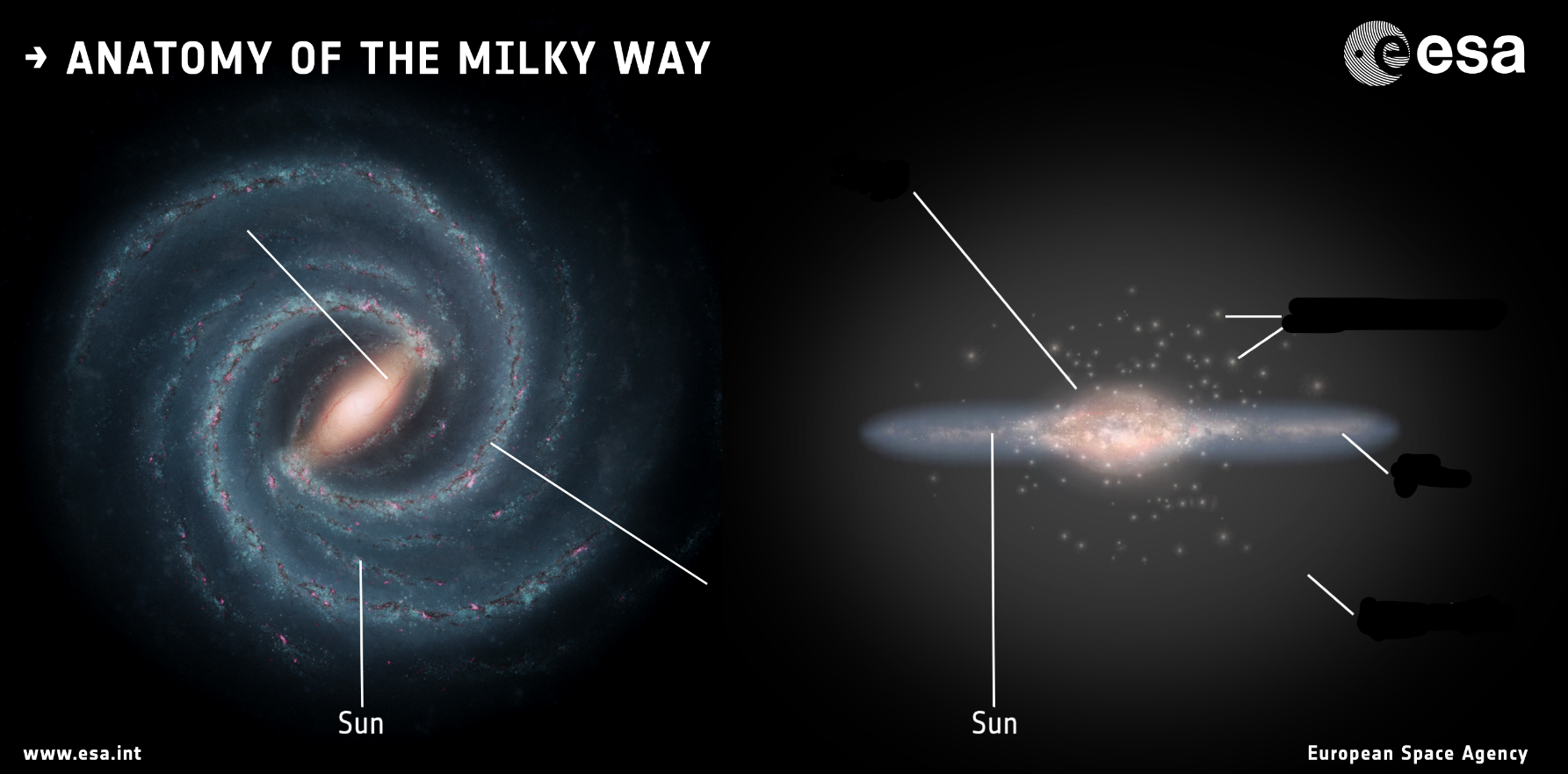
The Milky Way is a typical barred spiral galaxy with the following parts:
  • Galactic bulge: Dense, spherical region of older stars in the center of the Milky Way with a supermassive black hole at its center
  • Spiral arm: Concentrated regions of stars, dust, and gas extending from the galactic bulge
  • Bar: Central bar-shaped structure across the galactic bulge
Use the descriptions above to help you match the labels below onto the image.
Other Answer Choices:
bulge
bar
spiral arm
Question 2
2.
The Milky Way also contains:
  • Disc: Flattened plane containing most of the galaxy's younger stars, gas, and dust
  • Halo: Sparsely populated spherical region surrounding the disc containing older stars, globular clusters, and dark matter
  • Globular cluster: Small group of stars bound together by gravity

Use the descriptions above to help you match the labels below onto the image.
Other Answer Choices:
disc
globular clusters
halo
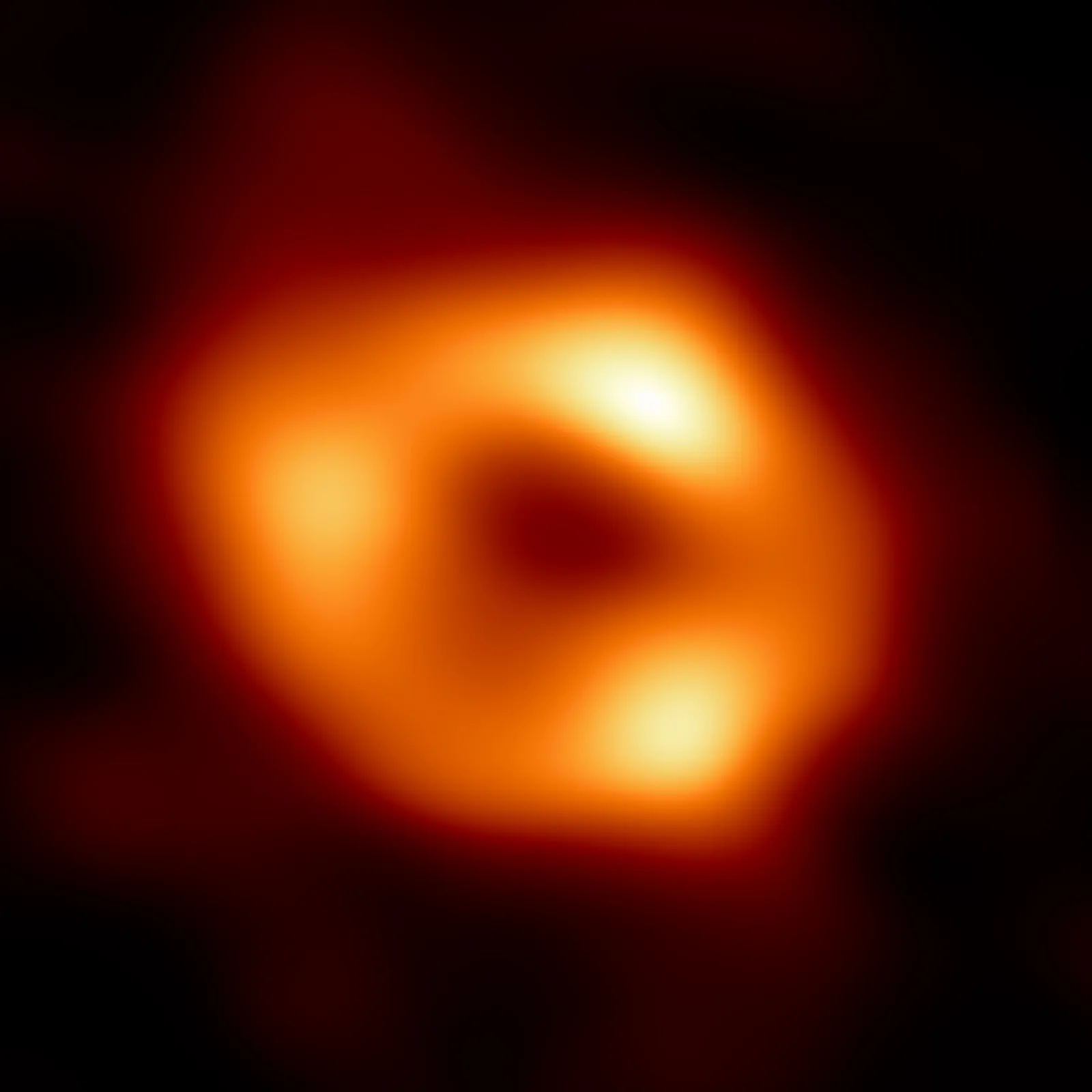
At the galactic center of almost every galaxy is a black hole. A black hole is a region of space packed with so much mass that its own gravity prevents anything from escaping—even light.

This is Sagittarius A*, the black hole in the center of the Milky Way Galaxy

Required
1
HS-ESS1-4
Hubble's Law

In the 1920s, a scientist named Edwin Hubble was studying galaxies. He looked at light from these galaxies and noticed something interesting called redshifts. This helped him figure out how fast the galaxies were moving. Hubble also discovered a type of star called Cepheid variables in these galaxies. Cepheid variables are special because they change in brightness over time.

Hubble found out that bigger, brighter Cepheid stars have longer periods of brightness changes, while smaller, dimmer Cepheids have shorter periods. By watching how fast these stars pulsed, he could estimate how bright they were and how far away the galaxies were.

When Hubble made a graph showing the speed of the galaxies compared to their distance, he noticed two important things:
  1. Most galaxies (except a few close ones) are moving away from us. This means the universe is getting bigger.
  2. The farther away a galaxy is, the faster it is moving away. This idea is known as Hubble's Law.
It's important to note that when we say galaxies are moving away, we really mean that space itself is expanding. This expansion creates more space between us and distant galaxies, pushing them farther away than closer ones.

If the embedded website below doesn't work for you, click here to open it in a new tab.
Question 4
4.

Question 5
5.

The arrow lengths convey how fast galaxies are moving.

Describe the velocities (length of arrows) of galaxies nearby your location versus the velocities (length of arrows) of galaxies that are far away.

Question 6
6.

Question 7
7.
Summarize Hubble's Law:
The farther away a galaxy is, the __________ it moves away from Earth.
Use the website Interacting Galaxies: Future of the Milky Way to help answer these questions. Use the timeline scroll bar to see the changes.
Required
1
HS-ESS1-2
Required
1
HS-ESS1-2
Question 10
03:12
keyboard_arrow_down
Required
2
Question 10
10.

If the universe is expanding, how is it possible that the Milky Way and Andromeda will collide?

HS-ESS1-2
Question 3
3.

How did scientists determine there was a black hole in the center of the Milky Way galaxy?

Use the website Black Holes: Sagittarius A* to help answer this questions. Use the timeline scroll bar to see the changes.

Zoom out until you can see a bunch of galaxies. The galaxy with the red circle around it represents your location (the Milky Way). The red arrows represent the galaxies' velocities.

Can you find a galaxy that is moving toward you?
Yes
No
Click on a different galaxy to make it the observation point.

Does Hubble's Law still apply?
Yes
No
Question 8
8.

Question 9
9.

Which galaxy is moving towards the Milky Way?
Large Magellenic Cloud
Orion
Andromeda
What will be formed once the 2 galaxies merge?
Nebula
Elliptical galaxy
Black hole