Preskoči na glavni sadržaj
Prijava
Sign up for FREE
arrow_back
Biblioteka

Test: Nature of Science

star
star
star
star
star
Posljednje ažuriranje 10 months ago
21
1
1
1
1
1
1
1
1
1
1
1
1
1
1
1
1
1
1
1
1
1
Pitanje 1
1.

Scientists do many types of work. Their work often includes making field observations, conducting surveys, creating models, and carrying out experiments. Which description characterizes an experiment?

Pitanje 2
2.

Raul wants to investigate how the angle of a ramp affects the speed of an object rolling down the ramp. He can conduct his investigation in a number of different ways. Which investigation should he perform?

Pitanje 3
3.

Ryan made a list of activities that are scientific and activities that are not scientific. Which activity should Ryan classify as not scientific?

Pitanje 4
4.

Lee wants to make sure she understands the components of a good scientific investigation. She knows that it should be controlled and have a large sample size. Also, she thinks that the results should be communicated to other scientists.

Which is another component that is necessary for a good investigation?

Pitanje 5
5.

A friend who knows a lot about science reads in a book that a piece of black paper will get warmer in sunlight than a piece of white paper. Which of these is a scientific reaction to this information?

Pitanje 6
6.

Cindy predicts that plastic foam insulates cold drinks better than metal or ceramic materials do. To test the hypothesis, she fills cups made from these materials with equal amounts of cold water. She records the temperature of the water in each cup, using scientific thermometers, every 10 minutes until the water reaches room temperature.

Which of these conditions must be the same for this experiment to be valid?

Pitanje 7
7.

Astrology is an example of pseudoscience. Astrologists use horoscopes that are based upon the positions of planets and stars to make predictions about a person’s life. Which claim describes how science is different than pseudoscience?

Pitanje 8
8.

A school physician performed an experiment to investigate the effects of aerobic exercise on high school freshmen. He examined 25 student volunteers and found them to be in good health. He then had the students perform aerobic exercises, such as jogging, swimming, and bicycling. The doctor recorded the students’ pulse rates before each activity, during each activity, and after each activity.

Which is the dependent variable in this experiment?

Pitanje 9
9.

Ana has done an experiment to find out whether spider plants grow faster under fluorescent lighting or incandescent lighting. She found that fluorescent lighting made the plants grow one centimeter taller over a period of two months. She gave her notes to Alberto, who did the same experiment with very similar results.

Which term describes Alberto’s experiment?

Pitanje 10
10.

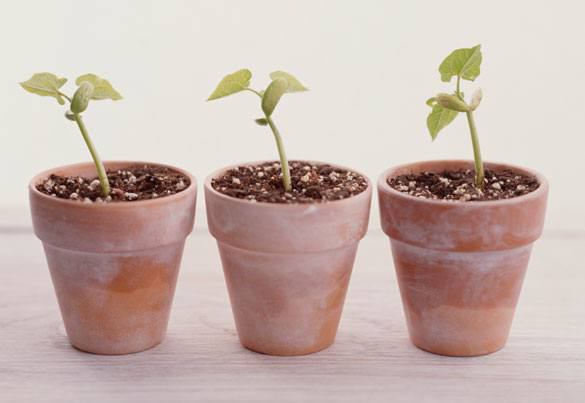
Three small plants growing in terracotta pots placed in a row on a surface.

Maya designed an experiment to answer the following question: How does the amount of water given to a lima bean seed affect how tall it grows?

In this experiment, what is the independent variable?
Pitanje 11
11.

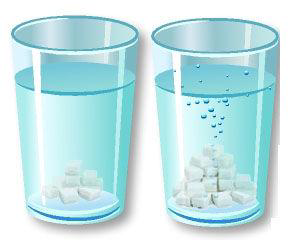
Illustration showing two glasses of water with sugar cubes at the bottom. The glass on the right has bubbles indicating effervescence or reaction.

Anthony designed an experiment to answer the following question: How does the temperature of water affect the time it takes for a sugar cube to dissolve?

What is the independent variable in this experiment?

Pitanje 12
12.

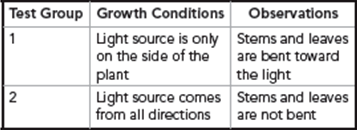
Table showing test groups with growth conditions and observations. Test group 1: Light source from the side, stems and leaves bent toward the light. Test group 2: Light source from all directions, stems and leaves not bent.

Valerie designed and conducted an experiment on pothos plants, which are common houseplants. Her hypothesis is that the direction of light will affect the growth pattern of a pothos plant. To test the hypothesis, she sets up two test groups of pothos plants and observes them three weeks later. The table summarizes the test groups and observations.

What are the roles of the two test groups in this investigation?

Pitanje 13
13.

Students are investigating the distribution of aquatic life in the Florida Everglades. They learn that the feeding patterns of alligators and bull sharks influence the prey populations in the area.

Which of the following describes the most reliable source for this information?

Pitanje 14
14.

A scientist wants to determine whether water pollution causes deformities in frogs. Which of these statements best explains why frog samples collected from unpolluted water are needed?

Pitanje 15
15.

Students are learning about the contributions that resulted in the development of the cell theory and comparing differences between scientific theories and scientific laws. Which of the following statements describes why scientists consider the cell theory a scientific theory rather than a scientific law?

Pitanje 16
16.

After analyzing the results of the experiment, Valerie asks if her hypothesis should be classified as a theory. Which is the best response to Valerie’s question?

Pitanje 17
17.

After a team of scientists completes an investigation, they submit an article about the investigation to a scientific journal. Before the journal publishes the article, they send it to other scientists for an anonymous, independent review. What is the purpose of this review?

Pitanje 18
18.

When, if ever, can a scientific theory become a scientific law?

Pitanje 19
19.

Students in a biology class are investigating the process of ecosystem recovery following a disturbance. Which of the following sources would provide the most reliable information about the recovery of an ecosystem after a volcanic eruption?

Pitanje 20
20.

How is the word theory used in science?

Pitanje 21
21.

Phrenology was the study of the bumps on the human head and the use of those bumps to determine a person's character traits, such as wit or combativeness. It was developed by a German doctor who noted features on people's skulls and then looked at other people to find similar features.
Although it was popular at the time, phrenology has been discredited and is not considered a pseudoscience. What is most likely reason that phrenology would not have been scientifically valid?