Ɛhia
4
Study the map to answer the questions below.
Study the map to answer the questions below.
Ɛhia
1
Ɛhia
1
Ɛhia
1
Ɛhia
1
Section Introduction: Exploring Four Empires of Mesopotamia (Part 1)
Ancient Sumer flourished in Mesopotamia between 3500 and 2300 B.C.E. As you read on, you will discover what happened to the Sumerians and who ruled Mesopotamia after them.
The city-states of ancient Sumer were like small independent countries. They often fought over land and water rights, never uniting into one group. Their division left them open to attacks by stronger groups.
About 2300 B.C.E., the Akkadians (uh-KAY-dee-unz) conquered Sumer. This group made the Sumerian city-states a part of an empire, which is a large territory where groups of people are ruled by a single leader or government. Groups like the Akkadians first conquer and then rule other lands.
Click on the word that is a synonym for "separate." Then click on the word that is a synonym for "combining."
Section Introduction: Exploring Four Empires of Mesopotamia (Part 2)
In this lesson, you will learn about four empires that rose to power in Mesopotamia between 2300 and 539 B.C.E. They were the Akkadian Empire, the Babylonian (bah-buh-LOH-nyuhn) Empire, the Assyrian (uh-SIR-ee-un) Empire, and the Neo-Babylonian Empire.
You will also learn that each of these empires faced conflict with neighboring lands, which led to many wars. Rulers focused on improving their military strategies and began training warriors in more advanced tactics. Some people even chose to rebel against kings, creating problems within the empire.
What was life like in each of these powerful Mesopotamian empires? Who were the ruthless rulers that commanded them? Why did they all collapse? Let's find out more about these empires.
Read the paragraphs in this section to answer the questions below. Don't be afraid to re-read!
Click on the word that is a synonym for "bordering." Then click on the word that is a synonym for "army."
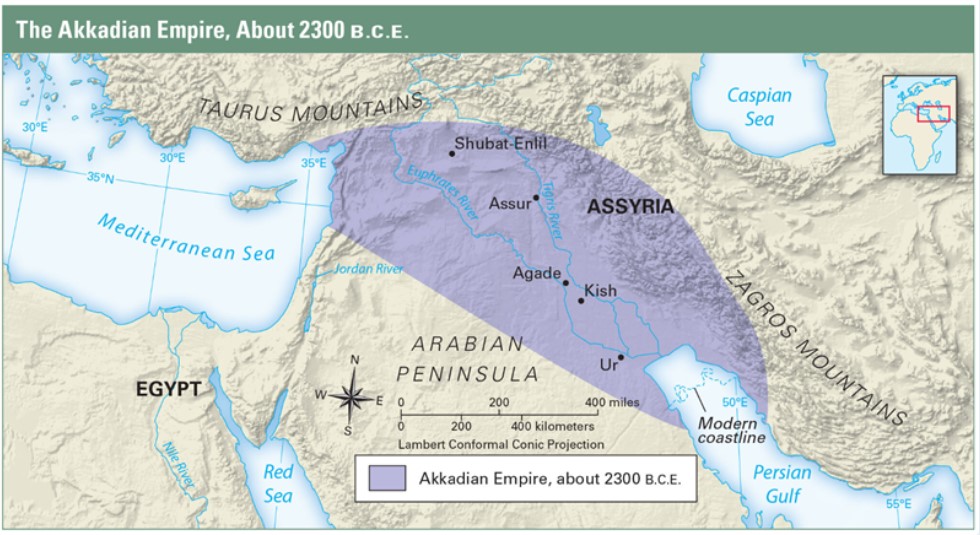
Study the map to answer the questions below.
Section 1. The Akkadian Empire (Part 1)
For over a thousand years, Sumer was a land of independent city-states. Later, around 2300 B.C.E., the Akkadians from northern Mesopotamia conquered the land. According to legends, King Sargon led the Akkadians and went on to become the first ruler of the Akkadian Empire.
Sargon was both a strong king and a skilled general who built his empire through effective military strategies. After assembling a large army, he taught his soldiers to fight in tight formations. Soldiers carrying shields stood at the front of the formation, while those carrying spears stood in the line behind. The spear-carriers would extend their weapons between the shields.
Sargon used his military tactics to add territory to his empire. After defeating the king of the city-state of Uruk, Sargon had gained control of all of Mesopotamia, including Sumer.
Read the paragraphs in this section to answer the questions below. Don't be afraid to re-read!
Click on the word that is a synonym for "successful." Then click on the word that is a synonym for "units."
Section 1. The Akkadian Empire (Part 2)
To maintain control of his empire, Sargon used very clever political strategies. He destroyed the walls of many city-states, leaving them completely defenseless. Sargon believed that without the protection of the walls, people were less likely to rebel. He also demanded the loyalty of the governors of city-states, replacing any disloyal ones with his own men.
Sargon lived to an old age and decreed that his sons rule after his death. His name soon passed into legend because he and the Akkadians had created the world's first empire stretched across Mesopotamia.
Read the paragraphs in this section to answer the questions below. Don't be afraid to re-read!
Click on the word that is a synonym for "smart." Then click on the word that is a synonym for "devotion."
To
Section 2. Life Under Akkadian Rule (Part 1)
Sargon ruled his empire for more than 50 years, during which he formed the city of Agade (uh-GAH-duh) in northern Mesopotamia, the empire's capital. He constructed the city with the help of tributes collected from the people he conquered. One of the richest and most powerful cities in the world, Agade became a cultural center with many beautiful temples and palaces.
The Akkadians may have ruled Sumer, but the Sumerian culture continued to thrive. The Akkadians farmed using the Sumerians' irrigation techniques. To record information, they used Sumer's system of cuneiform writing. They even worshipped the same gods and goddesses, despite referring to them by different names. For example, the goddess Inanna became known as Ishtar, while the god An became known as Anu. Religion stayed central to the social order, and kings continued to rule in the name of the gods. Although men typically held power, priestesses and noblewomen had some access to power. For example, Sargon placed his daughter Enheduanna in the powerful position of high priestess of the moon god, a tradition that later kings adopted as well.
Read the paragraphs in this section to answer the questions below. Don't be afraid to re-read!
Click on the word that is a synonym for "succeed." Then click on the word that is a synonym for "methods."
Section 2. Life Under Akkadian Rule (Part 2)
The Akkadians had their own cultural achievements. Over time, their language replaced that of the Sumerians. In art, they became especially well known for their skillful three-dimensional sculptures. Artisans also carved relief sculptures, called steles, on stones. A famous example is the Victory Stele, which was created to celebrate a military victory by Sargon's grandson, King Naram-Sin. The stele shows Naram-Sin leading his victorious army up a mountain slope. Some of his enemies are crushed underfoot, while others die, flee, or beg for mercy.
Sargon had hoped that his empire would last for a thousand years, but future kings found it difficult to rule such a large territory, causing the empire to grow weak. After about 200 years, the Akkadian Empire fell to new invaders from the north and east.
Read the paragraphs in this section to answer the questions below. Don't be afraid to re-read!
Click on the word that is a synonym for "craftspeople." Then click on the word that is a synonym for "triumphant."
Match the achievement used in the Akkadian Empire with the culture who created it.
Akkadian Cultural Achievements | Sumerian Cultural Achievements | |
|---|---|---|
3-Dimentional Sculptures | ||
Language that replaced the old one used in the Akkadian Empire | ||
Irrigation Techniques | ||
Created rich and beautiful city of Agade | ||
Writing | ||
Gods and Goddesses |
Match the vocabulary words from these sections to the correct meaning.
| Draggable item | arrow_right_alt | Corresponding Item |
|---|---|---|
invaders | arrow_right_alt | conflict: a disagreement or fight caused by opposing points of view |
strategies | arrow_right_alt | a large territory in which several groups of people are ruled by a single leader or government |
capital | arrow_right_alt | a planned approach |
conflict | arrow_right_alt | to bring together |
techniques | arrow_right_alt | a city that is the center of government |
assembling | arrow_right_alt | wealth sent from one country or ruler to another as a sign that the other is superior |
tribute | arrow_right_alt | a skilled way of doing something |
empire | arrow_right_alt | someone who forces entry into a place where they are unwanted |
Read the paragraphs in this section to answer the questions below. Don't be afraid to re-read!
The
When did the Akkadians defeat Sumer?
Why were the city-states of Sumer attacked and defeated and forced to join an empire? (Hint: There's more than one)
What is true of the Akkadians? (Hint: There's more than one)
What were the four empires of Mesopotamia? (Hint: There is more than one)
You will also learn that each of these empires faced
What is true of all empires? (Hint: There's more than one)
Which city is in the center of the Akkadian Empire?
Which city is farthest north?
Which city is farthest south?
What direction would you need to travel to go from Shubat-Enlil to Ur?
Who was Sargon? (Hint: There is more than one)
What is the main idea of these paragraphs?
What strategies did Sargon use to stay in control of the Akkadian Empire? (Hint: There's more than one)
The
What was Agade? (Hint: There's more than one)
What Sumerian things did the Akkadians continue to use? (Hint: There's more than one)
What were the Akkadians cultural achievements? (Hint: There's more than one)