Give the unit the answer will be in
Give the unit the answer will be in
Give the unit the answer will be in
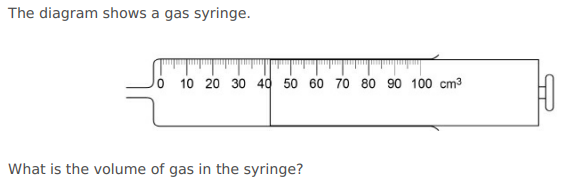
What is the volume of gas in the syringe?
Volume =
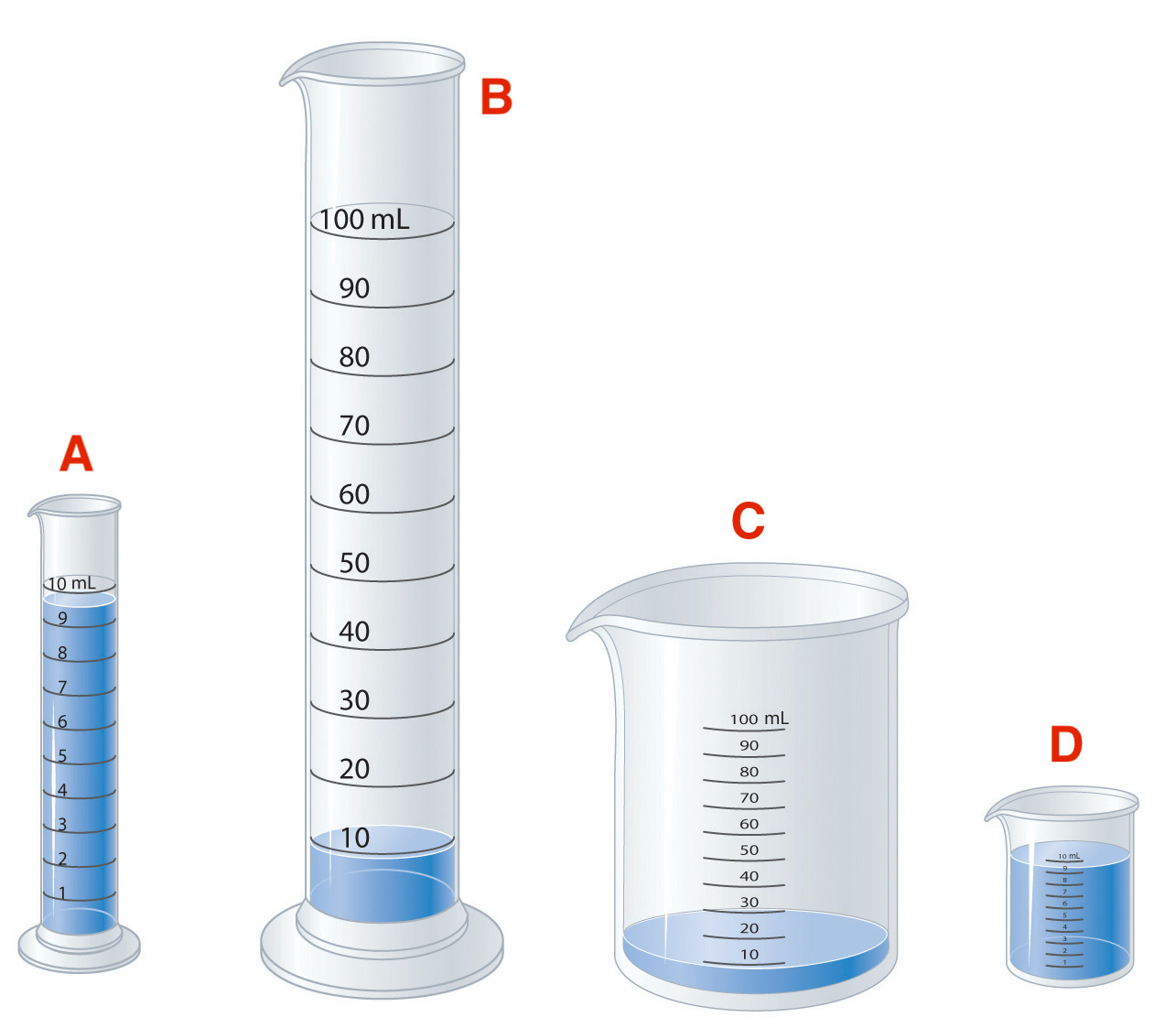
Which apparatus would measure 50cm3 of hydrochloric acid with the greatest accuracy
The student measured the volume of gas produced every 20 seconds for 2 minutes.
The volume of gas was zero at the start of the experiment.
The measured volumes of gas were: 26 cm3 38 cm3 47 cm3 55 cm3 59 cm3 60 cm3
Complete the table to show these results.
Tick one box to select the correct unit for each variable.
Describe the trends shown in the student’s results.

Which carbonate produced carbon dioxide at the highest rate?
What volume of carbon dioxide was produced by strontium carbonate in twelve minutes? [1]
12g of iron oxide is produced in 120s, what is the reaction rate?
Match the method to the unit of rate of reaction
| Draggable item | arrow_right_alt | Corresponding Item |
|---|---|---|
A conical flask containing sodium thiosulfate and dilute hydrochloric acid is placed on a piece of paper with a cross on it. | arrow_right_alt | g/s |
Marble chips and hydrochloric acid are placed in a conical flask on a top-pan balance. | arrow_right_alt | cm3/s |
Marble chips in hydrochloric acid are placed in a conical flask, with a bung attached to a gas syringe at the opening. | arrow_right_alt | s |
Describe the trends shown in the student’s results.
The symbol equation for the decomposition of hydrogen peroxide (H2O2) is:
2 H2O2 → 2 H2O + O2
Complete the word equation for the decomposition of hydrogen peroxide.
hydrogen peroxide →
Measuring the gas produced, the mass lost, or the light transmitted are all ways of measuring the rate of reaction.
Describe to Jun a method he could use to measure rate of reaction, and an advantage of using this method.
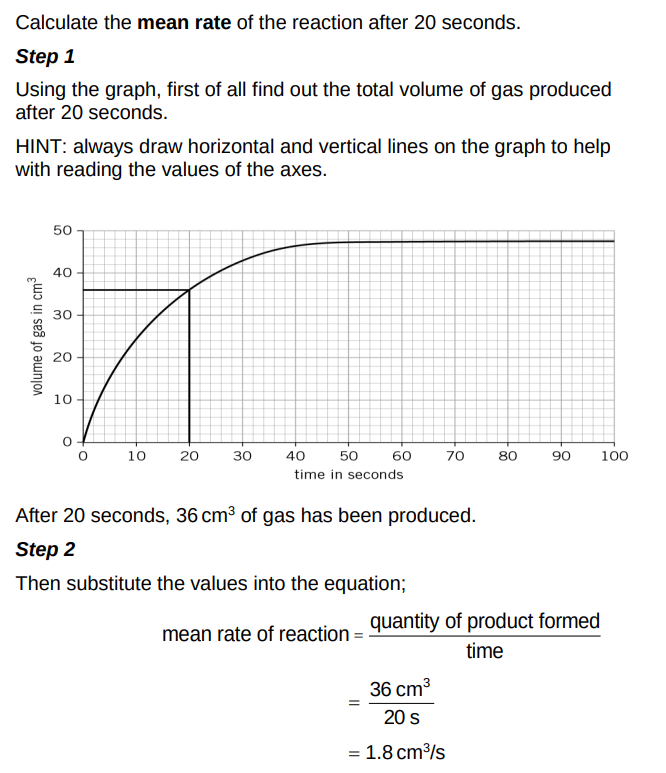
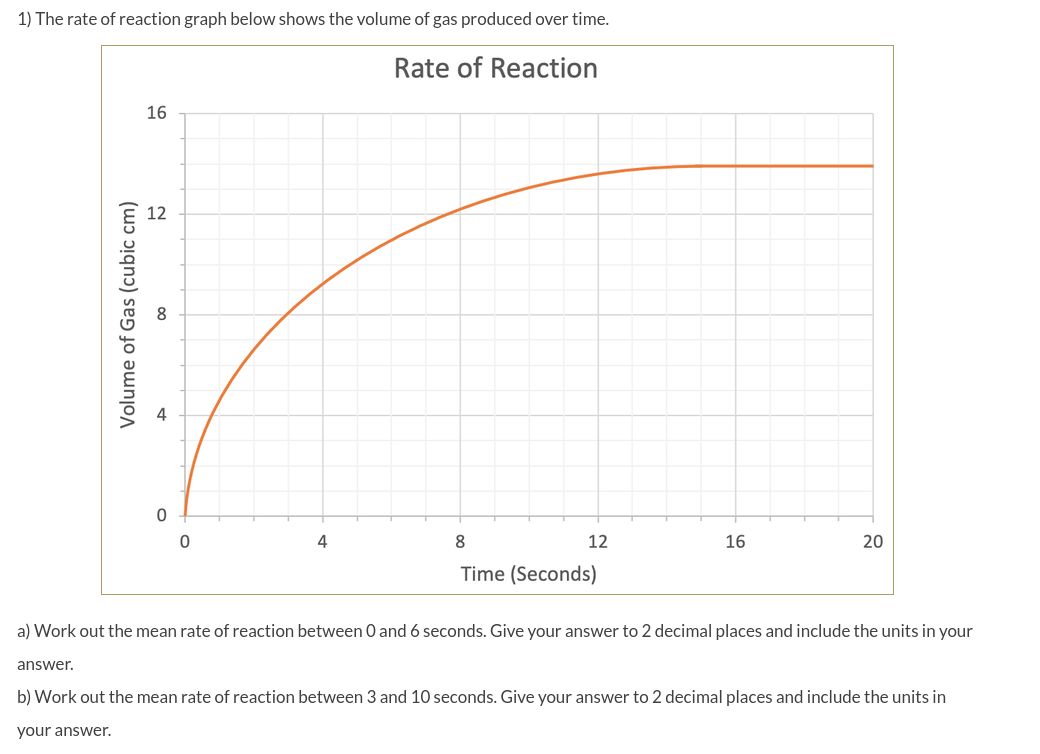
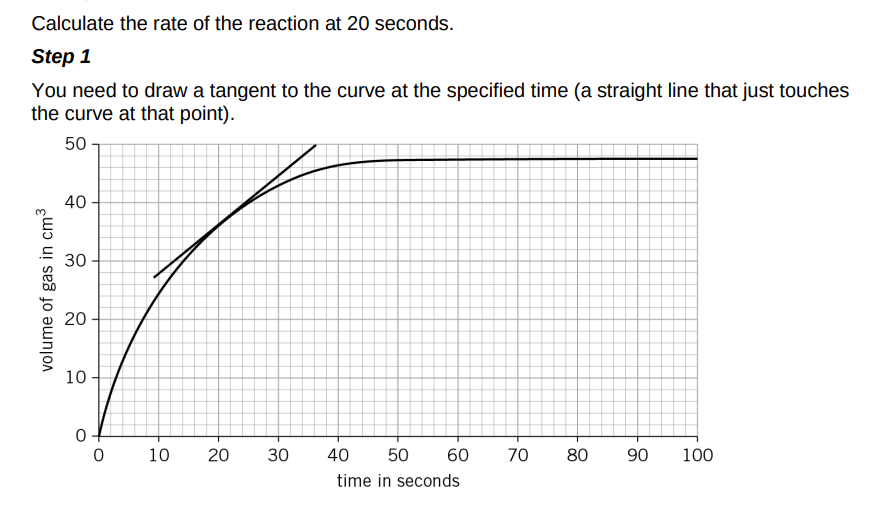
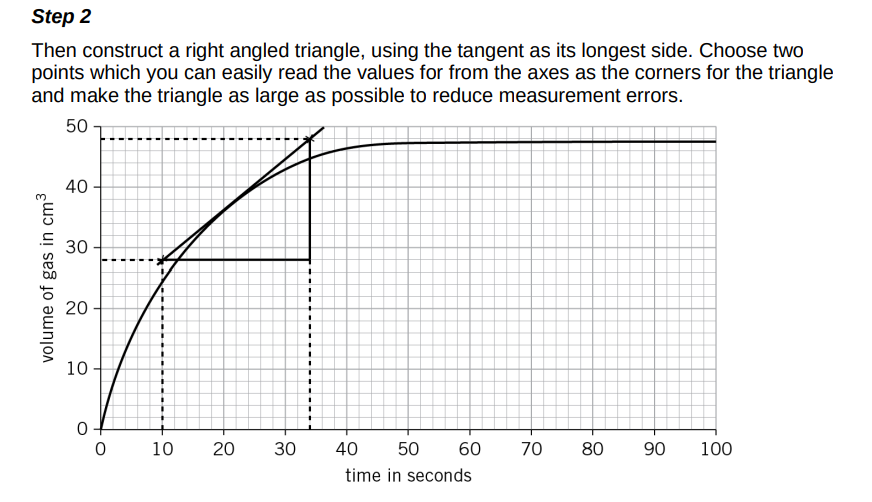
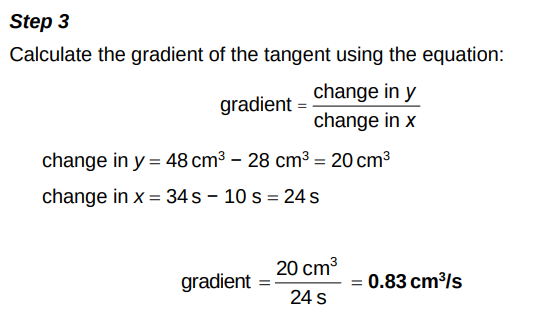
Work out the average rates of reaction for the time periods given.
a) average rate between 0 and 6 seconds = (change in volume / time = 11/6)
b) average rate between 3 and 10 seconds = (Change in volume / time = 13/8)
c) The reaction ends at
Show your calculations
(note your should make the large to minimise error and use values that are easy to read from the graph)
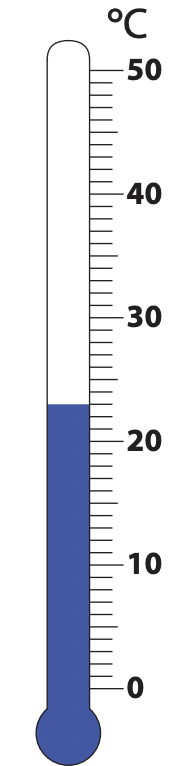
What is the reading on this thermometer? The temperature is
Which one of these would be most suitable to use to measure a liquid of volume of 9 cm3?
What is the volume reading below, in cm3?
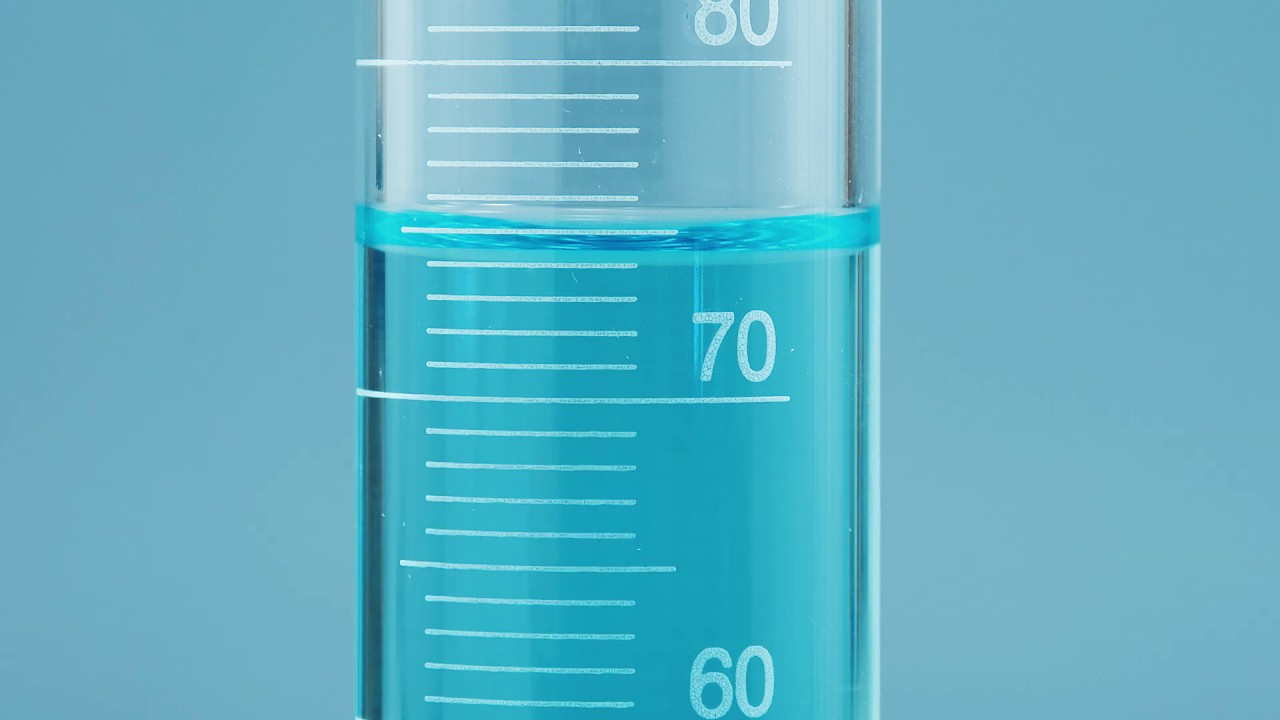
Write number value only, no unit.
The rate of reaction between gases is affected by changing the pressure.
Complete the sentences.
When the pressure of the reacting gases is increased, the rate of reaction .
This is because at higher pressures the distance between the particles .
This means that the frequency of collisions .
Name a piece of equipment suitable for measuring the volume of a solution.
 What is the volume of gas in the syringe?
Increasing the pressure of gases in a reaction will increase the rate of reaction.
Increasing the temperature of reactants increases the number of particles in the reaction.
There are five main factors that affect the rate of reaction.
For every 10°C temperature increase, the rate of reaction triples.
Which of the following factors does not affect the rate of a chemical reaction?
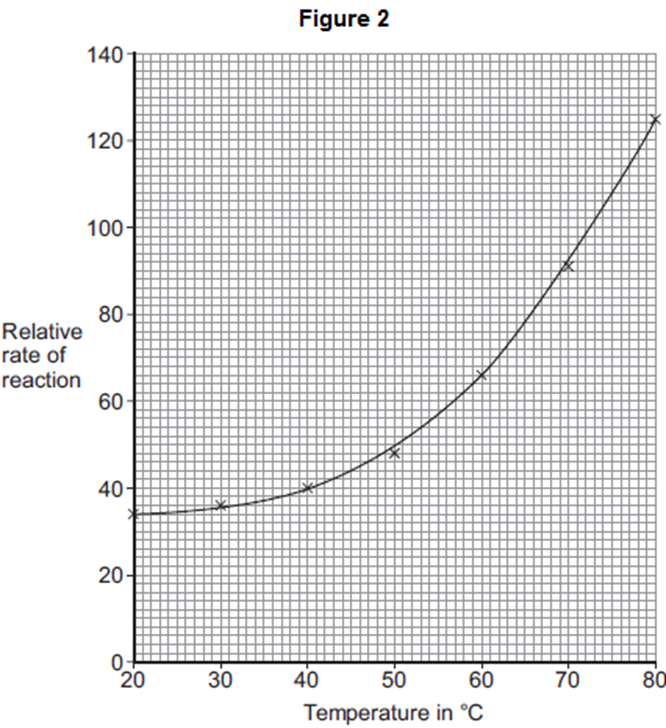
What happens to the rate of reaction when the temperature is increased?
What is the minimum energy required for a reaction to occur called?
What causes the cross to disappear in the disappearing cross experiment?
Doing which of the following will increase the rate of a reaction?
What happens to the rate of a chemical reaction when the temperature is increased?
If the temperature of a reaction increases, what happens to the energy of the particles?
Which of the following explains why increasing temperature increases the rate of reaction?
Why does cooling a reactant decrease the rate of a reaction?
Which of the following statements about temperature and volume of gas produced is correct?
What effect does increasing the temperature have on the reactant particles?
Collision theory states that particles must collide with enough energy in order to react.
The minimum amount of energy required for a successful collision is called the starter energy.
Different catalysts are needed for different reactions.
During a reaction, a catalyst gets used up and has to be replaced each time.
Catalysts are usually cheap transition metals.
Metals and metal salts are good catalysts. This is not just because there are so many metals. They have specific characteristics, or
A catalytic converter efficiently converts unwanted combustion products (e.g. CO, C, NOx) into CO2 and N2
Why are these two gases preferred over the other substances?
Match the following key terms to their definition.
| Draggable item | arrow_right_alt | Corresponding Item |
|---|---|---|
decomposition reaction | arrow_right_alt | a chemical that speeds up rate of a reaction without being used up |
enzyme | arrow_right_alt | when atoms are rearranged, and changes can be observed e.g. bubbles |
chemical reaction | arrow_right_alt | type of reaction when a reactant breaks down into two or more products |
Catalyst | arrow_right_alt | a biological catalyst that speeds up reactions in living things |
What group of elements are catalysts from?
What is rate?
What reaction is most suitable to measure rate?
Select the correct equations for calculating rate of reaction
What are suitable units of rate?
What is always the correct unit of time?
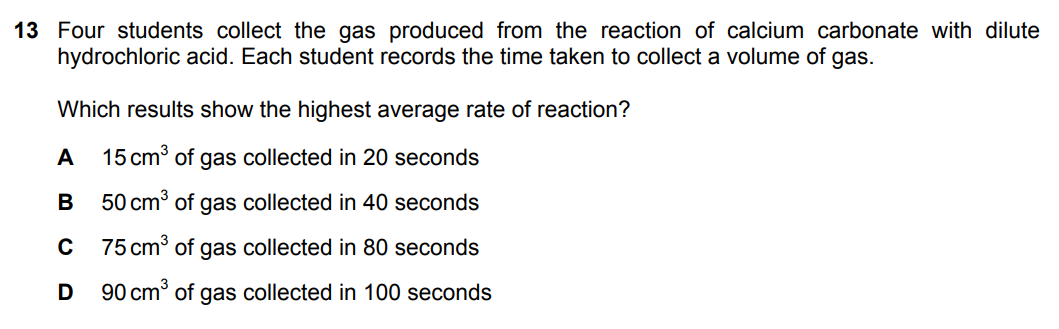
We produce 10g in 2 minutes. What is the average rate of reaction?
At the beginning of a chemical reaction, the rate is....
What two pieces of measuring equipment is he going to use to capture gas is this experiment?
What pieces of equipment is best for measuring the volume of a liquid, like acid?
Which piece of equipment is he using to capture gas in the first method?
How often do you need to measure the gas produced?
The first time he did this, he used 2 mol/dm3. The second time time he is using 1 mol/dm3. Do you think it will be faster or slower?
What piece of equipment captures the gas in this second experiment?
What piece of equipment measures time for all his experiments?
What do both experiments level off at the same point?
List the 3 sources of error from the video