Log in
Sign up for FREE
arrow_back
Library
Cell Structure and Function test
By Leah Weaver
star
star
star
star
star
Share
share
Last updated 5 months ago
41 questions
Add this activity
1
1
1
1
1
1
1
1
1
1
1
1
1
1
1
1
1
1
1
1
1
1
1
1
1
1
1
1
1
1
1
1
1
1
1
1
1
1
1
1
1
Question 1
1.
The shape of a cell may tell you something about the job the cell does.
True
False
Question 2
2.
Both plants and animals are made up of cells.
True
False
Question 3
3.
The cell theory states that all cells come from cells that already exist.
True
False
Question 4
4.
Diffusion is a type of active transport.
True
False
Question 5
5.
Only animals undergo respiration.
True
False
Question 6
6.
Passive transport takes place without the use of energy.
True
False
Question 7
7.
Animals use clorophyll to produce glucose.
True
False
Question 8
8.
Photosynthesis results in the release of oxygen.
True
False
Question 9
9.
In respiration, glucose is broken down .
True
False
Question 10
10.
Glucose and oxygen are the result of respiration.
True
False
Question 11
11.
Which is NOT a macromolecule?
DNA
cholesterol
cellulose
water
Question 12
12.
All of the following are principles of the cell theory EXCEPT _____.
the cell is the smallest unit of life
water is the main ingredient in every cell
all new cells come from preexisting cells
all living things are made of one or more cells.
Question 13
13.
Which function do the lipids in a cell control?
a protective membrane
hold genetic information
transport
communication
Question 14
14.
Which two macromolecules offer energy storage to the cell?
lipids and nucleic acids
proteins and carbohydrates
nucleic acids and proteins
lipids and carbohydrates
Question 15
15.
Which substance makes up the macromolecule carbohydrate?
amino acids
vitamins
nucleotides
sugar
Question 16
16.
Which best explains the function of a cell membrane?
offers protection from the outside environment
provides a framework to help the cell move
transforms energy in the cell into ATP
removes viruses from inside the cell
Question 17
17.
Photosynthesis occurs at the cell level. Which organelle is necessary for photosynthesis?
Golgi apparatus
chloroplasts
mitochondrion
rough endoplasmic reticulum
Question 18
18.
Which organelle prepares proteins into vesicles to transport from one area of a cell to another?
golgi apparatus
chloroplasts
mitochondrion
rough endoplasmic retivulum
Question 19
19.
Which is used to make proteins in the cell?
water
ribosomes
DNA
lipids
Question 20
20.
What is the main difference between a prokaryotic cell and an eukaryotic cell?
Only prokaryotic cells have vacuoles.
Eukaryotic celss are smaller than prokaryotic cells.
Prokaryotic cells have many organelles, each with their own specialized functions.
Only eukaryotic cells have its genetic material surrounded by a membrane.
Question 21
21.
What is the function of a lysosome?
food storage
preparing proteins
making food
recycle material
Question 22
22.
What is the difference between rough endoplasmic reticulum (ER) and smooth endoplasmic reticlum (ER) ?
Rough ER has lysosomes covering the organelle while smooth ER does not.
Rough ER has ribosomes covering the organelle while smooth ER does not.
Smooth ER releases energy while rough ER absorbs energy.
Rough ER is found on the inside of the cell while smooth ER is found on the outside of the cell.
Question 23
23.
What is the main difference between active transport and passive transport?
During active transport the water inside the cell is used to transport substances throughout the cell. Passive transport uses the cell's cytoplasm to move substances around the cell.
Passive transport moves substances throughout the cell without using the cell's energy and active transport moves substances using the cells energy.
Active transport moves substances from higher concentrations to lower concentrations and passive transport moves substances from lower concentrations to higher concentrations.
Passive transport moves substances that are too large to get through the cell membrane by forming a vesicle inside the cell and active transport forms the vesicle on the outside of the cell.
Question 24
24.
Which substance is broken down during glycolysis?
glucose
carbon dioxide
cytoplasm
water
Question 25
25.
Which substance is released as a waste product during photosynthesis?
glucose
carbon dioxide
cytoplasm
oxygen
Question 26
26.
Which type of fermentation is illustrated below?
GLUCOSE -------------> ATP + CARBON DIOXIDE + ALCOHOL
lactic -acid fermentation
alcohol fermentation
photosynthesis
cellular respiration
Question 27
27.
Which form of energy is necessary in photysnthesis?
ATP
lactic acid
glycolysis
light
Question 28
28.
Usually, the largest organelle in a cell is the _____.
chromatin
nucleus
vacuole
lysosome
Question 29
29.
Plant cells that are long and hollow transport ____ and water throughout the plant.
oxygen
chlorophyll
blood
food
Question 30
30.
Which of these have prokaryotic cells?
snails
frogs
bacteria
food
Question 31
31.
Substances too large to pass through the cell membrane enter the cell in a process called ____.
endocytosis
active transport
exocytosis
passive transport
Question 32
32.
Active transport occurs when ___ is used to move substances through a membrane.
osmosis
energy
diffusion
chlorohyll
Question 33
33.
The passive transport of water through a membrane is _____.
osmosis
fermentation
equilibrium
active transport
Question 34
34.
During periods of strenuous activity, muscle cells run low on _____.
oxygen
gluscose
carbon dioxide
lactic acid
Question 35
35.
The process that releases energy without using oxygen is _____.
photosynthesis
respiration
osmosis
fermentation
Question 36
36.
Diagram A is an example of ______.
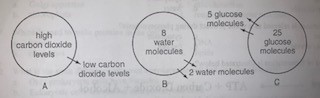
diffusion
active transport
osmosis
equilibrium
Question 37
37.
Diagram B is an example of _____.
exocytosis
active transport
osmosis
equilibrium
Question 38
38.
Photosynthesis is the process in which plants use energy from light to produce _____.
new cells
organelles
food (glucose )
none of the above
Question 39
39.
Which of the following is NOT involved in photosynthesis or respiration?
water
carbon dioxide
chlorophyll
cytokinins
Question 40
40.
Respiration is the process in which organisms break down food to release _____.
energy
nutrients
sugar
oxygen
Question 41
41.
The green color of tree leaves is due to green light energy reflected from _____.
auxins
caarbon dioxide
chlorphyll
gibberellins