Ɛhia
7
Ɛhia
1
Ɛhia
1
Ɛhia
1
Ɛhia
1
Ɛhia
3
From Hunters and Gatherers to Farmer (Introduction Part 1)
Scientists have identified and studied five important groups of hominins. Like the hominins before them, early modern humans hunted and gathered their food. You will read about how early people learned, over thousands of years, to produce food by farming.
Humans discovered farming toward the end of the Stone Age. This period gets its name from the stone tools prehistoric people made and used. Historians divide the Stone Age into two periods. The first is the Paleolithic Age, or Old Stone Age. During this period, people got food by roaming from place to place to hunt wild animals and gather nuts, berries, seeds, and plants they found.
Read the paragraphs above to answer the questions below. Don't be afraid to re-read!
From Hunters and Gatherers to Farmer (Introduction Part 2)
By about 8000 B.C.E., some people had learned how to raise animals and crops for food. This knowledge enabled these people, for the first time, to settle in one place. The Neolithic Age, or New Stone Age, had begun.
This gradual shift from hunter-gatherers (food collectors) to farmers (food producers) is one of the most important advances in human development. People built permanent shelters. They lived in larger communities in the best areas for growing crops. People developed new skills and made a variety of things that improved the quality of their lives. Over time, they also began to exchange goods with people in other communities for the things they lacked in their own villages. In this lesson, you will explore the many ways in which the development of farming changed human life.
Read the paragraphs above to answer the questions below. Don't be afraid to re-read!
1. From Old Stone Age to New Stone Age (Section 1, Part 1)
The Old Stone Age, or Paleolithic Age, began about 2 million years ago, with the first tool-making hominins, and lasted until about 8000 B.C.E. It was during this time period that early modern humans developed. Like the hominins before them, early humans were hunter-gatherers. They wandered from place to place, hunting animals and gathering plants for food. Often, they took shelter in caves where cave painters left clues about their prehistoric ways of life.
The New Stone Age, or Neolithic Age, began when people started to farm and produce their own food. The discovery of farming did not happen all at once. Over thousands of years, people across the world gradually learned to raise animals and plant crops. They eventually began to rely on these farms for their food. Now, rather than having to roam long distances in search of things to eat, people could settle down in one place.
Read the paragraphs above to answer the questions below. Don't be afraid to re-read!
Drag the details from the reading above to either Paleolithic Age or Neolithic Age. Reread the paragraphs above as many times as necessary to find the correct Age for each detail.
Old Stone Age
Raise Animals
Plant Crops
Hunter Gatherers
New Stone Age
Wandered from Place to Place
Farmers
Happened 2 Million Years Ago
Paleolithic Age
Neolithic Age
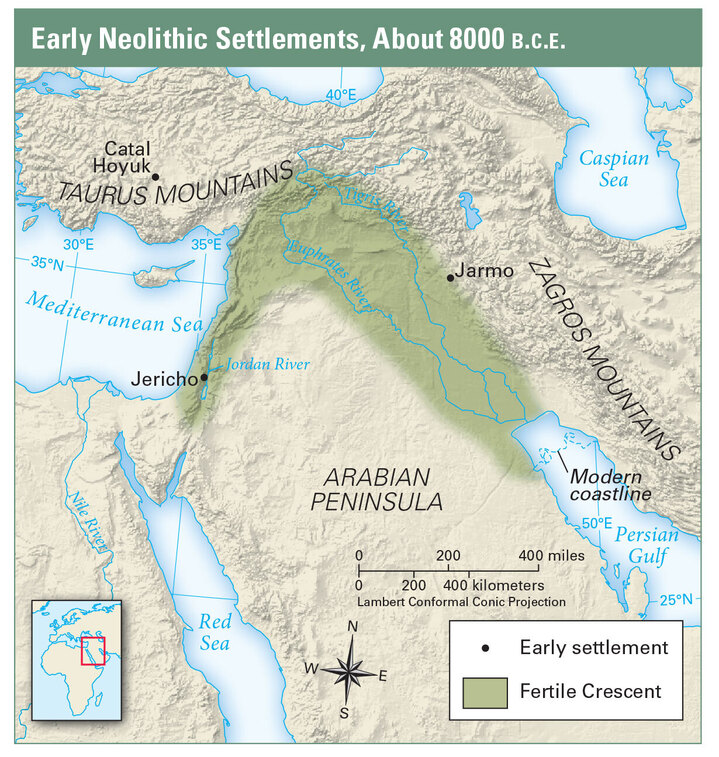
Study the map to complete the graph below.
In the Fertile Crescent | Not in the Fertile Crescent | |
|---|---|---|
Jericho | ||
Jarmo | ||
Catal Hoyuk | ||
Nile River |
1. From Old Stone Age to New Stone Age (Section 1, Part 2)
The Neolithic Age began around 8000 B.C.E. and lasted until about 3000 B.C.E., when people learned to make tools out of metal instead of stone. During this time, farming developed in many places throughout the world, including parts of Europe, Africa, Asia, and the Americas.
Many Neolithic settlements were located in the Fertile Crescent, east of the Mediterranean Sea, where the land was fertile. Here, people built towns such as Jericho, Catal Hoyuk, and Jarmo.
People in settlements like these lived very different lives from earlier hunter-gatherers. They could now concern themselves with other matters such as building permanent shelters and forming larger communities. They could make better tools and clothing. And they could swap items they had with other communities to get the things they lacked. As you will see, these changes made life safer, more comfortable, and more interesting.
Read the paragraphs above to answer the questions below. Don't be afraid to re-read!
Click on the word below that means, "land that is good for growing crops."
What three ways did people get food in the Paleolithic age?
What three ways did people get food in the Neolithic age?
What were three of the effects of people becoming farmers instead of hunter-gatherers? (Hint: There's more than one)
Select all the statements that are true below. (Hint: There is more than one)
Study this map closely to answer the questions below. This map can also be found in TCI, Lesson 4, Section 1.
What is the title of this map?
Which Sea is the furthest EAST on this map?
In which cardinal direction would you have to travel over land to get to the Persian Gulf from the Caspian Sea?
What does the map show in the color green?
Which three cities are shown on this map?
Select all the three statements that are true below.